No rituals selected yet.
Browse Pooja Packages →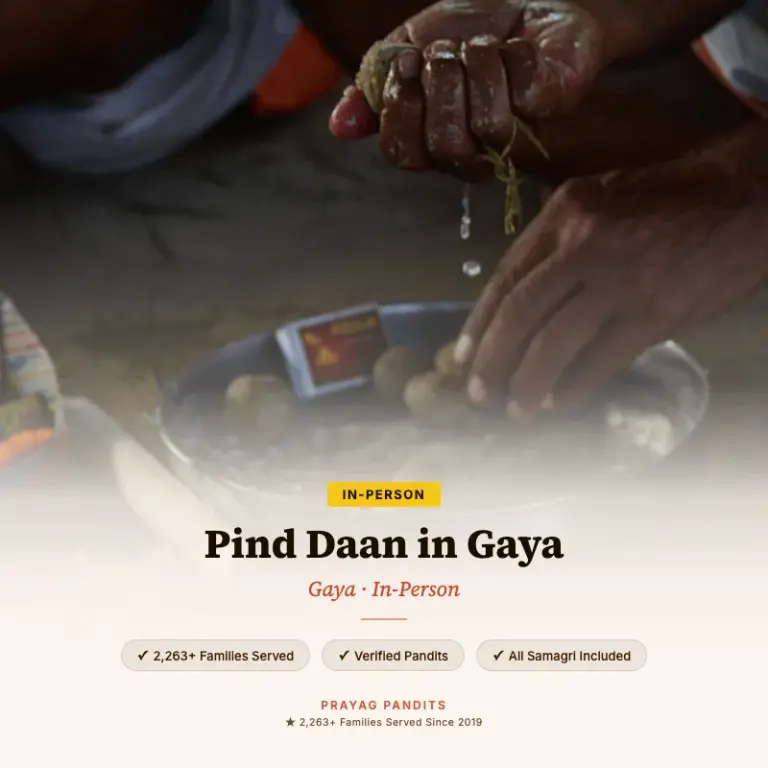 Save 35%
Gaya
Pind Daan in Gaya
Pind Daan at Vishnupad Temple / Phalgu River, Gaya Experienced Gayawal Pandit...
from
₹7,100
₹11,000
Plan your family's ancestral rites
at Vishnupad in Gaya
Compare in-person and online Pind Daan packages, check the included sites and services, and choose the arrangement for your family. Our team coordinates the pandit, your language preference and the meeting point before arrival.
The moksha journey
Where the journey begins — Triveni Sangam. Pitrutirtha and Tirthraj.
Learn more →Where ancestors are released from pretahood — Pishachmochan Kund and the Avimukta kshetra.
Learn more →The final rite — at Vishnupad's footprint where the ancestors are conveyed to Brahmaloka.
You are hereTell us your situation — we will suggest the package that fits the family. No booking pressure; we will explain the choice on WhatsApp first if needed.
Every package includes an experienced Vedic pandit and the required puja samagri. The difference is in boat, location, stay, and tradition.
Save 35%
Pind Daan at Vishnupad Temple / Phalgu River, Gaya Experienced Gayawal Pandit...
 Save 31%
Pind Daan at Vishnupad Area AND Phalgu Area Dedicated experienced pandit for...
 Save 48%
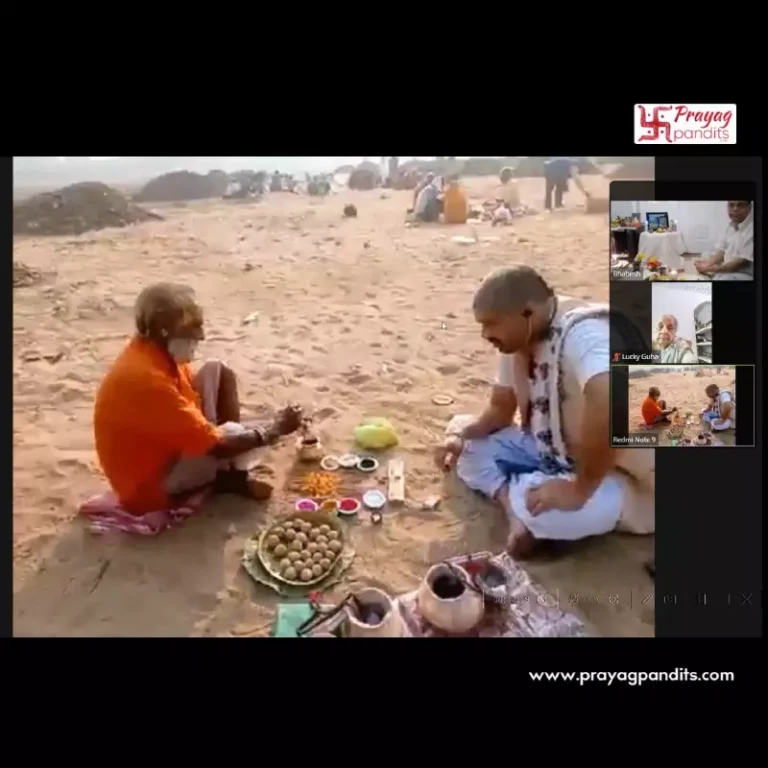
Online Pind Daan at Vishnupad Area OR Phalgu Area Experienced pandit (Gaya...
 Save 40%
Online Pind Daan at Triveni Sangam, Prayagraj (live video) Online Pind Daan...
 Save 29%
Senior Gayawal Brahmin Pandit (hereditary) Pind Daan at Phalgu, Vishnupad & Akshaywat...
 Save 24%
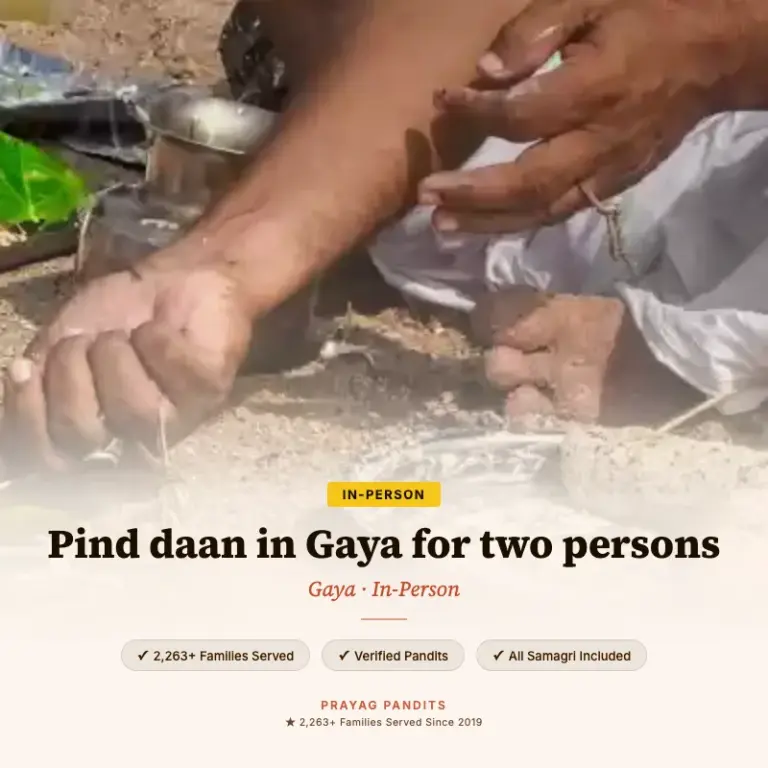
Complete Pind Daan ceremony for two persons (2 families) at Gaya Experienced...
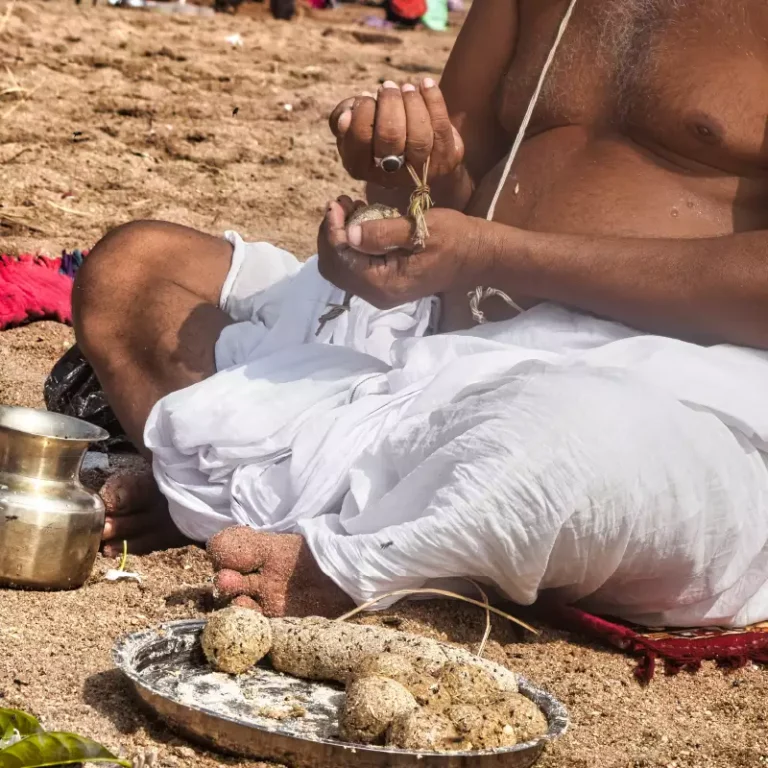 Save 45%
Odia Vidhi Ceremony Qualified Gayawal Pandit (speaks basic Odia) Pind Daan at...
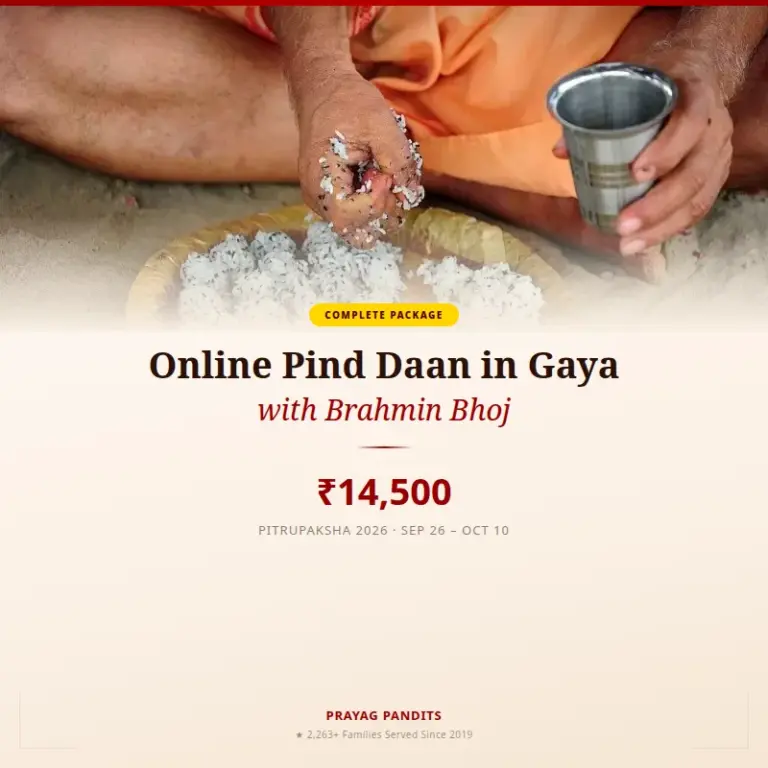
Online Pind Daan at Phalgu Vedi / Vishnupad Vedi, Gaya (Pitrupaksha 2026)...
No packages match this filter. Talk to a family advisor →
What's included
We've seen too many families face hidden boat fees, samagri costs, and "dakshina" pressure on the day. Here's exactly what's covered, and what isn't.
Included
Verified Gayawal Panda from a registered ghat — the only priestly lineage scripturally authorised at Vishnupad.
Included
Kusha grass, til, jau (barley), rice flour, jaggery, ghee, gangajal, sandalwood, white cloth.
Included
Optional package upgrades include Gau Daan (Platinum + 3-day Pitrapaksha tiers), Brahmin Bhoj, multi-day vedi circuit, the Tri-tirtha combination (Prayagraj + Kashi + Gaya, ₹21,000), and Odia-vidhi packages.
Included
One person on WhatsApp through your entire booking — fluent in Hindi, English, and major regional languages — before and after the ceremony.
Included
WhatsApp message from the Gayawal Panda the same evening, with details of all offerings made on your behalf.
Included*
Bundled into Platinum and 3-day Pitrapaksha packages — completes the Gaya ancestral circuit.
Not included
Train, flight, or road travel. Gaya Junction is well-connected; we can recommend trusted operators.
Not included*
Only included in 3-day and Platinum packages.
Not included
Optional add-on — feeding pandits & needy families is meritorious but not required.
Step 03 · How it works
From your first call to same-day confirmation — we handle every coordination, so the family can focus on what matters.
Choose a package and complete payment online. Our team calls within 2 hours to confirm details.
~ 5 minutes
Provide gotra, names of departed ancestors (up to three generations), preferred date, and any special vidhi requirements.
~ 10 minutes
Gayawal Panda performs the complete pind-daan vidhi at Vishnupad Temple — Sankalp, Tarpan, pind preparation, offering to ancestors at the Vishnupad footprint, and visarjan in the Falgu.
60–180 min
Gayawal Panda sends a same-evening WhatsApp confirmation with offerings detail. Photos and video available as opt-in add-ons.
Same day
When to perform
Gaya Pind Daan is valid throughout the year — Vishnupad Temple's sanctity is permanent. Pitrupaksha (the 16-day fortnight in Ashwin Krishna Paksha) is the most powerful window, but every Amavasya, eclipse day, and the death anniversary tithi carry full scriptural merit. The Mahabharata describes the Tri-tirtha circuit (Prayagraj → Kashi → Gaya) as the most meritorious sequence.
Performed by Tirth Purohits at Triveni Sangam since 2019
Three ways to perform
Performed by your own hands at Vishnupad Temple — the Third Gate of Salvation. Offer pinds at the Vishnupad footprint and immerse them in the Falgu river.
Starts at ₹7,100
For families abroad or unable to travel. Sankalp recited remotely; Gayawal Panda performs pind daan at Vishnupad with live video proof.
Starts at ₹11,000
The complete moksha sequence — Prayagraj (First Gate) → Kashi (Second) → Gaya (Final). The Mahabharata Vana Parva names this the most meritorious pilgrimage circuit.
Starts at ₹21,000
The sacred geography
Multi-day packages cover the full traditional circuit. One-day at Vishnupad is the minimum prescribed; three days walks the full Vayu Purana sequence.
Lord Vishnu's footprint pinned in stone. Where Lord Rama performed for Dasharatha (Narada Purana, Rudrapada vedi).
Day 1The undying banyan. Garuda Purana: offering here uplifts a hundred generations and shows the Primordial Deity.
Day 1–2Foundational Day-1 stop in the Vayu Purana itinerary. The Bali offering to Yama, Dharma, and the dogs Syama and Sabala.
Day 1Local sthala-parampara: the hill where Lord Rama is said to have rested. Modern temple complex.
Day 2The river bank for Sankalp and Tarpan. Vayu Purana III.16: the Phalgu carries more sacred merit than the Ganga.
Day 1–3Cave-temple of Brahma. Combined with Mangalagauri (one of the 18 Shakti Peethas) on the extended circuit.
Day 3Complete guide
An editorial reference covering the ritual, the place, eligibility, timing, and what to keep ready — written for families weighing the decision.
Gayasur was a demon of extraordinary devotion. His penance was so severe that Lord Brahma granted him a boon: anyone who saw or touched him would attain moksha. This caused a cosmic crisis — sinners bypassed karma entirely by walking past Gayasur. The gods approached Lord Vishnu for help.
Vishnu performed a great yajna using Gayasur's body as the ritual altar, then pressed his divine foot onto Gayasur's chest, pinning him into the earth. As a dying request, Gayasur asked that the land where he lay become the holiest ground for ancestral salvation forever. Vishnu agreed. The Vishnupad Temple marks the exact spot where Vishnu's foot touched the earth.
Inside the Vishnupad Temple stands a 40 cm footprint of Lord Vishnu, imprinted in solid basalt rock and encased in a silver-plated basin. Nine divine symbols are carved into the footprint — the Shankha (conch), Chakra (discus), Gada (mace), and others — each representing an aspect of Vishnu's divine power.
The current temple structure — octagonal, 30 metres tall, with eight rows of carved pillars — was built by Rani Ahilyabai Holkar of Indore in 1787 AD. The scriptures say that Lord Vishnu himself is present here as Gadhadhara. Any pinda offered within the Vishnupad complex reaches the ancestors directly through Vishnu's grace.
The Kurma Purana (34/7-8) is unequivocal: performing Pind Daan in Gaya liberates seven generations on the paternal side and seven generations on the maternal side. The Vayu Purana describes Gaya as the supreme centre for ancestral liberation. The Agni Purana adds that offerings at Gaya's Akshayavat grant ancestors an "imperishable position" and elevate hundreds of family members across generations.
During the Treta Yuga, Lord Rama, Sita, and Lakshmana came to Gaya to perform Shraddha for King Dasharatha. While Rama and Lakshmana went to gather ritual materials, the auspicious time began to pass. King Dasharatha's spirit appeared before Sita and asked her to perform the rites immediately.
Sita called upon five witnesses: the Falgu River, the Akshayavat tree, a cow, the Ketaki flower, and a local Brahmin. She made a pinda from river sand and offered it for her father-in-law.
When Rama returned and the witnesses were asked to confirm the ritual, four of the five — the river, the cow, the Ketaki flower, and the Brahmin — denied witnessing it. Only the Akshayavat tree told the truth.
Sita cursed the Falgu River to flow underground — which is why it appears dry on the surface at Gaya to this day. The river still flows, but beneath the sandy riverbed. Pilgrims dig into the sand to access its sacred waters for Tarpan.
The Akshayavat she blessed: "You shall be truly Akshaya — immortal and ever-flourishing. No Pind Daan at Gaya is complete without your witness."
This is why Gaya carries a power that no other location holds: it was consecrated by Lord Vishnu, validated by Lord Rama, and sealed by Sita's own blessing.
Gaya Kshetra is not a single spot — it is an entire sacred region containing 360+ vedis (designated ritual platforms). The traditional Shraddha circuit covers the most powerful of these.
The ritual begins at the banks of the Falgu. Despite flowing underground, its waters are drawn up for Tarpan, pinda preparation, and the ritual bath. Facing south — the direction of Pitru Loka — the yajman releases water from cupped hands while reciting Pitru Gayatri mantras.
After Tarpan at the Falgu, the ritual moves to the Vishnupad complex. Pindas are offered near the sacred footprint. The Gayawal Panda recites Sankalp in the name of the yajman's gotra and the departed souls.
The Agni Purana states that an offering at Akshayavat is akshaya — imperishable. It can never be diminished or forgotten by the ancestors. No Gaya Pind Daan is scripturally complete without this step.
Pretshila means "Hill of Spirits." Located 8 km from Gaya city, it is specifically prescribed for ancestors who died by accident, suicide, or untimely death. The Puranas state these souls are trapped in preta form, and a pinda offered at Pretshila breaks this bondage.
Ramshila Hill is where Lord Rama left footprints on the rock. Mangalagauri Temple is one of the 18 Shakti Peethas. Pind Daan here carries combined Vaishnava and Shakta authority.
Gayawal Pandas are hereditary priests associated with Gaya’s ancestral rites and family lineage records. The ritual fit depends on the family details, date, venue and the vidhi being performed.
Prayag Pandits uses coordinator-led assignment rather than public profile selection. The team assigns the Pandit Ji automatically, uses the customer’s language preference during matching, and the assigned Pandit Ji coordinates before arrival. Read the Gaya Pandit assignment guide or go to the standard package booking page.
Pitrupaksha is the sixteen-day fortnight of Ashwin Krishna Paksha, and its dates move each year with the tithi — it fell 26 September to 10 October in 2026. During those days the veil between the living and the ancestral realms is held to be at its thinnest. Gaya's Pitrupaksha Mela draws lakhs of pilgrims, and the Bihar government deploys special facilities for it. Ask us and we will confirm next year's dates against the panchang before you book travel.
Bookings should be made two to three months in advance — for Pitrupaksha that means roughly by July, because the Gayawal Pandas at Vishnupad are fully committed well before the fortnight opens. See the Pitrupaksha and Amavasya dates.
Gaya Pind Daan is valid throughout the year. Other auspicious times include:
The advantage of Pitrupaksha is amplification, not exclusivity. Families who cannot travel in September–October can perform equally valid rites on any Amavasya.
This page is the complete ritual guide, not the live package catalogue. Use the Gaya Pind Daan booking page for the current price, inclusions, exclusions, timing and language preference. Use the cost guide to compare package scope, and the Gaya Pitrupaksha packages page for seasonal arrangements.
Pitru Dosh is identified when the 9th house, the Sun, or the Moon is afflicted by Rahu, Ketu, or Saturn. Its effects include repeated obstacles in marriage, children, career, and health — typically persisting across generations. The primary remedy prescribed in the Agni Purana and Brahma Purana is Pind Daan at Gaya specifically.
When a parent, grandparent, or elder sibling passes away, Hindu Dharmashastra prescribes Gaya Pind Daan within the first year. The Garuda Purana describes the state of a departed soul without Gaya Shraddha as uncertain — potentially trapped in the preta state. Where the death was by accident, sudden tragedy or unnatural illness, a distinct rite is usually advised alongside the Gaya Shraddha — tell us how the departure happened when you enquire and we will say which applies.
Even families who have performed Gaya Shraddha once are not exempt from annual Shraddha on the tithi and during Pitrupaksha. The Kurma Purana notes that the liberated status confirmed at Gaya holds — annual rituals are for continuation of blessings.
Online Pind Daan at Gaya is a valid option. A verified Gayawal Panda performs the ritual at the actual Vishnupad site while the family participates via live video call. The scriptural validity depends on the Sankalp containing correct information (gotra, tithi, ancestors' names) and being chanted by a verified priest at the actual vedi. Prayag Pandits provides live-streamed video with GST receipt. Book online Pind Daan in Gaya →
Gaya: The only location where moksha — permanent liberation from the cycle of rebirth — is specifically guaranteed by scripture. The Garuda Purana states this explicitly. Gaya is prescribed for Pitru Dosh remediation and for ancestors trapped in preta form.
Prayagraj (Triveni Sangam): Designated Tirthraj — the king of all pilgrimages. The confluence of three rivers amplifies merit. Year-round availability and the "First Gate of Salvation" in the three-gate hierarchy.
Varanasi (Kashi): The city of Lord Shiva, where the Taraka Mantra is whispered to the departing soul. Premier site for those who died in Kashi or seek Kashi Labh.
Haridwar: Where the Ganga descends from the Himalayas. Powerful for Asthi Visarjan and Shraddha for ancestors connected to the Gangetic plains.
Can you do multiple locations? Yes — the traditional tri-tirtha circuit of Prayagraj, Kashi, and Gaya is actively encouraged. Prayag Pandits offers combined multi-location packages. See all locations →
By Train: Gaya Junction (GAYA) is on the Grand Chord line. The Howrah Rajdhani from New Delhi arrives in 11 hours. Trains run from Mumbai, Kolkata (6-hour overnight), and Chennai. Book 60–90 days ahead for Pitrupaksha travel.
By Air: Gaya International Airport (GAY) is 10–13 km from the city. Direct flights from Delhi and Kolkata via IndiGo and others.
From Bodhgaya: 13–17 km by road (30–40 minutes). Many pilgrims stay in Bodhgaya where hotels are better, then commute to Gaya for the ritual.
During Pitrupaksha, all Gaya hotels fill weeks ahead. Options include hotels near Vishnupad (walking distance), Bodhgaya hotels (better quality, 15–30 min commute), dharamshalas near the temple, and Bihar government packages via BSTDC.
When the family is ready, the commercial package owner shows the current booking scope and checkout. The pandit owner explains automatic assignment and language matching without requiring public priest profiles.
Pitrupaksha demand, dates and seasonal package availability are maintained on the dedicated Gaya Pitrupaksha packages page. Confirm the departed family member’s tithi and the final muhurat with the assigned Pandit Ji before travel.
| Pind Vedi Name | Place |
|---|---|
| Brahma pad | VishnuPad Temple Circile |
| Dakshinaagni pad | VishnuPad Temple Circile |
| Garhyapatyaagni pad | VishnuPad Temple Circile |
| Aahwanyaragni pad | Sambhyaagni pad |
| Awasthayaagni pad | VishnuPad Temple Circile |
| Surya pad | VishnuPad Temple Circile |
| Kartikya pad | VishnuPad Temple Circile |
| Indra pad | VishnuPad Temple Circile |
| Agast pad | VishnuPad Temple Circile |
| Kanwan pad | VishnuPad Temple Circile |
| Chandra pad | VishnuPad Temple Circile |
| Ganesh pad | VishnuPad Temple Circile |
| Kaach pad | VishnuPad Temple Circile |
| Maatang pad | VishnuPad Temple Circile |
| Kasyap pad | VishnuPad Temple Circile |
| Gajakarna pad | VishnuPad Temple Circile |
| Sitakund | On the Bank of Falgu River (East side) in front of Deoghat |
| Ramgaya | On the Bank of Falgu River (East side) in front of Deoghat |
| Gaya seer | VishnuPad Samshan Ghat |
| Gaya kup | VishnuPad Temple Circile |
| Mund Pristha | On Karsili Hill |
| Aadi gaya | On Karsili Hill |
| Dhaut Pad | Dakshin Gate |
| Waitrani | Dakshin Gate |
| Bheem Gaya | Manglagauri |
| Goprachar | Manglagauri |
| Akshay wat | Maranpur |
| Gadalol | Near akshay Wat |
| Gaytri Ghat | Near Brahmni Ghat |
| Rudra pad | VishnuPad Temple Circile |
| Pind Vedi Name | Place |
|---|---|
| Punpun | Punpun Ghat Station in Gaya – Patna Railway |
| Godawari | On the Way to Manglagauri |
| Falgu River | From Dev Ghat to Pitamaheswar |
| Pretseela | Underneath of Pretshila Hill |
| Brahmakund | Underneath of Pretshila Hill |
| Ramsheela | Near Panchayati Akhara |
| Kakwali | Near Ramsheela Hill |
| Uttarmanas | Pitamaheswar Mohalla |
| Dakhinmanas | Surya Kund in Vishnupad Area |
| Udichi | Surya Kund in Vishnupad Area |
| Kankhal | Surya Kund in Vishnupad Area |
| Jihwal | On the bank of Falgu River near Vishnupad Temple |
| Gadhadhar Vedi | VishnuPad Temple Circile |
| Sharswati Vedi | East side of Amba village in Gaya – Bodhgaya road |
| Matangwapi | Bodhgaya |
| Dharmarnaya | Bodhgaya |
| Bodhitaru | Bodhgaya |
| Brahma Sarowar | Maranpur |
| Kaakbali | Maranpur |
| Aamrasechan | Near Manglagauri Temple |
| Tarakbarahm | Near Manglagauri Temple |
| Name of Sarowar |
|---|
| Brahma Sarowar |
| Waitarani Sarowar |
| Rukmini Talab |
| Suryakund |
| Pitamaheswar |
| Godawari |
| Ramsheela |
| Pretsheela |
Select your package and complete booking. Our team calls within 2 hours to confirm details.
Provide your gotra, departed soul's name, and any special requirements.
Experienced pandit performs the complete ceremony at the sacred site.
The family receives ceremony updates on WhatsApp after completion.
Tradition counts forty-five vedis — sanctified offering sites — spread across the Gaya kshetra. The principal ones are the Vishnupad Temple, which enshrines the footprint of Lord Vishnu; the Phalgu riverbank below it; the Akshayavat, the undecaying banyan under which offerings are held imperishable; and Pretshila Hill, sought for souls believed to be in distress. Beyond these, families also offer at Gayasiras, the Ramshila and Brahmayoni hills, and water-side vedis such as Gayakupa. Your purohit selects the vedis appropriate to your family's sankalpa — most rites centre on the Vishnupad–Phalgu–Akshayavat triad.
Yes. The standard single-day observance covers the Phalgu riverbank, the Vishnupad Temple and the Akshayavat in sequence — riverside tarpan and pind daan first, then the temple offering, closing at the banyan. Families who wish to extend the rite add Pretshila and the hill vedis on a second day. A complete circuit of all forty-five vedis is a longer undertaking that few families attempt today; the purohit will advise what your sankalpa and time allow, and nothing is lost by completing the rite at the principal triad alone.
In-person pind daan in Gaya starts at ₹7,100 per family — the complete rite at the Vishnupad Temple / Phalgu riverbank with an experienced Gayawal pandit and all samagri. Current package prices:
| Package | Price |
|---|---|
| Pind Daan in Gaya (in person) | ₹7,100 |
| Premium — two-vedi ceremony with Brahmin Bhoj | ₹11,000 |
| Pind daan for two persons (two families) | ₹13,000 |
| Online Pind Daan (live video, recording shared) | ₹11,000 |
| Silver — pooja + 3-star stay + cab (all-inclusive) | ₹23,000 |
| Gold — adds Shradh Pooja + Brahmin Bhoj, premium stay | ₹30,000 |
| Platinum — adds Gau Daan, 4-star stay | ₹45,000 |
| Pitrupaksha special — 3-day observance | ₹31,000 |
Every price is confirmed with you before payment, and there are no post-ritual charges.
For a full breakdown — package inclusions, travel, stay and what to actually budget — see our complete Pind Daan in Gaya cost & expenses guide. If you are travelling during the ancestral fortnight, compare Gaya Pind Daan packages for Pitru Paksha 2026.
The base package covers the ceremony at the Vishnupad Temple / Phalgu riverbank, an experienced Gayawal Brahmin pandit, complete samagri (pind ingredients, sesame, kusha, flowers, incense, ghee), sankalp with your family name, gotra and ancestor names, and a pre-ceremony consultation. It does not include travel to Gaya, accommodation, or station pickup — and Brahmin Bhoj and Gau Daan are available as add-ons rather than bundled, so you only pay for what your observance needs. Families who want stay and transfers handled choose the Silver, Gold or Platinum packages instead.
Plan for travel to Gaya, your stay (the all-inclusive packages bundle a hotel night and sedan transfers if you prefer it handled), meals, and small temple donations or alms at the ghat — typically modest amounts. Dakshina beyond the package price is entirely at your discretion, never demanded. The one cost to actively avoid is the unauthorised panda or tout who quotes low at the ghat and escalates mid-ritual: pre-booking with a fixed written price before you arrive is the simplest protection.
Usually, once travel is counted. The online ceremony is ₹11,000: the pandit performs the full rite at the Gaya vedis with your sankalpa (name, gotra, ancestor names), you join by live video on WhatsApp, Zoom or Google Meet, and a recording is shared within 72 hours of the ceremony. An in-person visit costs ₹7,100 for the rite plus your travel and stay — worthwhile if you wish to offer the pinda with your own hands, which many families consider part of the observance itself.
Four things separate quotes: the pandit's training and standing in the Gaya Kshetra tradition; the quality and completeness of the samagri provided; whether the price is fixed in writing beforehand or grows mid-ritual; and whether the service is accountable — booked through a registered service with confirmation and follow-up rather than negotiated at the ghat. A very low quote that excludes samagri, adds "mandatory" daan mid-ceremony, or has no written confirmation usually ends up costing more than a transparent fixed price.
Voices from families
We had been wanting to perform Pind Daan for years but couldn't travel to India. This online service was a blessing. The entire ritual was done as per shastras. Thank you Prayag Pandits team for your dedication. 🙏
Performed Pind Daan here during Pitrapaksha. The entire process was smooth. Pandit ji was very cooperative and explained the mantra meanings. The prasad distribution was also well organized. A truly fulfilling experience.
We booked this for our grandfather's annual shradh. The ceremony was performed with great reverence. Pandit ji even shared stories from the Garuda Purana which were very enlightening for the younger generation. 🙏
First time performing Pind Daan and was nervous about the process. But the team guided us well. They explained what to wear, what to bring, and what mantras to recite. Everything went smoothly. Dhanyavaad.
Outstanding service for Pind Daan. The pandit arrived early, set up everything neatly, and began the ceremony right on time. His pronunciation of Sanskrit shlokas was impeccable. Very authentic experience. Om Shanti.
Very professional service. The pandit ji explained every step of the ritual which helped us understand the significance. Everything was arranged well including the samagri. We are grateful to Prayag Pandits for making this spiritual journey meaningful. Dhanyavaad.
Frequently asked
Compiled from 2,263+ family conversations on WhatsApp and over the phone.
Traditionally, the eldest son or a male blood relative (such as grandson, brother, or nephew) performs Pind Daan. However, if no male heir exists, under certain customs and with proper guidance, even daughters may perform the ritual. It is done primarily for:
Deceased parents and grandparents
While Pind Daan can be done anytime as per family need (especially after a death), the most spiritually potent time is during:
Pitru Paksha (15 lunar days before Sarvapitri Amavasya, usually in September–October)
Pind Daan at Gaya Ji is usually done once in a lifetime for each departed soul. However, annual Shraddha and Tarpan should still be continued every year, especially during Pitru Paksha. If one forgets to do regular Shraddha, Pind Daan at Gaya can compensate due to its powerful effects. It is also common to do it for ancestors who passed away generations ago and were not given proper rituals.
Yes. While Pind Daan can be performed at various places like:
Gaya Ji is considered Param Teerth for Pind Daan.
Scriptures say:
In Gaya alone, ancestors attain the highest liberation.
Traditionally, Pind Daan is a male-dominated karma, with eldest sons taking responsibility. However, under special circumstances such as:
Free consultation
We’ll listen, understand your family’s situation, and recommend the right package — never push. Reply within 10 minutes on WhatsApp, every day.