No rituals selected yet.
Browse Pooja Packages →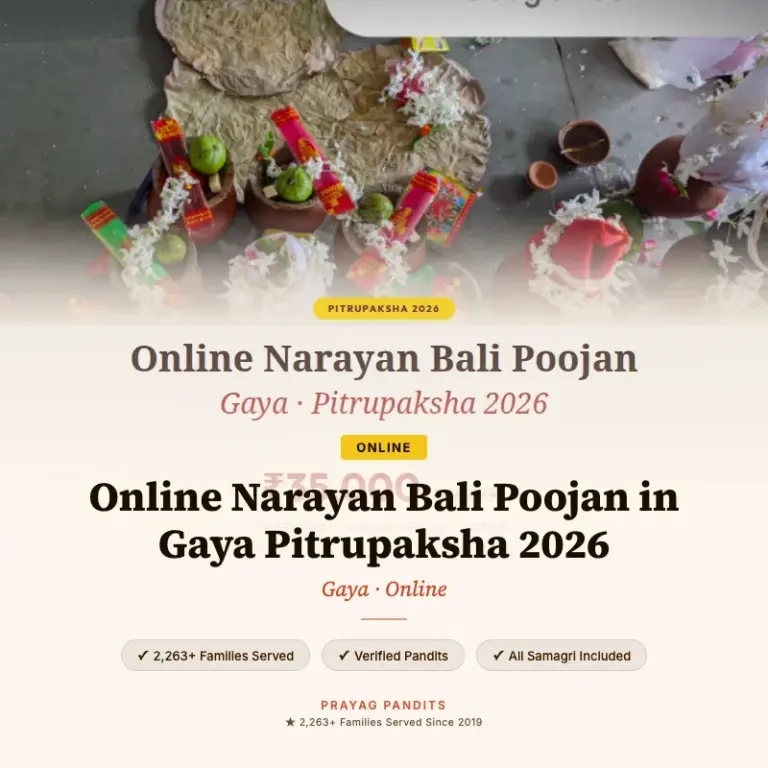 Save 24%
Gaya
Online Narayan Bali Poojan in Gaya Pitrupaksha 2026
Online Narayan Bali Poojan at Gaya (live video, 4–5 hours) Experienced pandit...
from
₹35,000
₹46,000
Narayan Bali at the Phalgu,
the remediation rite for unnatural-death ancestors.
The Padma Purana prescribes Narayan Bali — invoking Vishnu Narayan to complete the death rites for ancestors who died unnatural deaths (akal mrityu). Trimbakeshwar is the canonical tirtha per the Skanda Purana; at Gaya, the Vayu Purana names the Phalgu river an incarnation of Vishnu Narayan himself, making the rite uniquely apt here.
Tell us your situation — we will suggest the package that fits the family. No booking pressure; we will explain the choice on WhatsApp first if needed.
Every package includes an experienced Vedic pandit and the required puja samagri. The difference is in boat, location, stay, and tradition.
Save 24%
Online Narayan Bali Poojan at Gaya (live video, 4–5 hours) Experienced pandit...

Complete Narayan Bali Poojan at Vishnupad Temple area, Gaya Experienced qualified pandit...
No packages match this filter. Talk to a family advisor →
What's included
We've seen too many families face hidden boat fees, samagri costs, and "dakshina" pressure on the day. Here's exactly what's covered, and what isn't.
Included
Verified Gayawal Panda from a registered Phalgu ghat — the priestly lineage qualified in the Narayan Bali vidhi at Gaya, with the specific mantras drawn from the Padma Purana and Garuda Purana Pretakalpa for akal-mrityu ancestral remediation.
Included
Darbha (kusha) grass for the prescribed human-effigy, gold pieces, ghee, milk, honey, til, jau (barley), gangajal, samidha (sacred wood), kalash, white cloth — all the materials the Padma Purana names for the Narayan Bali procedure, prepared in advance.
Included
Optional upgrades: Nag Bali paired-rite (the Padma Purana prescribes Narayan Bali + Nag Bali as the doctrinally complete remediation), Tripindi Shradh combination, online format with live video proof, combined Narayan Bali + Pind Daan packages at the Vishnupad vedi.
Included
One person on WhatsApp through your entire booking — fluent in Hindi, English, and major regional languages — before and after the multi-day rite.
Included
WhatsApp message from the Gayawal Panda after each stage completes — Sankalpa, effigy creation, full death-rite recitation, second-cremation, and tirtha-shradh — with the final report on the evening the multi-stage rite concludes.
Included*
The principal Gaya vedi for Narayan Bali is at Vishnupad, where the prescribed effigy-and-second-cremation procedure is performed by a Gayawal Panda. The closing tirtha-shradh is offered at the Phalgu — the river the Vayu Purana names an incarnation of Vishnu — completing the Gaya-Mahatmya alternative to Trimbakeshwar's canonical Narayan Bali tirtha.
Not included
Train, flight, or road travel. Gaya Junction is well-connected; we can recommend trusted operators. Narayan Bali typically requires a 2-3 day visit for the complete rite plus the recommended Nag Bali pair.
Not included*
Not bundled with the base packages; stay-inclusive bundles available on request for the typical 2-3 day Narayan Bali visit.
Not included
The Padma Purana prescribes Narayan Bali + Nag Bali as the doctrinally complete pair. The base package covers Narayan Bali only; add the Nag Bali pair on request — many families perform both together at Gaya during a single Pitrupaksha visit.
Step 03 · How it works
From your first call to same-day confirmation — we handle every coordination, so the family can focus on what matters.
Choose a package and complete payment online. Our team calls within 2 hours to confirm details and explain the multi-stage Narayan Bali procedure.
~ 5 minutes
Provide gotra, names of departed ancestors (with focus on those who died unnatural / untimely deaths — akal mrityu), the death tithi if known, preferred date — the annual Tithi or a Pitrupaksha day — and any special vidhi requirements.
~ 10 minutes
Gayawal Panda performs the complete multi-stage Narayan Bali vidhi at Vishnupad — Sankalpa, creation of the prescribed darbha-grass human-effigy, recitation of the full Antyeshti (death rites) per the Padma Purana and Nirnaya Sindhu tradition invoking Vishnu Narayan, second-cremation of the effigy, and closing tirtha-shradh at the Phalgu river.
4–6 hours (multi-stage)
Gayawal Panda sends a same-evening WhatsApp confirmation with offerings detail across all rite stages. Photos and video available as opt-in add-ons (default for the Online variant).
Same day
When to perform
Narayan Bali is the remediation rite that the Padma Purana, the Nirnaya Sindhu, and the Smriti Kaustubha tradition prescribe for ancestors who died unnatural, untimely, or violent deaths (akal mrityu), where the standard cremation could not complete its prescribed stages. Trimbakeshwar at Nashik is the canonical Narayan Bali tirtha per the Triambakeshwar Mahatmya tradition and centuries of continuous practice; Gaya is a major alternative site through the Vayu Purana Gaya Mahatmya — the Phalgu river an incarnation of Vishnu Narayan, with the principal Gaya vedi for the rite at Vishnupad. Pitrupaksha (Sep 26 → Oct 10, 2026) is the peak window; the death tithi of the akal-mrityu ancestor is primary; the rite is valid year-round outside sutaka periods.
Performed by Tirth Purohits at Triveni Sangam since 2019
Two ways to perform
Performed by your own hands at the Vishnupad vedi with the closing tirtha-shradh at the Phalgu under a hereditary Gayawal Panda — Sankalpa, darbha-effigy creation, full second-cremation invoking Vishnu Narayan, and tirtha-shradh. The 2-3 day visit typically pairs with Nag Bali; pricing for the pair depends on lineage count, Brahmin-bhojan scale, and samagri additions.
Starts at ₹35,000
For families abroad or unable to travel. Sankalpa recited remotely; Gayawal Panda performs the multi-stage Narayan Bali at the Phalgu with live video proof through the effigy-creation, second-cremation, and tirtha-shradh stages; gangajal couriered after the rite.
Starts at ₹35,000
Complete guide
An editorial reference covering the ritual, the place, eligibility, timing, and what to keep ready — written for families weighing the decision.
In 2026, Pitrupaksha commences on 26 September and concludes with Sarva Pitru Amavasya on 10 October. Each day of this period is dedicated to performing Tarpan for different family members.
Here are the dates:
| Date | Name | Occasion |
|---|---|---|
| September 26 | Purnima Shraddha | Bhadrapada, Shukla Purnima |
| September 27 | Pratipada Shraddha | Ashwina, Krishna Pratipada |
| September 28 | Dwitiya Shraddha | Ashwina, Krishna Dwitiya |
| September 29 | Tritiya Shraddha | Ashwina, Krishna Tritiya |
| September 29 | Maha Bharani | Ashwina, Bharani Nakshatra |
| September 30 | Chaturthi Shraddha | Ashwina, Krishna Chaturthi |
| September 30 | Panchami Shraddha | Ashwina, Krishna Panchami |
| October 1 | Shashthi Shraddha | Ashwina, Krishna Shashthi |
| October 2 | Saptami Shraddha | Ashwina, Krishna Saptami |
| October 3 | Ashtami Shraddha | Ashwina, Krishna Ashtami |
| October 4 | Navami Shraddha | Ashwina, Krishna Navami |
| October 5 | Dashami Shraddha | Ashwina, Krishna Dashami |
| October 6 | Ekadashi Shraddha | Ashwina, Krishna Ekadashi |
| October 7 | Dwadashi Shraddha | Ashwina, Krishna Dwadashi |
| October 7 | Magha Shraddha | Ashwina, Magha Nakshatra |
| October 8 | Trayodashi Shraddha | Ashwina, Krishna Trayodashi |
| October 9 | Chaturdashi Shraddha | Ashwina, Krishna Chaturdashi |
| October 10 | Sarva Pitru Amavasya | Ashwina, Krishna Amavasya |
| Pind Vedi Name | Place |
|---|---|
| Brahma pad | VishnuPad Temple Circile |
| Dakshinaagni pad | VishnuPad Temple Circile |
| Garhyapatyaagni pad | VishnuPad Temple Circile |
| Aahwanyaragni pad | Sambhyaagni pad |
| Awasthayaagni pad | VishnuPad Temple Circile |
| Surya pad | VishnuPad Temple Circile |
| Kartikya pad | VishnuPad Temple Circile |
| Indra pad | VishnuPad Temple Circile |
| Agast pad | VishnuPad Temple Circile |
| Kanwan pad | VishnuPad Temple Circile |
| Chandra pad | VishnuPad Temple Circile |
| Ganesh pad | VishnuPad Temple Circile |
| Kaach pad | VishnuPad Temple Circile |
| Maatang pad | VishnuPad Temple Circile |
| Kasyap pad | VishnuPad Temple Circile |
| Gajakarna pad | VishnuPad Temple Circile |
| Sitakund | On the Bank of Falgu River (East side) in front of Deoghat |
| Ramgaya | On the Bank of Falgu River (East side) in front of Deoghat |
| Gaya seer | VishnuPad Samshan Ghat |
| Gaya kup | VishnuPad Temple Circile |
| Mund Pristha | On Karsili Hill |
| Aadi gaya | On Karsili Hill |
| Dhaut Pad | Dakshin Gate |
| Waitrani | Dakshin Gate |
| Bheem Gaya | Manglagauri |
| Goprachar | Manglagauri |
| Akshay wat | Maranpur |
| Gadalol | Near akshay Wat |
| Gaytri Ghat | Near Brahmni Ghat |
| Rudra pad | VishnuPad Temple Circile |
| Pind Vedi Name | Place |
|---|---|
| Punpun | Punpun Ghat Station in Gaya – Patna Railway |
| Godawari | On the Way to Manglagauri |
| Falgu River | From Dev Ghat to Pitamaheswar |
| Pretseela | Underneath of Pretshila Hill |
| Brahmakund | Underneath of Pretshila Hill |
| Ramsheela | Near Panchayati Akhara |
| Kakwali | Near Ramsheela Hill |
| Uttarmanas | Pitamaheswar Mohalla |
| Dakhinmanas | Surya Kund in Vishnupad Area |
| Udichi | Surya Kund in Vishnupad Area |
| Kankhal | Surya Kund in Vishnupad Area |
| Jihwal | On the bank of Falgu River near Vishnupad Temple |
| Gadhadhar Vedi | VishnuPad Temple Circile |
| Sharswati Vedi | East side of Amba village in Gaya – Bodhgaya road |
| Matangwapi | Bodhgaya |
| Dharmarnaya | Bodhgaya |
| Bodhitaru | Bodhgaya |
| Brahma Sarowar | Maranpur |
| Kaakbali | Maranpur |
| Aamrasechan | Near Manglagauri Temple |
| Tarakbarahm | Near Manglagauri Temple |
| Name of Sarowar |
|---|
| Brahma Sarowar |
| Waitarani Sarowar |
| Rukmini Talab |
| Suryakund |
| Pitamaheswar |
| Godawari |
| Ramsheela |
| Pretsheela |
| Pind Vedi Name | Place |
|---|---|
| Brahma pad | VishnuPad Temple Circile |
| Dakshinaagni pad | VishnuPad Temple Circile |
| Garhyapatyaagni pad | VishnuPad Temple Circile |
| Aahwanyaragni pad | Sambhyaagni pad |
| Awasthayaagni pad | VishnuPad Temple Circile |
| Surya pad | VishnuPad Temple Circile |
| Kartikya pad | VishnuPad Temple Circile |
| Indra pad | VishnuPad Temple Circile |
| Agast pad | VishnuPad Temple Circile |
| Kanwan pad | VishnuPad Temple Circile |
| Chandra pad | VishnuPad Temple Circile |
| Ganesh pad | VishnuPad Temple Circile |
| Kaach pad | VishnuPad Temple Circile |
| Maatang pad | VishnuPad Temple Circile |
| Kasyap pad | VishnuPad Temple Circile |
| Gajakarna pad | VishnuPad Temple Circile |
| Sitakund | On the Bank of Falgu River (East side) in front of Deoghat |
| Ramgaya | On the Bank of Falgu River (East side) in front of Deoghat |
| Gaya seer | VishnuPad Samshan Ghat |
| Gaya kup | VishnuPad Temple Circile |
| Mund Pristha | On Karsili Hill |
| Aadi gaya | On Karsili Hill |
| Dhaut Pad | Dakshin Gate |
| Waitrani | Dakshin Gate |
| Bheem Gaya | Manglagauri |
| Goprachar | Manglagauri |
| Akshay wat | Maranpur |
| Gadalol | Near akshay Wat |
| Gaytri Ghat | Near Brahmni Ghat |
| Rudra pad | VishnuPad Temple Circile |
| Pind Vedi Name | Place |
|---|---|
| Punpun | Punpun Ghat Station in Gaya – Patna Railway |
| Godawari | On the Way to Manglagauri |
| Falgu River | From Dev Ghat to Pitamaheswar |
| Pretseela | Underneath of Pretshila Hill |
| Brahmakund | Underneath of Pretshila Hill |
| Ramsheela | Near Panchayati Akhara |
| Kakwali | Near Ramsheela Hill |
| Uttarmanas | Pitamaheswar Mohalla |
| Dakhinmanas | Surya Kund in Vishnupad Area |
| Udichi | Surya Kund in Vishnupad Area |
| Kankhal | Surya Kund in Vishnupad Area |
| Jihwal | On the bank of Falgu River near Vishnupad Temple |
| Gadhadhar Vedi | VishnuPad Temple Circile |
| Sharswati Vedi | East side of Amba village in Gaya – Bodhgaya road |
| Matangwapi | Bodhgaya |
| Dharmarnaya | Bodhgaya |
| Bodhitaru | Bodhgaya |
| Brahma Sarowar | Maranpur |
| Kaakbali | Maranpur |
| Aamrasechan | Near Manglagauri Temple |
| Tarakbarahm | Near Manglagauri Temple |
| Name of Sarowar |
|---|
| Brahma Sarowar |
| Waitarani Sarowar |
| Rukmini Talab |
| Suryakund |
| Pitamaheswar |
| Godawari |
| Ramsheela |
| Pretsheela |
Select your package and complete booking. Our team calls within 2 hours to confirm details.
Provide your gotra, departed soul's name, and any special requirements.
Experienced pandit performs the complete ceremony at the sacred site.
The family receives ceremony updates on WhatsApp after completion.
Narayan Bali is the remediation rite that the Padma Purana, the Nirnaya Sindhu, and the Smriti Kaustubha tradition together prescribe for ancestors who died unnatural, untimely, or violent deaths — accident, suicide, sudden illness, drowning, fire, or death in a foreign land — where the standard cremation (Antyeshti) could not complete its prescribed stages. The rite invokes Vishnu Narayan to receive the death rites on behalf of the ancestor; a human-effigy is created from darbha grass and the prescribed materials, the full Antyeshti is recited over the effigy, and the effigy is then cremated as a "second cremation" completing the original. The rite is doctrinally distinct from Tripindi Shradh (three-pindas within the shradh rite-family) and from Pind Daan (pinda offering for moksha-release).
Trimbakeshwar at Nashik is the canonical Narayan Bali tirtha per the Triambakeshwar Mahatmya tradition and centuries of continuous practice (see our Trimbakeshwar Narayan Nagbali guide for the canonical-site detail). Gaya is a major alternative site through the Vayu Purana Gaya Mahatmya — the Phalgu river is named an incarnation of Vishnu Narayan himself. The principal Gaya vedi for the rite is at Vishnupad, where Gayawal Pandas perform the prescribed effigy-and-second-cremation procedure; the closing tirtha-shradh is offered at the Phalgu. For families who cannot travel to Trimbakeshwar, or who are already performing other ancestral rites at Gaya (pind-daan, shradh, tarpan), the Vishnupad-anchored Narayan Bali is the doctrinally valid Gaya-Mahatmya alternative.
The eldest son or designated karta of the deceased holds the authority. After marriage, the son performs the rite with his wife. If the eldest son is deceased, the younger son carries out the rite. In the absence of a son, the grandson (son's son); in the absence of male issue from the deceased, the brother; if the departed had only daughters, the daughter's son holds the right. In modern practice, when no male issue is available, daughters and daughters-in-law perform the rite under Gayawal Panda guidance and the rite is fully valid. We coordinate the family-relation verification + sankalpa wording during pre-booking.
Narayan Bali is performed whenever the family is ready for the remediation — there is no strict calendar window (unlike shradh, which is more closely Pitrupaksha-anchored). Four windows carry intensified Mahatmya merit: (1) Pitrupaksha — the 16-day fortnight in Ashwina Krishna Paksha (Sep 26 — Oct 10, 2026); (2) Mahalaya / Sarva Pitru Amavasya — catches all akal-mrityu ancestors; (3) The death tithi of the akal-mrityu ancestor; (4) Monthly Amavasya. The rite is valid year-round. We recommend booking 3-4 weeks in advance during Pitrupaksha as Phalgu coordination is dense.
Three doctrinally distinct rites. Narayan Bali is the remediation rite (Padma Purana) — a human-effigy is created, the full Antyeshti is recited invoking Vishnu Narayan, and the effigy is cremated as a "second cremation" to complete the death rites the original cremation could not complete. Tripindi Shradh is a special shradh subtype (within the shradh rite-family) — three pindas offered to specific deity-groups for akal-mrityu ancestors; no effigy, no second-cremation. Pind Daan is the moksha-release pinda offering — rice-flour balls at the sacred vedis for ancestral liberation. Many families perform all three at Gaya during a single Pitrupaksha visit on different days.
The Nirnaya Sindhu and the Triambakeshwar tradition that the Padma Purana corroborates prescribe Narayan Bali + Nag Bali as the doctrinally complete pair. Nag Bali is the remediation rite for curses related to harming serpents (Naga) — accidentally killing a snake in a previous life or in the family lineage, or any pitri-dosha rooted in Naga-curse. The two rites are typically performed together over 2-3 days. We offer Nag Bali as an add-on to the Narayan Bali base package; the combined-pair pricing is determined during pre-booking consultation based on three factors: (1) the lineage count (how many ancestors and which side of the family), (2) the Brahmin-bhojan scale (how many Brahmins fed on the closing day), and (3) any additional samagri elections (premium gold pieces, extended darbha quantities). Many Gaya families perform both during a single Pitrupaksha visit.
Yes. Online Narayan Bali is performed by a Gayawal Panda at the Vishnupad vedi with live video proof through all the multi-stage rite components — the Sankalpa, the darbha-effigy creation, the full Antyeshti recitation, the second-cremation, and the closing tirtha-shradh at the Phalgu. The karta recites Sankalpa remotely (over Zoom or WhatsApp); names and gotra are confirmed remotely before sankalpa; the complete recording is shared within 48 hours. The Parashar Smriti and Yajnavalkya Smriti both describe Pratinidhi Karma (rite performed by an authorised pandit on the family's behalf, anchored on the karta's sincere Sankalpa) — the Sankalpa and the offering define the rite, not physical presence. Online Narayan Bali at Gaya is priced at ₹35,000, the same sale price as the in-person variant.
Yes — the full Gaya rite-set. Many families perform Narayan Bali for their akal-mrityu ancestors, Pind Daan at Vishnupad for moksha-release of all ancestors, Shradh at the Phalgu for the annual Tithi observance, and Tarpan daily through the Pitrupaksha fortnight. We coordinate combined packages on request; pricing depends on the rite-mix selected. See our Pind Daan in Gaya, Shradh in Gaya, and Tarpan in Gaya pages for the standalone rites.
Drawn from puranic references and pandit consultations — for families who want to understand the ritual's meaning before booking.
Voices from families
Narayan Bali is a very specific ritual and finding the right pandit was our main concern. Prayag Pandits connected us with an experienced purohit who had performed this poojan many times. Very satisfied. Dhanyavaad.
We performed Narayan Bali Poojan on the advice of our family pandit. The ceremony took the full day but Prayag Pandits managed everything perfectly. The senior pandit was very knowledgeable about this complex ritual.
The Narayan Bali Poojan was conducted exactly as described in the Garuda Purana. All the required materials were arranged by the team. The 4-5 hour ceremony was performed with full devotion.
Very authentic Vedic ceremony. All materials were included as promised. Will definitely use their services again.
Frequently asked
Compiled from 2,263+ family conversations on WhatsApp and over the phone.
The primary purpose is to provide liberation (Moksha) and peace (Shanti) to the souls of ancestors who died unnaturally. It aims to fulfill their lingering desires, release them from a state of suffering or wandering, prevent them from causing distress (Pitru Dosha) to their living descendants, and secure their blessings for the family's well-being, prosperity, and harmony.
Gaya is one of the most sacred Hindu pilgrimage sites (Teertha Kshetras) and is especially renowned as a 'Mukti-Sthal' (place of salvation). It's believed that souls of the departed wander here, awaiting rituals from their descendants. Lord Vishnu himself is said to have granted salvation to Gayasur here, blessing the place for ancestral rites. Furthermore, Lord Rama performed Pind Daan for his father Dasharatha in Gaya. Due to these divine associations and its inherent sanctity, performing Narayan Bali in Gaya is believed to yield exceptionally potent results for the liberation of troubled souls.
While Narayan Bali can technically be performed in Gaya throughout the year (365 days), certain periods are considered more auspicious:
Costs can vary significantly based on:
Estimates range widely:
The procedure is complex and best performed by experienced pandits. Key steps typically include:
Pind Daan: This is a general ancestral rite performed for all deceased ancestors (usually annually during Pitru Paksha or upon death) to nourish and appease them, ensuring their peaceful journey. It involves offering rice balls (pindas). It is a fundamental duty for Hindus.
Narayan Bali: This is a specific ritual performed primarily for ancestors who died an unnatural or untimely death, or whose funeral rites were not performed correctly. Its main aim is liberation from the troubled state (Pret Yoni) caused by such deaths and alleviation of resulting Pitru Dosha. While Pind Daan might be part of the Narayan Bali process, Narayan Bali addresses a specific type of death and associated problems.
Yes, several service providers now offer online Narayan Bali puja performed in Gaya on your behalf. They conduct the ritual with pandits in Gaya, often providing video recordings or live streaming options. This is convenient for those unable to travel.
Performing this ritual, especially in the potent kshetra of Gaya, is believed to bring numerous benefits:
Free consultation
We’ll listen, understand your family’s situation, and recommend the right package — never push. Reply within 10 minutes on WhatsApp, every day.