No rituals selected yet.
Browse Pooja Packages → Save 35%
Pind Daan
Pind Daan in Prayagraj this Pitrupaksha 2026
Complete Pind Daan at Triveni Sangam Shastri-qualified pandit Private boat ride to...
from
₹7,100
₹11,000
Performed by Tirth Purohits at the Triveni Sangam — where the Ganga, Yamuna, and Saraswati meet, and where the Padma Purana places ancestral merit above all other tirthas.
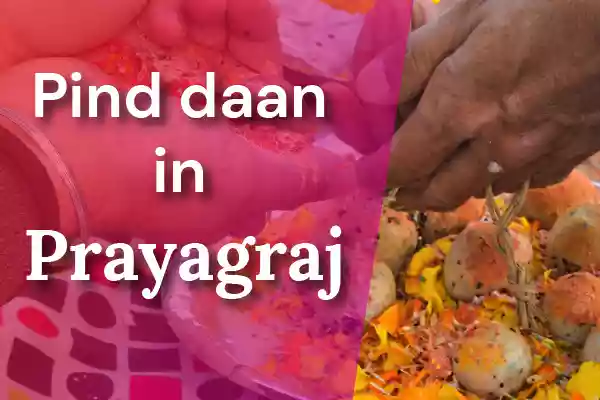
Tell us your situation — we will suggest the package that fits the family. No booking pressure; we will explain the choice on WhatsApp first if needed.
Every package includes an experienced Vedic pandit and the required puja samagri. The difference is in boat, location, stay, and tradition.
Save 35%
Complete Pind Daan at Triveni Sangam Shastri-qualified pandit Private boat ride to...
 Save 40%
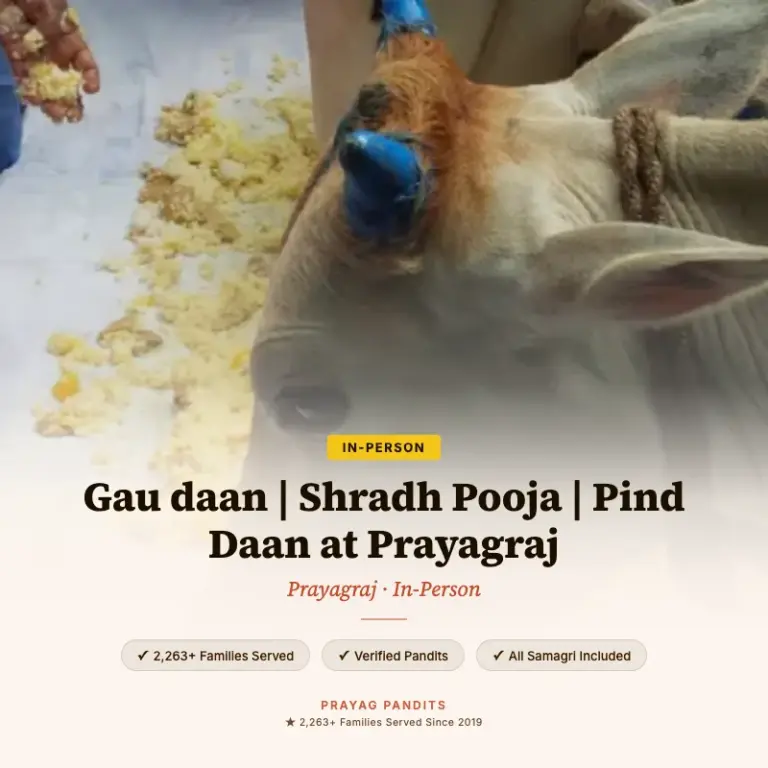
Gau Daan Complete Shradh Pooja with Tarpan at Triveni Sangam (up to...
 Save 40%
Online Pind Daan at Triveni Sangam, Prayagraj (live video) Online Pind Daan...
 Save 40%
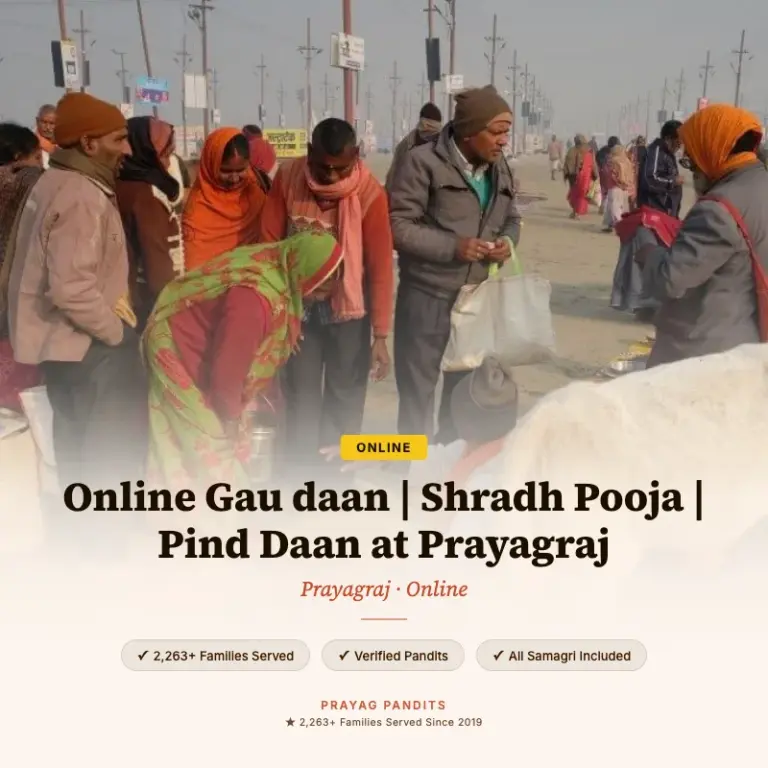
Online Pind Daan at Triveni Sangam, Prayagraj Complete Shradh Pooja with Tarpan...
 Save 22%
Complete Pind Daan ceremony for two persons (2 families) at Triveni Sangam...
 Save 35%
Online Pind Daan at Triveni Sangam (live video) Experienced Prayagraj-based pandit Complete...
 Save 35%
Odia Vidhi Ceremony Pind Daan at Triveni Sangam (pindas of rice, barley,...
No packages match this filter. Talk to a family advisor →
What's included
We've seen too many families face hidden boat fees, samagri costs, and "dakshina" pressure on the day. Here's exactly what's covered, and what isn't.
Included
Sangam pandit qualified in pind-daan vidhi & gotra-pravara recitation.
Included
Kusha grass, til, jau (barley), rice flour, jaggery, ghee, gangajal, sandalwood, white cloth.
Included
Optional package upgrades include Veni Daan combination, Brahmin Bhoj (Platinum tier), Pitru Tarpan extension, and dedicated Odia-vidhi packages for Odia families.
Included
One person on WhatsApp through your entire booking — fluent in Hindi, English, and major regional languages — before and after the ceremony.
Included
WhatsApp message from the pandit the same evening, with details of all offerings made on your behalf.
Included*
Bundled into Premium, Odiya, 3-in-1, Gold, and Platinum packages.
Not included
Train, flight, or road travel. We can recommend trusted operators.
Not included*
Only included in 2D/1N, Gold, and Platinum packages.
Not included
Optional add-on — feeding pandits & needy families is meritorious but not required.
Step 03 · How it works
From your first call to same-day confirmation — we handle every coordination, so the family can focus on what matters.
Choose a package and complete payment online. Our team calls within 2 hours to confirm details.
~ 5 minutes
Provide gotra, names of departed ancestors (up to three generations), preferred date, and any special vidhi requirements.
~ 10 minutes
Pandit performs the complete pind-daan vidhi at Triveni Sangam — Sankalp, Tarpan, pind preparation, offering to ancestors, and visarjan in Ganga.
60–120 min
Pandit sends a same-evening WhatsApp confirmation with offerings detail. Photos and video available as opt-in add-ons.
Same day
When to perform
Pitrupaksha (the 16-day fortnight in Ashwin Krishna Paksha) is the most auspicious window for pind daan, but Triveni Sangam carries year-round merit. Monthly Amavasya, the death anniversary tithi, and Sankranti days are equally valid — and unlike asthi visarjan, pind daan has no time limit.
Performed by Tirth Purohits at Triveni Sangam since 2019
Two ways to perform
Performed by your own hands at Triveni Sangam — the highest scriptural merit. Offer pinds to ancestors at the confluence of three rivers.
Starts at ₹7,100
For families abroad or unable to travel. Sankalp recited remotely; pandit performs pind daan at Sangam with live video proof.
Starts at ₹9,999
Complete guide
An editorial reference covering the ritual, the place, eligibility, timing, and what to keep ready — written for families weighing the decision.
Pind Daan is the sacred Vedic ritual of offering consecrated rice balls — called pindas — to departed ancestors. According to the Garuda Purana, the soul of the deceased exists as a Preta (wandering spirit) after death, unable to find peace until the proper rites are performed. The pindas, made from rice, barley flour, sesame seeds, honey, milk, and ghee, provide subtle nourishment that enables the soul's transition from Preta to Pitru — a peaceful ancestor residing in Pitru Loka.
Hindu philosophy holds that every person is born with three debts: Deva Rina (to the gods), Rishi Rina (to the sages), and Pitru Rina (to the ancestors). Pind Daan is the primary means of discharging Pitru Rina. Among all sacred places in India, Prayagraj — designated as Tirthraj (King of all Pilgrimages) in the Garuda Purana and Padma Purana — holds a singular position for this rite.
The Garuda Purana, Padma Purana, and the Mahabharata all designate Prayagraj as Tirthraj — the supreme pilgrimage. This is not a title of convenience. The scriptural declaration "Prayage Sangame Snaanam Mukti Daayakam" states directly that bathing at the Prayag Sangam bestows liberation. If a sacred bath here grants liberation, the offering of Pind Daan in these waters carries the highest accumulated merit for any departed soul.
Triveni Sangam is the confluence of three sacred rivers — Ganga (representing purity and moksha), Yamuna (representing devotion and bhakti), and the mystical underground Saraswati (representing knowledge and wisdom). The combined spiritual energy at this confluence point is described in Hindu texts as Akshay — inexhaustible merit. Any ritual performed here yields amplified purifying results that no single river can match.
The Triveni Sangam holds permanent sanctity, which means Pind Daan can be performed here on any day of the year — a significant advantage over locations where rituals are restricted to specific seasons or festivals.
The Valmiki Ramayana records that Lord Rama, during his fourteen-year exile, visited Triveni Sangam and performed Pind Daan for his father King Dasharatha at this very confluence. This is the most powerful scriptural endorsement any pilgrimage site can carry — the act of God himself choosing this location for ancestral rites.
Hindu scriptures place three cities in a specific hierarchy for ancestral liberation:
| Location | Designation | Presiding Deity | Role |
|---|---|---|---|
| Prayagraj | First Gate of Salvation | Lord Brahma | Where the journey of ancestral liberation begins |
| Kashi (Varanasi) | Second Gate | Lord Shiva | Where liberation deepens through Shiva's grace |
| Gaya | Third / Final Gate | Lord Vishnu | Where ultimate moksha is conferred at Vishnupad |
This positions Prayagraj as the starting point of the moksha journey — not a lesser alternative to Gaya, but the essential first step. Many families perform Pind Daan in Prayagraj first and later undertake the Gaya yatra for final rites.
The Pind Daan ceremony at Prayagraj follows an eight-step Vedic procedure, typically lasting 2 to 5 hours. The entire ritual is performed at Triveni Sangam, often from a boat positioned directly over the confluence point — the most auspicious spot.
The Pandit is not merely a facilitator — they are essential. The Vedic mantras must be recited in Sanskrit with correct intonation (swara). The Pandit also determines the correct tithi, verifies gotra identification, and manages the sequence when multiple ancestors are being honoured simultaneously. An untrained person cannot perform this effectively. Prayag Pandits' verified Pandits are from traditional Panda families resident at Prayagraj, trained specifically in Vedic ancestral rites.
Unlike some pilgrimage sites with seasonal restrictions, Triveni Sangam's permanent sanctity means Pind Daan can be performed on any day of the year. This is one of Prayagraj's most significant advantages for families who cannot travel during peak periods.
Pitrupaksha 2026 runs from September 27 to October 10, 2026 — the 16-day lunar fortnight when Hindu tradition holds that ancestors descend closest to the earthly plane. Sarva Pitru Amavasya falls on October 10, 2026 — the most powerful single day, covering all ancestors including those whose tithi is unknown.
Bookings during Pitrupaksha should be made 2–3 months in advance due to high demand at Triveni Sangam.
Every Amavasya (new moon) is auspicious for Pind Daan. Significant Amavasyas in 2026 include Mauni Amavasya (January), Phalguna Amavasya (February), and the monthly new moons throughout the year.
Performing Pind Daan on the exact lunar tithi of the ancestor's death is considered highly meritorious — it aligns the offering with the precise karmic moment of the departed soul.
When departed ancestors remain unsatisfied — due to improper last rites, unfulfilled desires, or incomplete Shraddha — they may affect descendants through Pitru Dosh (ancestral affliction).
Performing Pind Daan at Prayagraj's Triveni Sangam — particularly during Pitrupaksha or on the ancestor's death tithi — is among the most potent prescribed remedies for Pitru Dosh.
By Vedic tradition, the eldest son holds primary responsibility for ancestral rites. The pinda offering creates a subtle link between the son's physical lineage and the departed soul.
Yes. In the absence of a son, a daughter, grandson, or wife of the deceased can perform the ritual with complete spiritual validity. The Dharmashastra tradition acknowledges that devotion (bhakti) and intent (sankalpa) carry as much weight as lineage. Several ghats at Prayagraj actively accommodate women-led Pind Daan ceremonies.
Families living abroad can participate through live video call. The Pandit performs the complete ritual at Triveni Sangam while the family joins via WhatsApp or Zoom — speaking the Sankalpa (sacred vow) in real time. The Sankalpa is the spiritual heart of the ritual: when the family member voices their intent, it is formally registered regardless of physical distance. Photos and video documentation are sent after the ceremony. Read our NRI guide.
By Air: Prayagraj Airport (Bamrauli/IXD) has direct flights from Delhi (~1 hour), Mumbai (~2 hours), Bengaluru, and Hyderabad. The airport is 12 km from Triveni Sangam.
By Train: Prayagraj Junction (PYJ) is on the major Delhi–Howrah and Mumbai–Howrah routes. From Delhi: 6.5–8 hours by Rajdhani/Shatabdi. From Varanasi: 2.5–3 hours. From Mumbai: 20–28 hours.
By Road: From Delhi: ~630 km via NH19 (10–12 hours). Volvo AC buses available from ISBT Kashmiri Gate. From Varanasi: ~120 km (2.5 hours).
The ceremony is performed on a boat directly over the confluence point of Ganga, Yamuna, and Saraswati — the most sacred spot. Boats depart from Sangam Ghat and Arail Ghat.
| Aspect | Tarpan | Pind Daan |
|---|---|---|
| What is offered | Water mixed with sesame seeds, poured through cupped palms | Consecrated rice balls (pindas) |
| Who performs | Any family member | Guided by a qualified Pandit |
| Frequency | Daily during Pitrupaksha; on each Amavasya | At a major Tirtha, typically once |
| Mantra requirement | Simpler mantras | Full Vedic chanting by trained Pandit |
| Where performed | Any sacred river or at home | At major Tirthas like Prayagraj, Gaya, Kashi |
| Spiritual function | Provides cooling relief to ancestral souls | Provides nourishment; enables Preta-to-Pitru transition |
Shraddha is the umbrella term encompassing both Tarpan, Pind Daan, Brahmin feeding, and Daan — all performed together in the complete ancestral ceremony.
Book Pind Daan in Prayagraj — Rs 7,100 All-Inclusive →
In 2026, Pitrupaksha will commence on 27th September, and conclude with Sarva Pitru Amavasya on 10th October. Each day of this period is dedicated to performing Tarpan for different family members.
Here are the dates:
| Date | Name | Occasion |
|---|---|---|
| September 27 | Purnima Shraddha | Bhadrapada, Shukla Purnima |
| September 28 | Pratipada Shraddha | Ashwina, Krishna Pratipada |
| September 29 | Dwitiya Shraddha | Ashwina, Krishna Dwitiya |
| September 30 | Tritiya Shraddha | Ashwina, Krishna Tritiya |
| October 1 | Chaturthi Shraddha | Ashwina, Krishna Chaturthi |
| October 2 | Maha Bharani / Panchami | Ashwina, Bharani Nakshatra |
| October 3 | Shashthi Shraddha | Ashwina, Krishna Shashthi |
| October 4 | Saptami Shraddha | Ashwina, Krishna Saptami |
| October 5 | Ashtami Shraddha | Ashwina, Krishna Ashtami |
| October 6 | Navami Shraddha | Ashwina, Krishna Navami |
| October 6 | Dashami Shraddha | Ashwina, Krishna Dashami |
| October 7 | Ekadashi Shraddha | Ashwina, Krishna Ekadashi |
| October 8 | Dwadashi Shraddha | Ashwina, Krishna Dwadashi |
| October 8 | Trayodashi Shraddha | Ashwina, Krishna Trayodashi |
| October 9 | Chaturdashi Shraddha | Ashwina, Krishna Chaturdashi |
| October 10 | Sarva Pitru Amavasya | Ashwina, Krishna Amavasya |
Select your package and complete booking. Our team calls within 2 hours to confirm details.
Provide your gotra, departed soul's name, and any special requirements.
Experienced pandit performs the complete ceremony at the sacred site.
The family receives ceremony updates on WhatsApp after completion.
Voices from families
Quick booking, prompt response, and excellent execution. We were a group of 6 family members and everything was managed well. The pandit was respectful and the ceremony felt genuine. 🙏
Very professional service. The pandit ji explained every step of the ritual which helped us understand the significance. Everything was arranged well including the samagri. We are grateful to Prayag Pandits for making this spiritual journey meaningful.
Performed Pind Daan here during Pitrapaksha. The entire process was smooth. Pandit ji was very cooperative and explained the mantra meanings. The prasad distribution was also well organized. A truly fulfilling experience. Om Shanti.
Smooth experience from start to finish. The live video call gave us peace of mind that everything was done correctly.
We are NRI family based in USA. We booked online poojan and it was conducted very sincerely. The video quality was good and we could see everything clearly. The team sent us photos and videos after the ceremony too. Jai Shri Ram.
Booked this for my mother-in-law's teerth yatra. The arrangements were perfect from pickup to drop. The pandit performed all mantras correctly and with devotion. The poojan materials were all arranged by them. Very satisfied with the service. Om Shanti.
Frequently asked
Compiled from 2,263+ family conversations on WhatsApp and over the phone.
While Pind Daan is significant everywhere, performing it at the Triveni Sangam in Prayagraj carries exceptional weight. The confluence is a point of immense divine energy. It is believed that offerings made here:
Prayagraj, earlier known as Allahabad, is considered one of the most sacred places for performing Pind Daan, as it is situated at the holy confluence (Triveni Sangam) of three rivers - Ganga, Yamuna, and the mythical Saraswati. The main ritual is performed on the banks of the Ganga river or at the Triveni Sangam, where many pandits and priests are available to assist.
Some of the famous and important places for Pind Daan in Prayagraj include:
The ritual starts with a holy dip in the sacred waters of Ganga and Yamuna at the Sangam, followed by the primary rituals and rites performed by the priests on the river banks.
Although Pind Daan can be performed on any day, the most auspicious times include:
Pitru Paksha (16 days dedicated to ancestors)
Performing Pind Daan during these periods at Triveni Sangam helps in resolving Pitru Dosha and ensures that ancestors bless their descendants with peace and prosperity.
There is no fixed "price" for Dharma. However, performing Pind Daan in Prayagraj involves practical aspects. The main component is the dakshina offered to the guiding Pandit. This should be given respectfully based on your capacity (yatha shakti) and satisfaction with the service – think of it as gratitude for their knowledge and time. Other potential costs in Prayagraj might include:
The ritual starts with a holy dip at Triveni Sangam, followed by:
Yes, Hindu scriptures allow women to perform Pind daan, especially if they are the eldest in the family or if there is no male heir. However, some traditions suggest that the ritual is more effective when done by a son or close male relative. Widows, daughters, and sisters can also offer prayers and Tarpan for their ancestors at Triveni Sangam.
Yes, for unnatural deaths (durmaran), our Shastras often recommend additional rites alongside or before the regular Pind Daan, even here in Prayagraj. The soul's departure is considered more troubled. While standard Pind Daan is still performed, it's often strongly advised to also perform Narayan Bali and/or Tripindi Shraddha. These specific rituals, conducted by experienced Pandits in Prayagraj, help pacify the disturbed soul, address any negative energies associated with the death, and ensure their smooth passage. It is crucial to inform your chosen Pandit in Prayagraj about the circumstances of death so they can guide you correctly on the necessary procedures.
While both are important rituals performed in Prayagraj, they serve different purposes. Veni Daan is performed by married couples for marital longevity and well-being. Pind Daan is a ritual performed for ancestors, offering rice balls (pindas) for the peace and salvation (Moksha) of their souls. Both rituals underscore Prayagraj's significance as a major center for Hindu rites.
Free consultation
We’ll listen, understand your family’s situation, and recommend the right package — never push. Reply within 10 minutes on WhatsApp, every day.