No rituals selected yet.
Browse Pooja Packages →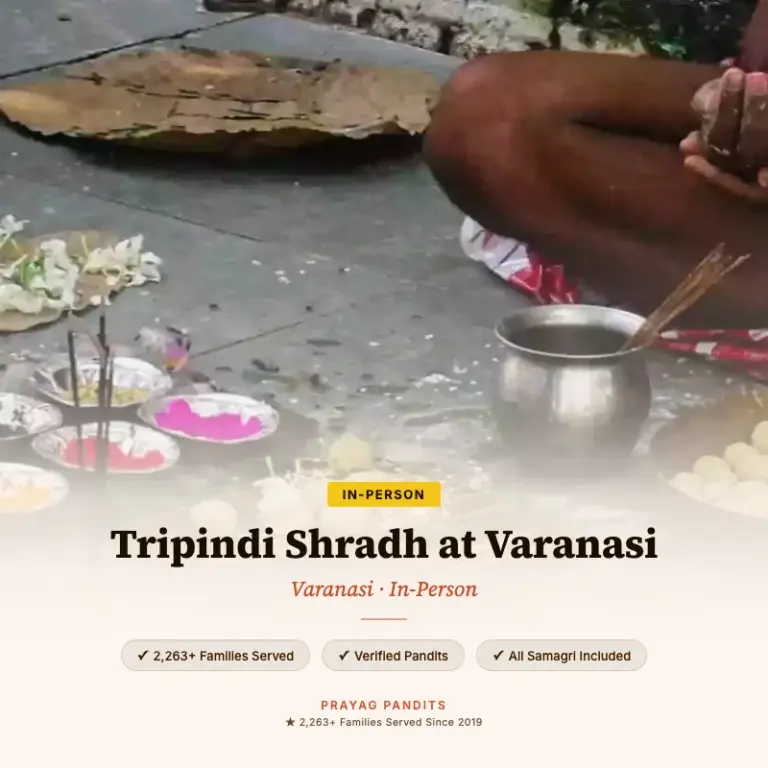 Save 32%
Shradh in Varanasi
Tripindi Shradh at Varanasi
Tripindi Shradh at Ganga Ghat, Varanasi Experienced Kashi-trained pandit All samagri (sesame,...
from
₹21,000
₹31,000
Shradh in Avimukta,
the one kshetra Shiva pledged never to abandon.
The Mahabharata Vana Parva names Kashi as Avimukta — the kshetra Shiva pledged never to abandon — held above pralaya on his trishul per the Linga Purana. The kshetra itself does not lapse; the annual Tithi and Pitrupaksha shradh (Sep 26 — Oct 10, 2026) both hold here.

Tell us your situation — we will suggest the package that fits the family. No booking pressure; we will explain the choice on WhatsApp first if needed.
Every package includes an experienced Vedic pandit and the required puja samagri. The difference is in boat, location, stay, and tradition.
Save 32%
Tripindi Shradh at Ganga Ghat, Varanasi Experienced Kashi-trained pandit All samagri (sesame,...
 Save 45%
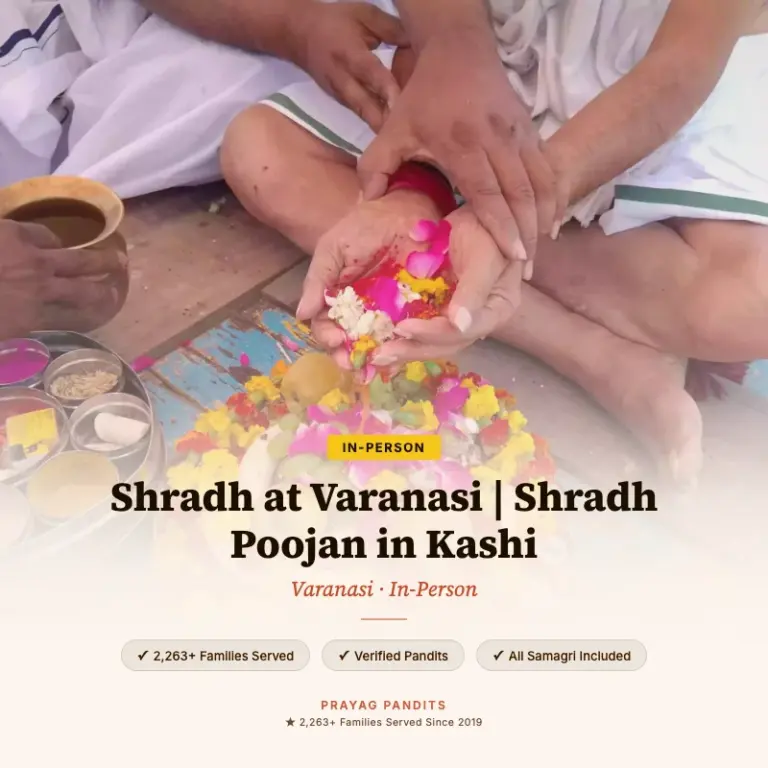
Shradh Poojan at Ganga Ghat, Varanasi Experienced Kashi-trained pandit All samagri (sesame,...
No packages match this filter. Talk to a family advisor →
What's included
We've seen too many families face hidden boat fees, samagri costs, and "dakshina" pressure on the day. Here's exactly what's covered, and what isn't.
Included
Vedic Tirth Purohit qualified in Kashi shradh vidhi, with gotra-pravara verified. The Brahmins of the Kashi Tirth lineage carry the Vedic instruction required for proper Brahmin Bhoj recitation per the Shradh Kalpa texts.
Included
Til, kusha, jau (barley), gangajal, kalash, white cloth, dhoop, sindoor, sandalwood — all the materials prescribed in the Shradh Kalpa, prepared in advance and ready before the family arrives at the Manikarnika or Harishchandra ghat.
Included
Optional upgrades: Tripindi Shradh variant (₹21,000) for ancestors who died unnatural or untimely deaths, Kala Bhairava darshan before the ceremony, and combined Shradh + Asthi Visarjan or Shradh + Pind Daan packages on request.
Included
One person on WhatsApp through your entire booking — fluent in Hindi, English, and major regional languages — before and after the ceremony.
Included
WhatsApp message from the Tirth Purohit the same evening, with details of all shradh offerings, the tarpan performed, and the Brahmin Bhoj completed on your behalf.
Included*
Shradh in the kshetra the Mahabharata Vana Parva names Avimukta — the one tirtha Shiva pledged never to abandon. The kshetra itself does not lapse with the calendar; the annual Tithi-shradh and Pitrupaksha shradh both carry full Mahatmya merit here per the Linga Purana corroboration.
Not included
Train, flight, or road travel. Varanasi Cantt + Babatpur airport well-connected; we can recommend trusted operators.
Not included*
Not bundled with the base packages; stay-inclusive bundles available on request.
Not included
The base Shradh ceremony covers tarpan + dakshina + Brahmin Bhoj — the components the Manusmriti names as shradh's substance. For a dedicated standalone Pind Daan offering at Kashi (Pishachmochan-anchored), see /pind-daan-in-varanasi/. Combined Shradh + Pind Daan packages on request.
Step 03 · How it works
From your first call to same-day confirmation — we handle every coordination, so the family can focus on what matters.
Choose a package and complete payment online. Our team calls within 2 hours to confirm details.
~ 5 minutes
Provide gotra, names of departed ancestors (up to three generations), preferred date — the annual death-anniversary Tithi or a Pitrupaksha day — preferred ghat (Manikarnika or Harishchandra), and any special vidhi requirements.
~ 10 minutes
Tirth Purohit performs the complete shradh vidhi at the family-chosen ghat — Sankalpa, tarpan in three directions per Baudhayana (East for deva-tarpan, South for pitri-tarpan), samagri offering, Brahmin Bhoj with the Shradh Kalpa mantras recited to direct merit to your ancestral lineage. Optional Kala Bhairava darshan before the ceremony.
90–150 min
Tirth Purohit sends a same-evening WhatsApp confirmation with offerings detail. Photos and video available as opt-in add-ons.
Same day
When to perform
Shradh is the karta's lifelong calendar obligation — the Manusmriti, in its Pitri-yajna section, names it one of the five mahayajnas every householder performs across the annual cycle. At Kashi, the rite intensifies through the Avimukta Mahatmya: the Mahabharata Vana Parva names Kashi as Avimukta-tirtha, the one kshetra Shiva pledged never to abandon, and the Linga Purana extends this with the figure of Avimukteshwara — even during pralaya, Shiva holds Kashi above the waters on his trishul. The kshetra itself does not lapse; the annual Tithi-shradh and Pitrupaksha shradh (Sep 26 → Oct 10, 2026) both carry full Mahatmya merit at Manikarnika or Harishchandra ghat.
Performed by Tirth Purohits at Triveni Sangam since 2019
Two ways to perform
Performed by your own hands at Manikarnika or Harishchandra ghat (family's choice) under a Kashi Tirth Purohit — Sankalpa, tarpan, samagri offering, Brahmin Bhoj completed at the riverside with Shradh Kalpa mantras. Optional Kala Bhairava darshan before the ceremony.
Starts at ₹10,999
For ancestors who died unnatural or untimely deaths — accident, suicide, sudden illness, or death in a foreign land — where the standard Sapindikarana was not performed. Three pindas offered to specific deity-groups; rite takes 3-4 hours; bundled Brahmin Bhoj and dakshina.
Starts at ₹21,000
Complete guide
An editorial reference covering the ritual, the place, eligibility, timing, and what to keep ready — written for families weighing the decision.
Select your package and complete booking. Our team calls within 2 hours to confirm details.
Provide your gotra, departed soul's name, and any special requirements.
Experienced pandit performs the complete ceremony at the sacred site.
The family receives ceremony updates on WhatsApp after completion.
Shradh at Varanasi carries Mahatmya merit anchored in the Avimukta framing. The Mahabharata Vana Parva names Kashi as Avimukta-tirtha — "the never-forsaken," the one kshetra Shiva pledged never to abandon. The Linga Purana extends this with Avimukteshwara: even during pralaya (cosmic dissolution), Shiva holds Kashi above the waters on his trishul. For shradh — the annual recurring rite — this is the doctrinally correct anchor: the kshetra itself does not lapse with the calendar, so the rite always holds here. The Manusmriti's universal shradh-as-mahayajna obligation gains the Avimukta Mahatmya amplifier when performed at Manikarnika or Harishchandra ghat.
The eldest son holds the first authority to conduct Shradh karma with tarpan and Brahmin Bhoj per the Manusmriti. After marriage, the son performs Shradh with his wife. If the eldest son is deceased, the younger son carries out tarpan, pind-daan, and Shradh karma. In the absence of a son, the grandson (son's son); in the absence of male issue from the deceased, the brother; if the departed had only daughters, the daughter's son holds the right. Women family members traditionally accompany the karta; in modern practice, when no male issue is available, daughters and daughters-in-law perform the full rite under Tirth Purohit guidance and the rite is fully valid.
Shradh at Varanasi is performed at the city's cremation ghats — primarily Manikarnika Ghat (the foremost ancestral-rite ghat, where Vishnu's chakra dug the kund and Shiva's jewelled earring fell, per the Skanda Purana Kashi Khanda Ch 26) and Harishchandra Ghat (the older living-tradition cremation ghat, named for King Harishchandra's truth-test). Families also visit Dashashwamedh Ghat for the evening Ganga aarti before or after the shradh ceremony. Each ghat carries its own scriptural and historical character; we coordinate either ghat at the family's preference with the same vidhi.
Shradh is the karta's lifelong calendar obligation per the Manusmriti Pitri-yajna section. Three primary windows: (1) The annual death-anniversary Tithi — performed every year on the lunar day the ancestor departed. (2) Pitrupaksha — the 16-day fortnight in Ashwina Krishna Paksha (Sep 26 — Oct 10, 2026), with Sarva Pitru Amavasya (Mahalaya) as the universal-ancestors closing day. (3) Monthly Amavasya — the recurring touchpoint between Pitrupakshas. At Kashi — Avimukta, the never-forsaken kshetra — the rite holds year-round per the Mahabharata Vana Parva anchor. We recommend booking 2-3 weeks in advance during Pitrupaksha as Manikarnika coordination is dense.
Three related but doctrinally distinct rites. Shradh is the broader ancestral institution — the calendar-anchored rite combining tarpan + dakshina + Brahmin Bhoj + (in Pitrupaksha) pinda offering. Pind Daan is the specific pinda-offering rite — at Kashi anchored on the Pishachmochan / Vimal Kund Skanda Purana tradition. Tarpan is jala-tarpana, the daily water-libation with darbha twigs (one of the five daily mahayajnas per Manusmriti). Shradh contains tarpan + Brahmin Bhoj as components. See our Pind Daan in Varanasi page for the standalone pinda-offering ceremony and Asthi Visarjan in Varanasi for the cremation-ashes rite.
Tripindi Shradh is a special shradh subtype performed for ancestors who died unnatural, untimely, or violent deaths — accident, suicide, sudden illness, or death in a foreign land — where the standard Sapindikarana (the rite admitting the soul to the ranks of established ancestors) was not performed at the time. The rite involves three pindas offered to specific deity-groups at the prescribed vedis. Pitrupaksha (especially Mahalaya Amavasya) is the ideal window, though Tripindi is valid year-round. We offer Tripindi Shradh at Kashi at ₹21,000 with bundled Brahmin Bhoj and dakshina; the rite takes 3-4 hours.
The Manusmriti, in chapter 3 verse 3.189, makes the doctrinal claim plainly: "Brahmanobhojanat punyam pitarah susthiran smrita" — the ancestors are established in peace and contentment through the feeding of Brahmins. The Garuda Purana Pretakalpa elaborates: the Pitrs arrive at the shradh ceremony drawn by the Sankalpa, receive the tarpan offering, and depart fully nourished by the Brahmin Bhoj. Without Brahmin Bhoj, the offering reaches the ancestors but the ceremony's completion as described in the Shradh Kalpa texts is not achieved. Every Shradh package we offer at Manikarnika or Harishchandra includes Brahmin Bhoj as the central completing component.
The Shiva Purana, in the Shatarudra Samhita, records Kala Bhairava as the dharma-magistrate of Kashi — the kotwal who oversees the dharma of the kshetra. By long Kashi tradition, families performing ancestral rites take darshan at the Kala Bhairava temple before or after the shradh, requesting his permission and protection for the offering. The darshan is optional, not required for the rite's validity, but families who incorporate it report a deeper sense of completion. We can arrange the Kala Bhairava darshan as a pre-shradh stop in your itinerary.
Drawn from puranic references and pandit consultations — for families who want to understand the ritual's meaning before booking.
Voices from families
We had been wanting to perform Pind Daan for years but couldn't travel to India. This online service was a blessing. The entire ritual was done as per shastras. Thank you Prayag Pandits team for your dedication. Dhanyavaad.
Good service overall. The pandit was on time and well prepared. He guided us through each step of the ceremony. The booking process was simple and the team was responsive on WhatsApp. Would recommend to others.
Booked this for my late father. Everything was arranged perfectly. The team was professional and respectful throughout.
After losing my father suddenly we needed guidance on the proper rituals. Prayag Pandits team was very compassionate and helped us through every step. The Pind Daan brought us immense peace. Jai Shri Ram.
First time performing Pind Daan and was nervous about the process. But the team guided us well. They explained what to wear, what to bring, and what mantras to recite. Everything went smoothly.
We booked Pind Daan for our late father's shradh ceremony. The pandits were very knowledgeable and performed all rituals with proper Vedic mantras. The whole family felt at peace after the poojan. Highly recommended for anyone looking for authentic rituals. Jai Shri Ram.
Frequently asked
Compiled from 2,263+ family conversations on WhatsApp and over the phone.
Kashi is no ordinary city. It is the city of Lord Shiva, the Moksha-Dayini Nagari (city that grants liberation). Performing Shradh here, especially Pind Daan on the banks of Maa Ganga, is believed to grant ultimate peace (Sadgati) and liberation (Moksha) to the departed souls. It is said that ancestors receive immense satisfaction when their descendants perform these rites in Kashi, helping them ascend peacefully to higher realms or even break the cycle of rebirth.The energy of this place, combined with the purity of the Ganga, amplifies the merit of the ritual manifold.
Shradh rituals, particularly Pind Daan and Tarpan, are predominantly performed on the holy Ghats along the banks of the River Ganga. Some of the most significant Ghats for these rites are:
The choice of Ghat can sometimes depend on family tradition or the specific type of Shradh being performed.
While variations exist, the core components usually include:
Traditionally, the duty falls upon the eldest son (Karta). After marriage, he performs it along with his wife. If the eldest son is not available (deceased or otherwise unable), a younger son can perform it.
In the absence of a son, a grandson (son's son) can perform the rites. If there are no sons or grandsons, the daughter's son (dauhitra) holds a very significant right to perform Shradh. Even the brothers of the deceased can perform it if needed.
Regarding women: While the primary responsibility often lies with male descendants, women absolutely can perform Shradh, especially if there are no eligible male members in the immediate family or if they are unable to perform it. There are scriptural examples, like Mata Sita performing Pind Daan for King Dasharatha. In Kashi, we see daughters and wives performing these rites with full reverence and achieving the same merit for their ancestors. Unmarried women, however, are generally advised against performing certain specific elaborate rites like Tripindi Shradh alone, but can participate and perform simpler Shradh or Tarpan.
Tripindi Shradh is a special ritual performed to bring peace to ancestors whose Shradh rites might not have been performed regularly (perhaps for three consecutive years), or for those who suffered an unnatural or untimely death (like accidents, suicide, murder). It addresses ancestors from the last three generations whose souls might be lingering in an unsatisfied state (Preta Yoni). It involves invoking Brahma, Vishnu, and Mahesh (Shiva) and offering Pindas to pacify these souls.
Pishach Mochan Kund in Varanasi is uniquely powerful for this ritual. It is believed to predate even the arrival of Ganga Maiya on earth. Performing Tripindi Shradh here is said to specifically liberate souls suffering due to untimely death or those stuck in spirit-obstruction states (Pishach Yoni), granting them Sadgati (peaceful passage). The Garuda Purana and Skanda Purana mention its significance. It's considered the primary place for such specific Shradh karmas.
Yes, it is highly recommended to engage a qualified and experienced Pandit (Purohit). Shradh involves specific mantras, procedures, and understanding of lineage (Gotra) which a knowledgeable Pandit can guide you through correctly.[2] Performing the ritual accurately maximizes its benefit for the ancestors.
Finding a Pandit:
Free consultation
We’ll listen, understand your family’s situation, and recommend the right package — never push. Reply within 10 minutes on WhatsApp, every day.