No rituals selected yet.
Browse Pooja Packages →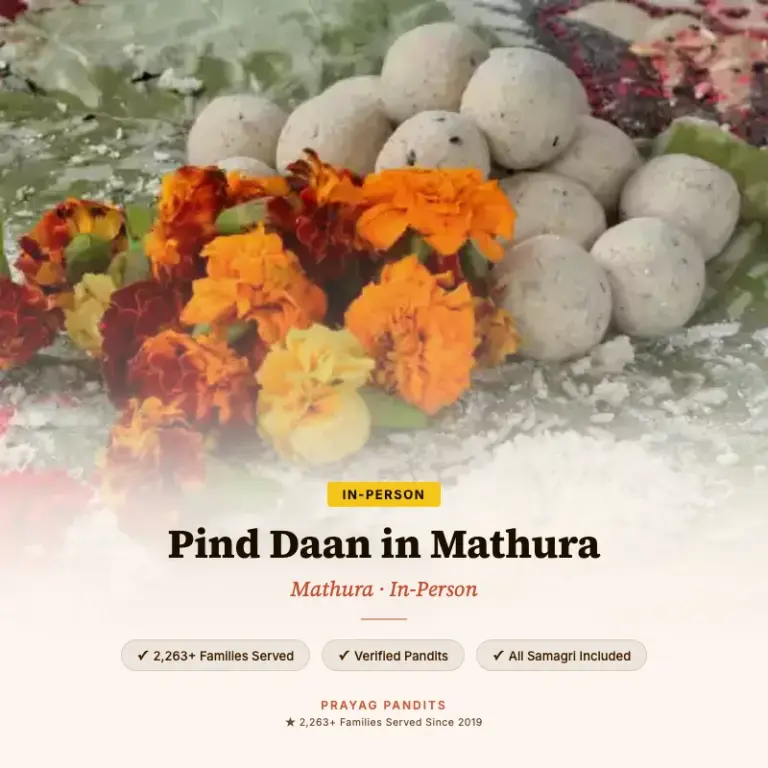 Save 35%
Mathura
Pind Daan in Mathura
Pind Daan at Vishram Ghat, Mathura Experienced pandit (Mathura tradition) Complete samagri...
from
₹7,100
₹11,000
The Varaha Purana Mathura Mahatmya names Vishram Ghat among the 24 tirths of this Krishna kshetra. Bhagavata describes Vishram Ghat as Krishna's rest-ghat after slaying Kamsa. The Yamuna — Krishna's own river — receives the consecrated pinda. Vayu Purana names Gaya supreme; Mathura carries its own Vaishnava Sapta-Puri register.
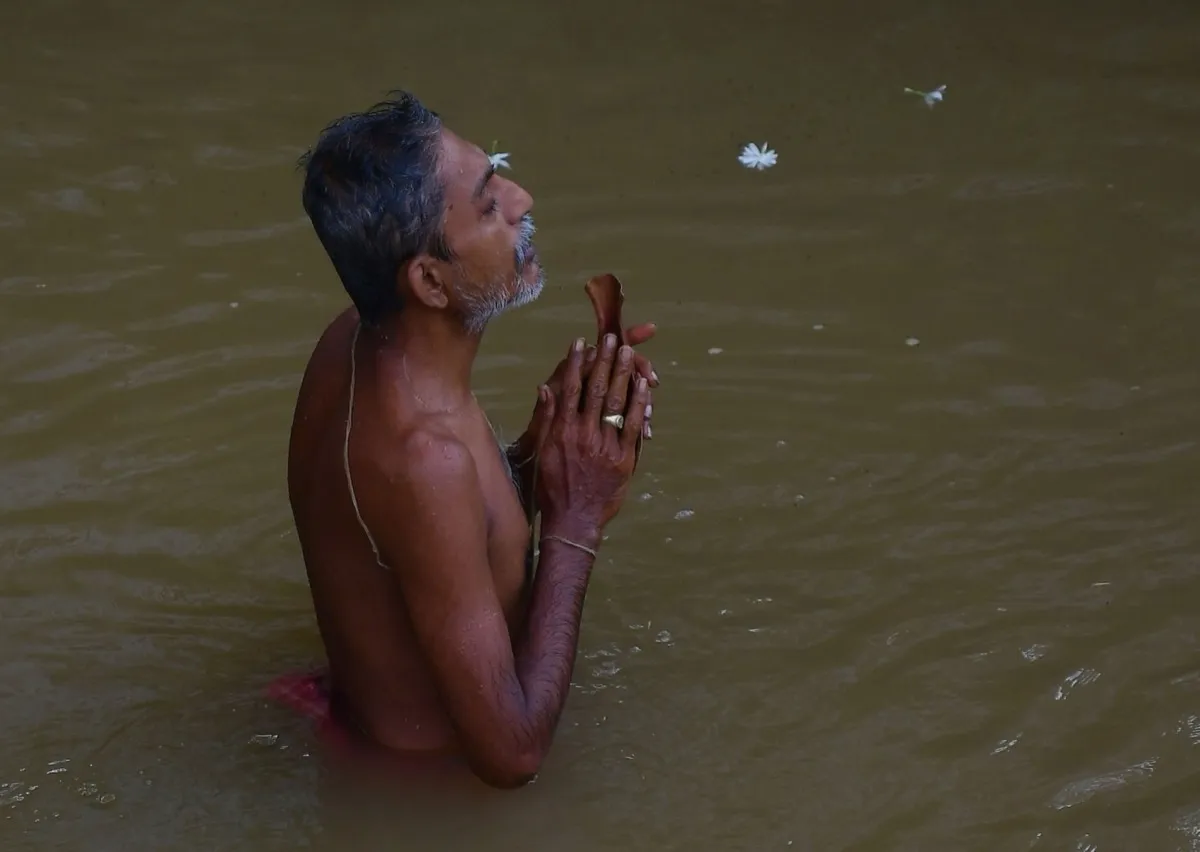
Tell us your situation — we will suggest the package that fits the family. No booking pressure; we will explain the choice on WhatsApp first if needed.
Every package includes an experienced Vedic pandit and the required puja samagri. The difference is in boat, location, stay, and tradition.
Save 35%
Pind Daan at Vishram Ghat, Mathura Experienced pandit (Mathura tradition) Complete samagri...
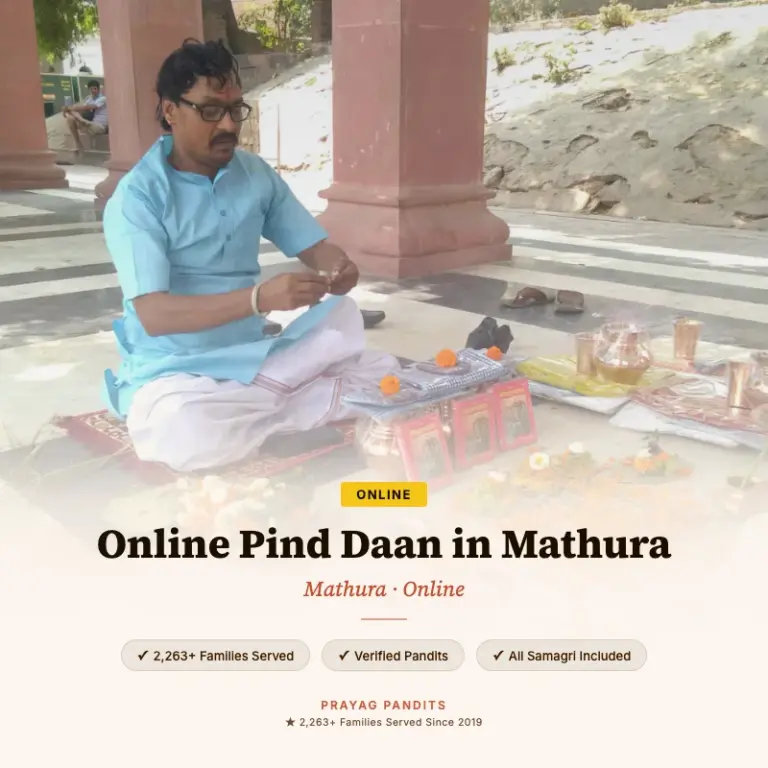 Save 27%
Online Pind Daan at Vishram Ghat, Mathura (live video) Experienced pandit (Mathura...
No packages match this filter. Talk to a family advisor →
What's included
We've seen too many families face hidden boat fees, samagri costs, and "dakshina" pressure on the day. Here's exactly what's covered, and what isn't.
Included
Sanskrit-trained pandit from the Mathura ritual tradition, with gotra-pravara verified. The hereditary purohits of the Vishram Ghat lineage carry the Vedic instruction required for pind-daan Sankalpa, pinda consecration with gotra-pravara recitation, and pitru-tarpan at the Yamuna per the Garuda Purana Pretakalpa.
Included
Pinda dough prepared from sesame, barley flour, and kusha grass — consecrated in advance with the gotra-pravara of the departed and ready before the family arrives at Vishram Ghat. The Garuda Purana Pretakalpa names pind as the preta's vehicle of transit.
Included
Pind, sesame, barley, kusha grass, flowers, incense, Yamuna jal, kalash, white cloth, sandalwood, lamp — the materials prescribed for the Vishram Ghat pind-daan vidhi, prepared in advance at the ghat-side and ready before the family arrives. Online variant uses Yamuna jal couriered to the family after the rite.
Included
Optional upgrades for the Mathura-Vrindavan yatra: combined pind-daan + tarpan at Vishram Ghat (separate ceremony, additional samagri), Dwarkadheesh Temple darshan, Vrindavan parikrama (Banke Bihari, Prem Mandir, Iskcon, Nidhi Vana), Govardhan parikrama, and multi-day Vaishnava Sapta-Puri circuit packages connecting Mathura with Ayodhya / Kashi.
Included
One person on WhatsApp through your entire booking — fluent in Hindi, English, and major regional languages — before and after the ceremony. Available for last-minute coordination around the Vrindavan / Govardhan day-trip sequencing.
Included*
WhatsApp message from the Mathura-tradition pandit the same evening of the ceremony, with details of all pind-daan offerings made on your behalf and the pitru-tarpan completed at Vishram Ghat. For the Online variant, a Google Meet / Zoom recording of the ceremony is delivered within 72 hours.
Not included
Mathura is well-connected: nearest railhead is Mathura Junction (major stop on the Delhi-Mumbai trunk route); nearest airport is Delhi IGI (~150km / 3 hours) or Agra Kheria (~60km / 1.5 hours). The Yamuna Expressway makes Mathura a 2.5-3 hour day-trip from Delhi NCR. We can recommend trusted operators for the itinerary; ceremony bookings exclude travel arrangement.
Not included*
Most families perform Mathura pind-daan as part of a 1-2 day Mathura-Vrindavan yatra. Stay-inclusive Vaishnava Sapta-Puri circuit packages available on request for families combining multiple cities.
Not included
The broader Mathura-Vrindavan darshan circuit (Dwarkadheesh, Banke Bihari, Prem Mandir, Iskcon, Govardhan parikrama, Nidhi Vana) is coordinated separately from the pind-daan rite — different temple timings, different administrations. We help sequence the darshan around the pind-daan window on request.
Step 03 · How it works
From your first call to same-day confirmation — we handle every coordination, so the family can focus on what matters.
Choose the in-person or online package and complete payment online. Our team calls within 2 hours to confirm details. For families combining the Mathura pind-daan with Vrindavan / Govardhan parikrama or the broader Sapta-Puri yatra, the coordinator helps sequence the bookings.
~ 5 minutes
Provide gotra, names of departed ancestors (up to three generations of paternal lineage; one maternal generation in some traditions), preferred date — Pitrupaksha, a monthly Amavasya, the annual death-anniversary Tithi, or a Sankranti — and any special vidhi requirements. For families with Yadava-lineage or Brij-area ancestral ties, share that context during the booking call.
~ 10 minutes
Mathura-tradition pandit performs the complete pind-daan vidhi at Vishram Ghat on the Yamuna — Sankalpa, pinda consecration with gotra-pravara recitation, pind offering with the Mathura-specific mantras invoking the Varaha Purana Mathura Mahatmya doctrine, and pitru-tarpan in three directions per Baudhayana. For the Online variant, the ceremony is conducted live on Zoom / WhatsApp / Google Meet with the karta participating remotely.
60–180 min
Mathura-tradition pandit sends a same-evening WhatsApp confirmation with offerings detail. For the Online variant, a recorded Google Meet / Zoom session is delivered within 72 hours and Yamuna jal is couriered to the family within 5-7 days. Photos and additional videography available as opt-in add-ons.
Same day
When to perform
The Garuda Purana Pretakalpa prescribes pind-daan during Pitrupaksha (the 15-16 day fortnight in Ashwina Krishna Paksha — Sep 26 → Oct 10, 2026), every Amavasya, on the death-anniversary tithi, and on Sankranti days. At Vishram Ghat on the Yamuna — named in the Varaha Purana Mathura Mahatmya as part of the 24-tirth Mathura register — the rite carries the Vaishnava Sapta-Puri register specific to this Krishna kshetra. Yamuna is Krishna's own river (kalindi-jaa per Bhagavata Purana); the universal Ganga-water doctrine applies indirectly via the downstream Yamuna-Ganga confluence at Prayagraj Triveni Sangam. Mathura's visitor density is highest during Janmashtami (Krishna's birth, Aug-Sep), Radhashtami (Sep), Govardhan Puja (Oct-Nov), and Pitrupaksha — book 2-3 weeks in advance for these windows. The Vayu Purana Gaya Mahatmya remains the supreme pind-daan textual authority; Mathura carries a distinct Sapta-Puri register, not a competing one.
Performed by Tirth Purohits at Triveni Sangam since 2019
Two ways to perform
Performed by your own hands at Vishram Ghat on the Yamuna under a Mathura-tradition pandit — pandit recites the pind-daan vidhi mantras and the gotra-pravara; the karta offers the pinda and performs the pitru-tarpan personally. Many families combine the rite with Dwarkadheesh Temple darshan, Vrindavan parikrama (Banke Bihari, Prem Mandir), Govardhan parikrama, and the evening Yamuna Aarti as the closing devotional act.
Starts at ₹7,100
For families abroad or unable to travel. Sankalpa + gotra-pravara recited remotely on Zoom / WhatsApp / Google Meet; the Mathura-tradition pandit, acting as Pratinidhi (authorised proxy per Angirasa Smriti + Nirnaya Sindhu Pratinidhi-nirnayah), performs the pind-daan at Vishram Ghat with live video proof. A recorded ceremony is delivered within 72 hours; Yamuna jal is couriered to the family afterwards.
Starts at ₹11,000
Complete guide
An editorial reference covering the ritual, the place, eligibility, timing, and what to keep ready — written for families weighing the decision.
In 2025, Pitrupaksha will commence on 7th September, and conclude with Mahalaya Amavasya on 21st September. Each day of this period is dedicated to performing Tarpan for different family members.
Here are the dates:
| Date | Name | Occasion |
|---|---|---|
| September 7 | Purnima Shraddha | Bhadrapada, Shukla Purnima |
| September 8 | Pratipada Shraddha | Ashwina, Krishna Pratipada |
| September 9 | Dwitiya Shraddha | Ashwina, Krishna Dwitiya |
| September 10 | Tritiya Shraddha | Ashwina, Krishna Tritiya |
| September 10 | Chaturthi Shraddha | Ashwina, Krishna Chaturthi |
| September 11 | Maha Bharani | Ashwina, Bharani Nakshatra |
| September 11 | Panchami Shraddha | Ashwina, Krishna Panchami |
| September 12 | Shashthi Shraddha | Ashwina, Krishna Shashthi |
| September 13 | Saptami Shraddha | Ashwina, Krishna Saptami |
| September 14 | Ashtami Shraddha | Ashwina, Krishna Ashtami |
| September 15 | Navami Shraddha | Ashwina, Krishna Navami |
| September 16 | Dashami Shraddha | Ashwina, Krishna Dashami |
| September 17 | Ekadashi Shraddha | Ashwina, Krishna Ekadashi |
| September 18 | Dwadashi Shraddha | Ashwina, Krishna Dwadashi |
| September 19 | Trayodashi Shraddha | Ashwina, Krishna Trayodashi |
| September 19 | Magha Shraddha | Ashwina, Magha Nakshatra |
| September 20 | Chaturdashi Shraddha | Ashwina, Krishna Chaturdashi |
| September 21 | Sarva Pitru Amavasya | Ashwina, Krishna Amavasya |
Select your package and complete booking. Our team calls within 2 hours to confirm details.
Provide your gotra, departed soul's name, and any special requirements.
Experienced pandit performs the complete ceremony at the sacred site.
The family receives ceremony updates on WhatsApp after completion.
Mathura is canonically named in the Varaha Purana Mathura Mahatmya as Vishnu kshetra — Krishna's birth-city and one of the seven Vaishnava Sapta Puri liberation-cities. Vishram Ghat on the Yamuna is the central pind-daan vedi within the Mathura Mahatmya's 24-tirth register; the Mathura-tradition pandit performs the rite with the Mathura-specific mantras invoking the Varaha Mahatmya doctrine. Honest framing: the Vayu Purana Gaya Mahatmya remains the supreme pind-daan textual authority for the once-in-a-lifetime Gaya-Shradh tradition; Mathura carries the distinct Vaishnava Sapta-Puri register, not the Gaya Mahatmya equivalent. The two registers are canonically valid but doctrinally distinct — Mathura serves families with Krishna-bhakti orientation, Yadava-lineage or Brij-area ancestral ties, or those combining the pind-daan with the broader Mathura-Vrindavan yatra (Dwarkadheesh + Banke Bihari + Govardhan parikrama) or the wider Vaishnava Sapta-Puri pilgrimage (Mathura + Ayodhya + Mayapuri / Kashi / Kanchi / Avantika / Dvaravati).
The eldest son holds the first authority to perform pind-daan with Sankalpa and pinda offering per the Manusmriti Pitri-yajna section. After marriage, the son performs the rite with his wife. If the eldest son is deceased, the younger son carries out the pind-daan. In the absence of a son, the grandson (son's son); in the absence of male issue, the brother; if the departed had only daughters, the daughter's son holds the right. In modern practice, when no male issue is available, daughters and daughters-in-law perform the full rite under the Mathura-tradition pandit's guidance and the rite is fully valid per the Parashar and Yajnavalkya Smritis on Pratinidhi Karma.
Vishram Ghat (also called Vishranti Tirth) sits on the Yamuna River at Mathura, in the central ghat-row near the Krishna Janmabhoomi complex. It is named "Vishram" (= rest) because Bhagavata Purana describes Krishna resting here after slaying Kamsa — the foundational Mathura narrative event. Vishram Ghat is the principal pind-daan vedi within the Mathura Mahatmya's 24-tirth register; the hereditary purohit lineage performs Sankalpa, pinda consecration with gotra-pravara recitation, and pitru-tarpan here per the Varaha Mathura Mahatmya vidhi. After the offering, the pinda is released into the Yamuna current with the prescribed mantras. Many families combine the rite with the evening Yamuna Aarti at the same ghat, and with darshan at Dwarkadheesh Temple (the central Vaishnava temple at Mathura) before or after the rite.
The Garuda Purana Pretakalpa prescribes pind-daan during four primary windows: (1) Pitrupaksha — the 15-16 day fortnight in Ashwina Krishna Paksha (Sep 26 → Oct 10, 2026), with Sarva Pitru Amavasya (Mahalaya, Oct 10) as the closing universal-ancestors day. (2) Monthly Amavasya. (3) The annual death-anniversary Tithi. (4) Sankranti days. Mathura-specific calendar density: Mathura's visitor density is highest around Krishna-festival days — Janmashtami (Krishna's birth, Aug-Sep), Radhashtami (Sep), Govardhan Puja (Oct-Nov), and the Pitrupaksha window. For the recurring annual Tithi-pind and monthly Amavasya pind that the family sustains across years, weekday slots outside these festival windows offer a calmer atmosphere. Book 2-3 weeks in advance for Pitrupaksha or any Krishna-festival overlap.
Both are canonically valid pind-daan rites with distinct Mahatmya registers. Gaya carries the supreme pind-daan Mahatmya per the Vayu Purana Gaya Mahatmya — Phalgu river is named as Vishnu himself, Vishnupad Temple holds the principal vedi where Vishnu's footprint receives the pinda offering, and the Akshayavata / Pretashila / Rudrapada vedis carry the Lord Rama Dasharatha-shradh tradition. Gaya is the traditionally first-rank choice for the once-in-a-lifetime Gaya-Shradh pilgrimage that Hindu families undertake. Mathura carries the Varaha Purana Mathura Mahatmya register — a Vaishnava Sapta-Puri Mahatmya rooted in Krishna's kshetra at Vishram Ghat on the Yamuna, with the broader 24-tirth Mathura register surrounding the central vedi. The choice is contextual: Gaya for the canonical once-in-a-lifetime Mahatmya pilgrimage; Mathura for families with Krishna-bhakti orientation, Yadava-lineage or Brij-area ancestral ties, or those combining the pind-daan with the Mathura-Vrindavan yatra or broader Sapta-Puri pilgrimage. We do not recommend one over the other; we recommend coordinating both across a lifetime of pitru-rites where logistics permit.
Mathura is exceptionally well-connected from Delhi NCR via the Yamuna Expressway (2.5-3 hour drive). Nearest railhead: Mathura Junction — a major stop on the Delhi-Mumbai trunk route. Nearest airports: Delhi IGI (~150km / 3 hours) or Agra Kheria (~60km / 1.5 hours). Most families perform Mathura pind-daan as a same-day trip from Delhi NCR or as part of a 1-2 day Mathura-Vrindavan yatra. The broader yatra typically includes: Dwarkadheesh Temple darshan (the central Vaishnava temple at Mathura), Krishna Janmabhoomi complex visit (Krishna's birthplace), Banke Bihari + Prem Mandir + Iskcon temple darshans at Vrindavan (~12km from Mathura), Nidhi Vana parikrama, Govardhan parikrama (the 21km circumambulation of Govardhan hill), and the evening Yamuna Aarti at Vishram Ghat. Families with broader Sapta-Puri interest extend to Ayodhya (~5-6 hours by road via Kanpur → Ayodhya) or sequence Mathura with the Brij parikrama circuit (84-kos Vraja-yatra).
Yes. Online Pind Daan is performed by a Mathura-tradition pandit at Vishram Ghat on the Yamuna with live video proof — the karta recites Sankalpa remotely on Zoom / WhatsApp / Google Meet, the pandit recites the gotra-pravara on the karta's behalf, and the pandit — acting as Pratinidhi (authorised proxy per the Parashar and Yajnavalkya Smritis) — offers the consecrated pinda and performs the pitru-tarpan in three directions per Baudhayana. A recorded ceremony is delivered within 72 hours via Google Meet / Zoom. Yamuna jal is couriered to the family within 5-7 days after the rite. The online Pind Daan at Mathura is currently priced at ₹11,000 (regular ₹15,000).
The pinda is a small consecrated dough ball prepared at Vishram Ghat by the Mathura-tradition pandit from three Vedic ingredients: sesame seeds (til) — for purification and pitri-tradition; barley flour (jau) — the grain offered to ancestors since Vedic times per the Pitri Sukta; and kusha grass (darbha) — the sacred grass used in all Vedic rites for its purifying property. Yamuna jal binds the mixture (online variant: Yamuna jal couriered to the family afterwards). The Sankalpa names the karta, the gotra, and three generations of paternal ancestors (plus one maternal generation in some traditions); the pinda is consecrated with the gotra-pravara recitation and the Mathura-specific mantras invoking the Varaha Mathura Mahatmya doctrine. After the offering, the pinda is released into the Yamuna current — Yamuna is Krishna's own river per the Bhagavata Purana (kalindi-jaa, daughter of the Sun) and carries the pinda's merit via its own Yamuna Mahatmya register (note: Yamuna is also a Ganga tributary meeting Ganga at Prayagraj Triveni Sangam — see the dedicated detailed FAQ below for the Yamuna-vs-Ganga doctrinal subtlety). The physical release is by the karta's own hand (in-person variant) or by the pandit's hand acting as Pratinidhi (online variant).
Both choices are valid; the answer depends on the family's circumstances. If you can undertake the once-in-a-lifetime Gaya-Shradh visit — typically a 3-4 day pilgrimage with Phalgu darshan and the broader Gaya vedi circuit — Gaya is the traditionally first-rank choice for a first pind-daan because of the supreme Vayu Purana Mahatmya register. If you are undertaking the Mathura-Vrindavan yatra — Dwarkadheesh + Banke Bihari + Govardhan parikrama — performing pind-daan at Vishram Ghat within the same yatra is a Mahatmya-class first pind-daan choice rooted in the Krishna-kshetra tradition. If logistics prevent both — recent bereavement, health considerations, NRI distance, extended-family scheduling — the dharmashastra tradition (Manusmriti + Garuda Pretakalpa) is clear that pind-daan at any valid tirtha with correct Sankalpa and qualified pandit is fully scripturally efficacious. We do not advise families to defer their first pind-daan in pursuit of an idealised pilgrimage they may not be able to complete; performing the rite promptly honours the ancestors more than postponing it. Families often complete their first pind-daan online and then undertake the in-person Gaya or Mathura pilgrimage in a subsequent year as an act of devotion.
The Mathura catalogue currently carries two published packages, both on active sale. In-person: ₹7,100 sale (regular ₹11,000) — the karta performs pind-daan at Vishram Ghat by their own hand under a Mathura-tradition pandit. Online: ₹11,000 sale (regular ₹15,000) — performed by the Mathura-tradition pandit at Vishram Ghat on the family's behalf via Pratinidhi Karma, with live video and a 72-hour Google Meet / Zoom recording. In-person includes: Mathura-tradition pandit, complete samagri (Pind, sesame, barley, kusha, flowers, incense, Yamuna jal), Sankalpa with the karta present, gotra-pravara recitation, pitru-tarpan using Yamuna River water, and pre-ceremony guidance. In-person excludes: travel to Mathura, accommodation, station / airport pickup, Vrindavan / Dwarkadheesh Temple darshan (separate coordination), photography, and extra dakshina. Online includes: Sanskrit-trained Mathura-tradition pandit at Vishram Ghat with live video, pre-ceremony consultation call, all ritual materials (barley, sesame, kusha, flowers, incense, lamp, Yamuna jal), Sankalpa via live video, Pind Nirmaan + Pind Daan for up to 3 generations, gotra-pravara recitation by the pandit acting as Pratinidhi, recorded Google Meet / Zoom session delivered within 72 hours, post-ritual blessings call, and Yamuna jal couriered to the family. Online excludes: physical presence at Mathura, tarpan (separate rite), Vrindavan / Dwarkadheesh darshan (in-person product covers the broader yatra coordination), additional ceremonies (Narayan Bali / Tripindi Shradh — separate bookings), and extra dakshina.
Drawn from puranic references and pandit consultations — for families who want to understand the ritual's meaning before booking.
Voices from families
Had a wonderful experience. The booking process was easy and the ceremony was conducted with full devotion.
We had been wanting to perform Pind Daan for years but couldn't travel to India. This online service was a blessing. The entire ritual was done as per shastras. Thank you Prayag Pandits team for your dedication. Dhanyavaad.
We came from Delhi specifically for this puja. The whole process was smooth and the pandit ji guided us patiently. Highly recommend.
Quick booking, prompt response, and excellent execution. We were a group of 6 family members and everything was managed well. The pandit was respectful and the ceremony felt genuine.
Performed Pind Daan here during Pitrapaksha. The entire process was smooth. Pandit ji was very cooperative and explained the mantra meanings. The prasad distribution was also well organized. A truly fulfilling experience. Dhanyavaad.
Excellent experience. We were worried about how to perform Pind Daan from abroad but the online option made it possible. The live video call was clear and we could participate in real time. The pandit was patient and answered all our questions. 🙏
Frequently asked
Compiled from 2,263+ family conversations on WhatsApp and over the phone.
Yes. Vishram Ghat on the Yamuna in Mathura is sacred for Tarpan, the offering of water to departed ancestors. Prayag Pandits can arrange qualified pandits to conduct Tarpan at Vishram Ghat with proper Vedic mantras and ritual procedure.
Mathura is most famous as the birthplace of Lord Krishna, one of the principal avatars of Lord Vishnu. The city is home to the Shri Krishna Janmabhoomi temple, the Dwarkadhish Temple, Vishram Ghat on the Yamuna, and dozens of other sacred sites. It is also renowned for its extraordinary Holi and Janmashtami celebrations, its ancient Mathura Art School heritage, and the famous Mathura Peda sweet.
The 7 Moksha Kshetras (the seven sacred cities of liberation) identified in Hindu scripture are: (1) Ayodhya — birthplace of Lord Rama, (2) Mathura — birthplace of Lord Krishna, (3) Haridwar (Mayapuri) — where Ganga enters the plains, (4) Varanasi (Kashi) — the city of Shiva where Pishach Mochan is for ancestor liberation, (5) Kanchipuram — sacred city in South India, (6) Ujjain (Avantika) — Mahakaleshwar Jyotirlinga, and (7) Dwarka — Krishna's kingdom. Pind Daan performed in any of these seven cities carries exceptional spiritual merit. Additionally, Gaya (while not always counted among the 7 Moksha Kshetras) is considered the supreme Pitru Tirtha specifically for ancestral rites. Many pilgrims combine Pind Daan with visits to these sacred cities as part of a comprehensive spiritual pilgrimage.
The best times are October to March for pleasant weather, July-August for Janmashtami (the holiest time spiritually), and March for the famous Holi season. Avoid May and June when temperatures can exceed 45 degrees Celsius.
Shradh is the complete ancestral ceremony that encompasses several rituals performed with faith (Shrad) — including Tarpan (water offering), Pind Daan (food offering), Brahmin Bhojan (feeding of a Brahmin), and Daan (charity). Pind Daan is specifically the act of offering rice balls (Pind) to the ancestors as nourishment for their journey through the afterlife. Every Pind Daan is part of Shradh, but Shradh is broader than Pind Daan alone.
Traditionally, the eldest son performs Pind Daan on behalf of the family. Any male descendant in the direct paternal line — son, grandson, or nephew — is eligible. A daughter's son (Dauhitra) may perform the rite when there is no male heir in the paternal line. In the modern era, many traditions also allow a devoted daughter to perform Shradh and Pind Daan, particularly in the absence of a male heir, with proper guidance from a qualified Pandit.
Prayag Pandits offers both in-person and online (live video) options for all Pind Daan services across all nine cities. The online option via WhatsApp or Zoom is fully valid from a Vedic perspective when the devotee participates actively in the Sankalp — the formal declaration of intent that personalises the ritual to your family. Your name, gotra, and the names of your departed ancestors are recited during the Sankalp, establishing the direct spiritual connection regardless of your physical location. This option is especially popular with NRI families and those who cannot travel on short notice.
Do not worry. Our pandits are experienced in guiding families who are unfamiliar with the ritual requirements. We will help you determine the necessary information before your ceremony and guide you through the process step by step. If you do not know your gotra, we use the standard prescribed alternatives that the Shastras sanction for such situations. No family should be prevented from performing their sacred obligations by lack of procedural knowledge — that is precisely what our pandits are there to provide.
Free consultation
We’ll listen, understand your family’s situation, and recommend the right package — never push. Reply within 10 minutes on WhatsApp, every day.