
Garh Mukteshwar ritual guidance

Three handfuls at the Brij-Ganga,
the most accessible Gangetic tarpan for Delhi-NCR families.

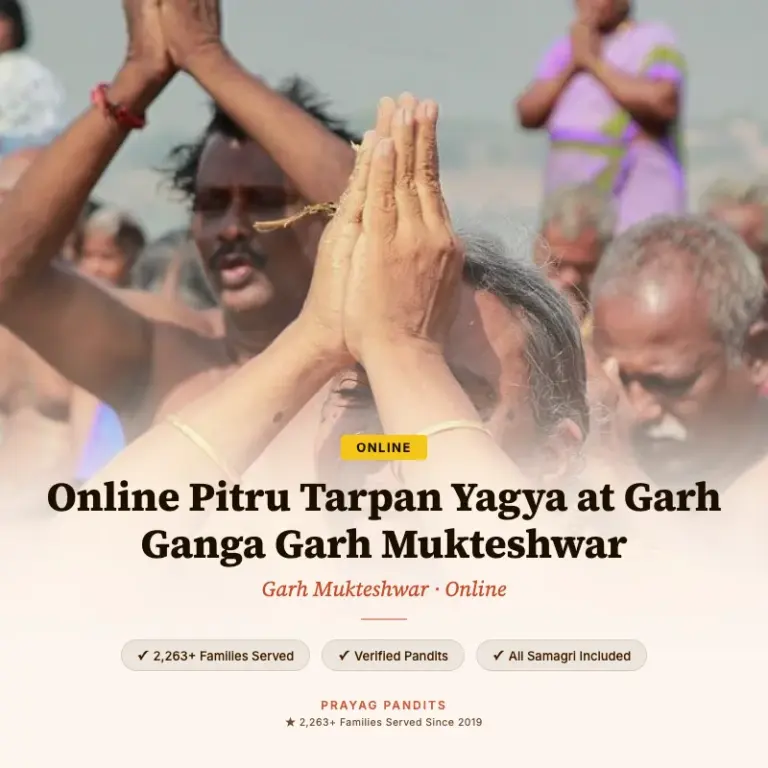
Tarpan at Garh-Mukteshwar — the Brij-area Gangetic tirtha anchored on the Mukteshwar Shiva temple, three hours from Delhi. Three handfuls of water with darbha twigs per the Baudhayana procedure. Daily, through Pitrupaksha (Sep 26 — Oct 10, 2026), and on the annual Tithi.

✓ Verified Pandits 📹 Video Proof 🕉 Vedic Vidhi 📦 All Samagri Included
2,263+
Families served since 2019
1
Curated packages
11
Sacred cities covered
Tarpan water-libation ceremony at the Ganga ghat, Garh Mukteshwar
Brij-Ganga Ghat · Mukteshwar Temple
Garh-Mukteshwar, Uttar Pradesh
Verified arrangement
Starting from
₹8,100 ₹11,000 Save 26%
Choose package →
Step 02 · Choose your package

Choose the arrangement
that fits your family

Every package includes an experienced Vedic pandit and the required puja samagri. The difference is in boat, location, stay, and tradition.

Showing 1 of 1 packages
Not sure which package fits? Talk to a family advisor — free, no obligation. We reply on WhatsApp Mon–Sat 10AM–9PM.

What's included

Every package is complete
no pressure for "extra dakshina" on the day

We've seen too many families face hidden boat fees, samagri costs, and "dakshina" pressure on the day. Here's exactly what's covered, and what isn't.

Included

Experienced Brij-Ganga Pandit

Verified Brij-Ganga Tirth Purohit from the Garh-Mukteshwar ghat — the priestly lineage qualified for tarpan, shradh, and pind-daan rites across the Pitrupaksha calendar and the annual death-anniversary Tithi.

Included

All Tarpan Samagri

Darbha (kusha) twigs, til, jau (barley), gangajal, kalash, white cloth — prepared in advance, ready before the family arrives at the ghat. Tarpan requires the dried grass twig and the prescribed water vessel per Baudhayana.

Included

Package add-ons available

Optional upgrades surfaced in this catalogue: online tarpan with live video proof for NRI families, Pitrupaksha 2026 timing-specific variants (Sep 26 — Oct 10), and combinations with Shradh or Pind Daan rites on request. Mukteshwar darshan can be added to in-person packages.

Included

Family Coordinator

One person on WhatsApp through your entire booking — fluent in Hindi, English, and major regional languages — before and after the ceremony.

Included

Same-day Confirmation

WhatsApp message from the Brij-Ganga pandit the same evening, with details of all tarpan offerings made on your behalf.

Included*

Brij-Ganga tarpan coordination

Tarpan on the Garh-Mukteshwar Ganga ghat — the primary Brij-area ancestral tirtha held in long sthala-parampara (place-tradition). The city is anchored on the Mukteshwar Shiva temple; many families combine the tarpan with a darshan. The Padma Purana and Agni Purana affirm the universal Ganga-water doctrine: water from the Ganga carries merit for ancestral offerings at any point along the river.

Not included

Travel to Garh-Mukteshwar

Road travel only — 3-4 hours from Delhi NCR. Most families do a same-day trip. We can recommend trusted operators.

Not included*

Hotel / Accommodation

Most families do a same-day trip from Delhi-NCR; overnight stay available on request.

Not included

Pind Daan offering (Not included)

Tarpan packages cover the water-libation rite only. For the full Pind Daan offering at Garh-Mukteshwar, see /pind-daan-in-garh-mukteshwar/. Combined tarpan + pind-daan packages available on request.

Step 03 · How it works

Four steps.
We carry the rest.

From your first call to same-day confirmation — we handle every coordination, so the family can focus on what matters.

  1. Book & confirm

    Choose a package and complete payment online. Our team calls within 2 hours to confirm details.

    ~ 5 minutes

  2. Share ancestral details

    Provide gotra, names of departed ancestors (up to three generations), preferred date — the annual Tithi or a Pitrupaksha day — and any special vidhi requirements.

    ~ 10 minutes

  3. Tarpan at the Brij-Ganga

    Brij-Ganga pandit performs the complete tarpan vidhi at the Ganga ghat — Sankalp, then water libation with darbha twigs for deva-tarpan (East), rishi-tarpan, and pitri-tarpan (South), with the prescribed anjali count per Baudhayana.

    45–90 min

  4. Confirmation & report

    Brij-Ganga pandit sends a same-evening WhatsApp confirmation with offerings detail. Photos and video available as opt-in add-ons (default for the Online tarpan variants).

    Same day

Start with WhatsApp We respond within 2 hours · No commitment required

When to perform

When to perform tarpan at Garh-Mukteshwar — daily, monthly, annually, and through Pitrupaksha

Tarpan is a nitya-karma — the Manusmriti, in its Pitri-yajna section, names tarpan one of the five mahayajnas every householder performs daily after the morning bath. At Garh-Mukteshwar — the primary Brij-area Gangetic ancestral tirtha, anchored on the Mukteshwar temple — the rite gains the practical-accessibility of a same-day Delhi-NCR trip combined with regional sthala-parampara merit. The Padma Purana and Agni Purana affirm the universal Ganga-water doctrine: water from the Ganga carries merit for ancestral offerings at any point along the river. Pitrupaksha (Sep 26 — Oct 10, 2026) is the peak fortnight; the annual death-anniversary Tithi is the lifelong family obligation; monthly Amavasya keeps the rite alive between Pitrupakshas. Garh-Mukteshwar is not in the moksha trinity — for the highest Mahatmya-merit tarpan, see our pages for Gaya, Prayagraj, Varanasi, or Haridwar.

  1. Daily Nitya-karma
  2. Pitrupaksha Most ideal
  3. Amavasya Monthly
  4. Tithi Anniversary
  5. Year-round Always valid

Performed by Tirth Purohits at Triveni Sangam since 2019

Two ways to perform

In-person at the Brij-Ganga,
or online from anywhere

Travel to Garh-Mukteshwar

Performed by your own hands at the Brij-Ganga ghat under a Brij-Ganga Tirth Purohit. Karta recites Sankalp; tarpan is offered in three directions — deva-tarpan facing East, pitri-tarpan facing South — with the prescribed darbha twigs and anjali count per Baudhayana.

  • Karta performs Sankalp & tarpan personally
  • Brij-Ganga ghat — 3-4 hours from Delhi NCR
  • Pitrupaksha 2026 variant available (Sep 26 — Oct 10)
  • Add Mukteshwar temple darshan

Starts at ₹7,100

Online for NRI families

For families abroad or unable to travel — the Angirasa Smriti authorises Pratinidhi Karma specifically when the karta is at a distance. Sankalp recited remotely; Brij-Ganga pandit acting as Pratinidhi performs tarpan at the Ganga ghat with live video proof; gangajal couriered to the family after the rite.

  • Live Zoom / WhatsApp ceremony
  • Purohit as Pratinidhi per Angirasa Smriti
  • Names & gotra confirmed remotely before sankalp
  • Pitrupaksha 2026 online variant available

Starts at ₹8,100

Complete guide

Tarpan in Garh Mukteshwar
everything families ask before booking

An editorial reference covering the ritual, the place, eligibility, timing, and what to keep ready — written for families weighing the decision.

About Tarpan

Tarpan in Garh Mukteshwar

Book Online and Offline Tarpan in Garh Mukteshwar Packages
  • 50000+ Poojas Performed
  • Pooja Samagri Included
  • Experienced Pandits
  • Average 4.5 Star Reviews
  • Online Pooja Available

What's Included

Included

  • Experienced Vedic Pandit
  • All Puja Samagri & Materials
  • Ceremony update on WhatsApp
  • Coordination support before the ritual

Not included

  • Travel to Garh Mukteshwar
  • Hotel / Accommodation

How It Works

  1. 01

    Book & Confirm

    Select your package and complete booking. Our team calls within 2 hours to confirm details.

  2. 02

    Share Family Details

    Provide your gotra, departed soul's name, and any special requirements.

  3. 03

    Ceremony Performed

    Experienced pandit performs the complete ceremony at the sacred site.

  4. 04

    Updates Shared

    The family receives ceremony updates on WhatsApp after completion.

Common questions about the procedure

How is tarpan performed at Garh Mukteshwar?

The traditional tarpan vidhi follows the procedure attributed to the Baudhayana Dharmasutra: stand in the river or sit on the ghat steps at the Brij-Ganga. Face East for the deva-tarpan (offerings to the deities); face South for the pitri-tarpan (offerings to the departed ancestors). The darbha (dried kusha grass) is the prescribed medium for the water-libation — held differently for each class of offering. Water mixed with til (sesame) and jau (barley) is offered through the hands in the prescribed number of handfuls for each class of recipient. At Garh-Mukteshwar, the rite is performed at the Ganga ghat near the Mukteshwar temple — the same traditional procedure observed at every Gangetic tirtha.

Why perform Tarpan at Garh Mukteshwar specifically?

Tarpan is valid at any river ghat per Baudhayana — every householder offers daily tarpan after the morning bath as one of the five mahayajnas. Garh-Mukteshwar offers a distinctive combination: it is the most accessible Gangetic tarpan tirtha for Delhi-NCR families (3-4 hours by road, same-day trip), anchored on the Mukteshwar Shiva temple in a long sthala-parampara (regional place-tradition) for ancestral rites. The Padma Purana and Agni Purana affirm the universal Ganga-water doctrine: water from the Ganga carries merit for ancestral offerings at any point along the river. For families who need a Gangetic tarpan without the 8-12 hour journey to Gaya, Prayagraj, or Varanasi, Garh-Mukteshwar is the practical-accessible choice.

Who can perform Tarpan at Garh Mukteshwar?

The eldest son holds the first authority to conduct tarpan to the ancestors as part of his shradh-karma obligation. After marriage, the son performs tarpan with his wife. If the eldest son is deceased, the younger son carries out tarpan, pind-daan, and shradh karma. In the absence of a son, the grandson (son's son); in the absence of male issue from the deceased, the brother; if the departed had only daughters, the daughter's son holds the right. We coordinate the family-relation verification before the ceremony.

When should Tarpan at Garh Mukteshwar be performed?

Tarpan is fundamentally a daily nitya-karma — Manusmriti chapter 3 lists it among the five mahayajnas every householder performs after the morning bath. Beyond the daily obligation: (1) Pitrupaksha — the 16-day fortnight in Ashwina Krishna Paksha, with Sarva Pitru Amavasya as the universal-ancestors closing day; (2) the annual death-anniversary Tithi — the karta's lifelong family obligation; (3) monthly Amavasya — the recurring touchpoint between Pitrupakshas. Pitrupaksha 2026 runs September 26 — October 10. The Ganga at Garh-Mukteshwar holds year-round for tarpan under the universal Ganga-water doctrine.

What is the difference between Tarpan, Pind Daan, and Shradh at Garh Mukteshwar?

Three related but doctrinally distinct rites. Tarpan is the water-libation offered with darbha twigs and the prescribed anjali count — performed daily by every householder, with peak intensity during Pitrupaksha. Pind Daan is the specific pinda-offering rite — rice-flour balls offered with mantras. Shradh is the broader institution combining tarpan + dakshina + Brahmin bhojan. At Garh-Mukteshwar, all three are available at the Ganga ghat near the Mukteshwar temple. Tarpan can be performed standalone as the daily rite; shradh requires Brahmin bhojan; pind-daan is the moksha-direction offering. Many families combine rites during Pitrupaksha; we offer combined packages on request.

Can tarpan at Garh Mukteshwar be performed online for NRI families?

Yes — the Angirasa Smriti and Nirnaya Sindhu (Prathama Pariccheda, Pratinidhi-nirnayah) specifically authorise Pratinidhi Karma when the karta is at a distance. Online tarpan is performed by a Brij-Ganga Tirth Purohit acting as Pratinidhi at the Ganga ghat with live video proof. The karta recites Sankalp remotely (over Zoom or WhatsApp); the purohit performs the three-direction tarpan with the prescribed darbha and water-libation; gangajal is couriered to the family after the rite. Names and gotra are confirmed remotely before the sankalp. The universal Ganga-water doctrine (Padma Purana and Agni Purana) does not condition merit on physical presence — the offering defines the rite.

What is the role of darbha grass in Tarpan?

The darbha (dried kusha grass twig) is the prescribed medium for water-libation per the Baudhayana Dharmasutra. The three forms — tip alone for the deities (deva-tarpan), folded in half for the sages (rishi-tarpan), and tip-and-root for the ancestors (pitri-tarpan) — physically distinguish the three offerings even when performed in sequence. The grass acts as a conductor between the karta's hand and the recipient lokas; per shastra tradition, water poured without the darbha is incomplete tarpan. Our packages include all the required darbha twigs prepared in advance.

How does Garh Mukteshwar compare to Gaya or Prayagraj for tarpan?

Garh-Mukteshwar has a different Mahatmya profile from the moksha-trinity tirthas; both are canonically valid for tarpan. Gaya intensifies tarpan through the Vayu Purana Gaya Mahatmya (the Phalgu = incarnation of Vishnu); Prayagraj through the Tirtharaj Sangam (Padma/Skanda Puranas); Varanasi through the Avimukta kshetra (Mahabharata Vana Parva + Linga Purana). Garh-Mukteshwar's strength is accessibility — a same-day trip from Delhi-NCR — combined with the universal Ganga-water doctrine affirmed by the Padma and Agni Puranas. For the daily nitya-karma tarpan, the Baudhayana procedure is identical at every Ganga ghat. The city's Mukteshwar Shiva temple provides an additional pilgrimage anchor.

Spiritual depth & scriptural detail

Drawn from puranic references and pandit consultations — for families who want to understand the ritual's meaning before booking.

What does the Manusmriti say about daily tarpan?
The Manusmriti, in its Pitri-yajna section (chapter 3), names the five great daily oblations every householder performs after the morning bath. Pitri-yajna is the second of the five, and the Manusmriti elaborates its substance as jala-tarpana — water libation, not Brahmin bhojan and not pinda offering. The smriti is explicit on the daily obligation: even if the karta is unable to perform the full shraddha rite, he must at minimum perform tarpan. For families in Delhi-NCR, the Ganga at Garh-Mukteshwar is the most accessible site to fulfil this obligation at a Gangetic tirtha without the longer journey to Gaya, Prayagraj, or Varanasi.
What is the Baudhayana procedure for tarpan, and why does precision matter?
The traditional tarpan procedure, attributed to the Baudhayana Dharmasutra, is the most detailed surviving liturgical instruction for the water-libation rite. The core elements observed by Brij-Ganga pandits: East-facing for the deva-tarpan, South-facing for the pitri-tarpan (ethnographically confirmed at major Gangetic tirthas); the darbha (kusha grass) twig held differently for each class of recipient; water mixed with til and jau offered in the prescribed number of handfuls per class. The precision matters because tarpan is a karma — a ritual act whose efficacy depends on procedural correctness, not just intention. Our pandits observe the traditional procedure faithfully; the prescribed materials (darbha, til, water-vessel) are prepared in advance.
What is the Mukteshwar temple, and how does it relate to tarpan?
The Mukteshwar Shiva temple is the central anchor of Garh-Mukteshwar — the city takes its name from the temple. The temple complex sits on a bluff overlooking the Ganga; the tarpan ghat is at the river below. Many families combine the tarpan ceremony with a Mukteshwar darshan. The temple is a sthala (place-anchor) — the city's identity as an ancestral-rite tirtha is held in long regional sthala-parampara (place-tradition) rather than a single-verse Puranic Mahatmya. The universal Ganga-water doctrine (Padma Purana and Agni Purana) provides the scriptural foundation for tarpan at any Ganga ghat including this one.
How is Pitrupaksha tarpan different from daily tarpan?
Daily tarpan is jala-tarpana to the three classes (deva / rishi / pitri) — the karta's mahayajna obligation, performed after the morning bath at any river or with prepared water. Pitrupaksha tarpan intensifies this in three ways: (1) Calendar specificity — the 16 tithis of Ashwina Krishna Paksha are each dedicated to a specific ancestor-category (Purnima for full-moon-day deaths, Bharani for Bharani-nakshatra deaths, Avidhava Navami for women, Ghata Chaturdashi for violent deaths). (2) Place specificity — tarpan at Gangetic tirthas during Pitrupaksha carries merit beyond daily tarpan at a local ghat. (3) Universality — Sarva Pitru Amavasya (Mahalaya), the closing day, catches every ancestor including those whose tithi is unknown.
What is the Pratinidhi Karma tradition for online tarpan?
The Angirasa Smriti and Nirnaya Sindhu (Prathama Pariccheda, Pratinidhi-nirnayah section) establish the Pratinidhi Karma tradition — the authorised proxy performance of ancestral rites specifically when the principal karta is at a distance. The Angirasa Smriti is explicit: if the karta is nearby, the proxy is invalid; the tradition is designed for physical absence. The purohit acting as Pratinidhi performs the tarpan on the karta's behalf, with the karta's Sankalp (vow of intention) recited remotely to establish the ritual link. This is the scriptural basis for online tarpan: the NRI karta participates via live video, confirms gotra and ancestor names, recites the Sankalp, and the purohit completes the three-direction water-libation with darbha twigs at the Ganga ghat.
What are the Pitrupaksha 2026 tarpan dates and how should families plan?
Pitrupaksha 2026 runs from September 26 (Saturday, Purnima Shraddha) through October 10 (Saturday, Sarva Pitru Amavasya / Mahalaya). The fortnight is daily-tithi-specific: families typically perform tarpan on the tithi corresponding to the ancestor's death day (Pratipada through Chaturdashi), with Maha Bharani Nakshatra (Sep 30) and Matru Navami (Oct 4, dedicated to women ancestors) as additional high-merit days. Mahalaya Amavasya (Oct 10) is the catch-all closing day. Garh-Mukteshwar is the most practical Pitrupaksha option for Delhi-NCR families — a same-day trip avoids the accommodation logistics that Gaya or Prayagraj require. We recommend booking 2-3 weeks in advance during Pitrupaksha.

Voices from families

“They were rescuers
in our most difficult time

★★★★★

Quick booking, prompt response, and excellent execution. We were a group of 6 family members and everything was managed well. The pandit was respectful and the ceremony felt genuine.

Abhishek Pathak
Online Pitru Tarpan Yagya at Garh Ganga Garh Mukteshwar
Verified
★★★★

We booked Pind Daan for our late father's shradh ceremony. The pandits were very knowledgeable and performed all rituals with proper Vedic mantras. The whole family felt at peace after the poojan. Highly recommended for anyone looking for authentic rituals. 🙏

Suman Agarwal
Online Pitru Tarpan Yagya at Garh Ganga Garh Mukteshwar
Verified
★★★★★

Booked this for my mother-in-law's teerth yatra. The arrangements were perfect from pickup to drop. The pandit performed all mantras correctly and with devotion. The poojan materials were all arranged by them. Very satisfied with the service.

Poonam Pathak
Online Pitru Tarpan Yagya at Garh Ganga Garh Mukteshwar
Verified
★★★★★

Very authentic Vedic ceremony. All materials were included as promised. Will definitely use their services again.

Priya Gupta
Online Pitru Tarpan Yagya at Garh Ganga Garh Mukteshwar
Verified

Frequently asked

Questions families ask us

Compiled from 2,263+ family conversations on WhatsApp and over the phone.

Why is Garh Mukteshwar significant for Tarpan?

Garh Mukteshwar (Garh Ganga) is one of the most sacred Ganga tirthas in western Uttar Pradesh for performing Tarpan — the water offering to departed ancestors. The Ganga at Brij Ghat retains its Himalayan purity, making Tarpan performed here exceptionally potent.

The Mahabharata tradition records that the Pandavas performed Tarpan for the Kaurava warriors at this location. The adjacent Mukteshwar Mahadev Temple adds Shiva's moksha-granting energy to every ancestral offering. For Delhi-NCR families, Garh Mukteshwar is the closest Ganga-based Tarpan destination — just 100 km (2-3 hours) from Delhi.

Where in Garh Mukteshwar is Tarpan performed?

Tarpan in Garh Mukteshwar is performed at the ghats along the Ganga river. Brij Ghat is the primary and most popular site with wide marble platforms. Mukteshwar Ghat, adjacent to the Mukteshwar Mahadev Temple, is considered the most scripturally powerful location. Shiv Ghat and Hanuman Ghat offer quieter alternatives during crowded Pitrupaksha periods.

Our pandits guide families to the most appropriate ghat based on family tradition and the specific Tarpan requirements.

When is the best time for Tarpan at Garh Mukteshwar?

Tarpan at Garh Mukteshwar can be performed year-round, but these periods carry enhanced merit:

Pitrupaksha (September–October) — The most powerful 16-day period. Each tithi is dedicated to specific ancestors. Thousands of Delhi-NCR families gather at Brij Ghat during this fortnight.

Monthly Amavasya — Every new moon day is suitable for Tarpan. Somvati Amavasya (Monday new moon) is especially powerful.

Death anniversary Tithi — Annual Tarpan on the lunar date of the ancestor's passing is a primary observance.

Kartik Mela — The annual Kartik fair at Garh Mukteshwar (October–November) draws pilgrims for additional ancestral merit.

What does Tarpan at Garh Mukteshwar include and how long does it take?

Tarpan is the offering of water mixed with black sesame seeds (til), kusha grass, and sometimes barley to satisfy the souls of departed ancestors. At Garh Mukteshwar, the ceremony guided by our pandit includes:

Ganga Snan — Purification bath in the Ganga. Sankalpa — Formal vow naming ancestors (three paternal generations). Tarpan offering — Water with sesame offered facing south through the Pitru Tirtha (space between thumb and index finger). Deva and Rishi Tarpan — Additional offerings to gods and sages. Concluding prayers — For ancestral peace and family blessings.

Duration: 45 minutes to 1.5 hours depending on the number of ancestors included. Tarpan can be combined with Pind Daan for a comprehensive ancestral ceremony.

How much does Tarpan at Garh Mukteshwar cost?

Prayag Pandits offers Tarpan at Garh Mukteshwar with transparent pricing:

Basic Tarpan (from ₹3,100): Experienced pandit, all samagri (sesame, kusha, Gangajal), complete Tarpan vidhi at Brij Ghat, and photo documentation.

Tarpan with Pind Daan (₹5,100–₹7,100): Combined ceremony for families seeking both offerings in a single visit.

Comprehensive Tarpan + Pind Daan + Brahmin Bhojan (₹7,100–₹11,000): Full ancestral package with Brahmin feeding and video documentation.

Garh Mukteshwar offers the most economical Ganga-based Tarpan service for Delhi-NCR families. All prices fixed — no ghat-side negotiations.

Can Delhi-NCR families do a day-trip for Tarpan at Garh Mukteshwar?

Yes — Garh Mukteshwar is ideal for a day-trip Tarpan from Delhi-NCR. At approximately 100 km from Delhi via NH-9, the entire trip takes 6-8 hours:

Schedule: Depart Delhi 6:30 AM → Arrive Garh Mukteshwar 8:30-9:00 AM → Ganga Snan 15 min → Tarpan ceremony 45-90 min → Optional Mukteshwar Temple darshan 30 min → Depart 11:30 AM → Back in Delhi by 2:00 PM.

This makes Garh Mukteshwar perfect for monthly Amavasya Tarpan or annual Pitrupaksha observances without taking a full day off work. By comparison, Haridwar requires 4-5 hours each way. Prayag Pandits coordinates pandit and samagri in advance so everything is ready on arrival.

Can women perform tarpan?

Traditional texts vary, but the majority view in the Smriti tradition is that sons are primary performers of Pitru Tarpan. However, daughters, granddaughters, wives, and daughters-in-law are permitted and encouraged to perform tarpan in the absence of a male heir. Many families today have daughters perform tarpan, and several regional traditions have always included women in the rite.

Can tarpan be performed online or remotely?

Yes. Prayag Pandits offers live-streamed tarpan at Prayagraj, Gaya, Varanasi, and Haridwar. A family member abroad provides the ancestor name and gotra; the pandit performs the complete tarpan vidhi at the sacred site and transmits live video. This has the same scriptural standing as in-person participation by a proxy.

Free consultation

Talk to a family advisor
today

We’ll listen, understand your family’s situation, and recommend the right package — never push. Reply within 10 minutes on WhatsApp, every day.

  • Free consultation, no booking required
  • Year-round availability, peak in Pitrupaksha
  • Same-day WhatsApp confirmation
  • 2,263+ families served since 2019
  • GST registered · 09AZAPK2937R1ZR

Your Booking

🙏 Add ₹10,000 more for priority scheduling

No rituals selected yet.

Browse Pooja Packages →
Need help booking? Chat with us on WhatsApp