No rituals selected yet.
Browse Pooja Packages →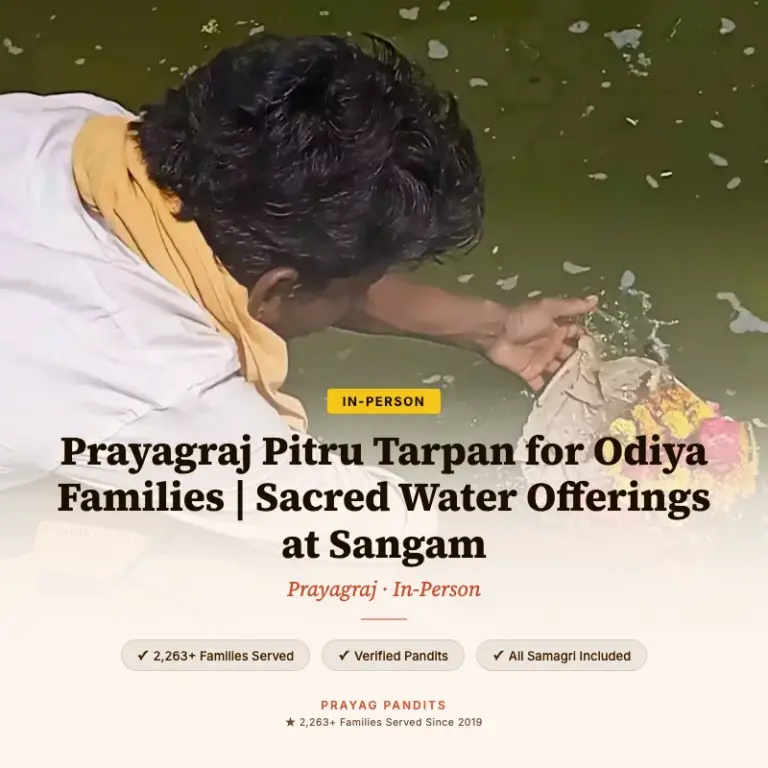 Save 39%
Tarpan in Allahabad
Prayagraj Pitru Tarpan for Odiya Families
Odia Vidhi Ceremony Pitru Tarpan at Triveni Sangam (Tila-tarpan with Gangajal) Complete...
from
₹10,999
₹17,999
Three handfuls where Ganga meets Yamuna,
on the confluence the Puranas call Tirtharaj.
Tarpan at the Triveni Sangam — the confluence of Ganga, Yamuna, and the mystic Saraswati that the Padma Purana names Tirtharaj, the King of Tirthas. Three handfuls offered with darbha twigs in three directions per Baudhayana. Daily, through Pitrupaksha (Sep 26 — Oct 10, 2026), and on the annual Tithi.

Tell us your situation — we will suggest the package that fits the family. No booking pressure; we will explain the choice on WhatsApp first if needed.
Every package includes an experienced Vedic pandit and the required puja samagri. The difference is in boat, location, stay, and tradition.
Save 39%
Odia Vidhi Ceremony Pitru Tarpan at Triveni Sangam (Tila-tarpan with Gangajal) Complete...
 Save 43%
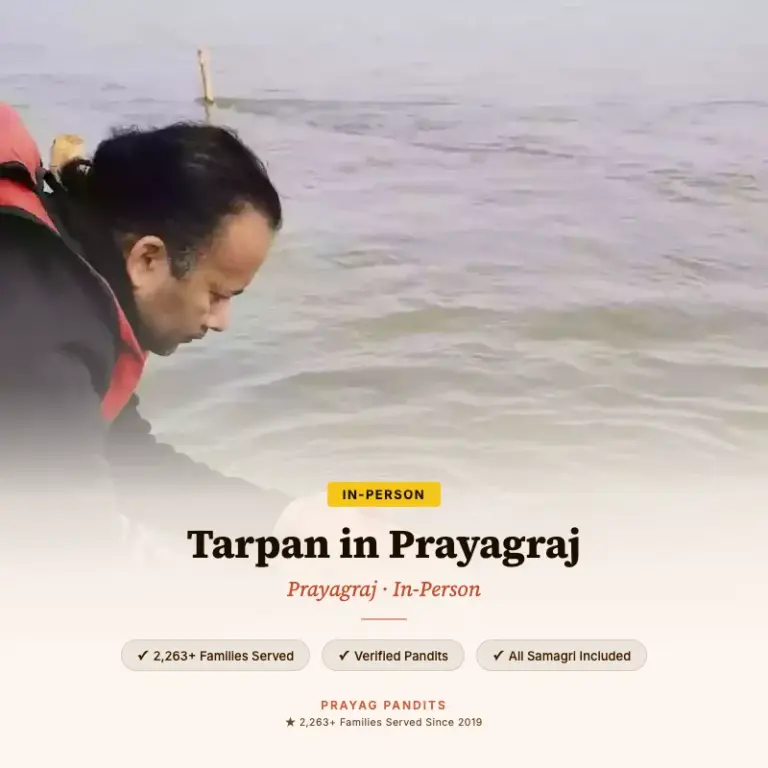
Tarpan at Triveni Sangam, Prayagraj Experienced Prayagraj-based pandit All samagri (sesame, kusha,...
No packages match this filter. Talk to a family advisor →
What's included
We've seen too many families face hidden boat fees, samagri costs, and "dakshina" pressure on the day. Here's exactly what's covered, and what isn't.
Included
Vedic Tirth Purohit qualified in Sangam-tarpan vidhi, with gotra-pravara verified. Odia-vidhi variant available for Odisha families through our hereditary Odia Pandit lineage.
Included
Darbha (kusha) twigs, til, jau (barley), gangajal, kalash, white cloth — prepared in advance, ready before the family arrives at the boat or at the Sangam ghat.
Included
Optional upgrades: the Odia-vidhi tarpan variant (₹10,999) for Odisha families; private boat to the Sangam confluence point on request; combined tarpan + pind-daan + asthi-visarjan packages for families completing the full Prayagraj ancestral circuit.
Included
One person on WhatsApp through your entire booking — fluent in Hindi, English, and major regional languages — before and after the ceremony.
Included
WhatsApp message from the Tirth Purohit the same evening, with details of all tarpan offerings made on your behalf.
Included*
Tarpan at the Triveni Sangam confluence — the Puranas name this the Tirtharaj, the King of Tirthas. Directional facing (East for deva-tarpan, South for pitri-tarpan) and the prescribed anjali count are observed per Baudhayana; the karta stands or sits on the boat at the confluence point.
Not included
Train, flight, or road travel. Prayagraj Junction + Bamrauli airport well-connected; we can recommend trusted operators.
Not included*
Not bundled with the base packages; stay-inclusive bundles available on request.
Not included
Tarpan packages cover the water-libation rite only. For the full Pind Daan offering at the Sangam, see /pind-daan-in-prayagraj/. Combined tarpan + pind-daan packages available on request.
Step 03 · How it works
From your first call to same-day confirmation — we handle every coordination, so the family can focus on what matters.
Choose a package and complete payment online. Our team calls within 2 hours to confirm details.
~ 5 minutes
Provide gotra, names of departed ancestors (up to three generations), preferred date — the annual Tithi or a Pitrupaksha day — and any special vidhi requirements (Odia families: please specify Odia-vidhi).
~ 10 minutes
Tirth Purohit performs the complete tarpan vidhi at the Triveni Sangam — Sankalp, then water libation with darbha twigs for the deva-tarpan facing East, rishi-tarpan, and pitri-tarpan facing South. Boat ride to the confluence point arranged where the package includes it.
60–120 min
Tirth Purohit sends a same-evening WhatsApp confirmation with offerings detail. Photos and video available as opt-in add-ons.
Same day
When to perform
Tarpan is a nitya-karma — the Manusmriti, in its Pitri-yajna section, names tarpan one of the five mahayajnas every householder performs daily after the morning bath. At Prayagraj, the rite intensifies: the Padma, Skanda, and Matsya Puranas name the Triveni Sangam — the confluence of Ganga, Yamuna, and the mystic Saraswati — as Tirtharaj, the King of Tirthas, and the Mahabharata Vana Parva names Sangam tarpan as the most meritorious of pitru-rites. Pitrupaksha (Sep 26 → Oct 10, 2026) is the peak fortnight, with Sarva Pitru Amavasya (Mahalaya) as the universal-ancestors day. The annual death-anniversary Tithi is the lifelong family obligation; tarpan at the Sangam is valid year-round.
Performed by Tirth Purohits at Triveni Sangam since 2019
Two ways to perform
Performed by your own hands at the Triveni Sangam under a Tirth Purohit — boat ride to the confluence point where the package includes it. Sankalp, then tarpan in three directions with the prescribed darbha twigs and anjali count per Baudhayana.
Starts at ₹5,100
Tarpan performed in the Odia-tradition vidhi by a hereditary Odia Pandit lineage at the Sangam. Sankalp, mantras, and the offering sequence follow the Odia-shradh convention familiar to families from Odisha. Includes all samagri and the boat ride.
Starts at ₹10,999
Complete guide
An editorial reference covering the ritual, the place, eligibility, timing, and what to keep ready — written for families weighing the decision.
Select your package and complete booking. Our team calls within 2 hours to confirm details.
Provide your gotra, departed soul's name, and any special requirements.
Experienced pandit performs the complete ceremony at the sacred site.
The family receives ceremony updates on WhatsApp after completion.
The Baudhayana Dharmasutra prescribes the procedure: stand in the river until the water level reaches the navel, or sit on the boat at the confluence point. Face East for the deva-tarpan (offerings to the deities); face South for the pitri-tarpan (offerings to the departed ancestors). Tarpan to the deities is offered with the tips of the fingers, to the sages with the base of the little finger and the third finger, and to the pitris with the middle of the thumb and the first finger. The darbha (dried kusha grass twig) is used in three different forms: the tip alone for deva-tarpan, folded in half for rishi-tarpan, and tip-and-root for pitri-tarpan. Anjali count — one handful for each deity, two for each sage, three for each ancestor; three handfuls each for matrutrayi (mother, grandmother, great-grandmother), one for the other female ancestors.
Tarpan is valid at any river ghat per Baudhayana — every Brahmin householder offers daily tarpan after the morning bath as one of the five mahayajnas. But at Prayagraj, the rite intensifies through the Sangam Mahatmya. The Padma, Skanda, and Matsya Puranas all name the Triveni Sangam — the confluence of Ganga, Yamuna, and the mystic Saraswati — as Tirtharaj, the King of Tirthas; the Mahabharata Vana Parva, in its Tirthayatra section, names Sangam-tarpan among the most meritorious of pitru-rites. The confluence itself adds a unique dimension: three rivers in one offering, mirroring the three classes (deva, rishi, pitri) of the tarpan rite.
The eldest son holds the first authority to conduct tarpan to the ancestors as part of his shradh-karma obligation. After marriage, the son performs tarpan with his wife. If the eldest son is deceased, the younger son carries out tarpan, pind-daan, and shradh karma. In the absence of a son, the grandson (son's son); in the absence of male issue from the deceased, the brother; if the departed had only daughters, the daughter's son holds the right. Women family members traditionally accompany the karta and can participate in the recitation; we coordinate the family-relation verification before the ceremony.
Tarpan is fundamentally a daily nitya-karma — Manusmriti chapter 3 lists it among the five mahayajnas every Brahmin householder performs after the morning bath. Beyond the daily obligation: (1) Pitrupaksha — the 16-day fortnight in Ashwina Krishna Paksha (Sep 26 — Oct 10, 2026), with Sarva Pitru Amavasya as the universal-ancestors closing day. (2) The annual death-anniversary Tithi — the karta's lifelong family obligation. (3) Monthly Amavasya — the recurring touchpoint. (4) Parvan Shraddha. The Mahabharata Vana Parva specifically commends Sangam-tarpan during the Kumbh / Magh Mela seasons when families gather at Prayagraj in greater numbers.
Three related but doctrinally distinct rites. Tarpan is the water-libation offered with darbha twigs and the prescribed anjali count — performed daily by every householder, with peak intensity at the Sangam during Pitrupaksha. Pind Daan is the specific pinda-offering — rice-flour balls offered with mantras at the Sangam ghats. Shradh is the broader institution combining tarpan + dakshina + Brahmin bhojan + (in Pitrupaksha) pinda offering. Tarpan can be performed standalone as the daily rite; shradh requires Brahmin bhojan as its sustaining component. Combined tarpan + pind-daan + asthi-visarjan packages for families completing the full Prayagraj ancestral circuit are available on request.
Families from Odisha hold a hereditary tradition of performing tarpan in the Odia-shradh vidhi — a procedural variant in which the Sankalp, mantras, and offering sequence follow the Odia regional convention rather than the standard north-Indian Vedic form. The doctrinal substance is the same — Baudhayana procedure, three-direction tarpan, prescribed anjali count — but the surrounding ceremonial wording and the offering sequence honour the Odia tradition. We coordinate this through our hereditary Odia Pandit lineage. The Odia-vidhi package is offered at ₹10,999 with sacred water offerings at the Sangam confluence.
Yes — the full Prayagraj ancestral circuit. Tarpan is the daily / annual water-libation; Pind Daan is the pinda offering at the Sangam ghats (see /pind-daan-in-prayagraj/); Asthi Visarjan is the immersion of cremation ashes in the confluence (see /asthi-visarjan-in-prayagraj/). Many families bring the asthi-kalash for visarjan at the Sangam, perform pind-daan for the soul's release, and offer tarpan to all preceding ancestors — all in a single 1-2 day visit. We coordinate combined packages on request; pricing depends on the rite-mix selected. The Padma Purana describes Prayagraj as the Tirtharaj where the full Pitri-yajna can be completed in a single visit.
The darbha (dried kusha grass twig) is the prescribed medium for water-libation per the Baudhayana Dharmasutra. The three forms — tip alone for the deities (deva-tarpan), folded in half for the sages (rishi-tarpan), and tip-and-root for the ancestors (pitri-tarpan) — physically distinguish the three offerings even when performed in sequence. The grass acts as a conductor between the karta's hand and the recipient lokas; per shastra tradition, water poured without the darbha is incomplete tarpan. Our packages include all the required darbha twigs prepared in advance before the family arrives at the Sangam.
Drawn from puranic references and pandit consultations — for families who want to understand the ritual's meaning before booking.
Voices from families
We booked this for our grandfather's annual shradh. The ceremony was performed with great reverence. Pandit ji even shared stories from the Garuda Purana which were very enlightening for the younger generation.
First time booking online for a religious ceremony. Was skeptical but the service exceeded expectations.
Booked for my mother-in-law's shradh. The entire ceremony was conducted with great reverence. Thank you.
My family performed Pind Daan through Prayag Pandits and it was a deeply spiritual experience. The location was serene and the pandit's chanting was beautiful. We felt connected to our ancestors throughout the ceremony. Om Shanti.
We are NRI family based in USA. We booked online poojan and it was conducted very sincerely. The video quality was good and we could see everything clearly. The team sent us photos and videos after the ceremony too. Om Shanti.
First time performing Pind Daan and was nervous about the process. But the team guided us well. They explained what to wear, what to bring, and what mantras to recite. Everything went smoothly.
Frequently asked
Compiled from 2,263+ family conversations on WhatsApp and over the phone.
Tarpan is the sacred Hindu ritual of offering water, typically mixed with black sesame seeds (til) and barley (jau), to gratify deities, sages, and primarily, departed ancestors (Pitrus). Performing Tarpan in Prayagraj holds exceptional significance because it is done at the Triveni Sangam, the holy confluence of the Ganga, Yamuna, and the mystical Saraswati rivers. This location is revered as 'Tirtharaj' (King of Pilgrimage Sites), making the offerings immensely potent for ancestral peace and liberation (Moksha).
The primary and most auspicious location is the Triveni Sangam itself – the actual point of confluence of the Ganga, Yamuna, and Saraswati. Devotees usually hire boats from nearby ghats (like Kila Ghat, Saraswati Ghat, Ram Ghat) to reach the Sangam point in the middle of the river, where priests (Prayagwals) conduct the Tarpan ritual from the boat. Rites can also be performed at the ghats along the banks.
Costs vary. Tarpan alone might cost INR 1000-3000. However, it's usually part of Pind Daan. Basic Pind Daan packages at Prayagraj (including Tarpan) often range from INR 4000-7000. More elaborate ceremonies can cost INR 11,000 - 21,000 or more. Crucially, boat charges to reach the Sangam (around INR 300-1500 depending on duration/boat type) might be separate or included in the package, so clarification is essential. Online platforms offer packages in similar ranges (e.g., INR 5100+ for Tarpan, INR 7100+ for Pind Daan). Agree on the Dakshina and inclusions beforehand
Usually, the performer (Karta) and their family hire a boat with a Prayagwal Panda (priest). After reaching the Sangam point and often taking a purificatory dip, the Karta, facing south, follows the Panda's guidance. Using Kusha grass, they offer water from the Sangam (mixed with black sesame, barley) from their palms while chanting mantras and invoking the names and gotra of ancestors. The offering is poured directly into the confluence
While traditionally a male duty, societal views are evolving. Women (daughters, wives, daughters-in-law) increasingly participate actively alongside male relatives. Some Prayagwal Pandas facilitate women performing the main rites, especially if no male heir is available, sometimes with minor variations (like using white sesame). The inclusivity often seen during Kumbh Melas further supports participation
Performing Tarpan at the Triveni Sangam is believed to grant unique and amplified benefits:
Tarpan is an indispensable part of the Pind Daan and Shraddha ceremonies performed at Prayagraj. If Pind Daan is done, Tarpan will be included. However, Tarpan (the water offering) can also be performed as a standalone ritual, particularly during daily practices or specific events like Pitru Paksha or Magh Mela, without the full Pind Daan (food offering) ceremony
Free consultation
We’ll listen, understand your family’s situation, and recommend the right package — never push. Reply within 10 minutes on WhatsApp, every day.