Key Takeaways
- Pitru rin — the debt we are born with
- What the rite actually does: preta to pitru
- What a pinda is made of
- Pind daan, shradh and tarpan are not the same thing
In This Article
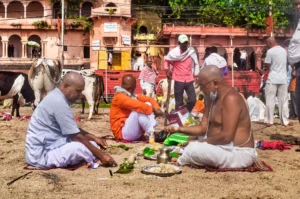
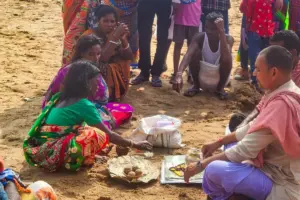
Pind Daan is the Hindu rite of offering pindas — balls of cooked rice kneaded with sesame, milk, honey and ghee — to the departed, so the soul passes from the restless state of a preta to the settled state of a pitru. It is the central act of all ancestral rites. The word pinda means a rounded body, and daan means giving: together, the giving of a body of nourishment to one who no longer has one.
Three pindas are offered in the standard rite, for the father, grandfather and great-grandfather. It is performed most powerfully at Gaya, and during Pitru Paksha above any other time of year. Packages start at ₹7,100 at the major tirthas, and group rites at Gaya from ₹751. This guide covers what it means, what the scriptures say, who may perform it, how it is done and what it costs.
Pitru rin — the debt we are born with
Hindu philosophy holds that every person is born carrying three debts. Deva rin is owed to the gods, rishi rin to the sages who preserved knowledge, and pitru rin to the ancestors. Of the three, pitru rin is the most personal, because existence itself is owed to an unbroken chain of forebears.
Pind Daan is the principal means of discharging it. Performed with correct procedure, it is held to benefit not only the immediate departed — usually the father, grandfather and great-grandfather on the paternal side — but the whole lineage. The ancestors receive nourishment through the pinda, and in turn the family is held to be relieved of the obstruction known as pitru dosha.
What the rite actually does: preta to pitru
For the first year after death the soul is held to be a preta — in transit, without a settled body, and dependent on what the living offer. The Garuda Purana describes the ten pindas of the Dashagatra as building that subtle body limb by limb over ten days, and the sapindikarana rite at the end of the period as the moment the departed joins the company of the ancestors and becomes a pitru.
That transition is the whole purpose of Pind Daan. Everything after it — the annual shradh, the Pitru Paksha offerings — is maintenance of a relationship that this rite establishes. It is why families who have missed the rites for a generation are told to perform them now rather than conclude that the moment has passed: the shastras provide for late performance precisely because the obligation does not expire.
What a pinda is made of
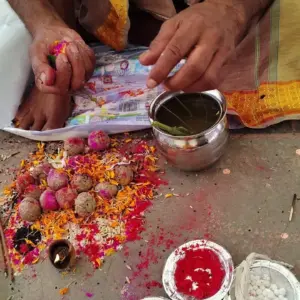
The base is cooked rice, or barley flour (yava) where rice is not used. To it are added black sesame, cow’s milk, honey and ghee, and the mixture is kneaded and formed into a rounded shape. The Garuda Purana treats the pinda as the subtle body of the ancestor: offered with the right mantras and intention, it supplies a body of sustenance to a soul that has lost its physical one.
Sesame carries particular weight. The Mahabharata’s Anushasana Parva singles out til as the offering most pleasing to the pitrs and as the element that purifies the rite. The full explanation of the pinda and its symbolism goes through each ingredient.
Pind daan, shradh and tarpan are not the same thing
The three terms are used interchangeably in everyday speech and they are not interchangeable.
- Shradh is the whole ceremony — everything offered to the ancestors with shraddha, faith. Tarpan, Pind Daan, Brahmin Bhojan and daan are all parts of it.
- Tarpan is the water offering. It satisfies the thirst of the ancestors and calls them to the rite, and it comes first.
- Pind Daan is the offering of the pindas themselves — the direct nourishment of the subtle body, and the central act.
Tarpan cleanses and invites, Pind Daan nourishes and releases, and Brahmin Bhojan — feeding a Brahmin afterwards — delivers the offering through a living channel. Taken together they complete the circuit. A family that performs only one of the three has done part of the duty, not all of it. Shradh dates and the Pitru Paksha calendar set out when each is done.
What the scriptures say
The Puranas
The Garuda Purana is the principal source: it describes the soul’s journey after death and the ten pindas of the Dashagatra that build the subtle body day by day. The Agni Purana and the Vayu Purana carry the Gayamahatmya, the passages that establish Gaya’s standing above every other tirtha for this rite.
Karna and the gold feast
No story has shaped popular understanding of Pind Daan more than Karna’s arrival in Svarga. Karna was called Daanveer, the supreme giver, because he refused no one who asked — he surrendered even the armour and earrings he was born with, knowing it would cost him his life. Yet when he reached Svarga he was served gold and jewels and nothing to eat. He asked Indra why a man who had given so much was offered no food. Indra’s answer was that in all his giving, Karna had never performed the rites for his ancestors — he had given gold, so gold was what he received.
Yudhishthira at Gaya
After the Kurukshetra war Yudhishthira travelled to Gaya to perform Pind Daan for everyone who had died in the eighteen days — hundreds of thousands of warriors from both sides, among them his own cousins and teachers. The Ashvamedhika and Shanti Parvas describe the pilgrimage as the closing act of his dharmic duty after the war. He offered pinda and tarpan at the Vishnupad and at the Falgu. That one journey settled Gaya’s standing: if the most righteous of kings chose it for rites on that scale, the question of the best tirtha was closed.
Bhishma on the bed of arrows
In the Anushasana Parva, Bhishma spends the fifty-eight days of his Sharashayyya transmitting dharma to Yudhishthira, and devotes a long passage to shraddha. He explains why the dark fortnight is more potent than the bright one and why Pitru Paksha eclipses every other period, why sesame is the offering most pleasing to the pitrs, and describes the seven categories of ancestral beings, each in its own realm and each needing its own ritual attention.
Who can perform pind daan
The eldest son is the foremost performer. Where there is no son, the rite passes to another male relative — a younger son, grandson, brother, nephew or son-in-law. Daughters perform it in a growing number of families and the shastras admit it; the purohits at Gaya and Prayagraj conduct the rite for daughters without qualification, and Gaya tradition holds that it was Sita who offered the pinda to Dasharatha at the Falgu.
Rites for ancestors who died unmarried or childless, for a mother, and for ancestors whose death tithi is unknown each have their own rules. Who is eligible to perform Pind Daan covers every case in detail, including whether it may be done while a parent is living.
When to perform it
Pitru Paksha is the most powerful window — the dark fortnight before Navratri, running 26 September to 10 October in 2026. The ancestors are held to be closest to the living world then and no sankalpa for a date is needed. The annual tithi of the death is the other principal occasion, observed each year as Varshik Shradh. Amavasya, the new moon of any month, serves where neither is possible, and a solar or lunar eclipse is traditionally regarded as potent. Families on a teertha yatra often perform it wherever the journey takes them.
The Shradh dates calendar gives the tithi-by-tithi schedule and tells you which day belongs to your ancestor.
Where it is performed
Gaya is the supreme site — the only tirtha where the rite is held to grant pitru mukti outright, performed at the Vishnupad temple and the Falgu. Prayagraj, the Tirtharaj, comes next, then Kashi. Badrinath’s Brahma Kapal carries the specific tradition that rites performed there complete pitru karma permanently.
The comparison of places for Pind Daan in India covers all of them with prices and travel notes. It can also be done at home, within limits — see Pind Daan at home.
The vidhi, step by step
- Sankalpa. The performer states his own name and gotra and those of the departed, and declares the intention of the rite.
- Preparation of the pindas. Rice is cooked and kneaded with til, milk, honey and ghee, and formed into the required number of balls.
- Avahana. The pitrs are invoked by name and gotra and invited to receive the offering. Kusha grass is laid to seat them.
- Samarpan. The pindas are offered with mantras, facing south, the direction of the ancestors.
- Tarpan. Water with til and kusha is offered to satisfy the ancestors’ thirst.
- Brahmana bhojanam. A Brahmin is fed, so that the offering reaches the pitrs through a living channel.
- Dakshina. The pandit receives his offering and the family asks the blessing of the ancestors.
Mantras and the number of offerings vary by region, community and gotra. The complete Pind Daan vidhi with mantras gives the full recitation.
How many pindas are offered
Three in the standard rite — for the father in his Vasu form, the grandfather as Rudra and the great-grandfather as Aditya. During the ten-day Dashagatra that follows a death, ten pindas are offered in sequence, each held by the Garuda Purana to build a specific part of the subtle body. During Pitru Paksha families offer anywhere from three to sixteen, depending on how many ancestors are being honoured. At Gaya the traditional circuit covers a far larger number of vedis; what your package includes is set out on the booking page.
What pind daan costs
| Where | Price | Note |
|---|---|---|
| Gaya — group rite, Ekadashi | ₹751 | Shared sankalpa on a fixed tithi |
| Gaya — group rite, Navami | ₹951 | Shared sankalpa on a fixed tithi |
| Gaya — group rite, Amavasya | ₹1,100 | Shared sankalpa on Sarva Pitru Amavasya |
| Gaya (Vishnupad and Falgu) | ₹7,100 | Individual sankalpa, own pandit |
| Prayagraj (Triveni Sangam) | ₹7,100 | Individual sankalpa, own pandit |
| Varanasi, Haridwar, Ujjain, Mathura, Ayodhya, Garh Mukteshwar | ₹7,100 | Individual sankalpa, own pandit |
| Badrinath (Brahma Kapal) | ₹10,999 | Pilgrimage season only |
The group rites at Gaya are a real option for families who cannot travel and do not need an individual sankalpa — the pandit performs on a fixed tithi for several families together. Everything above that is an individual rite with your own pandit and your own sankalpa.
🙏 Pind Daan at the Triveni Sangam
- Individual sankalpa in your ancestor's name
- Hereditary tirth purohit of the tirtha
- All samagri and pindas arranged
- Live video and a recording for families abroad
Can pind daan be done online?
Yes. The tradition provides for pratinidhi karma — rites performed by a qualified representative on behalf of someone who cannot be present. The pandit performs the complete vidhi at the tirtha, the sankalpa is taken in your name and your ancestor’s, and the family joins by video call. A recording and photographs follow. More than 2,263 families have booked through us since 2019, a large share of them from abroad. The guide for NRI families covers time zones, what to send and how booking works from outside India.
Common questions
Is pind daan done once or every year? The rites following a death are done once. Varshik Shradh on the annual tithi, and the Pitru Paksha offerings, continue every year.
What if the death tithi is not known? Sarva Pitru Amavasya, the last day of Pitru Paksha, exists precisely for ancestors whose tithi is unknown or who have been forgotten. More on this.
Does an unnatural death change the procedure? It can. Narayan Bali or a related rite may be advised before Pind Daan. See the guidance for Gaya.
What about the ashes? Asthi Visarjan is a separate rite performed before or alongside this one. See the complete Asthi Visarjan guide.
Book Your Sacred Ritual
Authentic ceremonies performed by Veda-trained pandits at sacred sites across India.