Key Takeaways
- Which rites belong at home, and which do not
- What the texts actually sanction
- What to get right at home
- When home is not the right answer
In This Article
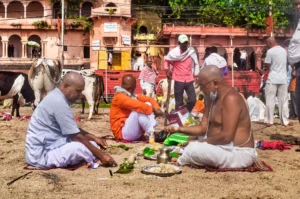
Yes. Pind daan can be performed at home, and for most of the rites in the ancestral calendar it is the ordinary place to perform them. The householder’s own hearth is where the Dharmashastra expects most of this to happen. What a home rite cannot do is replace the specific journeys the tradition singles out — Gaya above all — and the honest answer separates the two.
Which rites belong at home, and which do not
| Rite | At home? | What applies |
|---|---|---|
| Annual shradh on the death tithi | Yes | The normal place for it. A family pandit recites; most households keep this at home every year without question |
| Tarpan | Yes | Daily or on amavasya, and the lightest of all of them. Water with black sesame, which needs no ghat |
| Masik shradh, through the first year | Yes | Twelve of them. Nobody is expected to travel monthly |
| Barsi, the first anniversary | Yes | Kept at home by many families. A tirtha is the stronger option where the death was difficult or relatives are travelling in |
| Pitru Paksha offerings | Yes | Tarpan and pinda at home are valid and widely done. A tirtha multiplies it rather than being required |
| Gaya pind daan | No | The whole point is the place. There is no home equivalent of the Vishnupad rite |
| Asthi visarjan | No | Needs a sacred river. Where travel is impossible the ashes are couriered and the rite performed on your behalf |
| Narayan Bali | No | Three days and five qualified brahmins reciting simultaneously. It cannot be shortened into a home puja |
The pattern is straightforward once stated. The recurring rites — the ones a family keeps year after year — belong at home. The one-time rites tied to a particular place or needing several trained pandits do not.
What the texts actually sanction
The Grihya Sutras — the manuals of domestic ritual — are built around rites performed in the house. Ancestral offerings are among them, and the grihastha, the householder, is the person they address. The sacred domestic fire, the family deities, the hearth: the home is the primary field in which this dharma is practised, not a fallback from it.
The Puranas praise shradh at a tirtha in strong terms, and that is also true. Both things hold at once: the home is where most of it happens, and certain places multiply what is offered. The guide to pind daan covers the second half of that; this page is about the first.
What to get right at home
Five things, and none of them is the quantity of anything.
- The space. Clean the area thoroughly, ideally a spot on the ground or a low platform rather than a table. Face south for the offering. The place should not be a kitchen or a bedroom.
- Yourself. Bathe beforehand, wear undyed or plain cloth, and keep the fast until the rite is complete. Where illness or age makes fasting a health risk, the texts allow a light meal of rice and milk if the deviation is declared in the sankalpa — do not put an elderly karta through it unnecessarily.
- The sankalpa and the mantras. This is the part families get wrong alone, and it is why a pandit is worth having even at home. The gotra must be right and the sankalpa must name the ancestor properly. The full sequence is in the pind daan vidhi.
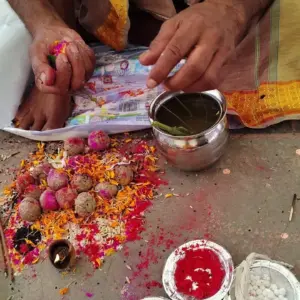
- The samagri. Cooked rice or barley, black sesame, ghee, honey, milk, kusha grass, white flowers, white sandalwood. How to make the pinda has the method.
- A qualified purohit. Not strictly required for tarpan, which a karta can learn. For a full shradh with pinda, invite one. A family pandit who knows your kula’s practice is better than a stranger who knows the generic form.
When home is not the right answer
Four situations where we would tell you to travel, or to have the rite performed on your behalf, rather than keep it at home:
- The ashes have never been immersed. Asthi visarjan needs the river. Everything after it assumes it is done.
- The death was unnatural — accident, suicide, snakebite, or the last rites were never performed. That calls for Narayan Bali, which is a three-day rite with five reciters and cannot be compressed.
- Annual shradh has lapsed for three years or more. The rite for that is tripindi shradh, performed at a tirtha.
- Nobody in the household can perform it — no eligible relative able to travel or to officiate. A purohit performs it in the family’s name, and that is provided for explicitly rather than being a modern convenience.
Performing it for yourself
People ask this about themselves more often than you would expect, and the answer is yes. The Garuda Purana describes jeeva shradh — a person performing their own shradh while alive — and offers it particularly to those who are childless or who have reason to think the rites will not be performed afterwards. Pind daan for unmarried or childless ancestors covers the wider case, and atma pind daan the specific one.
It is not morbid and we do not treat it as such. People usually come to it in their seventies, often after a sibling has died, and they describe afterwards the same relief families describe after performing the rite for someone else.
During Pitru Paksha — what you may and may not do
A question that arrives here often and that this page never answered: can you carry on with ordinary worship during the fortnight? Yes. Daily puja continues, temple visits continue, and the family deities are not set aside. Pitru Paksha is not a period of impurity in the way the days after a death are — it is a period in which the ancestors are held to be near and the offerings owed to them take priority.
What is customarily avoided is the auspicious and new rather than the devotional: weddings and engagements, housewarmings, buying a vehicle or a property, starting a business, and new clothes or jewellery. Many families also keep a simpler diet and avoid onion, garlic, meat and alcohol for the fortnight. These are observances of custom and regional strictness varies considerably — a Maharashtrian household and a Bengali one will not draw the line in the same place.
🙏 Pind Daan at the Triveni Sangam
- For the rites a home ceremony cannot cover — Gaya, asthi visarjan, lapsed years
- All samagri, ghat booking and dakshina included, settled before you travel
- Gotra and sankalpa confirmed with you beforehand
- Performed in your name with a live video link if you cannot come
If you are unsure which rite your family owes, or whether what you have been keeping at home is sufficient, tell us the circumstances. A pandit will say plainly — including when the answer is that you need nothing from us and should carry on as you are.
Book Your Sacred Ritual
Authentic ceremonies performed by Veda-trained pandits at sacred sites across India.