Key Takeaways
- What goes into a pinda
- How to make one
- What size, and how many
- Why black sesame matters more than the rest
In This Article
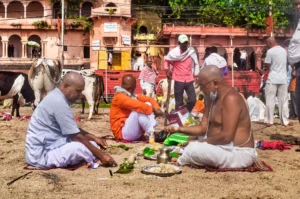
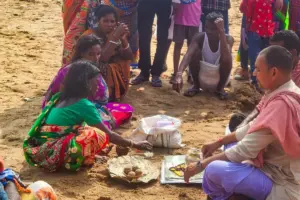
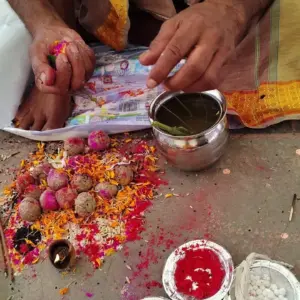
A pinda is a ball of cooked rice — or barley flour where rice is impractical — mixed with black sesame, ghee, honey and a little milk, and offered to the ancestors during shradh. In English it is usually rendered as a rice ball, though that undersells it: the pinda stands in for a body, and each ingredient is there for a stated reason rather than for flavour. This page covers what goes in, how to make one, and what it represents.
What goes into a pinda
| Ingredient | Role | Why it is used |
|---|---|---|
| Cooked rice, or barley flour | The body | Anna — food itself, the first thing the departed is held to need. Rice is the staple and the preferred form at a tirtha; barley is the older grain, named throughout the Vedas, and carries associations of austerity and purification |
| Black sesame (kala til) | Protector | The one ingredient with no substitute. Traced to Vishnu’s own body, dear to the pitrs, and held to turn away whatever would interfere with the offering. White sesame belongs to deva rites and will not do here |
| Water | Binder | Binds the ball and stands for purification and the quenching of thirst |
| Milk | Binder | Cow’s milk, and the Manusmriti specifies a cow with a living calf. Softens the offering and carries the sense of care given in infancy |
| Ghee | Carrier | The purest substance in the Vedic scheme and the medium of every fire offering. Stands for light and sacrifice, and is held to carry the offering upward |
| Honey or jaggery | Sweetener | Makes the offering pleasant. The wish encoded is that the journey be smooth rather than bitter |
| Kusha grass | The seat | Not in the pinda but under it — three blades with roots intact, tips pointing south, laid before the pinda is placed |
Regional and family variation is real. Some lines use barley where others use rice, some add tulsi, some leave out honey. What does not vary is the black sesame.
How to make one
Plenty of people arrive here looking for the method rather than the meaning, so here it is plainly. There is no fixed weight in the texts — what is prescribed is the size, which varies by which rite you are performing, and the proportions follow from that.
- Cook the rice plain. No salt, no oil, no spice, no tempering. Cook it soft enough to mash, slightly wetter than you would eat. Where you are using barley flour instead, work it with water into a firm dough.
- Let it cool enough to handle, then mash it smooth. Lumps make a ball that will not hold.
- Work in the black sesame, ghee, honey and a little milk — sesame generously, the rest enough to bind and sweeten without making the mixture wet. The ball must hold its shape in the hand without weeping.
- Roll it round and even. The Garuda Purana’s word is kapitthasama, like a wood apple: a natural sphere, not a flattened disc and not drawn out into an oval. Roll it between the palms rather than pressing it.
- Make one for each ancestor being named, to the size that rite calls for, and set them on the kusha grass rather than on a plate.
Prepare them fresh on the day. The texts treat food more than about three hours old as unfit for shradh, and that applies to the pinda as much as to the meal. Everything — the cooking, the mixing, the rolling — is done by someone in a state of ritual cleanliness, and the preparation counts as part of the ceremony rather than as catering for it.
What size, and how many
Size is prescribed by which shradh you are performing — a wood apple for ekoddishta or sapindikarana, a coconut for the monthly and annual rites, a hen’s egg at a tirtha, an amla for Pitru Paksha and Gaya. The sources and the full list are in the pind daan vidhi, along with the ten steps and the mantra for each.
On number: three pindas are prepared for each line being honoured — the father, the paternal grandfather and the paternal great-grandfather. That triad is the point rather than an arbitrary count: the offering addresses three generations, which is the span the Dharmashastra treats as sharing the pinda, and the word sapinda means exactly that, those who share it. Where the maternal line is included too, as at Matru Navami, three more are made for the mother’s side.
Why black sesame matters more than the rest
Every other ingredient has a substitute or a regional variant. Black sesame does not, and it is worth understanding why the texts are so firm about it.
The tradition traces til to Vishnu’s own body — accounts differ on the occasion, some placing it at the churning of the ocean and others during the Varaha avatar, and the shared point in all of them is the origin rather than the episode. What follows from that origin is a cluster of properties the texts assign to it: it pleases the pitrs and brings them tripti, satisfaction; it turns away whatever would interfere with the offering; it is held to be pleasing to Yama, and so bound up with safe passage; and it stands for the continuity of the line.
The practical consequence is the one to remember: black, not white. White sesame is used in deva rites. Substituting it is the single most common error in simplified ceremonies, and it is why we tell families gathering their own samagri to check this item above all the others. The same seed is what makes tarpan effective — water offered with til, which is why the two rites always appear together.
What the offering represents
Four things are happening at once when a pinda is offered, and the tradition does not rank them.
- Sustenance. The departed is held to be dependent on offerings made by the living, and the pinda is the form that takes.
- A body to travel in. The ten pindas of the first ten days build the subtle form the soul moves in, which is why they are offered in sequence and not all at once.
- Discharge of a debt. Pitru rina is one of the three debts the Dharmashastra holds every person is born carrying. Pind daan is how it is paid.
- Remembrance. The plainest of the four and the one families feel most. The sankalpa says the ancestor’s name aloud, sometimes a name nobody in the room ever heard spoken by someone who knew them.
The round shape carries the same idea as the rest — completeness, and a cycle that closes. A sphere has no beginning you can point at.
When and where pindas are offered
In the thirteen days after a death, monthly through the first year, at the barsi, on the ancestor’s tithi each year after that, and through Pitru Paksha — above all on Sarva Pitru Amavasya, which accepts offerings for any ancestor whatever their tithi.
Pindas can be offered at home. At a tirtha they are immersed in the river afterwards, at the Sangam at Prayagraj or into the Falgu at Gaya, and the tradition holds that offerings at Gaya reach generations rather than one named ancestor — which is why families who will make one journey make it there.
🙏 Pind Daan at the Triveni Sangam
- Every item of samagri sourced and prepared, kusha cut that morning
- The full ten-step vidhi with a Teerth Purohit — two to four hours
- Gotra and sankalpa confirmed with you before the day
- Also at Gaya, and online with a live video link for families abroad
If you are preparing to perform the rite yourself, the complete vidhi with every mantra is the page to work from, and why sesame and rice balls specifically covers the question this page opened with in short form.
Book Your Sacred Ritual
Authentic ceremonies performed by Veda-trained pandits at sacred sites across India.