
Veda-Trained Pandits
Experienced pandits guide the ceremony with care for your family’s tradition.
Multi-day pooja
Original price was: ₹78,000.00.₹71,000.00Current price is: ₹71,000.00.
Per pooja · 7 consecutive days
Applicable taxes are shown in your booking. Optional additions are separate.
Exclusions
Thoughtfully arranged, personally guided
Experienced pandits guide the ceremony with care for your family’s tradition.
Stay in touch with our team for your booking details and ceremony arrangements.
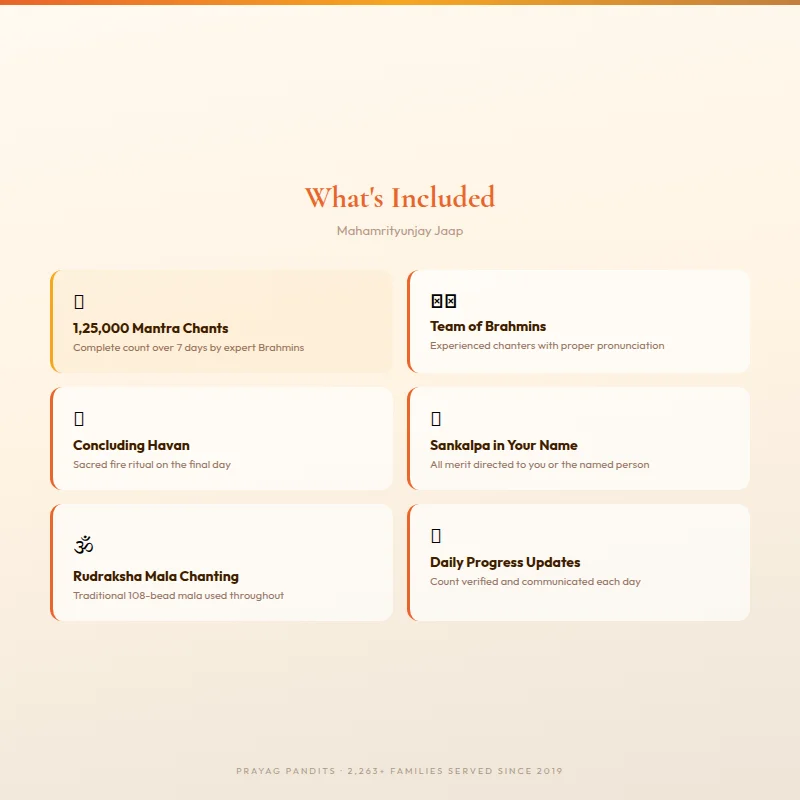
See what your selected package includes. Optional additions are shown separately.
Share the date and timing that suit you. Our team confirms the final arrangements.
Experiences shared by our families
25 family reviews17 for this pooja · 8 from across our services
Good service by Prayag Pandits. The booking was easy and the team was responsive. The pandit was well versed and performed the poojan with sincerity. Would definitely use their services again.
प्रयाग पंडित्स की सेवा बहुत बढ़िया है। समय पर सब arrangements हो गए। धन्यवाद।
पंडित जी ने बहुत अच्छे से समझाया और पूजा करवाई। परिवार को बहुत शांति मिली।
Very satisfied with the service. The pandit arrived on time and had all the materials ready. The ceremony was conducted as per proper Vedic traditions. The team followed up after the poojan as well. 🙏
खूप छान सेवा. पंडितजींनी सर्व विधी व्यवस्थित केली. अतिशय समाधानी आहे.
हमने अपने पिताजी के लिए यह पूजा करवाई। सब कुछ बहुत अच्छे से हुआ। पंडित जी बहुत अनुभवी थे।
बहुत ही professional और भक्तिपूर्ण सेवा। सारी सामग्री included थी। Recommend करता हूँ।
The coordination was excellent. We received all details well in advance. The puja was performed exactly as described.
We came from Delhi specifically for this puja. The whole process was smooth and the pandit ji guided us patiently. Highly recommend.
Booked this for my late father. Everything was arranged perfectly. The team was professional and respectful throughout.
Booked this service on recommendation from a friend. Was not disappointed at all. The entire process from booking to ceremony completion was smooth. The pandit was very experienced.
प्रयाग पंडित्स की सेवा से पूर्णतया संतुष्ट हूँ। उनकी टीम बहुत पेशेवर है और पंडित जी का ज्ञान गहन है। दूसरों को भी सिफारिश करूँगा। Jai Shri Ram.
We have used Prayag Pandits twice now for different ceremonies. Both times the service was excellent. The team remembers returning customers and gives personal attention. Highly recommended.
हमारे परिवार ने पहली बार ऑनलाइन पूजा करवाई। शुरू में थोड़ा संशय था लेकिन अनुभव बहुत अच्छा रहा। वीडियो कॉल की गुणवत्ता अच्छी थी और पंडित जी ने हमें पूजा में शामिल किया।
Simple booking process. Good communication on WhatsApp. The pandit was punctual and well prepared. The ceremony was performed with devotion. Fair pricing. Would recommend to anyone looking for authentic poojan services.
Simple booking process. Good communication on WhatsApp. The pandit was punctual and well prepared. The ceremony was performed with devotion. Fair pricing. Would recommend to anyone looking for authentic poojan services. Jai Shri Ram.
प्रयाग पंडित्स की सेवा से पूर्णतया संतुष्ट हूँ। उनकी टीम बहुत पेशेवर है और पंडित जी का ज्ञान गहन है। दूसरों को भी सिफारिश करूँगा।
Watching the pandit perform the rituals in real-time by the Falgu River, mentioning my father's name... it felt like we were truly there. Immense gratitude to the entire team.
Being in the USA, travelling to India just for Tarpan during Pitru Paksha was becoming very difficult. Prayag Pandits offered a well-coordinated solution.
I was skeptical about performing such a sacred ritual online from Canada. But honouring my parents in Kashi was important. They were very patient and answered all my questions.
Living in Singapore, we felt disconnected from these essential rituals. The live stream option for Tarpan at Prayagraj gave us a profound sense of connection and peace.
It was deeply important for us in Australia that the rituals were performed correctly. The ceremony reflected the authenticity we sought and was performed by a knowledgeable priest.
The Pind Daan at Kashi was handled carefully, with the pandit following every step diligently. Very reassuring.
Arranging Asthi Visarjan from Bhubaneswar seemed complex, but Prayag Pandits made it seamless. The pandit called us before the ceremony to explain every step. Very professional.
During Pitru Paksha, we booked Shradh at Prayagraj. The coordination was flawless - from date selection to the pandit assignment. Our family felt at peace after the ceremony.
YOUR EXPERIENCE MATTERS
Tell us about your ceremony and the support you received. Your email address will stay private.
From your first choice to your booking
Review your package and any available additions, then add it to your booking.
Enter your contact details, preferred date and time. Add ancestral details if you wish.
Our team confirms the arrangements and shares your coordinator’s details 24 hours before the pooja.
Choose a preferred start date. Our team coordinates the daily sessions. Online participation is available on request.
There are moments in life when ordinary prayers feel insufficient — when a loved one is battling a life-threatening illness, when surgery after surgery has left a family exhausted and frightened, when a physician speaks cautiously and a family prays desperately. It is in precisely these moments that the ancient wisdom of the Vedas offers its most powerful remedy: the Mahamrityunjay Jaap.
Our 7-Day Mahamrityunjay Jaap is the most intensive form of this sacred puja offered at Prayagraj, the confluence where the Ganga, Yamuna, and invisible Saraswati meet. Over seven unbroken days, eleven experienced Vedic Brahmins chant the Mahamrityunjay Mantra a total of 1,25,000 times — following the precise Vedic count prescribed in classical texts for full Mrityu Nashak (death-conquering) efficacy. This is not a shortened or symbolic observance. It is the complete, unadulterated form of the ritual, performed exactly as the Rishis intended.
The mantra at the heart of this puja comes from the Rig Veda, Mandala 7, Sukta 59, verse 12 — composed by the great Rishi Vasishtha and addressed to Lord Shiva in his form as Tryambaka, the Three-Eyed Lord:
Om Tryambakam Yajamahe Sugandhim Pushti-Vardhanam
Urvarukamiva Bandhanan Mrityor Mukshiya Maamritat
The literal meaning of each phrase reveals the depth of this prayer. Tryambakam — we worship the three-eyed one, Shiva, whose third eye sees beyond the veil of illusion and death. Sugandhim — fragrant, full of divine grace. Pushti-Vardhanam — the nourisher of all living beings, the one who sustains life and health. Urvarukamiva Bandhanan — as a ripe cucumber is released effortlessly from its vine, so may we be released from the bonds of disease and suffering. Mrityor Mukshiya Maamritat — liberate us from death itself, not from immortality, but toward it.
This verse is also found in the Yajur Veda and forms the core of the Rudra hymns. Across thousands of years, it has been the mantra Rishis and Pandits have reached for in times of mortal crisis — because it speaks directly to the divine power over life and death.
In the tradition of Vedic puja, the concept of Purascharana — the prescribed number of repetitions required for a mantra to achieve full potency — is taken with complete seriousness. For the Mahamrityunjay Mantra, classical texts including the Sharada Tilaka Tantra and the practices codified in Rudra-related Agamas prescribe 1,25,000 repetitions for a complete Mrityu Nashak Purascharana.
This is the number at which the cumulative vibrational energy of the mantra reaches critical mass — where it ceases to be merely sound and becomes a living force. Eleven Brahmins chanting simultaneously across seven days is not merely about speed or convenience. In Vedic tradition, collective chanting generates a synergistic field of sacred sound that individual chanting cannot replicate. Each Brahmin reinforces the others. The resonance builds. By the seventh day, the puja space itself becomes charged with Shiva’s presence.
The 7-Day Mahamrityunjay Jaap is specifically meant for situations where the need is acute and the stakes are high. This is not an everyday puja — it is the ritual our ancestors prescribed for the gravest of circumstances. Over the years, we have performed this anushthana for families in the following situations:
When a family member is in the ICU, battling advanced cancer, facing organ failure, or dealing with a condition where medical prognosis is guarded — this is exactly the situation the Mahamrityunjay Jaap was designed for. The mantra’s power over Mrityu (death) is invoked in its most complete form here. Many families who have commissioned this puja during such crises report not just improvement in the patient’s condition but a visible shift in the atmosphere of hope and resolve around the patient. Whether one understands this as divine intervention or as the collective focused intention of eleven trained minds directed toward healing, the effect has been observed across cultures and centuries.
Surgery of any significant nature — cardiac procedures, organ transplants, neurosurgery, complex cancer operations — carries inherent risk. Commissioning the 7-Day Jaap before a scheduled surgery creates a powerful protective kavach (shield) around the patient. If performed after surgery during recovery, it is believed to accelerate healing and remove the Mrityu Dosha that may have been aggravated by the surgical intervention itself. Many families plan the timing of this puja to conclude just before or just after the surgery date.
In Vedic astrology, certain planetary configurations in a horoscope create Mrityu Yoga — combinations that indicate a heightened vulnerability to accidents, serious illness, or premature death during specific time periods. When a Jyotishi identifies such a yoga in a person’s Kundali, particularly during a dangerous Mahadasha or Antardasha, the 7-Day Mahamrityunjay Jaap with a 1,25,000 chant count is the standard prescribed remedy. The complete Purascharana count is considered essential for neutralizing a severe Mrityu Yoga rather than merely softening its effects.
Some families find themselves in a prolonged struggle — a condition that defies clear diagnosis, a treatment that should work but doesn’t, or a pattern of repeated health crises in the same household. In such cases, there is often a deeper karmic or doshic cause that modern medicine cannot address. This puja works on that level, purifying accumulated karmic debt (Pitru Dosha, Karma Dosha, or ancestral curses) that may be manifesting as persistent physical suffering in the current generation.
If a family has experienced multiple untimely or unexpected deaths — particularly young members of the family — or a pattern of serious accidents within a short span of time, the 7-Day Jaap is performed as a Shanti (peace ritual) to break this pattern. This is a deeply serious situation in Vedic understanding, and it requires the most complete form of the puja to be effective.
Understanding the sequence of events across seven days gives you a clear picture of exactly what happens during this anushthana:
The puja begins at Brahma Muhurta — the auspicious pre-dawn period between approximately 4:30 and 6:00 AM — with the Sankalpa. This is the formal sacred resolve in which the Lead Pandit takes the name of the yajamana, their gotra (lineage name), nakshatra, and the specific intention of the puja. Ganesh is invoked first as the remover of all obstacles. The Shivalinga is installed, consecrated with Panchopachara (five-fold worship), and the first session of Mahamrityunjay Mantra chanting begins immediately after. The eleven Brahmins sit in the prescribed formation, and the count begins.
Each day follows a structured rhythm. Morning chanting runs from Brahma Muhurta through mid-morning. A brief ritual pause at midday. An afternoon chanting session. An evening session timed to Pradosha — the auspicious period just after sunset that is particularly dear to Lord Shiva. Daily Rudrabhishek is performed with the full Shri Rudram recitation, keeping the energy of the puja continuously renewed and preventing any ritual stagnation. The combined sound of eleven voices reciting in Vedic svaras fills the space continuously through these hours.
The final day is the most intensive. The remaining chanting quota is completed in the morning session. Then the Havan begins — a precisely constructed fire ritual using a Vedic Havan Kund built to the specifications of the Kalpa Sutras. Each of the 12,500 ahutis is offered with Swaha at the end of the mantra, the sacred smoke carrying the accumulated puja energy upward as an offering to Lord Shiva. After the Havan, the Brahmins receive Brahmin Bhoj. The Poornahuti (final grand offering) marks the formal completion of the seven-day cycle. You receive the full documentation, Vibhuti from the Havan, and Prasad.
One of the most frequent questions we receive is: can this puja be performed on behalf of someone who is ill and cannot travel to Prayagraj? The answer is yes — and this is, in fact, the more common arrangement. The Sankalpa at the beginning of the puja formally establishes the yajamana’s identity. The puja’s benefits are directed to the named individual through this Sankalpa, regardless of their physical location.
Families outside India, NRI devotees, and patients who are hospitalized regularly commission this puja through us. You need only provide: the person’s full name, their father’s name, their gotra (family lineage name, provided by your family priest if not known), and their Rashi (moon sign) or nakshatra if known. We handle everything from that point forward.
The location where a puja is performed matters in Vedic tradition. The Matsya Purana explicitly states that any ritual performed at Prayag — at the Triveni Sangam — is equivalent to the same ritual performed a thousandfold elsewhere. The Sangam is not merely a confluence of rivers. It is considered a meeting point of divine forces, a tirtha of the highest order, where the veil between the human world and the divine is at its thinnest. Our Pandits have performed these pujas at this location for generations, and the accumulated sanctity of the site is itself a component of the ritual’s power.
The Mahamrityunjay Mantra’s power to conquer death is not a folk belief — it is stated explicitly in multiple authoritative texts. The Shiva Purana describes Lord Shiva as Mrityunjaya specifically because of this mantra’s capacity to invoke his protective and life-restoring aspect. The story of Sage Markandeya — who was fated to die at sixteen but was saved by his devotion to Shiva and this very mantra — is cited in both the Shiva Purana and the Skanda Purana as the definitive scriptural demonstration of the mantra’s efficacy.
The Rudrashtadhyayi — the eight-chapter collection of Vedic hymns to Rudra — which includes the Shri Rudram and the Mahamrityunjay Mantra, is considered the most sacred Shiva-related text in the Vedic canon. Our Brahmins are trained in the correct recitation of these texts including the Vedic pitch accents (Udatta, Anudatta, Svarita) that are essential for proper mantric effect.
If you are also considering complementary rituals alongside this jaap, you may find the following services relevant:
Contact us with the following information: the full name of the person for whom the puja is to be performed, their father’s name, their gotra, their Rashi or nakshatra, and the specific reason or intention for the puja. Once we receive this, our Pandits will conduct a brief astrological check to confirm the most auspicious start date for the 7-day cycle. We typically require 5 to 7 days of advance notice to source the Samagri and arrange all eleven Brahmins.
Yes. The Sankalpa at the beginning formally establishes the connection between the ritual and the yajamana regardless of physical distance. You provide the person’s name, gotra, and intention.This is a common arrangement for our NRI clients and families with hospitalized patients who cannot travel.
For the specific purposes this 7-day package addresses — critical illness, Mrityu Yoga, severe doshic conditions — the 1,25,000 count is the complete Purascharana count prescribed in traditional texts for a full Mrityu Nashak anushthana. A reduced count is appropriate for different, less acute intentions, which is why we offer shorter-duration packages. For the situations described here, we do not recommend reducing the count.
The family members for whom the puja is performed are encouraged to maintain a Sattvic diet — vegetarian, simple foods without onion or garlic if possible — and to refrain from consuming alcohol or non-vegetarian food during the seven days. However, these are guidance for those who can follow them, not absolute requirements, particularly for patients who are ill. The Pandits observe all necessary ritual restrictions on your behalf regardless of what you are able to do on your end.
The Mahamrityunjay Mantra, like all Vedic mantras, carries specific tonal accents — Udatta (high pitch), Anudatta (low pitch), and Svarita (falling pitch) — that must be pronounced correctly throughout recitation. A pandit trained only in Puranic or general Sanskrit recitation may not know these accent patterns, and their recitation would lack the precise vibrational quality that makes the mantra effective. Our Pandits have trained in Shukla Yajurveda and Rudra-patha through Guru-shishya lineages, ensuring technically correct pronunciation across all 1,25,000 repetitions.
You are most welcome to attend, and many families do travel to Prayagraj for this puja — particularly for the final day’s Maha Havan. If you plan to attend, inform us in advance so we can arrange your formal participation in the Sankalpa and the concluding rituals. Attending in person adds a powerful personal dimension to the puja and is spiritually significant in its own right.
We select the start date based on the auspiciousness of the lunar phase and day of the week. Shukla Paksha (the bright fortnight leading up to Purnima) is generally preferred. Pradosha days, Chaturdashi, and Monday — all especially sacred to Lord Shiva — are ideal starting points. We will advise you on the best available date within your scheduling constraints and needs.