

Veda-Trained Pandits
Experienced pandits guide the ceremony with care for your family’s tradition.
Online pooja
Original price was: ₹31,000.00.₹21,000.00Current price is: ₹21,000.00.
Per pooja
Applicable taxes are shown in your booking. Optional additions are separate.
Exclusions
Thoughtfully arranged, personally guided
Experienced pandits guide the ceremony with care for your family’s tradition.
Stay in touch with our team for your booking details and ceremony arrangements.
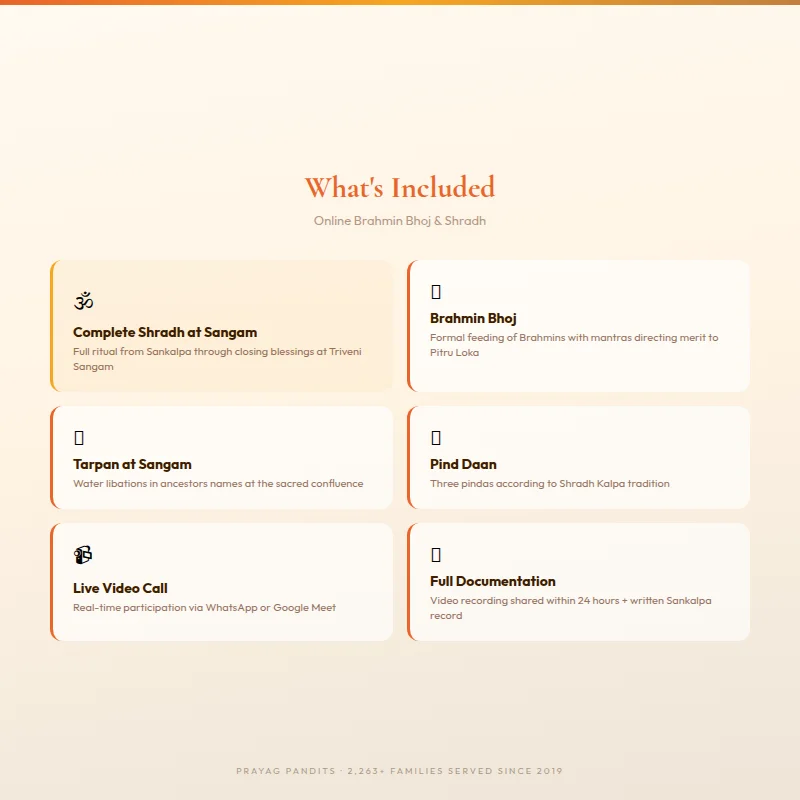
See what your selected package includes. Optional additions are shown separately.
Share the date and timing that suit you. Our team confirms the final arrangements.
Experiences shared by our families
26 family reviews18 for this pooja · 8 from across our services
बहुत संतोषजनक सेवा। पंडित जी का वेद-शास्त्र का ज्ञान अद्भुत था। उन्होंने गरुड़ पुराण के श्लोकों का पाठ किया जो बहुत मार्मिक था। पूरा परिवार भावुक हो गया। 🙏
बहुत ही professional और भक्तिपूर्ण सेवा। सारी सामग्री included थी। Recommend करता हूँ।
The pandit ji recited the mantras perfectly and explained the significance of each ritual. Deeply moving experience.
My family performed Pind Daan through Prayag Pandits and it was a deeply spiritual experience. The location was serene and the pandit’s chanting was beautiful. We felt connected to our ancestors throughout the ceremony.
पितृपक्ष में पिंडदान करवाया। पूरी व्यवस्था उत्तम थी। पंडित जी समय पर आए और सभी विधि-विधान पूर्ण भक्तिभाव से सम्पन्न करवाए। प्रसाद वितरण भी अच्छा था। Om Shanti.
We came from Delhi specifically for this puja. The whole process was smooth and the pandit ji guided us patiently. Highly recommend.
तीसरी बार प्रयाग पंडित्स से सेवा ली। हर बार सेवा उत्कृष्ट रही। पंडित जी का व्यवहार बहुत अच्छा है और वे पूजा को पूरी श्रद्धा से करवाते हैं। Dhanyavaad.
First time performing Pind Daan and was nervous about the process. But the team guided us well. They explained what to wear, what to bring, and what mantras to recite. Everything went smoothly. Om Shanti.
बहुत संतोषजनक सेवा। पंडित जी का वेद-शास्त्र का ज्ञान अद्भुत था। उन्होंने गरुड़ पुराण के श्लोकों का पाठ किया जो बहुत मार्मिक था। पूरा परिवार भावुक हो गया। Jai Shri Ram.
पितृपक्ष में पिंडदान करवाया। पूरी व्यवस्था उत्तम थी। पंडित जी समय पर आए और सभी विधि-विधान पूर्ण भक्तिभाव से सम्पन्न करवाए। प्रसाद वितरण भी अच्छा था।
ऑनलाइन video call पर पूजा हुई, सब कुछ सही तरीके से हुआ। बहुत अच्छा अनुभव।
We had been wanting to perform Pind Daan for years but couldn’t travel to India. This online service was a blessing. The entire ritual was done as per shastras. Thank you Prayag Pandits team for your dedication.
Third time booking with Prayag Pandits. Always reliable service. The pandits are well versed in the scriptures and perform rituals with full devotion. The pricing is fair and transparent. No hidden charges. Dhanyavaad.
पितृपक्ष में पिंडदान करवाया। पूरी व्यवस्था उत्तम थी। पंडित जी समय पर आए और सभी विधि-विधान पूर्ण भक्तिभाव से सम्पन्न करवाए। प्रसाद वितरण भी अच्छा था।
प्रयाग पंडित्स की टीम बहुत सहयोगी है। बुकिंग से लेकर पूजा तक सब कुछ सुव्यवस्थित था। पंडित जी ने मंत्रों के अर्थ भी बताए जो बहुत ज्ञानवर्धक था।
प्रयाग पंडित्स की टीम बहुत सहयोगी है। बुकिंग से लेकर पूजा तक सब कुछ सुव्यवस्थित था। पंडित जी ने मंत्रों के अर्थ भी बताए जो बहुत ज्ञानवर्धक था। Jai Shri Ram.
My family performed Pind Daan through Prayag Pandits and it was a deeply spiritual experience. The location was serene and the pandit’s chanting was beautiful. We felt connected to our ancestors throughout the ceremony.
Quick booking, prompt response, and excellent execution. We were a group of 6 family members and everything was managed well. The pandit was respectful and the ceremony felt genuine. Dhanyavaad.
Watching the pandit perform the rituals in real-time by the Falgu River, mentioning my father's name... it felt like we were truly there. Immense gratitude to the entire team.
Being in the USA, travelling to India just for Tarpan during Pitru Paksha was becoming very difficult. Prayag Pandits offered a well-coordinated solution.
I was skeptical about performing such a sacred ritual online from Canada. But honouring my parents in Kashi was important. They were very patient and answered all my questions.
Living in Singapore, we felt disconnected from these essential rituals. The live stream option for Tarpan at Prayagraj gave us a profound sense of connection and peace.
It was deeply important for us in Australia that the rituals were performed correctly. The ceremony reflected the authenticity we sought and was performed by a knowledgeable priest.
The Pind Daan at Kashi was handled carefully, with the pandit following every step diligently. Very reassuring.
Arranging Asthi Visarjan from Bhubaneswar seemed complex, but Prayag Pandits made it seamless. The pandit called us before the ceremony to explain every step. Very professional.
During Pitru Paksha, we booked Shradh at Prayagraj. The coordination was flawless - from date selection to the pandit assignment. Our family felt at peace after the ceremony.
YOUR EXPERIENCE MATTERS
Tell us about your ceremony and the support you received. Your email address will stay private.
From your first choice to your booking
Review your package and any available additions, then add it to your booking.
Enter your contact details, preferred date and time. Add ancestral details if you wish.
Our team confirms the arrangements and shares your coordinator’s details 24 hours before the pooja.
Your coordinator shares the joining instructions for your live ceremony.
In the Shradh tradition of Hinduism, no single act carries more weight for the peace of departed ancestors than Brahmin Bhoj — the ritual feeding of Brahmins in the name of those who have passed. The Manu Smriti states it plainly: “Na tarpayanti pitarah putrehi brahmanobhojanat tatha” — the ancestors are not as deeply satisfied by water offerings and pind daan as they are by the feeding of learned Brahmins. The Garuda Purana, which contains the most detailed description of the afterlife journey and ancestral rites in all of Hindu literature, devotes entire chapters to the merit generated by Brahmin Bhoj during Shradh. Feeding a Brahmin during Shradh is understood not as a social custom but as a direct act of feeding the ancestors themselves — the Brahmin becomes a vehicle through which the offering reaches the Pitru Loka.
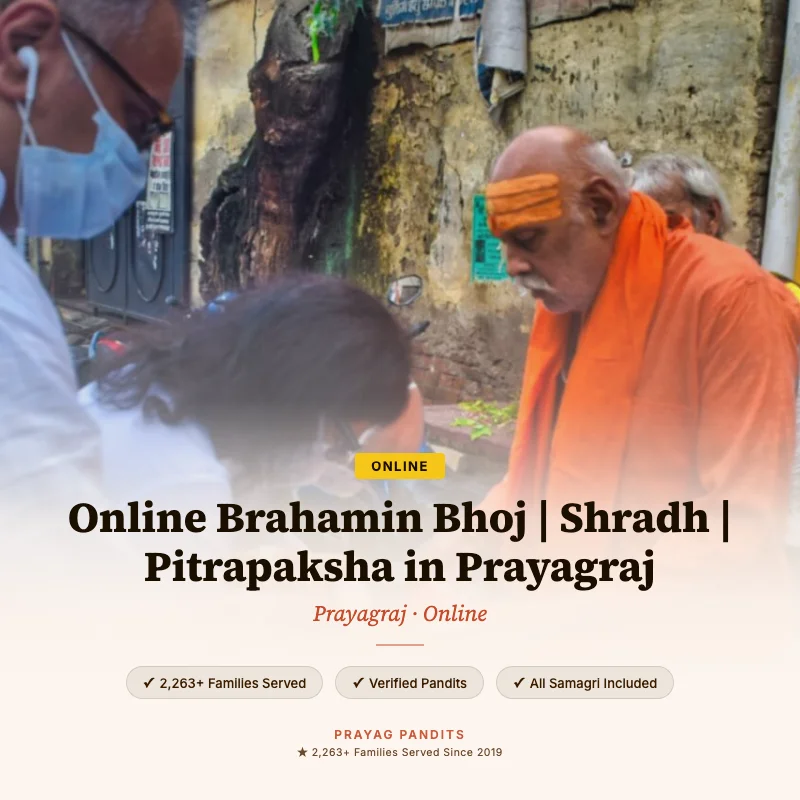
For those who cannot be present in Prayagraj — whether due to distance, health, work obligations, or because they live outside India — this presents a practical challenge. The Shradh must be performed. The Brahmin Bhoj must happen. But the individual cannot be there in person. This is precisely what our Online Brahmin Bhoj Shradh Pitrapaksha package addresses. For ₹31,000, our experienced pandits perform the complete Shradh ceremony with Brahmin Bhoj at Prayagraj’s Triveni Sangam during Pitrapaksha, while you participate in real time via video call from wherever you are in the world.
The centrality of Brahmin Bhoj in Shradh ceremonies is not a regional custom — it is documented across the most authoritative texts of Hindu dharma.
The Manu Smriti (Chapter 3) dedicates extensive verses to the proper conduct of Shradh, consistently identifying Brahmin Bhoj as the culminating and most meritorious act. Verse 3.189 notes that even one learned Brahmin fed at Shradh generates more merit than a thousand ordinary persons fed. The rationale is that learned Brahmins, through their study of Veda and their accumulated tapas, carry a spiritual current that can transmit the offering through the appropriate channels into the Pitru Loka.
The Garuda Purana (Pretakalpa section) describes the journey of the soul after death in precise detail — the soul’s passage through the various realms, its need for sustenance (which comes through pind and the merit generated by descendants), and the specific effect of different Shradh rituals. The Garuda Purana explicitly states that Brahmin Bhoj performed at a sacred Tirth during Pitrupaksha provides the departed soul with the equivalent of a year’s worth of sustenance in the realm it currently inhabits.
The Vishnu Purana and the Vayaviya Samhita of the Shiva Purana both describe the moment during Shradh when the Pitrs (ancestral beings) descend from their realm in subtle form to receive the offered energy. They arrive when invited through the Sankalpa, they receive the Tarpan water and the pind, and they receive the greatest sustenance through the act of Brahmin Bhoj. When the feeding is complete and the Brahmins are content, the scripture says the Pitrs depart satisfied, calling out blessings for the descendants.
Prayagraj’s Triveni Sangam — the meeting point of the Ganga, Yamuna, and the invisible Saraswati — holds a unique designation in the Puranas as the Pitru Tirth, the primary sacred point for all ancestral rites in the universe. The Matsya Purana states that Shradh performed at Prayagraj liberates not only the immediately deceased ancestors but all ancestors going back seven generations on the paternal side and seven on the maternal side — a total ancestral benefit that no other single location can match.
The power of the Triveni Sangam in the context of Shradh comes from its specific cosmological role. The confluence of three sacred rivers — particularly the underground presence of the divine Saraswati, which carries the vibrations of Vedic knowledge — creates an environment where the barrier between the world of the living and the Pitru Loka is at its thinnest. Offerings made here reach their destination with a directness and completeness that is considered impossible at ordinary locations. This is why pandits from the tradition of Prayag — the hereditary priests of the Sangam — have been performing ancestral rites at this location since the time the Puranas were composed.
During Pitrapaksha, this already extraordinary location becomes even more potent. The sixteen days of Pitrapaksha (Bhadrapada Krishna Paksha) are the period when the sun transits through the Virgo constellation — an astrological alignment described in the Surya Siddhanta as the time when the Pitru Loka is most accessible from the physical world. The Pitru Dwar (ancestral gateway) is fully open, and all rituals performed during this period carry multiplied merit. Combining Brahmin Bhoj Shradh with Prayagraj’s Triveni Sangam during Pitrapaksha is the most comprehensive and powerful form of ancestral propitiation available.
The shift toward online participation in sacred ceremonies was initially driven by necessity — first by NRI families already living abroad, and then more broadly during circumstances when physical travel was impossible. What emerged from this practical necessity has proven to be deeply effective. The Sankalpa (ritual declaration of intent) that anchors every Hindu ceremony has always been about the participant’s conscious intention — their name, gotra, and heartfelt resolution to perform the ceremony. The physical distance of the body does not prevent the Sankalpa from being valid; what matters is the presence of the mind and the sincerity of the intention.
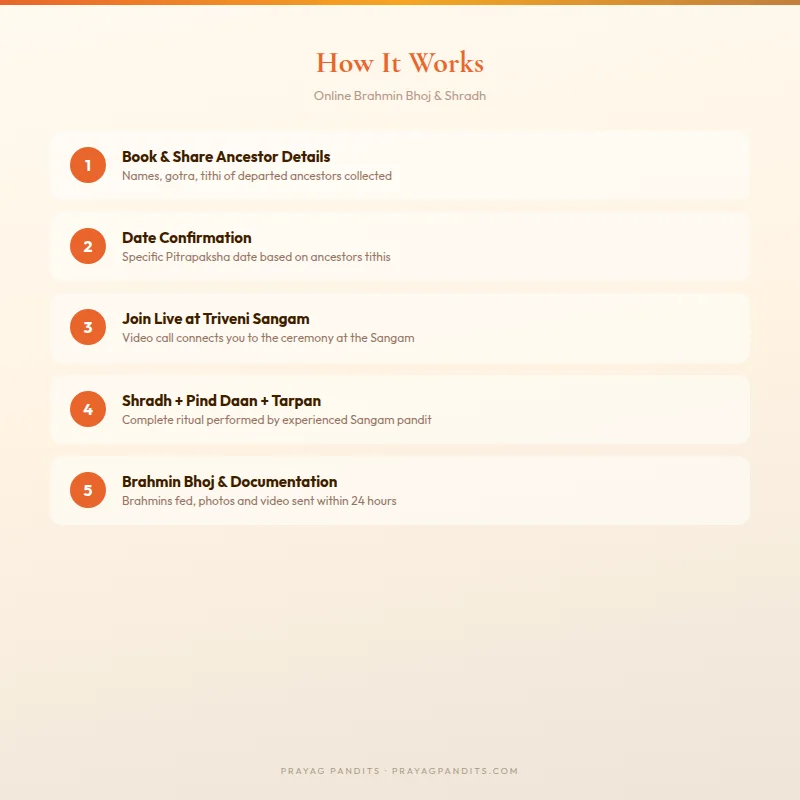
Here is how the online ceremony unfolds:
After booking, you will receive a booking confirmation with your scheduled ceremony date and time (IST). You will be asked to provide: your full name, your father’s name, your gotra (or state if unknown), the names of the ancestors for whom the Shradh is being performed, and any specific ancestral needs (e.g., ancestors whose date of death is unknown, ancestors who died in difficult circumstances, etc.). This information is used to prepare the Sankalpa precisely. You will also receive a list of simple items to keep with you during the ceremony — a glass of water, a few sesame seeds if available, and optionally a small lamp. Participation in this preparatory ritual anchors your presence in the ceremony even from a distance.
A WhatsApp or Google Meet video call is initiated by our team at the confirmed time. You join the call and can see the entire ceremony in real time. The pandit greets you, explains what will happen during each phase, and invites you to perform the Sankalpa remotely — repeating key phrases after the pandit as he states your name, gotra, and intent. From that point forward, you witness and spiritually participate in each step of the ceremony while the pandit performs the physical actions at the Sangam on your behalf.
The ceremony moves to the Triveni Sangam, with the camera facing the river so you can see the confluence. The pandit performs Tarpan — offering water mixed with sesame and barley in the names of your specific ancestors. As each ancestor’s name is called and the water is offered to the Ganga, you can participate by symbolically touching water in your home. This is not merely symbolic formality — the Sankalpa performed earlier has already established the ritual link between your intention and the ceremony being performed at the Sangam.
The pandit prepares the pindas (balls of rice, sesame, ghee, and honey) and offers them for each tier of ancestors according to the Shradh Kalpa tradition. You witness this in real time. The pindas are offered into the Sangam with the appropriate mantras from the Yajurveda’s Pitru Tarpan section.
This is the culminating act of the ceremony. Learned Brahmins who have been invited and prepared receive the formal meal in the name of your ancestors, with the pandit performing the specific Brahmin Bhoj mantras that direct the merit of this feeding toward your Pitru Loka. The food offered is sattvic (pure vegetarian), prepared specifically for this ceremony. After the meal, the Brahmins offer their blessings for your family’s welfare.
The ceremony closes with the pandit offering a complete blessing for your family, your ancestors’ peace, and the fulfillment of your Shradh. The entire ceremony, typically lasting 2 to 3 hours, is recorded and the video is shared with you via WhatsApp or Google Drive within 24 hours of completion. You will also receive a written summary of the Sankalpa performed, confirming the names of ancestors for whom the rites were conducted.
This service was created specifically for the following circumstances, all of which are increasingly common in modern Indian life:
For Hindus living outside India, the question of ancestral duties carries particular emotional weight. The distance from the homeland, from the sacred rivers, from the pandits who know the traditions — all of this creates a sense of being cut off from one’s dharmic obligations. The Shradh tradition itself, however, has always recognized that geography cannot override sincere intention. The Sankalpa performed from any point on earth, when made with full knowledge of one’s name, gotra, and lineage, is considered valid by the Dharmashastra texts.
What our online service provides is not a compromise but a complete ceremony — the only difference is that the physical performance at the sacred site is carried out by our experienced pandits as your authorized representatives, while your Sankalpa (statement of intent) anchors the ceremony to your specific ancestral line. This principle of authorized representation (Karta by proxy) in Shradh is recognized in the Shradh literature — it is documented in the Parashar Smriti and the Yajnavalkya Smriti as valid when the primary obligated person cannot be physically present.
For those wishing to add Tarpan offerings alongside the Shradh ceremony, our dedicated Tarpan in Prayagraj service can be booked alongside this package for a combined ancestral propitiation that covers both the water offerings and the full Brahmin Bhoj Shradh.
This is the question most people ask, and it deserves an honest answer. In the Dharmashastra tradition, the Sankalpa — the formal declaration of intent with name, gotra, and resolution — is the most critical element of any ritual. When performed correctly and sincerely, the Sankalpa establishes the ritual link between the yajman (person commissioning the ceremony) and the ceremony itself, regardless of physical distance. The Parashar Smriti explicitly allows for Shradh to be performed by proxy when the primary obligated person cannot be present. Physical presence at Prayagraj adds a dimension of personal merit for the individual that cannot be replicated remotely, but the core function of the ceremony — providing sustenance and peace to the ancestors — is fully accomplished through the proxy performance. For NRI families and those with genuine impediments to travel, this is not a lesser option; it is the recognized legitimate alternative.
Pitrapaksha 2026 runs from September 26 (Purnima) through October 10 (Sarva Pitru Amavasya). Shradh ceremonies can be booked for any day within this period. Certain dates carry additional significance: Matru Navami (October 4) is specially designated for mothers and female ancestors; Sarva Pitru Amavasya (October 10, the final day) is considered the most universally auspicious date for Shradh of all ancestors, including those whose specific tithi is unknown. Slots on Sarva Pitru Amavasya fill the earliest — early booking is essential for this date.
There is no strict limit on the number of ancestors included in the Sankalpa and Tarpan. The ceremony covers ancestors on both the paternal and maternal sides, and names of as many ancestors as the family can provide are included in the Tarpan recitation. For ancestors whose names are unknown (which is common for great-grandparents and beyond), the Sankalpa covers them collectively under the lineage gotra. The Brahmin Bhoj is performed for the benefit of all named and unnamed ancestors of the family line.
Gotra knowledge has unfortunately been lost in many families, particularly in urban contexts and among families that migrated across generations. When the gotra is genuinely unknown, the Sankalpa is performed using “Kashyap” gotra — this is the recognized Dharmashastra convention for precisely this situation, based on the understanding that Kashyap is the primordial rishi whose lineage encompasses all who cannot trace their specific gotra. The ceremony proceeds in full and its efficacy is not compromised.
Yes — and this combination is in fact recommended for families where Shradh has been missed for three or more consecutive years, or where Pitru Dosha has been identified. The Tripindi Shradh addresses the accumulated deficit of missed Shradh years in a comprehensive ceremony invoking the Trimurti, while the Brahmin Bhoj Shradh provides the ongoing sustenance offering that completes the ancestral propitiation cycle. If you wish to combine both ceremonies during Pitrapaksha at Prayagraj, please contact us for a combined booking — the two can be scheduled on consecutive or same-day timing for an integrated ancestral rites program.