

Veda-Trained Pandits
Experienced pandits guide the ceremony with care for your family’s tradition.
Pooja booking
Original price was: ₹11,000.00.₹8,100.00Current price is: ₹8,100.00.
Per pooja
Applicable taxes are shown in your booking. Optional additions are separate.
Exclusions
Thoughtfully arranged, personally guided
Experienced pandits guide the ceremony with care for your family’s tradition.
Stay in touch with our team for your booking details and ceremony arrangements.
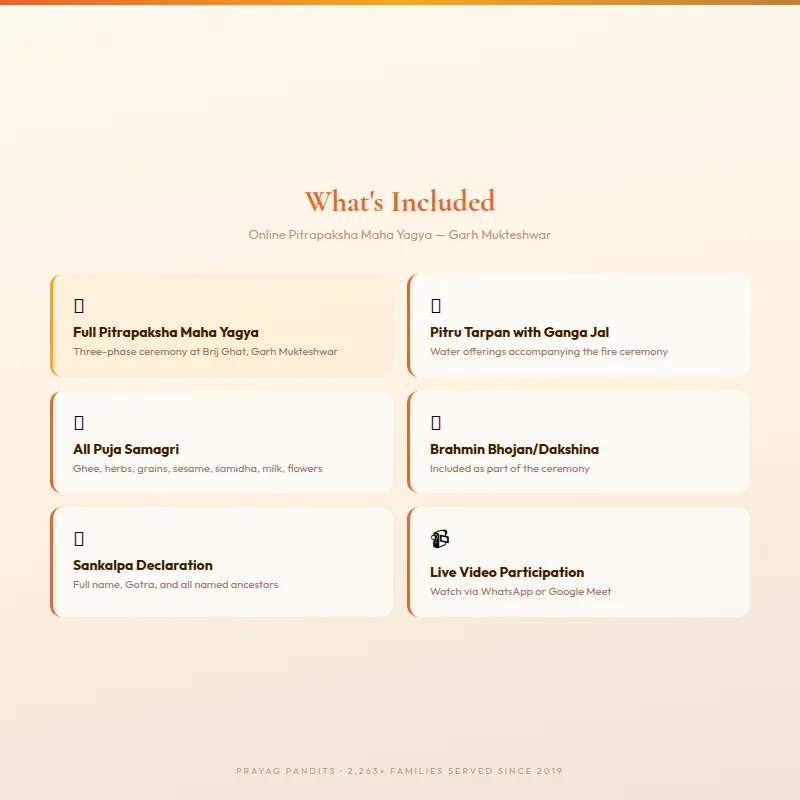
See what your selected package includes. Optional additions are shown separately.
Share the date and timing that suit you. Our team confirms the final arrangements.
Experiences shared by our families
26 family reviews18 for this pooja · 8 from across our services
The online poojan option is great for people living abroad. We could participate from our home in the UK. The video was clear and the pandit made us feel included in every step of the ceremony.
बहुत ही professional और भक्तिपूर्ण सेवा। सारी सामग्री included थी। Recommend करता हूँ।
చాలా మంచి సేవ. పండిట్ జీ చాలా అనుభవజ్ఞుడు. సంతృప్తిగా ఉన్నాం.
আমার বাবার জন্য এই পূজা করিয়েছিলাম। সব কিছু ঠিকঠাক হয়েছে। পণ্ডিত জি খুব অভিজ্ঞ।
We were looking for reliable pandit services online and found Prayag Pandits. The experience exceeded our expectations. Professional team, knowledgeable pandits, and transparent pricing. Jai Shri Ram.
Affordable and authentic poojan services. We compared several providers before choosing Prayag Pandits and we made the right choice. The quality of service matched what was promised.
हमारे पूर्वजों की आत्मा की शांति के लिए यह पूजा करवाई। पूरा परिवार संतुष्ट है।
Very satisfied with the service. The pandit arrived on time and had all the materials ready. The ceremony was conducted as per proper Vedic traditions. The team followed up after the poojan as well. Dhanyavaad.
Booked this service on recommendation from a friend. Was not disappointed at all. The entire process from booking to ceremony completion was smooth. The pandit was very experienced. Om Shanti.
অনলাইন বুকিং করেছিলাম, তবে সেবা অসাধারণ ছিল। ধন্যবাদ প্রয়াগ পণ্ডিতস।
Had a wonderful experience with Prayag Pandits. The team is very organized and the pandits are genuine. They don’t rush through the ceremonies like some other services do. Quality work. Om Shanti.
Very authentic Vedic ceremony. All materials were included as promised. Will definitely use their services again.
बहुत अच्छी सेवा। पंडित जी समय पर आए और सभी पूजन सामग्री लेकर आए। मंत्रोच्चार बहुत शुद्ध था। कुल मिलाकर एक संतोषजनक अनुभव रहा। Dhanyavaad.
Affordable and authentic poojan services. We compared several providers before choosing Prayag Pandits and we made the right choice. The quality of service matched what was promised. Jai Shri Ram.
Booked this service on recommendation from a friend. Was not disappointed at all. The entire process from booking to ceremony completion was smooth. The pandit was very experienced.
बहुत अच्छी सेवा। पंडित जी समय पर आए और सभी पूजन सामग्री लेकर आए। मंत्रोच्चार बहुत शुद्ध था। कुल मिलाकर एक संतोषजनक अनुभव रहा। Dhanyavaad.
सेवा उत्तम है। कोई छिपा हुआ खर्च नहीं। जो बताया गया वही किया गया। पंडित जी बहुत विनम्र और ज्ञानी हैं। दोबारा जरूर बुक करेंगे।
Affordable and authentic poojan services. We compared several providers before choosing Prayag Pandits and we made the right choice. The quality of service matched what was promised. 🙏
Watching the pandit perform the rituals in real-time by the Falgu River, mentioning my father's name... it felt like we were truly there. Immense gratitude to the entire team.
Being in the USA, travelling to India just for Tarpan during Pitru Paksha was becoming very difficult. Prayag Pandits offered a well-coordinated solution.
I was skeptical about performing such a sacred ritual online from Canada. But honouring my parents in Kashi was important. They were very patient and answered all my questions.
Living in Singapore, we felt disconnected from these essential rituals. The live stream option for Tarpan at Prayagraj gave us a profound sense of connection and peace.
It was deeply important for us in Australia that the rituals were performed correctly. The ceremony reflected the authenticity we sought and was performed by a knowledgeable priest.
The Pind Daan at Kashi was handled carefully, with the pandit following every step diligently. Very reassuring.
Arranging Asthi Visarjan from Bhubaneswar seemed complex, but Prayag Pandits made it seamless. The pandit called us before the ceremony to explain every step. Very professional.
During Pitru Paksha, we booked Shradh at Prayagraj. The coordination was flawless - from date selection to the pandit assignment. Our family felt at peace after the ceremony.
YOUR EXPERIENCE MATTERS
Tell us about your ceremony and the support you received. Your email address will stay private.
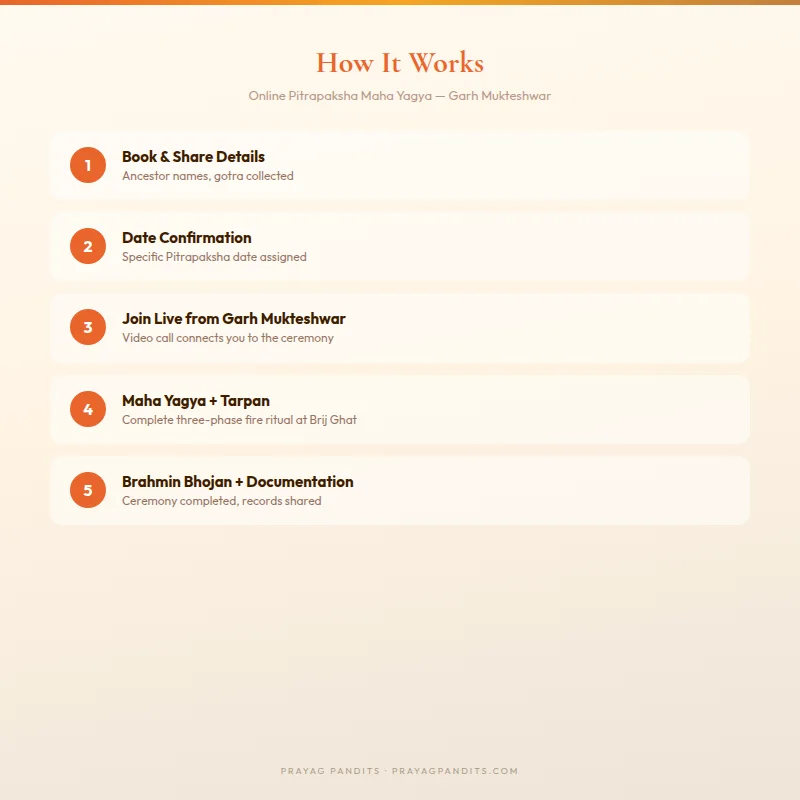
From your first choice to your booking
Review your package and any available additions, then add it to your booking.
Enter your contact details, preferred date and time. Add ancestral details if you wish.
Our team confirms the arrangements and shares your coordinator’s details 24 hours before the pooja.
Follow the participation and joining arrangements described in your package and shared by your coordinator.
Pitrapaksha — the sixteen sacred days when the gates between the living and the ancestral realm stand open — is the most potent window in the Hindu calendar for performing rituals in honour of departed family members. During these days, the scriptures teach, the Pitrus (ancestors) descend closer to the mortal world and are uniquely capable of receiving the merit of rites performed on their behalf. An offering made during Pitrapaksha carries many times the spiritual weight of the same offering made on an ordinary day.
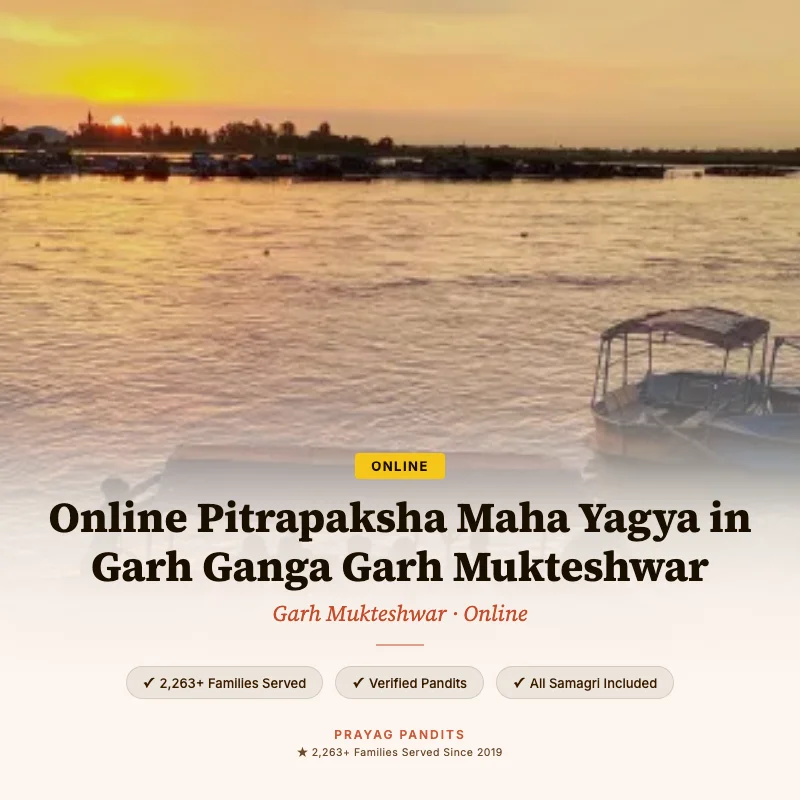
The Maha Yagya is the highest-level fire ritual in the repertoire of ancestral worship. It is not a simple Havan but an extended ceremony involving multiple rounds of offerings, the recitation of dedicated Vedic hymns for ancestral welfare, and specific invocations that address each ancestor by name, lineage, and spiritual need. Performed at Brij Ghat, Garh Mukteshwar — on the banks of the Garh Ganga, under the blessing of Lord Mukteshwara — during Pitrapaksha, this ceremony represents one of the most complete acts of ancestral devotion available in the Hindu tradition.
This package brings that ceremony to you online, via live video call, so that families across India and abroad can participate fully in this sacred act regardless of where they are located.
Read our complete guide to Garh Mukteshwar pilgrimage
The term “Maha” in Sanskrit means great or grand, and it is used in ritual contexts to distinguish a more elaborate, extended version of a standard ceremony. A regular Pitru Havan might involve a single fire with one set of offerings and a basic mantra sequence. The Maha Yagya involves three distinct phases of fire ritual, each with its own sequence of offerings and mantra chanting, and typically takes two to three times as long as a standard Havan.
The three phases follow a specific structure rooted in the Pitru Tantra of the Yajur Veda. The first phase is the Pitru Ahuti sequence, in which offerings are made to the three generations of paternal ancestors and their female lineage. The second phase is the Vishwa Deva Ahuti, in which offerings are made to the universal deities who govern the ancestral realm and ensure safe passage for souls. The third phase is the Brahma Ahuti, in which the merit of the entire ceremony is offered to Lord Brahma as the creator and preserver of the cosmic order that governs birth and rebirth.
The Pitrapaksha period, also called Mahalaya Paksha or simply Shraddha Paksha, falls in the Krishna Paksha (dark fortnight) of the month of Bhadrapada according to the Hindu lunar calendar, typically spanning September to early October. Ancient texts including the Brahma Purana, the Vishnu Purana, and the Garuda Purana all state that during this period the Pitru Dwar — the gates connecting the mortal realm with the Pitru Loka — are fully open.
The significance of this is not merely poetic. The Brahma Purana explains that during Pitrapaksha, departed souls who have accumulated sufficient merit are permitted to come nearer to the mortal world to await the rituals performed by their descendants. When those rituals are performed correctly and with sincere intention, the ancestor receives the merit directly and is advanced in their spiritual journey. The window closes at the end of Pitrapaksha, at Sarva Pitru Amavasya, which is considered the single most important day for ancestral rituals in the entire year.
Performing the Maha Yagya during this window, at a teertha of the calibre of Garh Mukteshwar where Lord Shiva’s liberation blessing is active, creates a confluence of auspicious factors that amplifies the merit many times over.
Garh Mukteshwar has been associated with ancestral rites for as long as the town has existed. The annual Kartik Mela, one of the largest fairs in Uttar Pradesh, has at its heart the tradition of ancestral worship and Deep Daan performed on the Ganga. But even beyond the Kartik season, Brij Ghat at Garh Mukteshwar is active with Tarpan and Shraddha ceremonies throughout the year, and especially during Pitrapaksha.
Families from Meerut, Ghaziabad, Delhi, Agra, Aligarh, and across western Uttar Pradesh have traditionally come to Garh Mukteshwar during Pitrapaksha because it is the closest major Ganga teertha to their homes. The rituals performed here are not tourist ceremonies — they are genuine Vedic rites maintained by pandits trained in the Pitru Tantra traditions specific to this teertha. When our pandits perform your Maha Yagya at Brij Ghat, they are continuing a lineage of ritual practice that has been maintained here for generations.
We understand that many families wish to be present for a ceremony of this significance but cannot travel during Pitrapaksha — perhaps because the dates fall during a working week, perhaps because elderly or ill family members cannot make the journey, or perhaps because the family lives abroad. The online format resolves this without compromising the ceremony.
A standard Pitru Havan is a single-phase fire ritual typically lasting 30 to 45 minutes, with a basic sequence of offerings and mantras. The Maha Yagya is a three-phase ceremony lasting 90 to 120 minutes, with distinct offering sequences for paternal ancestors, for the divine custodians of the ancestral realm, and for universal liberation. The depth of mantra recitation, the number of individual offerings, and the breadth of ancestral coverage are all significantly greater in the Maha Yagya. For important occasions — Pitrapaksha, the first anniversary of a death, or a long-overdue fulfillment of ancestral obligations — the Maha Yagya is the appropriate choice.
Yes. The Maha Yagya can include ancestors from both the paternal and maternal sides of the family, as well as ancestors from the wife’s paternal lineage if the ceremony is being performed by a married couple. If you have a complex family structure — a joint family with multiple branches, for example — our pandit will guide you through how to structure the Sankalp to ensure all intended ancestors are covered. Please share the details when booking so we can prepare adequately.
The Maha Yagya during Pitrapaksha is appropriate any time after the initial death rites (Antim Sanskar and the 13-day Shraddha period) have been completed. If the death occurred within the current Pitrapaksha period, the ceremonies should be structured accordingly — our pandit will advise you on the correct ritual sequence based on the specific circumstances. For deaths that occurred before the current Pitrapaksha, the Maha Yagya is fully appropriate and highly recommended.
Gotra is the lineage name that identifies your family’s Vedic lineage (typically tracing back to one of the ancient Rishis). If you do not know your Gotra, our pandit can help you identify it based on your community, regional background, and family name. In some cases, if the Gotra genuinely cannot be determined, the ceremony can be performed with the Kashyap Gotra, which is considered the default Gotra in the Vedic tradition when the specific lineage is unknown. This does not diminish the validity or effectiveness of the ceremony.
Pitrapaksha is our busiest season for ancestral ceremonies, and slots fill quickly. We strongly recommend booking at least two to three weeks before the start of Pitrapaksha if you want to ensure your preferred date within the period. If you have a specific Tithi in mind — the death anniversary of a parent or grandparent that falls within Pitrapaksha — please mention this when booking, as these specific Tithi dates are the most sought-after and the earliest to fill.