


Veda-Trained Pandits
Experienced pandits guide the ceremony with care for your family’s tradition.
Pooja booking
Original price was: ₹12,999.00.₹10,999.00Current price is: ₹10,999.00.
Per pooja
Applicable taxes are shown in your booking. Optional additions are separate.
Exclusions
Thoughtfully arranged, personally guided
Experienced pandits guide the ceremony with care for your family’s tradition.
Stay in touch with our team for your booking details and ceremony arrangements.
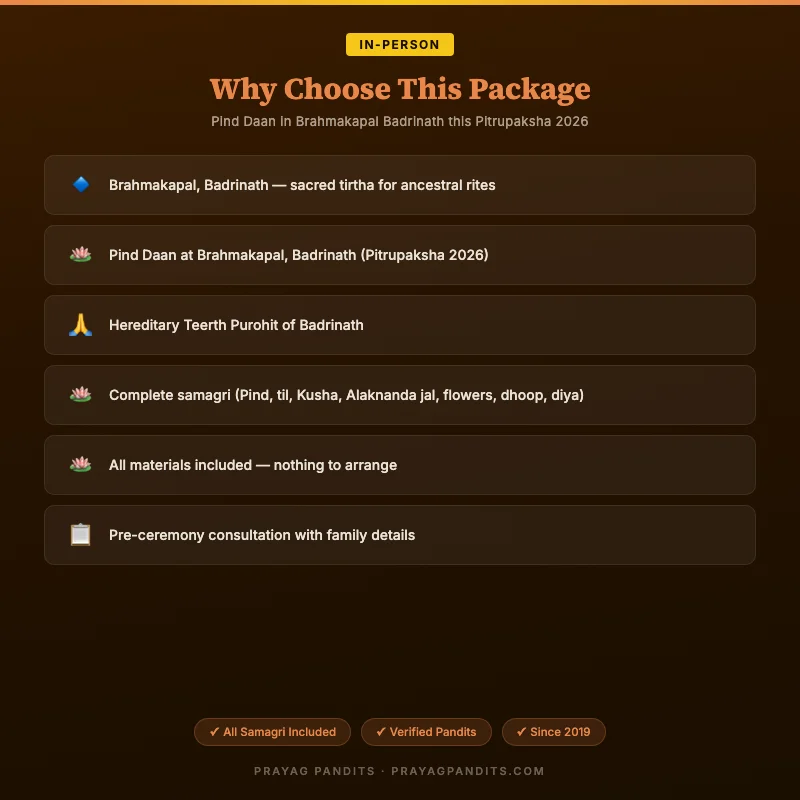
See what your selected package includes. Optional additions are shown separately.
Share the date and timing that suit you. Our team confirms the final arrangements.
Experiences shared by our families
26 family reviews18 for this pooja · 8 from across our services
हमारे नाना जी के पिंडदान के लिए यह बुक किया था। सब कुछ परंपरागत तरीके से हुआ।
हमारे पूर्वजों की आत्मा की शांति के लिए यह पूजा करवाई। पूरा परिवार संतुष्ट है।
Good service overall. The pandit was on time and well prepared. He guided us through each step of the ceremony. The booking process was simple and the team was responsive on WhatsApp. Would recommend to others.
Performed Pind Daan here during Pitrapaksha. The entire process was smooth. Pandit ji was very cooperative and explained the mantra meanings. The prasad distribution was also well organized. A truly fulfilling experience.
The coordination was excellent. We received all details well in advance. The puja was performed exactly as described.
The pandit ji recited the mantras perfectly and explained the significance of each ritual. Deeply moving experience.
The coordination was excellent. We received all details well in advance. The puja was performed exactly as described.
We booked this for our grandfather’s annual shradh. The ceremony was performed with great reverence. Pandit ji even shared stories from the Garuda Purana which were very enlightening for the younger generation. Jai Shri Ram.
Very authentic Vedic ceremony. All materials were included as promised. Will definitely use their services again.
हमने गया जी में पिंडदान करवाया। पंडित जी ने विष्णुपद मंदिर से लेकर फल्गु नदी तक सभी स्थानों पर विधि-विधान से पूजा करवाई। बहुत शांति मिली। 🙏
My family performed Pind Daan through Prayag Pandits and it was a deeply spiritual experience. The location was serene and the pandit’s chanting was beautiful. We felt connected to our ancestors throughout the ceremony. Jai Shri Ram.
तीसरी बार प्रयाग पंडित्स से सेवा ली। हर बार सेवा उत्कृष्ट रही। पंडित जी का व्यवहार बहुत अच्छा है और वे पूजा को पूरी श्रद्धा से करवाते हैं।
We are NRI family based in USA. We booked online poojan and it was conducted very sincerely. The video quality was good and we could see everything clearly. The team sent us photos and videos after the ceremony too. 🙏
बहुत संतोषजनक सेवा। पंडित जी का वेद-शास्त्र का ज्ञान अद्भुत था। उन्होंने गरुड़ पुराण के श्लोकों का पाठ किया जो बहुत मार्मिक था। पूरा परिवार भावुक हो गया। Dhanyavaad.
Very professional service. The pandit ji explained every step of the ritual which helped us understand the significance. Everything was arranged well including the samagri. We are grateful to Prayag Pandits for making this spiritual journey meaningful.
First time performing Pind Daan and was nervous about the process. But the team guided us well. They explained what to wear, what to bring, and what mantras to recite. Everything went smoothly. Dhanyavaad.
Performed Pind Daan here during Pitrapaksha. The entire process was smooth. Pandit ji was very cooperative and explained the mantra meanings. The prasad distribution was also well organized. A truly fulfilling experience. Jai Shri Ram.
After losing my father suddenly we needed guidance on the proper rituals. Prayag Pandits team was very compassionate and helped us through every step. The Pind Daan brought us immense peace. 🙏
Watching the pandit perform the rituals in real-time by the Falgu River, mentioning my father's name... it felt like we were truly there. Immense gratitude to the entire team.
Being in the USA, travelling to India just for Tarpan during Pitru Paksha was becoming very difficult. Prayag Pandits offered a well-coordinated solution.
I was skeptical about performing such a sacred ritual online from Canada. But honouring my parents in Kashi was important. They were very patient and answered all my questions.
Living in Singapore, we felt disconnected from these essential rituals. The live stream option for Tarpan at Prayagraj gave us a profound sense of connection and peace.
It was deeply important for us in Australia that the rituals were performed correctly. The ceremony reflected the authenticity we sought and was performed by a knowledgeable priest.
The Pind Daan at Kashi was handled carefully, with the pandit following every step diligently. Very reassuring.
Arranging Asthi Visarjan from Bhubaneswar seemed complex, but Prayag Pandits made it seamless. The pandit called us before the ceremony to explain every step. Very professional.
During Pitru Paksha, we booked Shradh at Prayagraj. The coordination was flawless - from date selection to the pandit assignment. Our family felt at peace after the ceremony.
YOUR EXPERIENCE MATTERS
Tell us about your ceremony and the support you received. Your email address will stay private.
From your first choice to your booking
Review your package and any available additions, then add it to your booking.
Enter your contact details, preferred date and time. Add ancestral details if you wish.
Our team confirms the arrangements and shares your coordinator’s details 24 hours before the pooja.
Follow the participation and joining arrangements described in your package and shared by your coordinator.
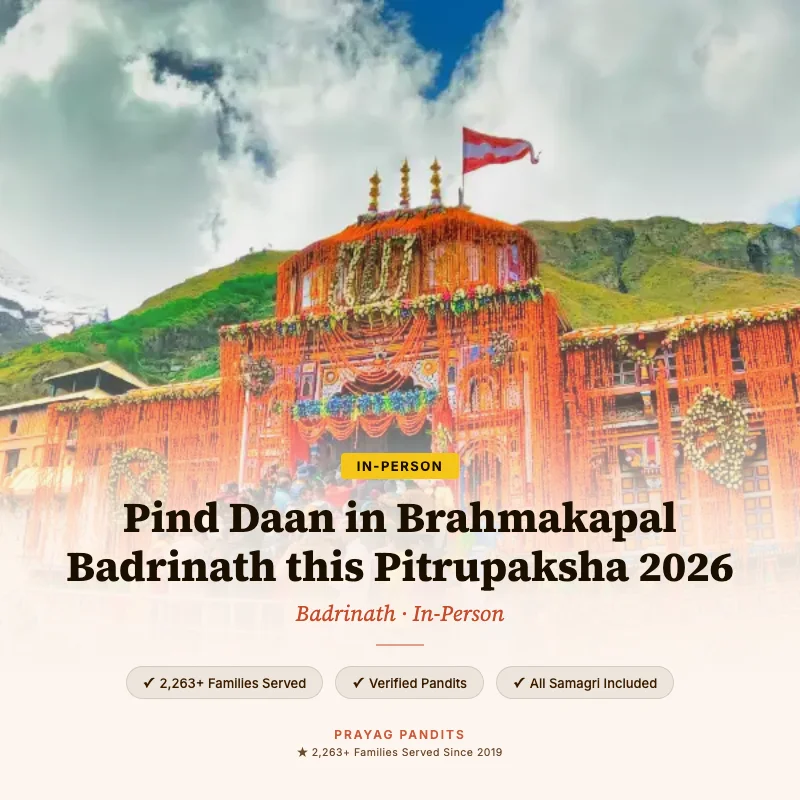
There are very few places in this world where the Himalayas, the sacred rivers, and the presence of divine energy converge in quite the way they do at Badrinath. And within Badrinath, the flat expanse of rock known as Brahmakapal holds a special place — it is where Lord Brahma himself is said to have performed the first yagna for the liberation of souls, and where the Alaknanda river flows beside you as you offer pind to your ancestors. Performing Pind Daan here, during the auspicious fortnight of Pitrupaksha, is one of the most powerful acts of ancestral remembrance available to a Hindu family. This package makes it possible, with a learned pandit, all ritual materials, and a guide to support you through the process.
Brahmakapal is not a famous name in popular culture the way Haridwar or Rishikesh might be. But among those who know the Puranic texts and the traditions of Pitru karma, it stands alongside Gaya and Prayagraj as one of the supreme tirthas for ancestral liberation. Coming here — particularly during Pitrupaksha — means you are choosing the most auspicious combination of place and time available anywhere in the Himalayan tradition.
The name Brahmakapal literally means “the skull of Brahma.” The story attached to this place is ancient and significant. When Lord Shiva severed the fifth head of Lord Brahma — a story with its own deep theological meaning about ego and creation — that head remained stuck to Shiva’s hand as a consequence of the act. Shiva, wandering with the skull of Brahma adhered to him, finally found release at this very spot in Badrinath, where the skull fell and was absorbed into the earth. The site thereafter became sacred to Brahma’s memory and to acts of purification and ancestral offering.
Beyond this story, the Brahmakapal is a natural rock platform on the bank of the Alaknanda, just upstream from the Badrinath temple. The Alaknanda — one of the primary tributaries of the Ganga — carries the combined sanctity of dozens of Himalayan tributaries, and its water at this altitude is considered among the purest and most powerful available anywhere in the Ganga system.
The Skanda Purana, which contains detailed descriptions of the Badrinath Kshetra, describes Brahmakapal as a place where the veil between the world of the living and the world of the ancestors is especially thin. Offerings made here are described as reaching Pitru Loka with greater directness than at most other tirthas, because this spot sits at the convergence of divine energy associated with both Brahma (the creator who governs cosmic cycles of birth and death) and Vishnu (whose dwelling is Badrinath itself).
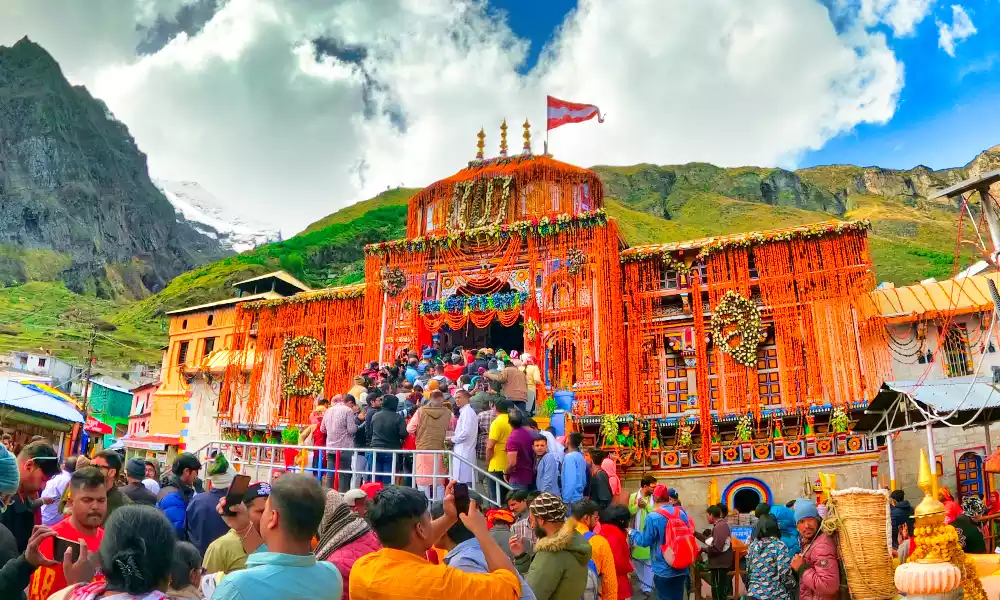
Badrinath is one of the four Char Dham tirthas — the sacred destinations that mark the four cardinal directions of the Hindu pilgrimage geography. For centuries, it has been understood that visiting Badrinath liberates the pilgrim from the cycle of rebirth. But Badrinath’s significance for ancestral rites is somewhat less widely known, and it deserves to be.
The Vishnu Sahasranama, recited at Badrinath daily, is itself a powerful tool for ancestral liberation — the recitation of Lord Vishnu’s thousand names is said to bring merit to three generations of ancestors. When Pind Daan is performed at Brahmakapal in conjunction with darshan at the Badrinath temple, the two acts reinforce each other: the Pind Daan feeds and honors the ancestors materially, while the proximity to Lord Vishnu’s seat ensures the divine presence that carries the offering forward.
Families who perform Pitrupaksha rites at Brahmakapal sometimes describe a sense of completion that they had not felt after performing Shradh at their home or at local tirthas. This is not unusual — the Puranas consistently teach that the power of a tirtha multiplies the effect of any ritual performed there, and Brahmakapal during Pitrupaksha concentrates that multiplying effect as fully as any location in the Himalayan tradition.
For a foundational understanding of what Pind Daan means, why it is performed, and what the Vedic tradition teaches about ancestral welfare, read our comprehensive guide: All You Need to Know About Pind Daan.
Pitrupaksha is the 16-day fortnight in the month of Ashwin (typically September–October) when the sun is in Kanya rashi and the doors of Pitru Loka are understood to be open. During this period, ancestors are said to come closer to the world of the living, awaiting the offerings of their descendants. The merit of any ancestral rite performed during Pitrupaksha is held to be many times greater than the same rite performed at other times of year.
At Brahmakapal, Pitrupaksha brings a particular concentration of energy. The high altitude, the clean Himalayan air, the sound of the Alaknanda, and the presence of many pilgrims performing ancestral rites simultaneously — all of this creates an atmosphere that is difficult to describe in ordinary terms. Those who have been here during Pitrupaksha often say the same thing: it did not feel like a tourist visit. It felt like something actually happened.
The Badrinath temple itself is only open for six months of the year (closing in November for winter and reopening in April/May). Pitrupaksha 2026 falls in late September, which places it well within the open season — making this year an excellent opportunity to perform this ceremony at its proper location and time.
Your pandit will meet you at the Brahmakapal site at the arranged time. He will take time to understand your family’s situation — which ancestors you are honoring, any specific names and gotra you have, and any particular intentions you carry for the ceremony. This initial conversation is unhurried; the sankalpa that follows needs to reflect your family accurately.
The ceremony begins with a ritual bath in the Alaknanda. At Badrinath’s altitude, the water is cold and moving swiftly — but contact with it is itself a purification that many pilgrims describe as instantly clarifying. You do not need to immerse fully; the ritual can be performed with water cupped in the hands and poured over the head.
Seated on or near the rock platform of Brahmakapal, you take the sankalpa — the formal declaration of your identity, your lineage, and your intention. The pandit recites; you repeat. This is where the ritual becomes yours personally rather than a generic ceremony.
The pind is prepared from the materials brought by the pandit. You participate in shaping the pind — this is not delegated entirely to the priest. The physical act of forming the offering with your own hands is part of the ritual’s integrity.
The pind is offered to the Alaknanda with the appropriate mantras, each ancestor addressed by name. Tarpan — water mixed with sesame seeds offered from cupped hands — follows. The river carries the offering away, dissolving it into the sacred current of the Ganga’s headwaters.
The ceremony concludes with circumambulation of the Brahmakapal rock and closing prayers. The pandit performs the final mantras that formally release the ancestors — sending them forward with your offering received. If time and energy permit, darshan at the Badrinath temple following the Pind Daan is strongly encouraged as a complementary act.
For a detailed walkthrough of the ritual elements of Pind Daan and what each step means spiritually, see our guide: How to Perform Pind Daan Poojan.
If you are not able to travel to Badrinath in person but wish to have Pind Daan performed there on your behalf, please see our Online Pind Daan at Brahmakapal Badrinath option, where our pandit performs the rite at the actual site and sends you documentation and a video call connection.
Arranging a pandit for a ceremony at Badrinath is not the same as arranging one in your city. Brahmakapal has its own local tradition, its own timing constraints (coordinating with the Badrinath temple schedule), and its own requirements for ritual materials that must be sourced correctly in the region. Our network in Badrinath means we are not making arrangements for the first time when you book — we have established relationships with the local pandits and guides who know this site as their own.
We also understand what families carrying grief need from us. When you have traveled all the way to Badrinath to perform this ceremony, the last thing you want is logistical confusion or a pandit who rushes through the rites without explanation. Our pandits take the time needed. The ceremony is never shortened. Every ancestor named in the sankalpa receives the full offering.
Our pricing is completely transparent. No surprise charges at the site. The package price covers everything listed — and if you have questions before booking, our team is available to answer them directly.
Brahmakapal is a separate location from the main Badrinath temple, though they are close to each other. Brahmakapal is a flat rock platform on the bank of the Alaknanda river, a short walk from the Badrinath shrine. Pind Daan is performed at Brahmakapal itself — on the rock and at the river’s edge — while the Badrinath temple visit is a separate darshan. Many families do both on the same day.
Yes. The rites at Brahmakapal follow the standard Vedic tradition of Pind Daan and are not restricted to any specific regional or caste community. Our pandit will adapt the mantras and gotra declarations to your family’s lineage. If your family follows a specific Vaishnava, Shaiva, or other tradition, please mention this when booking and we will accommodate accordingly.
We strongly recommend booking at least six to eight weeks before your intended date, particularly for Pitrupaksha dates. The Badrinath region sees heavy pilgrim traffic during this period, and both pandits and accommodation are in high demand. Early booking also gives you more flexibility in choosing your preferred date within the fortnight.
Badrinath is at approximately 3,300 metres (about 10,800 feet) above sea level. Altitude sickness is a real possibility, especially for those coming from plains regions. We recommend spending at least one night in Joshimath (at a lower altitude) before ascending to Badrinath, and allowing your body 24 hours to acclimatize after arrival before performing the ceremony. Please consult your physician if you have heart, lung, or blood pressure conditions before planning this journey.
Badrinath remains open through October and typically closes in November for winter. Pitrupaksha 2026 falls in late September, which is comfortably within the open season. In the very rare event of a road closure or natural disruption beyond our control, we will work with you to reschedule to the nearest available date or provide a full refund. Our team monitors conditions actively during the pilgrimage season.