Key Takeaways
- Which three rivers meet at the Triveni Sangam?
- Where did the Saraswati go?
- Why is Prayag called Tirthraj?
- The Amrit that fell at Prayag
In This Article
The Triveni Sangam is the point at Prayagraj where the Ganga and the Yamuna visibly meet and the Saraswati is held to join them from below. Tri means three and veni means braid: three streams braided into one. It is the site the Puranas call Tirthraj, and the place families come to for Pind Daan, Tarpan and Asthi Visarjan.
Which three rivers meet at the Triveni Sangam?
The Ganga, the Yamuna and the Saraswati. Two of them you can see. The Ganga arrives from the north-west, pale and wide. The Yamuna comes up from the south, darker and slower. Where they touch, the line between the two colours is visible from a boat, and in December and January it can be followed for several hundred metres before the waters mix.
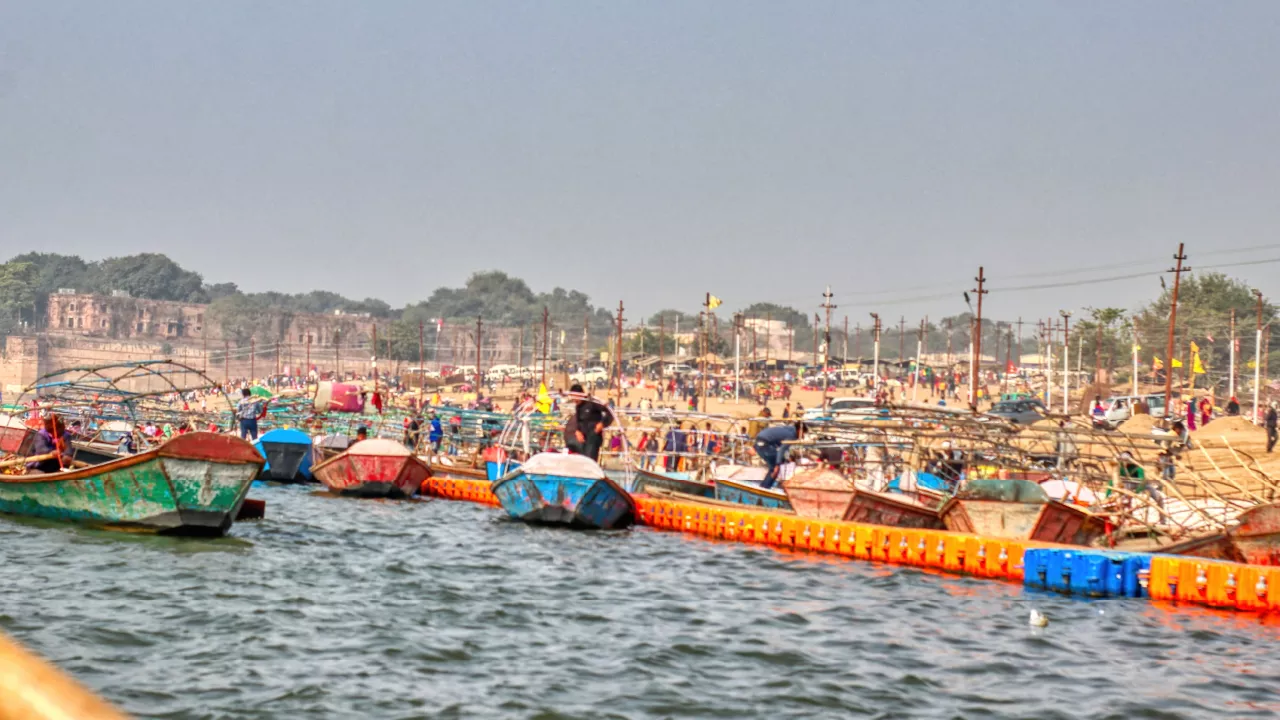
The third river is not visible. Hindu tradition holds that the Saraswati reaches Prayag underground and rises at the meeting point. That is what makes this a Triveni, a braid of three, rather than a meeting of two, and it is why a bath here is counted differently from a bath at any other confluence on the Ganga.
Where did the Saraswati go?
It stopped flowing on the surface. The Rigveda describes the Saraswati as the greatest of rivers, running east of the Yamuna and west of the Sutlej. By the time of the Mahabharata she is described as ending in the desert, at a place the epic calls Vinashak, the place of disappearance.
The Puranas read the loss as a withdrawal. The goddess of sacred knowledge left a land that had stopped honouring it, took Brahma’s permission, and turned toward Prayag; the country she left behind dried into what is now Rajasthan. Geologists describe the same event in different language. Satellite imagery of the Indo-Gangetic plain has traced dry palaeo-channels that broadly match the Rigvedic course, and uplift across present-day Haryana and Rajasthan is thought to have pushed the water east into the Yamuna system. Whether those channels are the river of the hymns is still argued among specialists.
Both accounts agree on the direction. The water went east, toward the Yamuna, and toward Prayag. If that is the part you came for, we answer it on its own page: why the Saraswati is invisible at the Triveni Sangam.
Why is Prayag called Tirthraj?
Tirthraj means king of the tirthas, and the title comes from the texts rather than from local pride. The Matsya, Padma, Vayu and Brahma Puranas all use it. The Mahabharata puts the claim in the mouth of the sage Markandeya, who tells Yudhishthira that a month spent at Prayag in bathing, restraint and meditation secures a place in heaven.
The image the Puranas keep returning to is a weighing scale. Every pilgrimage site in the world goes on one pan: every river, mountain and shrine, and in the Vayu Purana’s telling the seven seas and seven continents as well. Prayag alone goes on the other. The first pan rises. Prayag’s does not move.
The name says the same thing more quietly. Prayag is pra, foremost, and yaga, sacrifice: the place where Brahma is said to have performed the first sacrifice of the created world. From this the Puranas argue that Prayag is not a place made holy by something that happened at it, but the source the holiness of other places flows from. Ayodhya, Mathura, Haridwar, Kashi, Kanchi, Ujjain and Dwarka, the seven cities that grant liberation, are described as holding that power because Prayag conferred it on them.
The Amrit that fell at Prayag
The Sangam’s second claim comes from the Sagar Manthan, the churning of the cosmic ocean. When the pot of Amrit, the nectar of immortality, rose from the water, the devas and the asuras fought over it, and four drops fell to earth: at Prayag, Haridwar, Ujjain and Nashik.
The drop that fell at Prayag landed at the confluence itself. That is why the Kumbh Mela is held here every twelve years and the Ardh Kumbh every six. The dates are set by the planetary positions the tradition holds recreate the moment of the spill. The Maha Kumbh of 2025 drew more than 400 million people to this stretch of water over its run.
The Akshayavat and the temples around the Sangam
Inside the Allahabad Fort, in the underground Patalpuri temple, stands the Akshayavat, the banyan that does not die. Akshaya means inexhaustible. The Ramayana places Rama, Sita and Lakshmana resting beneath it during the exile, and the tradition holds that at the dissolution of the universe the tree remains, with Vishnu asleep as an infant on one of its leaves. The Chinese pilgrim Xuanzang recorded a great tree near the confluence in the seventh century, and Al-Biruni noted the site in the eleventh.
Four more places within walking or short driving distance of the ghats are worth the time:
- Veni Madhav. The presiding Vishnu of the confluence, and the chief of the twelve Madhav temples of Prayag.
- Alop Shankari Devi. A Shakti Peetha where the goddess is worshipped as alop, unseen, with no idol in the shrine.
- Bade Hanuman. The idol lies reclining rather than standing, which is unusual anywhere in India.
- Mankameshwar Mahadev. An old Shiva temple on the Yamuna bank, close to the fort.
What the Sangam ghats are actually like
Sangam Ghat is not one ghat but a run of them, and knowing which is which saves an argument with an auto driver. Sangam Ghat proper is the central and busiest set of steps, and most boats leave from here. Triveni Ghat, just along from it, is where ancestral rites are usually performed, and where our pandits work on most days. Saraswati Ghat is quieter and is associated with the invisible river. Rambagh Ghat and Naini Bridge Ghat flank the main area and take the overflow when the Melas fill the centre.
During Pitrupaksha the steps fill from before dawn. Dozens of pandits work in parallel along the same stretch, each with a family in front of them, the Sanskrit overlapping. Families who have not arranged a pandit beforehand end up negotiating on the steps, in the middle of that crowd, on the morning they were meant to be doing something else. That is the practical reason to book ahead, not a commercial one.
The boat ride to the confluence: cost and what you see
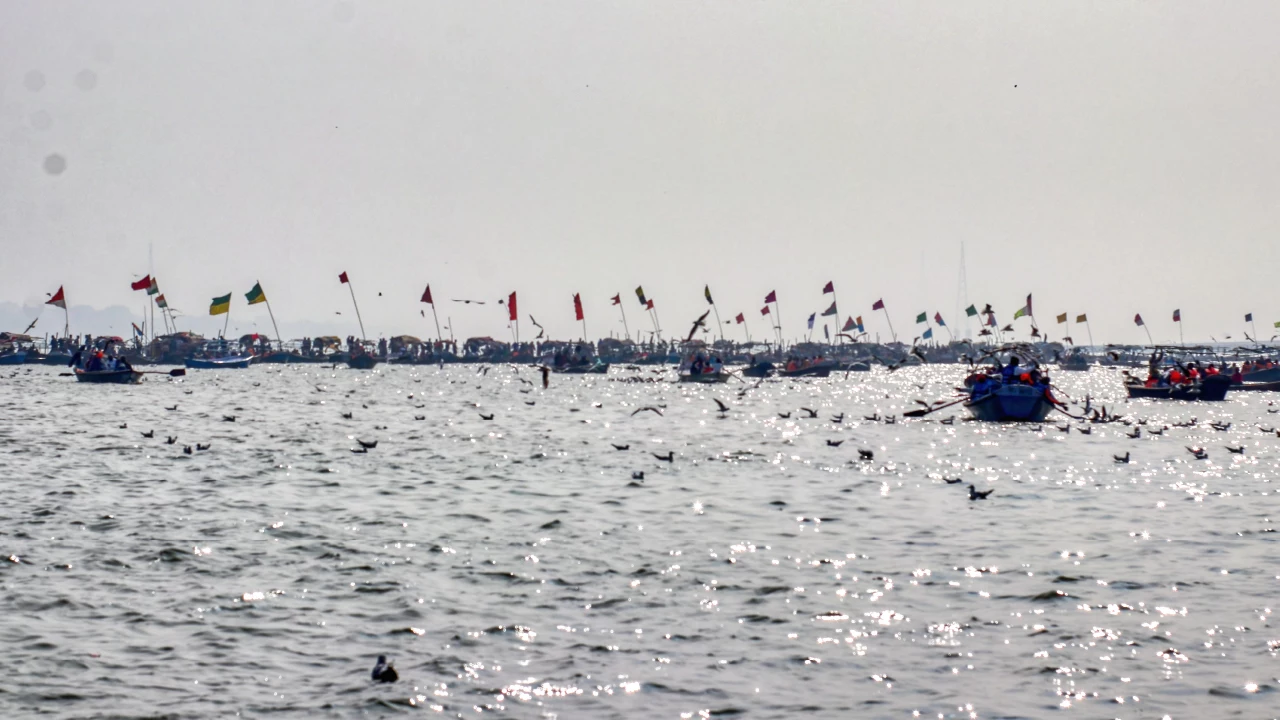
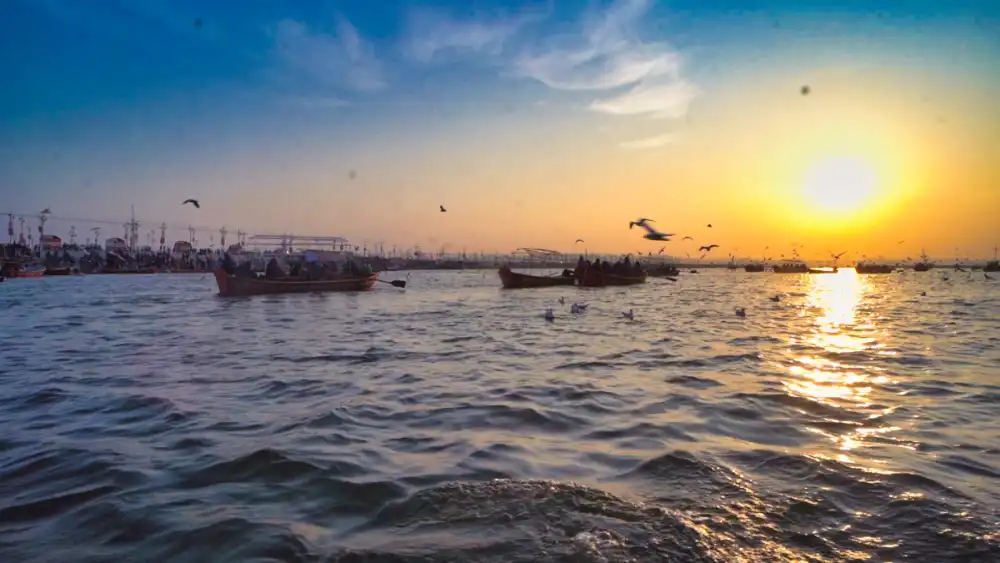
The meeting point is out in the river, not at the steps, so reaching it means taking a boat. A shared seat costs roughly ₹50 to ₹100 per person and a private boat for a family ₹300 to ₹600, higher during Pitrupaksha and the Magh Mela. The boats are wooden and take six to twelve people. It is ten to fifteen minutes out, and a round trip with time at the confluence runs 45 minutes to an hour.
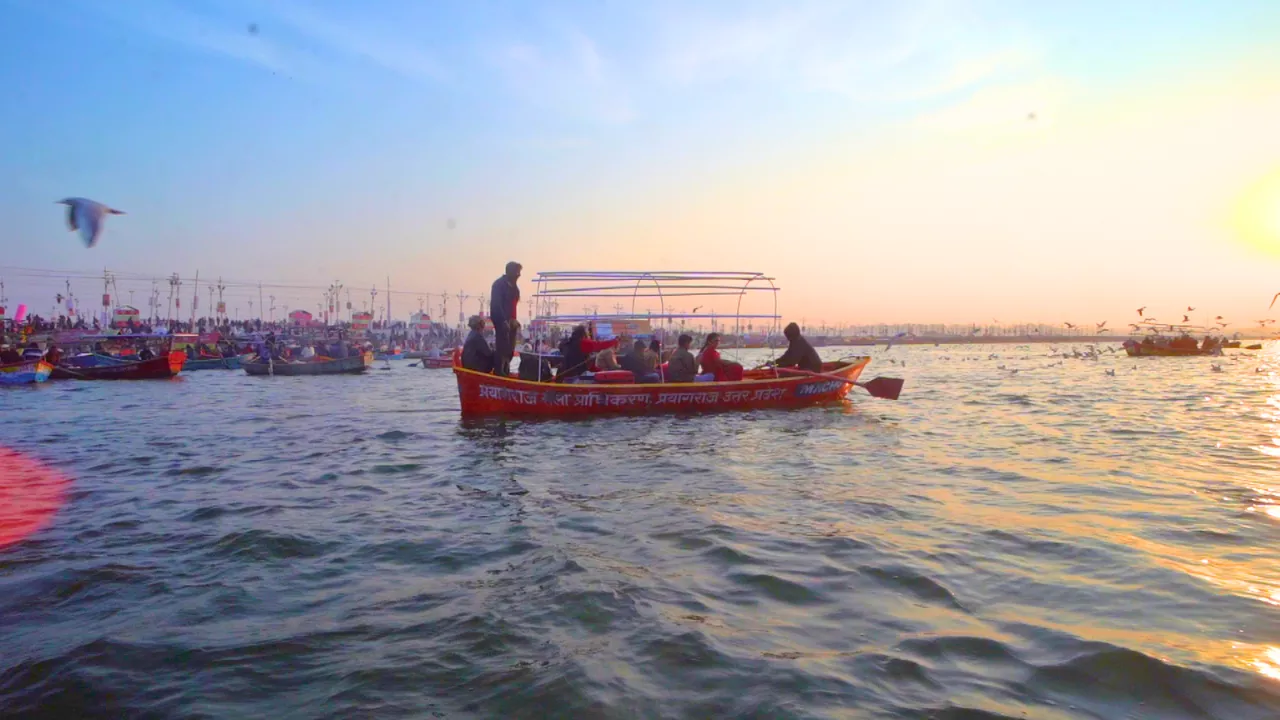
At the confluence the boatman holds the boat steady and pilgrims step down into the water from the side to bathe. Many perform Tarpan from the boat itself. Agree the fare before you get in, and say at the time of boarding if you are coming to perform a rite, because the boat has to wait. On our in-person bookings the boat is arranged with the ritual, so there is nothing to negotiate.
Sangam timings and the best time to visit
The Sangam has no opening hours. The ghats are reachable at any time, and the boats run roughly 6:00 AM to 6:00 PM, closing earlier in July and August when the current is strong. Which hour you want depends on why you are coming.
- Snan. Sunrise to about 9:00 AM. Quietest steps, best light, and the hour the Prayag Mahatmya singles out.
- Pind Daan and Tarpan. The Kutapa Kala, roughly 11:30 AM to 12:30 PM, is the window the Dharmashastra tradition prescribes for ancestral rites. We time bookings to it where the day allows.
- Aarti. Around sunset, between 5:30 and 7:00 PM depending on the season.
| Season | Months | What to expect |
|---|---|---|
| Best | October to February | Cool, colour line at its clearest, Magh Mela in January and February |
| Workable | March to June | Up to 44°C by May. Arrive before 8:00 AM |
| Difficult | July to September | High water, boats to the confluence often suspended |
Pitrupaksha, the sixteen-day fortnight for ancestral rites, falls at the end of that difficult stretch and is the busiest ritual period of the year here. In 2026 it runs from 26 September to 10 October. If you are planning around the city rather than the rite alone, our guide to Prayagraj covers where to stay and what else to see.
How to reach the Sangam
Every auto driver in Prayagraj knows “Sangam Ghat” and “Triveni Ghat”. Either will get you to the point the boats leave from.
| From | Distance | Usual fare or route | Time |
|---|---|---|---|
| Prayagraj Junction | 7 km | ₹80 to ₹120 by auto, ₹15 to ₹30 shared e-rickshaw | 20 to 35 min |
| Prayagraj Rambagh | 4 km | ₹40 to ₹60 by auto | 15 to 20 min |
| Bamrauli Airport (IXD) | 14 km | ₹350 to ₹500 prepaid taxi | 30 to 45 min |
| Varanasi by road | 125 km | NH19 | about 2.5 hr |
| Lucknow by road | 205 km | NH27 | about 4 hr |
Uttar Pradesh Tourism keeps current visitor guidance for the ghats and local accommodation on its Prayagraj page.
Rituals at the Sangam, and booking a pandit
Most families who contact us about the Sangam want one of five rites. All of them are performed at the confluence, and all include the boat out to it.
| Ritual | From | What it is for |
|---|---|---|
| Asthi Visarjan | ₹5,100 | Immersing the ashes after a death |
| Tarpan | ₹5,100 | Water offering to three generations of ancestors |
| Pind Daan | ₹7,100 | Rice-ball offering, the main Pitrupaksha rite |
| Shradh | ₹7,100 | The full ancestral ceremony, Pind Daan and Tarpan together |
| Veni Daan | ₹7,100 | The hair offering, performed only at this Sangam |
A booking includes a Shastri-qualified pandit, the private boat to the confluence, all samagri (rice, til, Kusha grass, ghee, flowers and Gangajal), the Sankalp with your gotra and your ancestors’ names, and a consultation before the day. It does not include travel to Prayagraj, accommodation, professional photography, or a second ceremony such as Narayan Bali or Tripindi Shradh, which are booked separately.
Of the five, Asthi Visarjan is the one with a clock on it. We set out the traditional window and what to do once it has passed in our guide to when to perform Asthi Visarjan in Prayagraj.
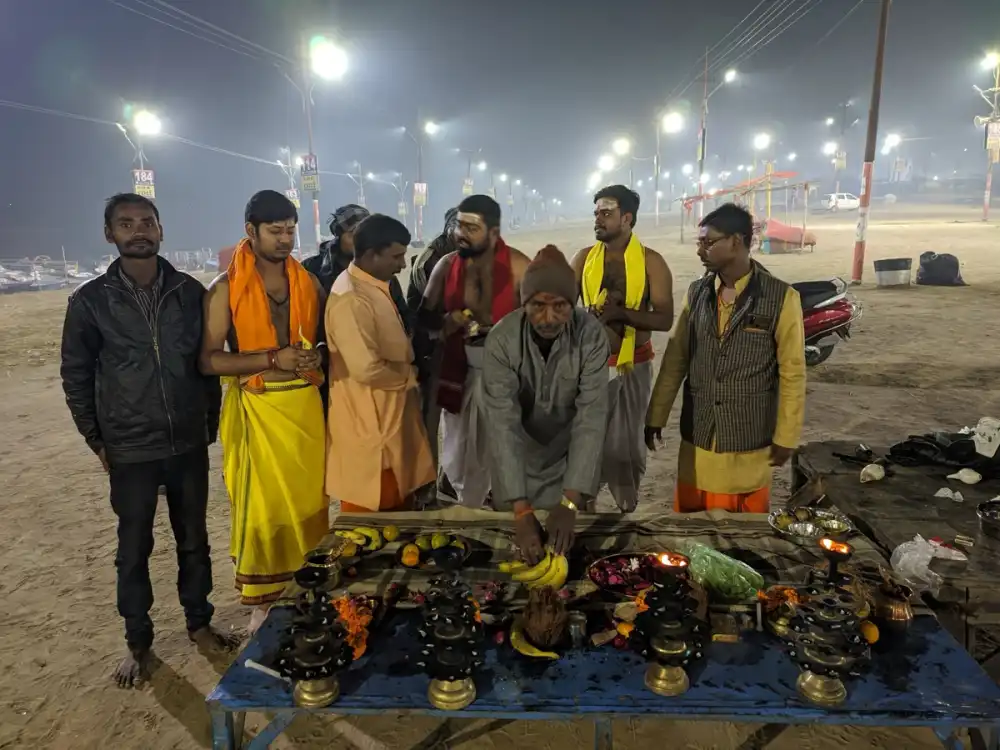
Booking takes four steps. Choose the rite, send us the names and gotra of the ancestors, agree a date and tithi with the pandit on the call, and arrive at the ghat at the time given. A pandit calls you within two hours of the booking.
🙏 Book a ritual at the Triveni Sangam
- Shastri-qualified pandit at the confluence
- Private boat and all samagri included
- Pandit calls you within 2 hours of booking
What we do not do: we do not sell a rite we cannot perform on the date you need, we do not add dakshina or donations to the bill on the day, and we do not promise an outcome. The ritual is performed correctly and completely. What follows from it is not ours to guarantee.
Common questions
What does “Triveni Sangam” mean?
Tri is three and veni is a braid or plait. Sangam is a confluence. The name describes three rivers braided together at one point: the Ganga and Yamuna visibly, the Saraswati by tradition from below.
Can women perform Tarpan and Shradh at the Sangam?
Yes. The older Smriti texts give the rite to male heirs, but daughters, wives and granddaughters perform Tarpan and Shradh at the Sangam regularly, and our pandits conduct the full ceremony for them with the same vidhi.
How long does a Shradh ceremony take at the Sangam?
Two to four hours. Pind Daan with Tarpan takes about two. Adding Sankalpa, Brahmin Bhoj and Navagraha puja takes it to three or four. The boat out to the confluence and back is part of that time.
Do I need to book a pandit before arriving?
During Pitrupaksha and the Magh Mela, yes. The ghats are full and arranging on the day means negotiating in a crowd. Outside those periods a day or two of notice is usually enough to fix a tithi and a boat.
The Sangam has taken families’ prayers, ashes and questions for as long as anyone has kept a record of it, and it asks nothing of a visitor beyond showing up. If you are coming for a rite rather than a look, send us the names and we will arrange the rest: Pind Daan at the Triveni Sangam.
Book Your Sacred Ritual
Authentic ceremonies performed by Veda-trained pandits at sacred sites across India.