Key Takeaways
- Varanasi as a Site of Transformation: The Spiritual Mechanics
- The Concept of Ancestral Healing: What the Scriptures Say
- Karmic Release: How Pind Daan Liberates the Departed
- The Psychological Transformation: Grief, Gratitude, and Continuity
In This Article
There are experiences that change you — not through drama or upheaval, but through a quiet, interior reorganization of what you understand about your place in time. Performing Pind Daan in Varanasi is one such experience. Thousands of families who have stood at the ghats of Kashi with handfuls of sesame-studded pindas describe coming away transformed in ways they struggle to articulate: a settling of old grief, a sense of being seen and witnessed by something larger than the present moment, a strange lightness afterward that persists for days.
This article explores the transformative power of Pind Daan in Varanasi from multiple dimensions — the spiritual mechanics as described in the scriptures, the karmic dynamics of ancestral healing, the psychological dimensions of grief and gratitude, and the experiential testimonies of those who have undergone this sacred rite. It also addresses the deeper question of why Varanasi specifically — why this ancient city with its burning ghats and its relentless proximity to mortality — is uniquely positioned to catalyze this transformation.
For a practical step-by-step guide to performing the ceremony, see our complete navigation guide to Pind Daan in Varanasi. For the comprehensive authority resource on this topic, see Pind Daan in Varanasi: Commemorating Ancestral Souls. This post explores the interior dimension — the why behind the what.
Varanasi as a Site of Transformation: The Spiritual Mechanics
Varanasi, known to the scriptures as Kashi — the City of Light — occupies a position without parallel in Hindu sacred geography. It is said that the city does not stand on the earth but rests on the trident of Lord Shiva. When Pralaya (cosmic dissolution) comes and the entire earth is submerged, Kashi alone floats above the flood. This is not a poetic metaphor in Hindu cosmology — it is a statement about the nature of the space itself: Varanasi exists at a junction point between the manifest and the unmanifest, between the temporal world and the eternal.
The Skanda Purana’s Kashi Khanda describes this at length. The text says that in Varanasi, every ritual action is multiplied manifold because the city functions as a cosmic amplifier. A lamp lit here illuminates more than a lamp lit elsewhere. A prayer offered here reaches further. A ritual performed here — particularly one aimed at the welfare of departed souls — carries exponentially greater force.
The Garuda Purana is even more specific about ancestral rites. It describes the Pitru Loka as a subtle realm where departed souls experience different states depending on the quality of their karma and the quality of attention received from their living descendants. Souls who receive regular Shraddha and Pind Daan offerings are described as nourished, peaceful, and progressing on their onward journey. Souls who are forgotten or neglected are described as restless and hungry, their progress stalled. The act of remembrance — formal, ritualized, sincere remembrance — is not sentimental but cosmologically significant.
The Concept of Ancestral Healing: What the Scriptures Say
Hindu tradition does not treat the dead as simply gone. The concept of Pitru Loka — the realm of ancestors — posits an ongoing relationship between the living and those who have departed. This relationship has both obligations and benefits flowing in both directions. Understanding this bidirectional exchange is essential to understanding why Pind Daan is transformative rather than merely commemorative.
The Debt of Pitru Rin
According to the Manusmriti and the Dharmashastra tradition, every person is born with three primary debts (rins): the debt to the gods (Dev Rin), the debt to the sages (Rishi Rin), and the debt to the ancestors (Pitru Rin). Of these three, Pitru Rin is considered the most foundational — because without the chain of ancestors who lived, loved, and passed on their lineage, the present individual would not exist at all. You owe your body, your family name, your cultural inheritance, and your very life to the succession of people who came before you. Pind Daan is the formal, ritualized acknowledgment and partial repayment of this debt.
When the debt is acknowledged and offerings are made with sincerity, the ancestors are believed to enter a state of tripti — satisfaction and contentment. From this satisfied state, they naturally bestow their blessings upon the family. The Brahma Purana describes this as a natural flow: satisfied ancestors become protectors and benefactors of their lineage, clearing obstacles that might otherwise manifest as difficulties in health, finances, relationships, or progeny.
Pitru Dosha: The Consequence of Neglect
The flip side of ancestral satisfaction is Pitru Dosha — the ancestral affliction that arises when the chain of remembrance and ritual is broken. The texts describe several conditions that can arise from Pitru Dosha: persistent financial difficulties despite effort, unexplained health problems, difficulties in finding a partner or conceiving children, friction and arguments within the family, and recurring patterns of misfortune across generations. These are not punishments administered by angry ancestors — they are described more as energetic imbalances, blockages in the flow of ancestral blessing, that arise from disconnection.
The remedy described consistently across the Puranas is sincere Shraddha and Pind Daan, particularly at a Tirtha (sacred site). Performing these rites at Varanasi is considered one of the most powerful ways to resolve Pitru Dosha, because the sanctity of the site amplifies the ceremony’s healing effect. Many families who have struggled with Pitru Dosha describe a noticeable shift in their family’s trajectory after performing Pind Daan at Varanasi’s ghats.
Karmic Release: How Pind Daan Liberates the Departed
To understand the karmic dimension of Pind Daan, it helps to understand the Hindu conception of the subtle body and its journey after physical death. According to Vedic teaching, the self (atman) continues after physical death in a subtle body (sukshma sharira), carrying with it the accumulated karma of that lifetime and all previous lifetimes. The quality of this karma determines the soul’s experience in the intermediate states between physical lives and its eventual destination.
The Pinda as a Vehicle for the Soul
The pinda — the rice ball prepared and offered during the ceremony — is not merely symbolic. In Vedic ritual science, the pinda is a vehicle: a physical-material offering that, when properly prepared and consecrated with mantras, provides nourishment to the subtle body of the ancestor. The Garuda Purana provides a detailed account of how the 16 pindas offered across the 16 days of Pitrupaksha rebuild the subtle body of the ancestor over the fortnight, providing it with the nourishment and energy needed to continue its journey.
At Varanasi specifically, the Ganges is described as a Devanadi — a divine river whose sacred waters serve as a conduit to the subtle realms. When pindas are released into the Ganges at Varanasi, the offerings are believed to reach the ancestors not merely symbolically but through an actual subtle-plane mechanism facilitated by the river’s sacred nature. The current carries the offering; the mantras direct it; the sincerity of the performer’s intention activates it.
The Shiva-Taraka Mantra and Instantaneous Liberation
Varanasi’s most distinctive contribution to ancestral liberation is the tradition of the Taraka Mantra. The texts say that Lord Shiva himself whispers the sacred two-syllable liberation mantra — Rama — into the ear of every soul that departs within the city’s sacred boundaries. This grants the departing soul immediate liberation, bypassing the normal karmic processing that would otherwise require multiple additional lifetimes.
When Pind Daan is performed at Varanasi for ancestors who did not die there, the tradition holds that the power of the sacred site and the Ganges together can still accelerate the ancestor’s progress significantly. The soul’s journey — which might otherwise take many more cycles — can be advanced or completed through sincere rites performed at this supreme Kshetra. This is the promise at the heart of performing Pind Daan in Varanasi, and it is what draws millions of families here across the generations.
The Psychological Transformation: Grief, Gratitude, and Continuity
Beyond the cosmological dimension, Pind Daan in Varanasi produces a psychological transformation in the living participants that is observable, consistent, and genuinely profound. This is not merely a matter of faith — the psychological literature on grief rituals from across cultures converges on findings that structured, meaningful ritual action accelerates the integration of loss in ways that unstructured grief cannot.
Grief Transformed Into Active Love
One of the most common responses families describe after Pind Daan is a transformation in the quality of their grief. Before the ceremony, grief tends to be characterized by helplessness — a sense that there is nothing more you can do for the one who has gone. After Pind Daan, families frequently describe this shifting to a sense of active participation in the departed soul’s ongoing journey. You are not passive in the face of death — you are actively doing something meaningful. This shift from passive grief to active love is psychologically restorative in a way that few other experiences can match.
The Experience of Ancestral Presence
Many participants in Pind Daan report experiences during the ceremony that suggest the presence of the ancestors is not merely imagined or metaphorical. Crows arriving suddenly and accepting offerings directly from the hand, the unexpected scent of a departed grandparent’s perfume at the ghat, an overwhelming sense of being accompanied — these experiences recur across thousands of testimonies from families of every background and education level. Whether one interprets these experiences in supernatural or psychological terms, their effect on the living participant is the same: a sense of genuine connection across the boundary of death, a feeling that the offering has been received.
Gratitude as a Spiritual Practice
The act of Pind Daan requires you to stop, acknowledge, and name the specific individuals who contributed to your existence. In a culture that increasingly prizes self-sufficiency and forward momentum, this practice of structured backward-looking gratitude is itself a form of healing. During the Sankalpa, when you speak the names of your father, grandfather, and great-grandfather aloud at the banks of the Ganges, you are performing a kind of genealogical prayer — claiming your place in a lineage that extends back through time. This is an act of radical humility and radical gratitude simultaneously, and it produces an interior settling that the word “transformation” only partially captures.
The Significance of the Ganges in Ancestral Transformation
The Ganges is not incidental to Pind Daan in Varanasi — it is central, indispensable, and irreplaceable. The river is described in the Puranas as flowing from the foot of Lord Vishnu in the celestial realm (Vaikuntha), through the matted hair of Lord Shiva, and down to the earth — making it simultaneously a divine conduit connecting all three realms of existence. When you stand in the Ganges at Varanasi performing Tarpan, you are standing in a living bridge between the earthly realm and the ancestors’ realm.
The transformative effect is not only for the ancestors. The Ganges is described as a paapa-nashini — destroyer of sins — whose waters remove karmic residues from the living as well as providing passage for the dead. Many pilgrims describe the physical sensation of immersing in the Ganges as accompanied by a release: of old emotions, of guilt, of grief, of something unnamed that has been carried for a long time. This is entirely consistent with the scriptural description of what the sacred river does.
The morning Ganga Aarti at Varanasi’s Dashashwamedh Ghat — where priests offer fire, flowers, and prayers to the river in a choreographed ceremony visible from the ghats — is one of the most visually spectacular sacred ceremonies in the world. For families who perform Pind Daan in the early morning and then witness the evening Aarti, the day becomes a complete arc: from personal ancestral rites in the dawn light to collective cosmic praise at dusk.
Transformation Across Generations: The Living Beneficiaries of Pind Daan
The transformative power of Pind Daan is not confined to the ancestor receiving the rites or the individual performing them. According to the Puranic tradition, the benefits of Shraddha and Pind Daan ripple outward through the entire lineage — both upward to the ancestors and downward to the descendants.
Blessings for Children and Progeny
The Brahma Purana specifically addresses progeny in the context of ancestral rites, describing how tripta (satisfied) ancestors bestow their blessings on the children and grandchildren of those who perform Shraddha. Families struggling with infertility or with concerns about their children’s wellbeing are often advised by astrologers and pandits to perform Pind Daan at a major Tirtha — and Varanasi is among the most commonly recommended sites for this purpose.
Resolution of Family Patterns
Family systems theory in modern psychology recognizes that certain patterns — of behavior, of relationship, of fortune and misfortune — tend to repeat across generations within families. The Hindu tradition recognized this dynamic thousands of years ago and named it: Pitru Dosha manifests precisely as these repeating patterns. Pind Daan, by addressing the energetic imbalance at its source, can initiate the dissolution of patterns that have persisted for generations. This is not a one-time cure but rather a beginning — the opening of a channel that, when maintained through annual Pitrupaksha observances, gradually clears.
Personal Spiritual Development
The Bhagavata Purana and other texts describe the performance of ancestral rites as one of the key practices through which an individual develops the qualities necessary for spiritual advancement: gratitude, humility, a sense of one’s place in a larger story, and the cultivation of dispassion toward the ego-self. By regularly engaging with the reality of death and impermanence through ancestral rites, the practitioner develops a wider perspective on their own life — one that naturally reduces attachment, envy, and the small grievances that preoccupy ordinary consciousness.
Pind Daan During Pitrupaksha: The Annual Window of Ancestral Access
While Pind Daan can be performed at Varanasi on any day of the year, performing it during Pitrupaksha — the 16-day ancestral fortnight — is described in the scriptures as the most potent opportunity. The Mahabharata contains a passage where the sage Markandeya explains that during this fortnight, the gates between the world of the living and the realm of ancestors are opened, and souls from the Pitru Loka descend to receive the offerings made in their name.
In 2026, Pitrupaksha runs from September 26 (Purnima) to October 10 (Sarva Pitru Amavasya). Performing Pind Daan at Varanasi’s sacred ghats during this window — particularly on the Sarva Pitru Amavasya — combines the power of the most auspicious time of year with the power of the most auspicious place for ancestral rites. The combination is, by scriptural testimony, unmatched for the liberation and blessing of departed ancestors.
Each of the 16 days of Pitrupaksha is associated with a specific lunar tithi and is recommended for those who died on or around that tithi. See the Gaya Pind Daan guide and our collection of Pitrupaksha tithi articles for specific date-by-date guidance on when to perform rites based on your ancestor’s death tithi.
🙏 Pind Daan in Varanasi — Complete Service
The Inner Journey: How Pind Daan Changes the Performer
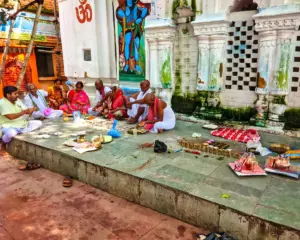
Those who have performed Pind Daan at Varanasi’s ghats consistently describe the experience as a turning point — not because of any single dramatic moment, but because of an accumulation of small things: the weight of the pinda in your palm, the coolness of the Ganges around your ankles, the sound of the priest’s voice carrying the names of those you loved through the morning air, the sight of the pindas slowly dissolving as the current takes them. These sensory details are etched into memory with unusual clarity.
The transformation is rarely sudden. More commonly, participants describe it as a gradual opening over the weeks and months following the ceremony: an unexpected lightness when thinking about a departed parent, a dissolution of lingering guilt about things left unsaid, a sense of having fulfilled a duty that had been quietly weighing on them without their full awareness. The relationship with the departed does not end — it changes quality, from one shadowed by unfinished obligation to one illuminated by gratitude.
This is what the tradition means when it says that Pind Daan is for the benefit of the living as much as the dead. It is the formal completion of a relationship that physical death otherwise leaves permanently suspended. By performing the rites, you give both yourself and the departed permission to continue.
Frequently Asked Questions About the Transformative Power of Pind Daan
Conclusion: The Timeless Exchange Between the Living and the Departed
The transformative power of Pind Daan in Varanasi is not a claim that requires faith to understand — it is visible in the changed faces of those who have performed it, in the testimonies that span cultures and centuries, in the simple fact that this ritual has persisted for thousands of years because something in it genuinely works. It works on the soul of the ancestor, providing nourishment and release. It works on the karma of the lineage, clearing what obstructs and opening what was closed. And it works on the heart of the living person who stands at the ghat and names their beloved dead, making an offering of rice and sesame and love into the ancient river.
Varanasi holds this ceremony in its most potent form because Varanasi is itself a place where the ordinary categories break down — where death and life are not opposites but partners, where the sacred and the mundane are so thoroughly intertwined that distinguishing them becomes impossible. When you perform Pind Daan in Varanasi, you are not just performing a ritual — you are entering a city-sized sacred space that has been doing this work for more than three thousand years.
To book a complete Pind Daan ceremony at Varanasi’s sacred ghats, or to arrange online Pind Daan on behalf of ancestors you cannot visit in person, contact Prayag Pandits. Our pandits have served families at these ghats for generations and will guide your family through every step of this sacred transformation with the care and knowledge it deserves.
Also explore: The Significance of Pitrupaksha in Hindu Traditions | Pind Daan 101: Meaning, Significance, Rituals and Benefits
Book Your Sacred Ritual
Authentic ceremonies performed by Veda-trained pandits at sacred sites across India.