
Key Takeaways
- Why Mathura is sacred
- The main temples
- The Braj circuit in four days
- The festivals
In This Article
Mathura is famous as the birthplace of Krishna — specifically the prison cell of Kansa, preserved inside the Janmabhoomi complex. Beyond that it is known for the Dwarkadhish temple, the Yamuna aarti at Vishram Ghat, the Braj circuit through Vrindavan and Govardhan, a fortnight of Holi that begins with sticks at Barsana, and its peda. It is also one of the seven Sapta Puri cities.
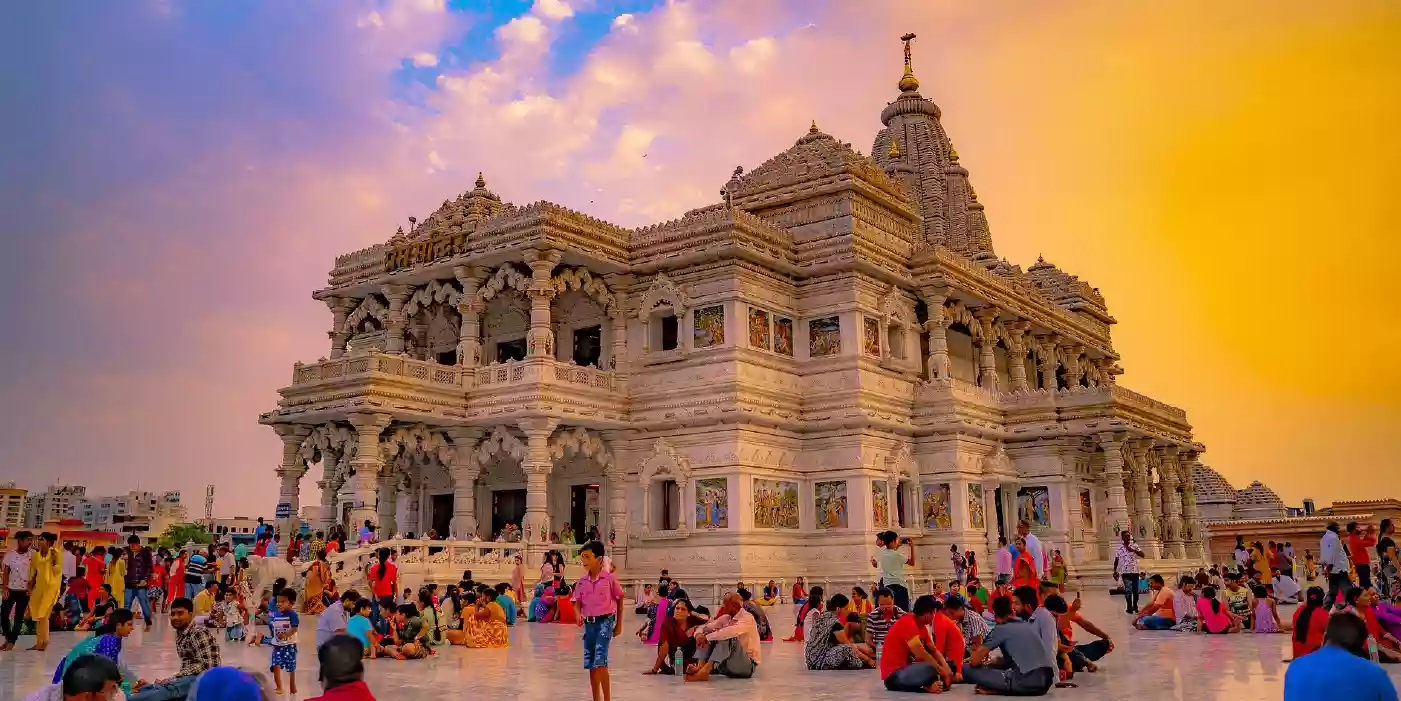
Why Mathura is sacred
Mathura is the janmabhoomi of Krishna, eighth avatar of Vishnu. The Bhagavata Purana, the Vishnu Purana and the Harivamsha all tell the circumstances: Devaki and Vasudeva imprisoned by Kansa, the announcement of the child who would end his rule, and the midnight birth.
It is also one of the Sapta Puri, the seven cities held to grant moksha to those who die in them. The verse is the familiar one:
अयोध्या मथुरा माया काशी काञ्ची अवन्तिका। पुरी द्वारावती चैव सप्तैता मोक्षदायिकाः॥
Ayodhya, Mathura, Maya (Haridwar), Kashi, Kanchipuram, Avantika (Ujjain) and Dwarka — these seven give moksha.
The wider region, Braj Mandal, takes in Mathura, Vrindavan, Govardhan, Barsana, Nandgaon and the villages between them, and nearly every hill, grove and pond in it is attached to an episode from Krishna’s childhood. That is what people mean when they call the geography here a living scripture.
The main temples
Shri Krishna Janmabhoomi
The holiest site in the city — the cell where Krishna is held to have been born, preserved and consecrated inside a larger complex, with the spot marked by a stone platform. The complex also holds the Keshav Dev Mandir, rebuilt more than once after Mughal-era destruction, and a museum of Krishnaite art. Aarti is at dawn and dusk. The midnight aarti on Janmashtami draws hundreds of thousands.
Dwarkadhish Temple
Built in 1814 by Seth Gokul Das Parikh, and one of the larger Vaishnava temples in north India — carved sandstone, a tall spire, and a full ritual schedule. It follows the Pushtimarg tradition established by Vallabhacharya, and the shringar darshan, when the deity is dressed and ornamented, is the one to time your visit for. Holi and Janmashtami here are conducted on a different scale from the rest of the year.
Vishram Ghat
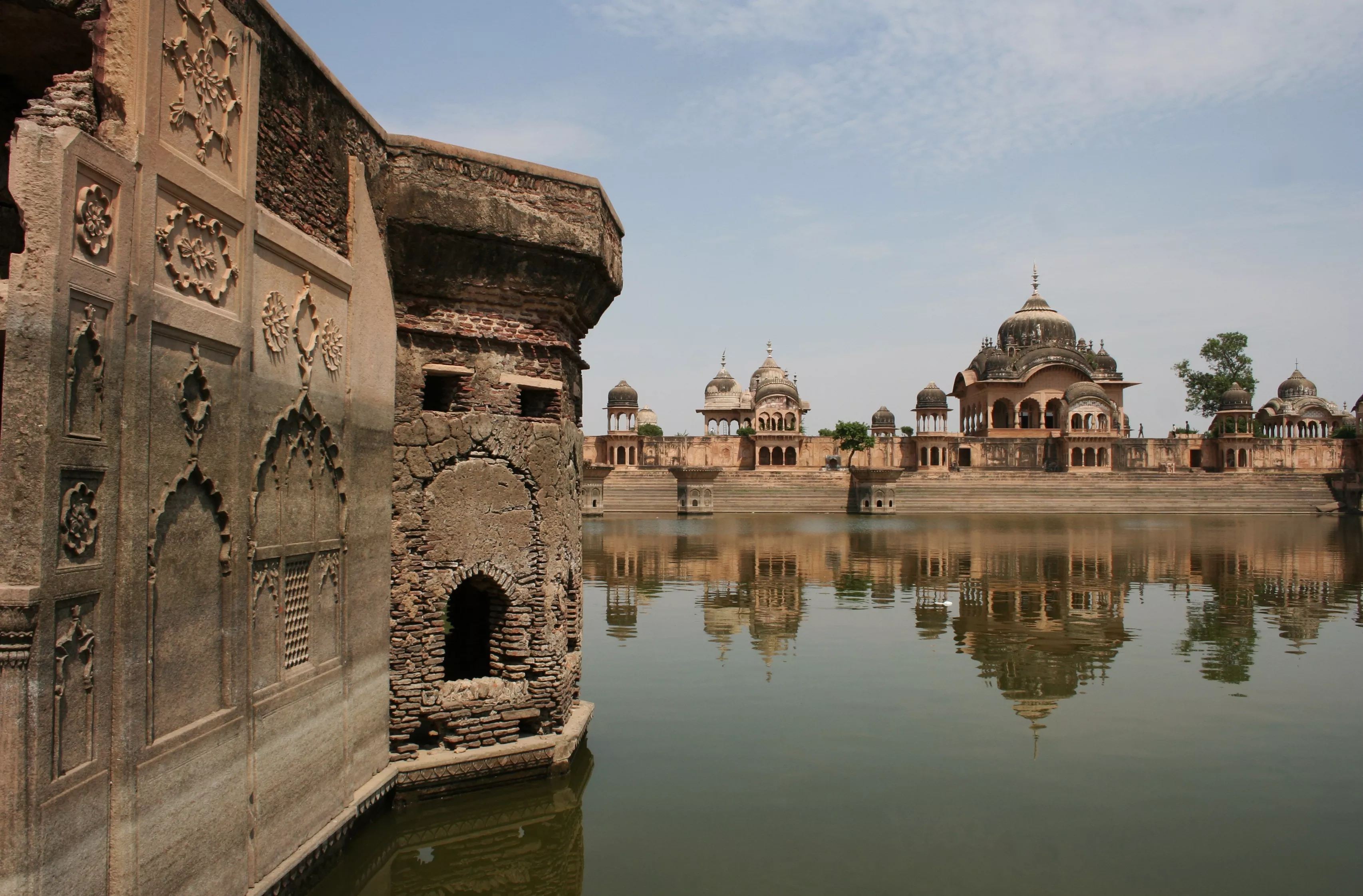
The principal ghat, on the Yamuna, where tradition has Krishna resting — vishram — after killing Kansa. It is lined with temples, and the Yamuna aarti is performed here every evening at sunset with diyas, chanting and conches. Kans Kila and Chakrateertha are the other ghats of note. A dip at Vishram Ghat during Pitru Paksha, Kartik Purnima or Janmashtami is what most pilgrims come for.
Govind Dev Temple, Vrindavan
Fifteen kilometres away in Vrindavan, built in the sixteenth century by Man Singh I of Amber and once described as the tallest temple in India. Its upper storeys were demolished under Aurangzeb; what remains is still the most striking building in Vrindavan. The deity is held to have been carved to resemble Krishna as described by Vajranabha, his great-grandson.
Radha Kund and Shyam Kund
Twin ponds near Govardhan Hill, about 26 km out, which the Bhagavata Purana has Radharani and Krishna making themselves. The Gaudiya Vaishnava tradition regards Radha Kund as the holiest place in creation, above Vrindavan itself. Bathing there on Bahulastami, the eighth day of the dark fortnight of Kartik, is held to carry the merit of countless pilgrimages.
The Braj circuit in four days
Experienced pilgrims do not visit Mathura on its own. The circuit runs like this.
Day one: Mathura
A dip at Vishram Ghat at dawn and the early aarti, then the Janmabhoomi for darshan. After the midday break, Dwarkadhish for the afternoon darshan and the shringar. Back to Vishram Ghat in the evening for the Yamuna aarti.
Day two: Vrindavan
Fifteen kilometres north, where Krishna spent his youth. Banke Bihari, the ISKCON temple, Radha Damodara — where Jiva Goswami lived — and Madan Mohan. Walk through Nidhivan at dusk, which tradition says is where the Rasa still goes on at night.
Day three: Govardhan
The hill Krishna lifted on one finger for seven days and nights to shelter Braj from Indra’s storm. The Govardhan Parikrama, the circuit of the hill, is about 21 km and is the thing devotees come to do. Radha Kund, Kusum Sarovar and Manasi Ganga are on the way round.
Day four: Barsana and Nandgaon
Barsana is Radharani’s birthplace and Nandgaon the village of Nanda Maharaj, where Krishna grew up. Between them they host the Lath Mar Holi, where the women beat the men with sticks in a re-enactment of Krishna teasing Radha and the gopis. The Radha Rani temple on the hill at Barsana has the view over Braj.
The festivals
Janmashtami
Krishna’s birth, on the eighth day of the dark fortnight of Bhadrapada, and the city’s own festival. It starts days ahead with singing, Bhagavata recitation and drama. At midnight — the hour of the birth — a golden cradle holding the infant Krishna is rocked at the Janmabhoomi while the Nanda Nanda Ananda Bhayo hymn is sung. The date moves each year with the tithi, so check a panchang before booking.
Holi
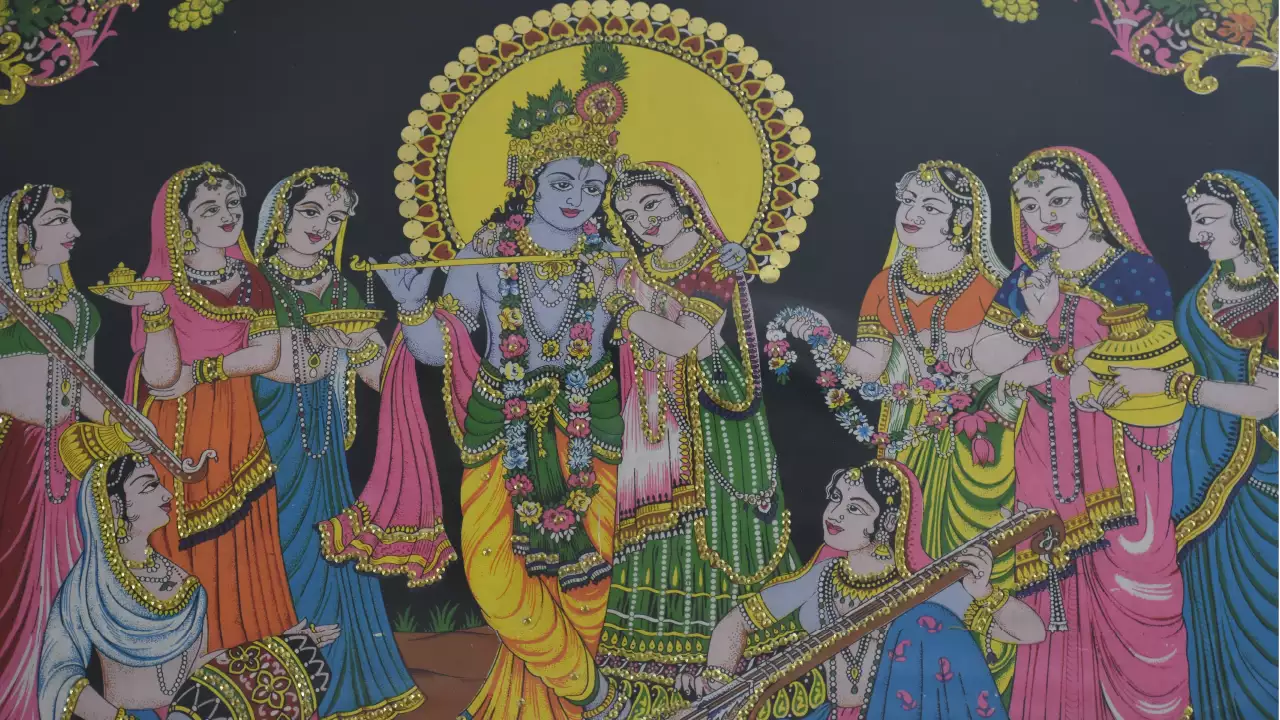
Holi is celebrated everywhere in India and Braj is where it belongs. Here it runs close to a fortnight: Lath Mar Holi at Barsana and Nandgaon first, then the Phoolon wali Holi — played with flowers — at Banke Bihari in Vrindavan, and the colours on the day itself. The meaning given to it is Krishna’s play with Radha and the gopis, so throwing colour is understood as joining the lila rather than marking an anniversary.
The rest of the calendar
- Annakut, or Govardhan Puja. The day after Diwali, when a mountain of food is offered to the hill.
- Radhashtami. Radharani’s birthday, kept with most ceremony at Barsana.
- Sharad Purnima. The autumn full moon, held to be the night of the Rasa Lila, marked with all-night singing.
- Kartik Purnima. Thousands of diyas floated on the Yamuna.
- Basant Panchami. The first day of spring, when Braj is strewn with flowers.
Ancestral rites at Vishram Ghat
Mathura is known for bhakti rather than for ancestral rites, but the Yamuna at Vishram Ghat is used for tarpan, and families in the Vaishnava tradition in particular include Mathura in the Pitru Paksha circuit alongside Prayagraj and Gaya.
Our pandits perform the tarpan and the Pind Daan at the ghat with the sankalp spoken in your gotra. For the wider circuit, see our guides to Pind Daan at Gaya and at Varanasi.
| Rite | Price | Where |
|---|---|---|
| Pind Daan in Mathura | ₹7,100 | Vishram Ghat, on the Yamuna, with tarpan. Was ₹11,000 |
| Online Pind Daan in Mathura | ₹11,000 | Performed on your behalf with a live video link. Was ₹15,000 |
🙏 Book Pind Daan at Vishram Ghat
- Performed on the Yamuna at Vishram Ghat
- Sankalp in your family gotra
- All puja samagri included
- Online option with a live video link
Mathura’s history
Mathura’s history runs well past its association with Krishna. Archaeology puts an important urban centre here by the sixth century BCE, which makes it one of the oldest continuously inhabited cities in the subcontinent.
The Mathura school of art
Between the first and third centuries CE Mathura was the centre of one of the great sculptural traditions of ancient India, working in the red sandstone quarried at Sikri. Its sculptors made some of the earliest images of the Buddha, of the Jain Tirthankaras and of Hindu deities, in a style marked by full figures, thin clinging drapery and a strong sense of physical life. The Government Museum in Mathura holds one of the best collections of it anywhere.
Under the dynasties
Ashoka visited in the Mauryan period and left inscriptions. Under the Kushanas, in the first to third centuries CE, Mathura became a cosmopolitan centre of trade, art and religious exchange. The Chinese pilgrim Xuanzang, here in the seventh century, described a thriving city with many Buddhist monasteries and Hindu temples. The Gupta period was a high point for its temples, and under Chandragupta II its Vaishnava tradition took the form it largely still has. The city then passed through the Rajputs, the Ghaznavids, the Delhi Sultanate and the Mughals.
The Six Goswamis
In the sixteenth century Chaitanya Mahaprabhu sent six of his closest disciples — Rupa, Sanatana, Jiva, Gopala Bhatta, Raghunatha Bhatta and Raghunatha Dasa Goswami — to Vrindavan to find and re-establish the sacred sites of Braj. They wrote extensively on Vaishnava theology, founded temples, and set the Mathura–Vrindavan pilgrimage on the footing it still has for Gaudiya Vaishnavas.
Art, music and the peda
Ras Lila is the dance drama of Krishna’s pastimes, performed by trained troupes in Vrindavan and the Braj villages, and it is a living form rather than a revival.
Dhrupad and haveli sangeet are the temple music traditions of the region — haveli sangeet being the devotional singing of the Pushtimarg temples, tied to the daily cycle of darshan.
The peda is what Mathura is famous for after the temples: a dense milk sweet, cooked down until it browns, sold from shops that have been making it for generations. Buy it near the Janmabhoomi or at Vishram Ghat.
Getting there, and when
By train, Mathura Junction is on the main Delhi–Mumbai and Delhi–Agra lines, with frequent services from Delhi, Agra and Jaipur. By road, it is on the Yamuna Expressway, about three hours from Delhi and an hour from Agra. By air, the nearest airports are Agra, about 60 km, and Delhi, about 180 km.
From Prayagraj, Mathura is five to six hours by road or rail, which makes it a workable two-day extension to a Prayagraj pilgrimage. The Yamuna that is worshipped at Vishram Ghat is the same river that meets the Ganga at the Triveni Sangam, which is the connection families usually have in mind when they pair the two.
When to come. October to March is comfortable. Holi, in February or March, and Janmashtami, in August or September, are the two occasions the city is known for — and both are difficult if you want anything other than the festival. For rites, Pitru Paksha.
Practical notes
- Dress. Arms and legs covered at every temple. Carry a shawl or dupatta.
- Footwear. Off at temples, ghats and many lanes. Bring a bag for it.
- No leather. Many Vaishnava temples here will not admit leather belts, wallets or bags. Leave them at your accommodation.
- Photography. Prohibited in the inner sanctum at the Janmabhoomi and at Banke Bihari, among others.
- Food. Mathura is strictly vegetarian — everywhere, not just near the temples.
- Book the pandit ahead. If you want a puja or tarpan performed during your visit, arrange it before you travel rather than at the ghat.
Common questions
What is Mathura most famous for?
Being Krishna’s birthplace. The Janmabhoomi complex preserves the cell he is held to have been born in, and everything else in the city follows from that.
How far is Vrindavan from Mathura?
Fifteen kilometres north, about half an hour. Most visitors do both.
How many days does the Braj circuit need?
Four covers Mathura, Vrindavan, Govardhan and Barsana with Nandgaon. Two will do Mathura and Vrindavan.
Can ancestral rites be performed at Mathura?
Yes, at Vishram Ghat on the Yamuna. Families often include it in the Pitru Paksha circuit with Prayagraj and Gaya.
Arranging a visit
Tell us when you can travel and whether you need rites performed as well as darshan, and we will confirm the pandit, the ghat and the total before anything is paid. Our note on the Mathura pilgrimage covers the packages, and ancestral rituals at Kashi, Gaya and Prayagraj covers the wider circuit.
Book Your Sacred Ritual
Authentic ceremonies performed by Veda-trained pandits at sacred sites across India.



