Key Takeaways
- What Panchak is
- The five types, named by the day it begins
- What is set aside during Panchak
- When a death occurs during Panchak
In This Article
Panchak is a window of about five days that comes round every twenty-seven, while the Moon passes through the last five nakshatras of the zodiac. Tradition sets certain things aside during it, and where a death falls inside it, a specific rite is performed at the cremation. It is a position in the calendar, not a verdict on a family.
What Panchak is
Panchak means a group of five. It names the stretch when the Moon travels through the last five nakshatras — Dhanishta (its second half), Shatabhisha, Purva Bhadrapada, Uttara Bhadrapada and Revati. In the twelve-sign reckoning that is the Moon crossing Kumbha and Meena, Aquarius and Pisces.
The Moon spends roughly a day in each nakshatra, so a Panchak runs about five days and returns roughly every twenty-seven, which is one lunar circuit of the zodiac. It happens twelve or thirteen times a year. Any panchang will show the exact start and end times for your location.
This is worth holding onto, because it changes how the period reads. Panchak is not a rare or singular event: it occupies about five days in every twenty-seven, which is close to a fifth of the year. Most families have lived through dozens of them without noticing. A death that falls inside one has fallen inside a window that covers a sixth of all the days there are.
The five types, named by the day it begins
Which form a Panchak takes depends on the weekday it starts on, and each name points at the kind of activity the tradition asks you to hold back. This is the classification the panchang uses.
| Begins on | Name | What is traditionally set aside |
|---|---|---|
| Sunday | Rog Panchak | Matters touching health; the name is from roga, illness |
| Monday | Raj Panchak | Dealings with government and authority, and changes of post |
| Tuesday | Agni Panchak | Fire and machinery: construction, moving in, work with furnaces |
| Friday | Chor Panchak | Travel, trade and large money movements; the name is from chora, theft |
| Saturday | Mrityu Panchak | The one named for death, and the one families ask about |
| Wednesday or Thursday | Samanya Panchak | Ordinary. Not one of the five, and carries no special reading |
Two of the seven weekdays produce no named type at all. A Panchak that begins on a Wednesday or a Thursday is Samanya, ordinary, and the tradition attaches none of the five readings to it. Before assuming the worst about a date, check which weekday the period actually began on. Families often discover the window they were worried about was a Samanya one.
What is set aside during Panchak
Five kinds of undertaking are traditionally held back until the window has passed. The list is short and specific, and nothing outside it is affected.
- Beginning something new — a venture, a contract, a signature that commits you.
- Buying a house or laying a foundation, and roof or terrace work on one you already have.
- Marriage ceremonies, and the ceremonies around them such as mundan and upanayana.
- Cremation, which cannot be postponed, and for which the tradition therefore prescribes a rite rather than a delay.
- Long journeys and moving house, particularly travel southward.
Ordinary life is not on that list. Shradh, tarpan, pind daan and the daily observances are performed during Panchak as at any other time — the prohibitions are about beginnings and about the funeral rite, not about ancestral offerings. Our guide to how the Hindu calendar works explains where these windows come from.
When a death occurs during Panchak
This is the question almost everyone arrives here with, so let us answer it the way we would answer it on the phone.
The classical texts treat a death during these five nakshatras as calling for an additional rite at the cremation, and the Muhurta Chintamani and the Garuda Purana both describe it. The verse usually quoted runs Dhanishtha-panchakam grame, Shatabhisha-kulapanchakam, Purvabhadrapada-rathya, Uttara grihapanchakam, Revati gramabahyam cha — assigning each of the five nakshatras a scope: the village, the clan, the street, the household, the land beyond the village.
What that verse does not say is that five people will die. It names a scope, and the commentaries read the “five” as touching those households with difficulty, illness or grief — not as counting out deaths. The same classical sources that describe the concern also list the remedy, which is the clearest sign that the tradition never regarded the matter as fixed. A rite that can resolve something is not a sentence.
You will find that sentence on a great many pages, including, until today, this one. It is not what the texts say and it is not something we will tell a family who has just lost someone. The honest position is this: the tradition asks for a particular rite at the cremation when a death falls in these five nakshatras, and that rite is well documented and straightforward to perform. Anyone who answers your question with a number of deaths and a deadline is selling you something. Ask them which verse they are reading from.
The rite performed at the cremation
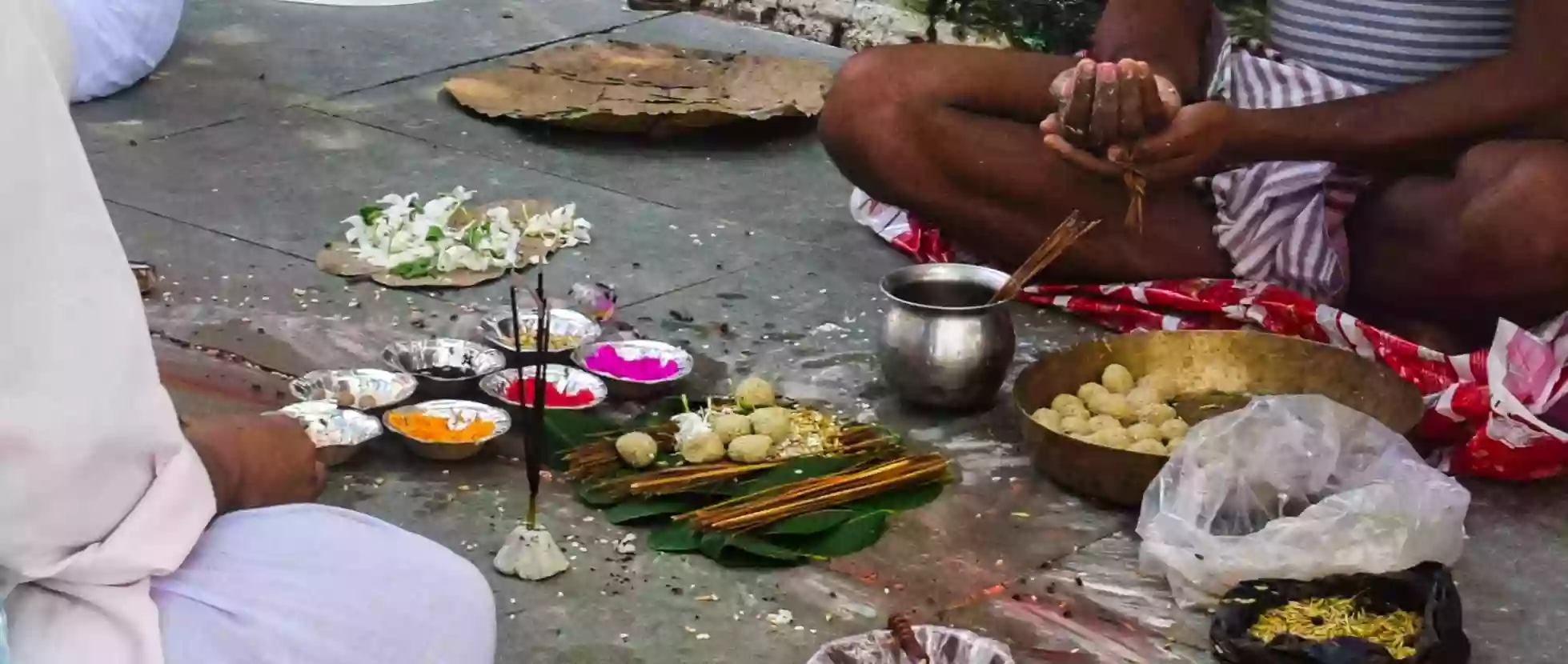
The remedy is specific and old, and it is performed at the cremation itself rather than afterwards. It should be arranged with a pandit who has done it before, because the sequence matters.
- Five effigies are made — putla — from kusha grass, or from wheat or gram flour where kusha is not available. One for each of the five nakshatras.
- Sankalp naming the deceased, the gotra and the nakshatra the death fell in.
- The effigies are placed with the body on the pyre and given the same rites, so that the five scopes the verse names are addressed together with the one death that has actually occurred.
- The nakshatra mantras are recited, one set for each of the five.
- The cremation proceeds in the ordinary way. Where it is possible to perform it at a tirtha, the tradition prefers that, but it is not a condition.
Done at the time, this is the whole of it. Nothing further is required on account of Panchak, and the rest of the family’s observances continue as they would for any death — the sequence set out in our guide to Hindu death rituals.
If the cremation has already happened
Families often learn about Panchak days later, when someone mentions it. The tradition has a path for that too, performed after the fifteenth day and alongside the ordinary shradh observances rather than instead of them.
- Shradh and pitru tarpan, with five effigies of kusha grass and white cotton prepared for the ceremony.
- Prana pratishtha over the five effigies, after which they are given to a river, a tank or the earth near one.
- Rudrabhishek, followed by tarpan.
- Mahamrityunjaya jaap, and nakshatra or navagraha shanti where the pandit advises it.
Where the death was sudden or unnatural, Narayan Bali is the rite the Garuda Purana prescribes, and it is performed within six months where that is possible. It is not specific to Panchak, and it applies whether or not Panchak was running.
Two sources carry most of what is said about Panchak. The Muhurta Chintamani, a sixteenth-century work on the selection of auspicious times, is where the nakshatra rule and the weekday classification are set out. The Garuda Purana, which deals at length with death and the rites that follow it, is where the cremation remedy is described. Both are muhurta and karma-kanda texts: works about when and how to perform rites. Neither is a work of prediction, and reading them as one is where most of the fear around Panchak comes from.
The rites we arrange at Prayagraj
At the Triveni Sangam our pandits perform the cremation-time shanti where a family can reach us in time, and the follow-up rites where they cannot. Alongside those, the ordinary ancestral rites — asthi visarjan, pind daan, shradh and tarpan — are what a family is actually there to do, and they are unchanged by Panchak.
| Ritual | Price | What it covers |
|---|---|---|
| Shanti Pooja at Prayagraj | ₹35,000 | Full vedic shanti with samagri, pandit and brahmin bhojan. Was ₹39,000 |
| Mahamrityunjay Jaap, three days | ₹31,000 | Three days of continuous recitation at the Sangam. Was ₹34,999 |
| Cremation-time Panchak shanti | ask us | Arranged with the pandit on the day; the cost depends on where and when |
If you are arranging a cremation now, message us with the date and time of death and we will check the panchang and tell you whether Panchak applied before you commit to anything.
🙏 Shanti Pooja at the Triveni Sangam
- Full vedic shanti performed at the Sangam
- All samagri, pandit dakshina and brahmin bhojan
- Live video link for families who cannot travel
- Prasad couriered in India and abroad
Common questions
What happens if someone dies during Panchak?
The cremation proceeds as normal, with one addition: five effigies of kusha grass are placed with the body and given the same rites. That is what the tradition asks for. If the cremation has already happened without it, the rite can be performed after the fifteenth day alongside the shradh.
Is it true that five more people in the family will die?
No. The verse that line comes from assigns each of the five nakshatras a scope — village, clan, street, household, beyond the village — and the commentaries read it as difficulty, illness or grief touching those households, not as a count of deaths. The texts that raise the concern also give the remedy.
Can shradh and pind daan be done during Panchak?
Yes. The five prohibitions cover beginnings, building, marriage, travel and the cremation rite. Ancestral offerings are not among them and are performed during Panchak as at any other time.
How do I know whether Panchak is running?
Any panchang lists it, with start and end times for your location, because it is a calculated position of the Moon rather than a matter of opinion. Send us the date and time and we will check it for you.
What about a child born during Panchak?
The muhurta texts are about choosing times for rites, not about judging a birth that has already happened. A birth nakshatra is read as part of the whole chart by someone who has the full details, and nothing useful can be said about a child from the Panchak window alone.
Book Your Sacred Ritual
Authentic ceremonies performed by Veda-trained pandits at sacred sites across India.