
Key Takeaways
- What the scriptures say about Gaya
- The legend of Gayasur
- What Pind Daan at Gaya is
- The three offerings, and why all three
In This Article
Pind Daan is performed at Gaya because the scriptures single it out. The Vayu Purana says the rite here liberates seven generations, and the texts hold that an offering made at Gaya does not need repeating at any other tirtha. That claim is why families travel from across India and abroad to perform it once, properly. You can see what we arrange on our Pind Daan in Gaya page.
What the scriptures say about Gaya
Gaya’s standing does not rest on one text. Four separate sources name it, and they agree on the essential point.
Vayu Purana
The Vayu Purana devotes a section to Gaya mahatmya and states that the rite performed here liberates seven generations of ancestors on both the father’s and the mother’s side. This is the source most often cited when families ask why Gaya rather than anywhere else.
Agni Purana
The Agni Purana treats Gaya shradh as superior to the same rite performed elsewhere, and describes the offering at Vishnupad as completing an obligation rather than merely observing one.
Vishnu Purana and the Mahabharata
Both describe Gaya as a place where the ancestral debt can be discharged. The Mahabharata records the tirtha in its account of pilgrimage, which places the tradition well before the temples standing there today.
The legend of Gayasur
The asura Gayasur performed such severe penance that whoever saw him was freed of their sins. This unsettled the order of things, and the gods asked him to lie down so a yajna could be performed on his body. He agreed, on the condition that the place would become a tirtha where ancestors could be released. Vishnu pressed his foot on him to hold him still, and that footprint is enshrined at Vishnupad today.
The story explains the geography. Gaya is not one shrine but a stretch of ground, because the body it is named for lay across it.
What Pind Daan at Gaya is
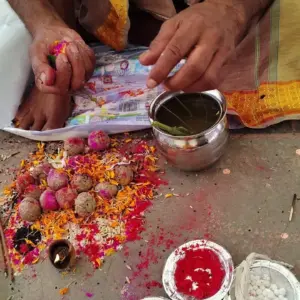
Pind Daan is the offering of pindas, balls of rice mixed with black sesame, barley and honey, made to named ancestors. The pandit speaks a Sankalp naming your gotra and lineage, the offerings are made at the vedi, and the pindas are given to the Falgu or left at the altar. The rite takes two to three hours for a standard observance.
The three offerings, and why all three
Families often arrive expecting one ritual. Gaya shradh is usually three, and they do different work.
- Pind Daan. The offering of form. The pinda stands for the body the departed no longer has, and giving it is what allows the passage onward.
- Tarpan. The water libation. Water mixed with black sesame is offered through the fingers to satisfy the ancestors, and it is the part the family performs with its own hands.
- Brahmin Bhoj. Feeding Brahmins after the rite. The tradition holds that what is given to the living reaches the departed, which is why the meal is part of the offering and not a courtesy after it.
The places that carry the rite
Vishnupad Temple
The temple enshrines the footprint of Vishnu, set in a silver basin. It is the centre of the Gaya rite, and the principal vedi sits within the complex. The present structure was rebuilt in the eighteenth century by Rani Ahilyabai Holkar of Indore. We cover the temple itself in our Vishnupad darshan guide.
The Falgu river
The Falgu runs beside the temple and is dry on the surface for much of the year, with water beneath the sand. Tradition attributes this to a curse spoken by Sita. Families dig a small hollow in the bed to reach water for tarpan, and that act is part of the Gaya rite as it is practised.
Akshayavat
The immortal banyan, where the rite is completed and the pandas confirm the shradh has been performed. Many families treat the blessing taken here as the formal close of the observance. There is more in our note on Akshayavat in the Gaya shradh.
The 45 vedis, and why the whole city is a tirtha
Gaya kshetra holds 45 vedis, altars where pinda may be offered, spread across the town rather than gathered in one compound. This follows from the Gayasur account: the ground itself is the tirtha. Most families offer at the principal vedis, which the texts treat as sufficient. A complete circuit of all 45 is performed over three days and is what families choose when they intend not to return.
Pitru Dosha, and what Gaya is held to do about it
Pitru Dosha is the condition described when ancestral rites have been left undone across generations, and it is traditionally read in a horoscope through the ninth house and the position of Rahu and Ketu. The remedy prescribed is the rite itself, performed properly, at Gaya. We do not promise outcomes, and no honest pandit will. What we will say is what the tradition says: the obligation is discharged by performing it.
Who performs the rite
Traditionally the eldest son performs Pind Daan. In practice the rite is performed by daughters, by younger sons, by grandsons, by a spouse, and by those with no blood relation who nonetheless held a duty of care. If there is no son, the rite is not closed to the family. Tell us the relationship when you book and the pandit will set the Sankalp accordingly.
When to perform it
Pind Daan at Gaya is valid on any day of the year. Pitru Paksha, the fortnight falling in September or October, is when most families come and when the Pitru Paksha Mela fills the town. The rite is also performed on the ancestor’s tithi, on Amavasya, and within the first year of a death as part of the sapindikarana.
Gaya, Prayagraj or Varanasi
All three serve ancestral rites and they are not interchangeable. Gaya is the tirtha named for Pind Daan specifically, and the one the texts say does not require repetition. Prayagraj is the Sangam, chosen for Veni Daan and by families combining the rite with Magh Mela. Varanasi is where Asthi Visarjan is performed at the Ganga, often before Pind Daan rather than instead of it.
Families performing rites in more than one city should say so at the enquiry stage, so the order and the dates can be arranged properly.
What to expect when you go
The rite begins early, often before sunrise, because the vedis are quieter and the day is cooler. You will walk between sites rather than stay in one place. The ground near the Falgu is uneven and the temple steps are worn, which matters if an elder is travelling with you.
- Meet your pandit at the agreed place with the booking reference.
- The Sankalp is spoken, naming the gotra and the ancestors.
- Pindas are prepared and offered at the vedi.
- Tarpan is offered by the family at the Falgu.
- The circuit closes at Akshayavat, and Brahmin Bhoj follows where it is part of the package.
If this is your first time
- Bring the ancestor’s name, your gotra and the date of death if you have it. The Sankalp needs them, and families are often caught out by the gotra.
- Wear simple cotton. Men are usually asked to wear a dhoti for the rite, and one can be arranged.
- Most families observe sattvic food through the stay, avoiding meat, onion and garlic.
- Carry small notes for alms, and expect to walk.
- Book before arriving. Arriving without a pandit is the situation touts at the station rely on.
🕉️ Book Pind Daan in Gaya
- Pind Daan, Tarpan and the full vidhi
- Trained pandit assigned before you travel
- Sankalp in your family gotra and lineage
- All puja samagri included
Common questions
Can Pind Daan be done at Gaya if it was already done elsewhere?
Yes. Families frequently perform it at Gaya after having performed rites elsewhere. The texts treat Gaya as completing the obligation rather than duplicating it.
Can a daughter perform Pind Daan?
Yes. Daughters perform the rite at Gaya, and our pandits conduct it without qualification. Tell us the relationship so the Sankalp is set correctly.
What if the date of death is unknown?
The rite can still be performed. Amavasya or the Pitru Paksha fortnight is used when the tithi is not known, and the Sankalp names the lineage.
What does it cost?
Packages start at ₹7,100 and run to ₹31,000 for the three-day circuit of all vedis. Our Gaya Pind Daan cost guide breaks down each package and the travel, stay and meal budget around it.
Performing the rite at Gaya
If you intend to perform the rite once and have it count, the tradition points to Gaya. Current packages, dates and inclusions are on our Pind Daan in Gaya page, and our team will answer questions on WhatsApp before you commit to anything.
Book Your Sacred Ritual
Authentic ceremonies performed by Veda-trained pandits at sacred sites across India.


