Key Takeaways
- What Is Asthi Visarjan? Meaning and Importance
- What Do the Scriptures Say? — Garuda Purana, Ramayana, and Kurma Purana
- The Story of Bhagirath — Why Ganga Is the River of Liberation
- When Should Asthi Visarjan Be Performed? — Timing and Tithi Rules
In This Article
Asthi Visarjan in English means “immersion of bones” or “sacred ash immersion.” It is the Hindu ritual of collecting the cremated remains of a loved one and immersing them in a sacred river — most commonly the Ganga at Prayagraj, Varanasi, Haridwar, or Gaya — so the departed soul attains moksha (liberation from the cycle of rebirth). The word Asthi (अस्थि) means bones or mortal remains; Visarjan (विसर्जन) means immersion or release into water. This guide covers the complete procedure, timing, samagri, costs, and the most sacred locations for performing Asthi Visarjan in India.
What Is Asthi Visarjan? Meaning and Importance
Asthi Visarjan (अस्थि विसर्जन) is one of the sixteen principal Antyesti (last rites) in Hindu Dharma. The word is formed from two Sanskrit roots — Asthi (अस्थि), meaning bones or the remnants of the physical body after cremation, and Visarjan (विसर्जन), meaning immersion or offering to flowing water. Together, Asthi Visarjan refers to the ritual of immersing the bones, ash, and charred remains of a cremated body into a sacred river, most commonly the Ganga or another holy tirtha.Hindu philosophy holds that the physical body is made of the Pancha Mahabhutas — the five great elements of earth, water, fire, air, and ether. At the time of death, the body is first returned to fire through Dahana (cremation). What remains — the bones and ash — still carries the energetic imprint of the departed soul. For the soul to fully shed its connection with the physical realm and journey forward, those remaining fragments must be returned to flowing, sacred water. The Ganga — and other holy rivers — are believed to be manifestations of divine grace capable of purifying any karma.Without Asthi Visarjan, many Hindu traditions hold that the soul (Atma) lingers in a state of unrest, unable to proceed smoothly to its next stage. It is for this reason that even families who are grief-stricken and exhausted from the immediate rituals of death ensure that Asthi Visarjan is completed within the prescribed time.What Do the Scriptures Say? — Garuda Purana, Ramayana, and Kurma Purana
The importance of Asthi Visarjan is not merely a folk tradition — it is deeply rooted in Hindu scripture. Three major texts speak to this directly.Valmiki Ramayana — Balkand, Chapter 43, Shloka 41The sage Vishwamitra narrates to Lord Rama the story of Ganga Avtaran and its purpose. He says:“O Rama, greatest of the Raghu dynasty — as soon as the waters of Ganga touch the ashes of the departed, the soul obtains Swarga (heaven), for all sins are cleansed by a single touch of Ganga.”This reference places Asthi Visarjan at the very heart of the story of Ganga’s descent to Earth — making it one of the most ancient scriptural justifications for the ritual.Kurma PuranaThe Kurma Purana adds a dimension of time to the merit of Asthi Visarjan:
“For as many years as the ashes of the departed remain in the Ganga, the soul enjoys residence in the heavenly realms for a thousand times that many years.”This is why many families do not simply pour the ashes into the river from a bridge — they perform a boat-based ritual that ensures the ashes settle deeply and remain in the sacred current.Garuda PuranaThe Garuda Purana, which deals most extensively with death, after-death states, and the duties of the living toward the dead, confirms that Asthi Visarjan — ideally at the Triveni Sangam of Prayagraj — is one of the most powerful acts a family can perform for the liberation of a departed soul. The text describes the journey of the soul (Pitra) and the role of water rites in easing that journey.You can explore the translated Garuda Purana at sacred-texts.com for further reading.
The Story of Bhagirath — Why Ganga Is the River of Liberation
To understand why Asthi Visarjan must be performed in sacred rivers — and especially the Ganga — one needs to know the story of Bhagirath and the descent of Ganga from the heavens. This story is told in both the Valmiki Ramayana and the Mahabharata.King Sagar of the Ikshvaku dynasty had 60,000 sons. While performing the 100th Ashvamedha Yajna (horse sacrifice), which would have elevated him to the throne of Indra, the sacred horse was stolen by Indra and tied near the ashram of the sage Kapila Muni. When the 60,000 sons of Sagar went looking for the horse and found it there, they mistook Kapila Muni — who was deep in meditation — as the thief and attacked him with great force.Kapila Muni, disturbed from his tapas, opened his eyes in anger, and the 60,000 sons of Sagar were instantly reduced to ash. Their souls, destroyed by the wrath of a rishi in an act of unrighteous violence, could not proceed to any higher realm. They were trapped, restless.Anshuman, the grandson of King Sagar, approached Kapila Muni with great humility and asked how the souls of his ancestors could be freed. Kapila Muni replied that only the waters of Ganga Devi — then flowing in the heavens — could cleanse the ashes and grant the 60,000 souls liberation.Three generations performed extraordinary tapas to bring Ganga to earth. Anshuman tried and failed. His son Dilip tried and failed. Then came Bhagirath, who performed such intense austerities that Lord Brahma granted his wish — but warned that the force of Ganga’s fall from the heavens would destroy the earth unless someone could bear the impact.Bhagirath then worshipped Lord Shiva, who agreed to receive Ganga in his matted locks (jata) and release her gently. Ganga descended, flowed through Shiva’s hair, and followed Bhagirath’s chariot across the earth. When her waters touched the ashes of the 60,000 sons of Sagar, they were instantly purified and their souls ascended to Swarga.This is the origin of Asthi Visarjan. Every family that brings the ashes of their departed to the Ganga is following the footsteps of Bhagirath, using sacred water to grant liberation to a soul they love. The Ganga is called Bhagirathi to this day in his honour. Read more about the spiritual significance of Prayagraj, where this sacred river meets the Yamuna and the invisible Saraswati.When Should Asthi Visarjan Be Performed? — Timing and Tithi Rules
The ideal timing of Asthi Visarjan is a question that troubles many families, particularly those who need to travel long distances to reach a tirtha.General rule: Asthi Visarjan should ideally be performed within 3 days (72 hours) of cremation. However, most texts and practising pandits acknowledge that this is not always practical, especially for joint families where members may be coming from different cities or even different countries.Extended window: The shastras permit Asthi Visarjan to be performed up to 10 days after cremation — coinciding with the 10-day Antyesti period during which the Pinda Dana rites (Dashagatra) are performed for the departed. Many families combine this ritual with the Dashami Kriya.Up to one year: If circumstances prevent earlier performance, Asthi Visarjan can be done within one year of the death. Some families wait until Pitrupaksha (the 15-day period of ancestral rites in the lunar month of Bhadrapada, typically September-October) to perform it in a dedicated and concentrated manner. In 2026, Pitrupaksha begins on September 26 and ends on October 10.Auspicious Tithis: Amavasya (new moon) days are considered especially powerful for all ancestral rites, including Asthi Visarjan. However, Asthi Visarjan is not restricted to Amavasya — any day is acceptable with proper pandit guidance.What to avoid: Avoid performing Asthi Visarjan during Sutak (period of ritual impurity, typically 10-13 days for close relatives), or during Sankranti unless a qualified pandit advises otherwise.Where to Perform Asthi Visarjan in India — Best Sacred Locations
The location of Asthi Visarjan matters greatly in terms of scriptural merit (Punya). While any flowing, clean river is acceptable, certain tirthas confer far greater liberation on the departed soul.1. Prayagraj — Triveni Sangam (Most Auspicious)
Prayagraj holds the supreme position among all Asthi Visarjan sites in North India. At the Triveni Sangam, the Ganga, the Yamuna, and the subterranean Saraswati converge — and the Puranas describe this confluence as a place where sins accumulated over multiple lifetimes are dissolved. The Brahma Purana calls Prayagraj the “Tirtha Raja” — the King of all tirthas.For Asthi Visarjan, the ashes are immersed by boat at the Sangam itself — the precise point where the three rivers meet. The ritual is performed with full Vedic mantras by a Tirth Purohit (hereditary pandit of the tirtha). Book the Asthi Visarjan in Prayagraj service, which includes a boat ride to the Sangam point, pandit services, and all required samagri. For families seeking a more comprehensive package with accommodation, explore the Prayagraj Asthi Visarjan Package (2D/1N).2. Varanasi (Kashi)
Kashi is the city of Shiva and the city of Moksha. Those who die in Varanasi are said to receive Moksha directly — and those whose ashes are immersed in the Ganga here receive liberation that extends across multiple lifetimes. The most sacred ghats for Asthi Visarjan in Varanasi are Manikarnika Ghat and Harishchandra Ghat — both active cremation ghats where the fire is said to have burned continuously since the time of the Puranas. Read about the complete Asthi Visarjan in Varanasi ritual.Book the Asthi Visarjan in Varanasi service with full pandit assistance. If you are combining this with a visit to the city, the Varanasi Asthi Visarjan Package (2D/1N) is recommended.3. Haridwar — Har Ki Pauri
Haridwar is the point at which the Ganga descends from the Himalayas to the plains — a transition point of immense spiritual power. Har Ki Pauri, the most sacred ghat in Haridwar, is where the Ganga is said to flow at maximum purity and divine charge. Asthi Visarjan at Haridwar is particularly popular with families from Punjab, Haryana, Himachal Pradesh, and Delhi NCR due to its proximity. Book Asthi Visarjan in Haridwar with an experienced pandit.4. Garh Mukteshwar (Garh Ganga)
Located about 100 km from Delhi in Hapur district of Uttar Pradesh, Garh Mukteshwar is one of the oldest Ganga tirthas mentioned in the Puranas. The name itself — Garh Mukteshwar — means “the fortress city of the Lord of Liberation.” It is especially popular among families from western Uttar Pradesh, Delhi NCR, and Haryana who want to perform the ritual without travelling to Haridwar or Prayagraj. Read the full history and significance at Garh Ganga — the Story Behind. Book the Asthi Visarjan at Garh Ganga service.5. Asthi Visarjan by Courier — For Remote Families
Many families, particularly those living abroad or in remote areas, find it impossible to physically carry the ashes to a tirtha. In such cases, Asthi Visarjan by courier or post is a recognised option where the ashes are sent to a qualified pandit at the tirtha who performs the ritual on the family’s behalf. This is different from online Asthi Visarjan (see below) in that the family sends the physical ashes rather than a representative performing the ritual at the site.Online Asthi Visarjan — For NRIs and Families Who Cannot Travel
For families unable to travel to India — whether due to distance, health, work constraints, or visa issues — online Asthi Visarjan is a deeply respectful and scripturally valid alternative. A qualified pandit from Prayag Pandits performs the complete vidhi at the sacred site, while the family participates via video call in real time.Online services are available at all four major tirthas:- Online Asthi Visarjan in Prayagraj — at the Triveni Sangam, the most auspicious site
- Online Asthi Visarjan in Varanasi — at the sacred ghats of Kashi
- Online Asthi Visarjan in Haridwar — at Har Ki Pauri on the Ganga
- Online Asthi Visarjan in Garh Mukteshwar — a sacred Ganga tirtha 100 km from Delhi
Asthi Visarjan Vidhi — Step-by-Step Procedure
The procedure for Asthi Visarjan follows a prescribed sequence that may vary slightly by caste, gotra, and region. The following is the general Vedic procedure followed by most North Indian Hindu families.Step 1 — Collection of Asthi (Bones and Ash)
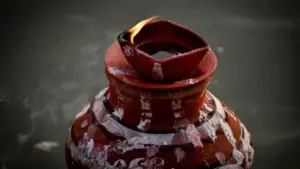
After cremation, the family waits for the funeral pyre to cool down — typically overnight (though in some traditions, the collection happens on the third day, called Teesra or Teeji). The bones, teeth, and remaining ash are carefully collected. A clay pot (Kalash or Ghada) lined with sesame seeds (til) and Ganga jal is used to store the collected remains.The Kalash is covered with a red cloth and placed carefully — it should never be set directly on the ground during transport. In traditional practice, the eldest son (or another male family member) carries the Kalash on his head or holds it at chest height throughout the journey to the tirtha.Step 2 — Journey to the Tirtha
The family travels to the sacred site. During travel:- The Kalash must not touch the ground at any point
- The family member carrying the Kalash should ideally maintain silence or chant the name of Vishnu or Shiva
- Traditional practice requires the carrier to wear a white dhoti (for men) or simple white clothing
- Do not eat non-vegetarian food or consume intoxicants before or during the journey
Step 3 — Sankalpa (Ritual Intention-Setting)
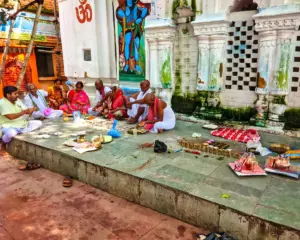
Upon reaching the tirtha, the pandit performs the Sankalpa — a formal declaration of the intention of the rite. The family member gives their name, gotra (lineage), and the name and gotra of the departed. The pandit invokes the deity of the river (Ganga Mata or the presiding deity of the tirtha) and the departed soul, establishing the spiritual framework for the rite.Step 4 — Puja and Mantra Recitation
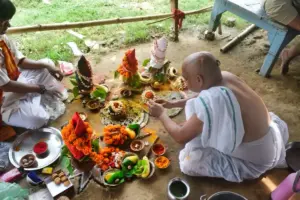
The pandit performs a puja (worship) of the river, offering flowers, Ganga jal, and other items. Key mantras recited during Asthi Visarjan include:- Ganga Stotram — invoking Ganga Devi as the purifier of ancestral karma
- Pitru Mantra — calling upon the departed soul to receive the offering of liberation
- Tarpan Mantras — water oblations offered in the name of the departed and their ancestors going back three generations
Om Namah Shivaya | Gange cha Yamune chaiva Godavari Saraswati | Narmade Sindhu Kaveri, jalesmin sannidhim kuru ||
Step 5 — Asthi Visarjan (The Immersion)
The family member who carried the Kalash, along with close male relatives, enters the river (if safe and accessible) or goes by boat to the immersion point. The ashes and bones are slowly poured into the flowing river with full mantra recitation by the pandit. In some traditions, the family member holds the Kalash at chest height and tilts it slowly toward the water while the mantra is being chanted.At Prayagraj, the immersion is performed by boat at the actual Sangam point — where the colours of the Ganga (greenish) and Yamuna (darker blue-grey) are visibly distinct, marking the precise confluence.Step 6 — Tarpan and Concluding Rites
After the immersion, Tarpan is performed — water mixed with sesame seeds, kush grass, and flowers is offered three times in the name of the departed, while facing south (the direction of the ancestors). The pandit recites the Pitru Tarpan mantras. The empty Kalash is typically placed in the river as well.The family then takes a bath (Snan) in the holy river to complete the ritual purification. After returning to the bank, they make a donation (Dakshina) to the pandit and offer food to the needy or to Brahmins, which is considered an act of Punya that benefits the departed soul.Samagri List for Asthi Visarjan — What You Need to Bring
If you are travelling to a tirtha to perform Asthi Visarjan independently, here is a list of the items typically required. Note that when you book through Prayag Pandits, all samagri is arranged by the pandit — you only need to bring the Kalash with the ashes.- Kalash (clay or copper pot) with the collected bones and ash — covered with red cloth
- Ganga jal (if not already in the Kalash)
- Sesame seeds (til / kala til)
- Kush grass (darbha)
- White flowers — particularly white marigolds or lotus if available
- Tulsi leaves
- Rice (akshat)
- Chandan (sandalwood paste)
- Incense sticks (agarbatti)
- Ghee (clarified butter)
- White dhoti for the male family member performing the rite
- Dakshina (cash offering for the pandit) — the amount varies; discuss with the pandit in advance
- If performing Pind Daan along with Asthi Visarjan: rice flour (atta), barley (jau), sesame, honey, and water for the Pindas
Rules and Restrictions During Asthi Visarjan
- Who performs the rite: Traditionally, the eldest son of the deceased is the primary performer (Kartaa). If there is no son, the next of kin — daughter, son-in-law, nephew, or brother — can perform the rite. In the absence of any male relative, a female family member may perform it in many traditions today.
- Sutak (impurity period): Close relatives observe Sutak for 10-13 days. The Asthi Visarjan should ideally be completed after the Sutak period, but if performed within the first 10 days, it can be done under the guidance of a qualified pandit who will prescribe appropriate purification rites.
- Diet: The Kartaa and other family members should eat only vegetarian, sattvic food during the period of last rites. Non-vegetarian food, alcohol, and onion-garlic are prohibited.
- Clothing: White clothing is the norm for Asthi Visarjan. Avoid colourful or festive clothes.
- The Kalash must not touch the ground: At no point during transport to the tirtha should the Kalash be placed on the ground.
- Do not delay beyond one year: If Asthi Visarjan has not been performed within one year of death, certain additional purification rites may be required. Consult a pandit.
- Caste-specific customs: Different communities have slightly different customs — the mantras, the duration, and certain procedural details may vary by caste and gotra. A knowledgeable Tirth Purohit who is familiar with regional and caste-specific customs is essential.
Asthi Visarjan in Prayagraj — Why the Triveni Sangam Is the Best Choice
Among all the tirthas in India, Prayagraj’s Triveni Sangam holds a unique distinction. The Brahma Purana states that Prayagraj is equal to all tirthas combined — “Prayagasya Samatulyam Tirthantam Nasti Bhutale” — there is no tirtha on earth equal to Prayag. The Skanda Purana similarly calls it the Tirtha Raja, the king of all tirthas.At the Triveni Sangam, three rivers converge. The Ganga and Yamuna are visible; the Saraswati flows underground. The meeting of these three divine rivers creates a field of extraordinary spiritual energy. For Asthi Visarjan, the ashes placed at this Sangam are believed to be simultaneously accepted by the power of all three rivers — multiplying the liberation effect.The immersion at Prayagraj is done by boat, reaching the precise Sangam point. This ensures that the ashes enter the confluence itself rather than the bank area. The ritual is typically performed in the early morning hours (Brahma Muhurta or Pratah Kaal) for maximum effect.After Asthi Visarjan, many families also perform Pind Daan at Prayagraj as a combined ancestral rite. The Prayagraj Asthi Visarjan Package (2D/1N) covers both rituals along with accommodation at a comfortable dharamshala near the Sangam.What Happens After Asthi Visarjan? — Continuing Duties to the Departed
Asthi Visarjan is not the final act in the sequence of ancestral rites. After the immersion, the family’s duties to the departed soul continue through several observances:Pind Daan: The offering of rice balls (Pindas) accompanied by Tarpan is the core of all ancestral rites. Pind Daan can be performed at the same site as Asthi Visarjan or at a dedicated Pind Daan tirtha like Gaya. Learn everything about Pind Daan — all you need to know.Masik Shradh: Monthly Shradh rites — performed on the tithi of the death date each lunar month — continue for one year after the death.Annual Shradh: On the death anniversary (Varshik Shradh) and during Pitrupaksha each year, the family performs Shradh and Tarpan for all departed ancestors.Pitrupaksha: The 15-day period dedicated to ancestral rites, occurring in Bhadrapada (August-September). This is the most powerful time of year for ancestral rites. In 2026, Pitrupaksha runs from September 26 to October 10. Many families who were unable to perform Asthi Visarjan earlier choose to do so during Pitrupaksha.Narayan Bali and Nagbali: In cases of accidental death, suicide, or death in unusual circumstances, additional rites called Narayan Bali may be required before the soul can proceed peacefully. A qualified pandit can advise on whether these are needed.Combining Asthi Visarjan with Pind Daan — A Complete Ancestral Pilgrimage
Many families plan a complete ancestral pilgrimage that combines Asthi Visarjan at Prayagraj or Varanasi with Pind Daan at Gaya — the three principal tirthas for ancestral rites in North India. This is called a Teerth Shradh circuit and is considered highly meritorious.A typical circuit might be:- Day 1-2: Prayagraj — Asthi Visarjan at Triveni Sangam + Pind Daan at Prayagraj
- Day 3-4: Varanasi — Ganga Aarti, Kashi Vishwanath darshan, optional Shradh at Varanasi
- Day 5-6: Gaya — Pind Daan at Gaya (Vishnupad Temple, Akshayavat, Falgu River)
Ready to Perform Asthi Visarjan? We Can Help
Prayag Pandits arranges complete Asthi Visarjan services across India — Prayagraj, Varanasi, Haridwar, Gaya, and Garh Mukteshwar. Packages include experienced Pandits, all Pooja Samagri, and boat arrangements where needed. Odia families from Odisha also have a dedicated guide comparing all three options — see our article on asthi visarjan in Odisha covering Puri, Jajpur and Prayagraj.
🙏 Asthi Visarjan Services Across India
Related Ancestral Services
After Asthi Visarjan, many families also perform these rituals for complete ancestral liberation:
- Narayan Bali Puja — ₹31,000 (recommended if death was unnatural or premature)
- Tarpan at Triveni Sangam — ₹5,100 (water offering for ancestral peace)
- Pind Daan in Prayagraj — ₹7,100 (sacred rice ball offering at Sangam)
View all puja services and pricing across 7+ sacred cities →
Book Your Sacred Ritual
Authentic ceremonies performed by Veda-trained pandits at sacred sites across India.