Key Takeaways
In This Article
Of all the sacred acts a son can perform for his ancestors, Pind Daan in Gaya stands at the pinnacle. The city of Gaya in Bihar is not merely a pilgrimage destination — it is the most spiritually charged site on Earth for ancestral liberation rites. Every year, hundreds of thousands of devout Hindus travel to this ancient city to offer pind — balls of cooked rice mixed with sesame seeds and milk — at the banks of the Falgu River and within the sanctum of the Vishnupad Temple. They come carrying the weight of grief, the burden of ancestral debt, and the hope that their departed loved ones will finally attain Moksha — release from the endless cycle of birth and death. Pind Daan in Gaya is that bridge between the world of the living and the realm of the ancestors, and its significance has been affirmed by the most revered of Hindu scriptures for thousands of years.
What is Pind Daan? Understanding the Sacred Ritual
Pind Daan is a Sanskrit term composed of two words: pind (a ball-shaped rice offering) and daan (charitable giving or offering). Together, they describe the act of offering consecrated rice balls to the souls of departed ancestors during a ritual known as Shradh or Pitru Karma. This is not a casual religious observance — it is one of the most sacred obligations in the entire spectrum of Hindu dharma.
According to Hindu cosmology, after death, the soul passes through multiple planes of existence before reaching its final destination. The Garuda Purana describes in detail how ancestral souls (pitru) may become trapped in intermediate states — neither fully liberated nor reborn — particularly if they died in difficult circumstances, harboured unfulfilled desires, or did not receive proper funeral rites. The pind offering serves as spiritual nourishment for these souls, providing the energy they need to complete their journey toward liberation.
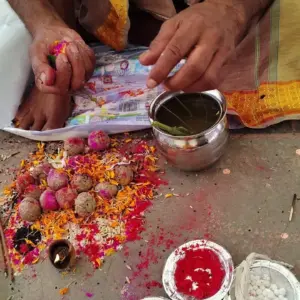
The ritual involves offering rice balls (pind) mixed with black sesame seeds (til), cow’s milk, honey, and barley flour at sacred water bodies or specific ritual platforms (pind vedis). These offerings are accompanied by Vedic mantras chanted by qualified priests, prayers for the peaceful liberation of the departed, and libations of water (tarpan). For a comprehensive understanding of the complete meaning, significance, and benefits of Pind Daan, our dedicated guide covers the entire tradition in depth.
Why Gaya is the Holiest Place for Pind Daan in Gaya
India has thousands of sacred sites where ancestral rites may be performed — from the ghats of Varanasi to the confluence at Prayagraj, from Haridwar to Rameshwaram. Yet none commands the reverence that Pind Daan in Gaya commands. The reason lies in a convergence of scriptural authority, mythological history, and the direct blessing of Lord Vishnu himself.
The Vayu Purana, one of the eighteen major Puranas, contains an entire chapter — the Gaya Mahatmya — devoted exclusively to explaining why Gaya surpasses all other pilgrimage sites for ancestral rites. It states that even a brief ritual performed at Gaya is worth hundreds of Shradh ceremonies performed elsewhere. The Mahabharata records that the sage Agastya declared: “One who performs Pind Daan at Gaya liberates not only his parents but all his ancestors going back twenty-one generations.” The Garuda Purana adds that performing Gaya Shradh nullifies even the most severe ancestral curses (pitru dosha) and removes obstacles from the lives of descendants.
The Legend of Gayasura — Scriptural Foundation of Pind Daan in Gaya
To understand why Pind Daan in Gaya carries such extraordinary power, one must know the story of Gayasura — one of the most remarkable figures in Hindu mythology.
Gayasura was a daitya (demon) of exceptional virtue and piety. Unlike most demons in the Puranas, Gayasura was not malevolent — he was extraordinarily devoted to Lord Vishnu and performed such intense austerities (tapasya) that his body itself became imbued with divine purity. Indeed, his body became so holy that whoever touched it or walked near it was instantly purified and liberated from all sins. The gods grew alarmed — if everyone was automatically attaining liberation simply by proximity to Gayasura, the cosmic order would be disrupted, as the natural process of karma, learning, and gradual spiritual evolution would be bypassed.
The gods approached Lord Vishnu for help. Vishnu, along with all the major deities, descended and requested Gayasura to sacrifice his body for the benefit of the world. Gayasura — in the ultimate act of devotion — agreed. He lay down and allowed the gods to place a divine stone (Dharmasila) upon him to hold his body still. But as the ritual of consecration proceeded, the stone began to tremble — Gayasura’s body was still pulsating with life. Various gods attempted to stabilize it, but none had sufficient divine weight. Finally, Lord Vishnu himself stepped forward and placed his foot upon the Dharmasila. At that moment, Gayasura was fully subdued.
Before passing from this world, Gayasura asked one final boon: that his body remain a tirtha (sacred site) for all time, and that any ancestral offering made at this site would guarantee liberation for the souls of the departed. Vishnu granted this boon in full. The footprint of Lord Vishnu pressed upon the Dharmasila is preserved to this day within the Vishnupad Temple in Gaya — making this the most sacred pind vedi on earth.
Step-by-Step Process of Pind Daan in Gaya
The process of performing Pind Daan in Gaya is a structured multi-stage ritual. Traditionally, the complete Gaya Shradh spans three to seven days, during which the performer visits multiple sacred sites and completes offerings at each. However, a condensed one-day or single-ceremony version is widely accepted for those who cannot complete the full sequence.
- Sankalpa (Sacred Vow): The ritual begins with the sankalpa — a formal declaration of intent before the presiding pandit. The performer states his name, gotra (family lineage), the names of the ancestors on whose behalf the ritual is being performed, and the specific purpose of the ceremony. This establishes the spiritual contract of the offering.
- Tarpan at the Falgu River: The next step is tarpan — offerings of water mixed with sesame seeds and barley, poured into the Falgu River. The performer stands knee-deep in the sacred river and chants specific mantras while making these water offerings to ancestors across multiple generations.
- Preparation of Pind: The pind — balls of cooked rice (or barley flour) mixed with black sesame seeds, cow’s milk, honey, and other sacred ingredients — are prepared under the guidance of the pandit. Each pind is formed by hand and represents a specific ancestor or group of ancestors.
- Offering at Vishnupad Temple (Dharmasila): The central act of Pind Daan in Gaya. The performer carries the prepared pinds to the Vishnupad Temple and places them upon the Dharmasila — the sacred footprint of Lord Vishnu. This is considered the most powerful moment of the entire ritual, as the offering is made directly at the divine seat of Vishnu.
- Pind Daan at Akshayvat: The Akshayvat — an immortal banyan tree within the Vishnupad Temple complex — is another powerful site for pind offerings. It is believed that pinds offered here never decay, symbolizing the eternal nature of the liberation granted to the ancestors.
- Pind Daan at Ram Gaya (Ramshila): According to the Ramayana, Lord Rama himself performed Pind Daan at this site in Gaya for his father King Dasharatha. Performing pind offerings here connects the devotee to this divine precedent.
- Brahman Bhojan (Feeding the Brahmin): The ritual concludes with feeding qualified Brahmins, who represent the ancestors in the physical world. Offering food, cloth, and dakshina to the Brahmins completes the circuit of the ritual and ensures its full spiritual effect.
- Visarjan: The final pinds are immersed in the Falgu River with prayers for the ancestor’s liberation, completing the ceremony.
Sacred Ghats and Pind Vedis in Gaya
Gaya is home to 45 officially recognized pind vedis — sacred platforms or sites designated for pind offerings. Each vedi has its own mythological significance and is associated with different deities, lineages, or spiritual outcomes. The most important sites for Pind Daan in Gaya include:
- Vishnupad Temple and Dharmasila: The supreme site. The 45-cm footprint of Lord Vishnu in solid basalt rock is the focal point of all Gaya pilgrimage. The temple, rebuilt in 1787 by Queen Ahilya Bai Holkar of Indore, rises eight stories high on the western bank of the Falgu River. The inner sanctum is accessible only to Hindus.
- Falgu River (Phalgu / Niranjana): The sacred river at Gaya — also known as the Niranjana — is where much of the tarpan and pind offering takes place. The river is mentioned in the Ramayana as the site where Sita Devi offered pinds to King Dasharatha. It is considered one of the most sacred rivers for ancestral rites in all of India.
- Akshayvat (Immortal Banyan Tree): Within the Vishnupad temple complex, the Akshayvat has stood for thousands of years. It is said that this tree witnessed the Pind Daan performed by Lord Rama himself. Pinds offered under this tree are believed to be eternally received by the ancestors.
- Ram Gaya (Ramshila Hill): A prominent hill south of the city, traditionally identified as the site of Rama’s pind offering for Dasharatha. The temple atop the hill commands sweeping views of Gaya and is a spiritually powerful site for Pind Daan in Gaya.
- Brahma Kund (Brahmayoni Hill): A tank and associated shrines on Brahmayoni Hill where Lord Brahma is said to have performed ancestral rites. Climbing the 444 steps to the summit and performing pind offerings there is considered highly meritorious.
- Pretashila (Pretasila Hill): Dedicated specifically to the liberation of souls that have become preta — trapped spirits unable to find peace. Pind offerings at Pretashila are particularly recommended for ancestors who died in sudden, violent, or untimely circumstances.
- Mangalgauri Temple: One of the 51 Shakti Pithas, the Mangalgauri Temple in Gaya is where the chest of Goddess Sati fell, according to the Shakta tradition. Performing pind offerings here adds a Shakta dimension to the ancestral rites.
When to Perform Pind Daan in Gaya — Best Time and Auspicious Dates
While Pind Daan in Gaya can be performed on any day of the year — and this is one of the unique features of Gaya as a tirtha — certain periods amplify the spiritual merit of the ritual many times over.
Pitrupaksha (September–October): The sixteen-day fortnight of the waning moon in the month of Bhadrapada (typically September–October) is the single most auspicious period for all ancestral rites. During Pitrupaksha, the ancestral realm is believed to be in closest proximity to the earthly realm, making communication between the living and the dead most effective. The scriptures state that pind offerings made during Pitrupaksha at Gaya carry exponentially greater merit. Gaya receives over one million pilgrims during this fortnight alone, transforming the city into a vast spiritual festival.
Amavasya (New Moon Day): The new moon day of every lunar month is considered auspicious for all ancestral rites. Monthly Pind Daan in Gaya performed on Amavasya is particularly powerful, as the ancestral realm is believed to be most receptive on this day.
Solar Eclipses and Lunar Eclipses: According to the scriptures, eclipses create powerful windows for spiritual merit. Pind Daan performed during a solar or lunar eclipse at Gaya is said to be equivalent to performing the ritual for a full year on normal days.
Gaya Ekadashi: The Ekadashi (eleventh day of the lunar fortnight) falling during certain months has specific significance in Gaya and is considered an auspicious time for Pind Daan.
Year-Round: Unlike many other tirthas that have restricted seasons, Pind Daan in Gaya can be performed throughout the year. The Gayawal Pandits — the hereditary priests of Gaya who have maintained the ritual traditions for centuries — are available year-round to assist pilgrims.
Cost of Pind Daan in Gaya — Packages and Pricing
The cost of Pind Daan in Gaya varies based on the scope of the ritual, the number of pind vedis covered, the duration of the ceremony, and whether the service includes travel logistics and accommodation assistance. Prayag Pandits offers several carefully structured packages to suit different needs and budgets.
🙏 Pind Daan in Gaya — Standard Package
- Experienced Gayawal Pandit (lineage-certified)
- Complete ritual materials included (pind, til, samagri)
- Vishnupad Temple ceremony + Falgu River tarpan
- Photo documentation of the ritual
Here is an overview of all available Pind Daan in Gaya service tiers:
- Standard Pind Daan in Gaya — ₹7,100: The core ritual covering the essential pind offerings at Vishnupad Temple, Dharmasila, and the Falgu River. Includes experienced Gayawal Pandit, all ritual materials, and completion of the primary Vedic procedure. Ideal for families performing Pind Daan for the first time or those with budget constraints. Book the Standard Package here.
- Platinum Pind Daan Gaya — ₹11,000: An expanded ritual covering all major pind vedis in Gaya, including Akshayvat, Ram Gaya, and Pretashila, in addition to the Vishnupad Temple. Includes full video documentation, a printed ritual report, and priority temple entry coordination. View the Platinum Package details.
- Online Pind Daan in Gaya — ₹11,000: Designed for NRIs and those unable to travel to Gaya in person. The ritual is performed by a certified Gayawal Pandit on your behalf, with live video streaming so you can participate remotely. Full ritual materials are included, and you receive a detailed video recording after completion. Book the Online Service.
- 3-in-1 Pind Daan Package (Gaya + Prayagraj + Varanasi) — ₹21,000: The most complete ancestral rites package, covering all three supreme ancestral pilgrimage sites as prescribed by the scriptures. Pind Daan at Gaya (liberation), at Prayagraj’s Triveni Sangam (purification), and at Varanasi (Moksha gifting). This package fulfills the traditional Hindu prescription of performing Pitru Karma at all three Muktidham sites.
- Special 3-Day Pitrupaksha Gaya Package — ₹31,000: The most comprehensive offering available. Three full days of ceremony at Gaya during the sacred Pitrupaksha fortnight, covering all 45 pind vedis, full Brahman Bhojan, all tarpan ceremonies, Akshayvat puja, and complete documentation. Recommended for those who wish to fulfill all scriptural prescriptions for Gaya Shradh in a single visit.
For a detailed breakdown of all Gaya Pind Daan pricing, including what each package covers and how to choose the right one for your family, see our complete guide to cost of Pind Daan in Gaya.
How to Book Pind Daan in Gaya with Prayag Pandits
Booking Pind Daan in Gaya through Prayag Pandits is designed to be straightforward, transparent, and fully supportive from the moment you enquire to the moment your ritual is complete. Here is how the process works:
- Select Your Package: Browse the available packages on the Pind Daan in Gaya product page and choose the one that matches your needs. If you are unsure which package is right for your situation, use the WhatsApp chat button to speak with our pandit coordinator — we will guide you based on your family’s specific circumstances and the wishes of the departed.
- Provide Ancestor Details: After booking, you will be asked to provide the names, gotras (family lineages), and other details of the ancestors for whom the ritual will be performed. This information is used in the sankalpa — the sacred declaration at the beginning of the ritual — to ensure the offering reaches the correct souls.
- Confirm Date and Pandit Assignment: Your booking will be confirmed with a specific date and the name of your assigned Gayawal Pandit. For in-person visits, our team will also advise on the best time to arrive at the temple to avoid peak crowds.
- Ritual Completion and Documentation: On the day of the ritual, your pandit will conduct the complete ceremony and send you photo and video documentation. For online bookings, you will receive a live video link and a recording of the full ceremony.
- Receive Completion Certificate: Prayag Pandits provides a formal ritual completion certificate in both Hindi and English, confirming the ceremony was performed according to Vedic procedure. This document is particularly valued by NRI families as a meaningful record of the ancestral tribute.
Spiritual Benefits of Performing Pind Daan in Gaya
The scriptures enumerate numerous specific benefits that flow from performing Pind Daan in Gaya. These benefits operate at multiple levels — for the ancestors, for the performer, and for the entire family lineage.
For the Ancestors: The most direct benefit is liberation from the intermediate state (preta loka) and accelerated progress toward Moksha. Ancestors who died with unresolved karma, unfulfilled desires, or without proper funeral rites are believed to be especially in need of Pind Daan in Gaya. The ritual at Vishnupad Temple, in particular, is said to have the power to grant Moksha directly — bypassing the normal karmic process — because it is performed at the direct seat of Lord Vishnu’s grace.
Removal of Pitru Dosha: Pitru Dosha — the ancestral curse or karmic debt that affects descendants when proper rites are not performed for departed ancestors — is one of the most widely recognized concepts in Hindu astrology and tradition. Symptoms attributed to Pitru Dosha include recurring obstacles in marriage, career, or progeny; chronic illness in the family; persistent financial difficulties; and a sense of spiritual unease that does not resolve with ordinary remedies. Pind Daan in Gaya is one of the most powerful prescribed remedies for Pitru Dosha. Many families report a visible shift in circumstances after completing this ritual.
Blessings for Descendants: The Vayu Purana and Mahabharata both describe how liberated ancestors become pitru devatas — benevolent divine beings who actively shower blessings on their descendants. Performing Pind Daan in Gaya effectively transforms your ancestors from beings who may be suffering or struggling in the intermediate realm into powerful spiritual allies who intercede on your behalf from the higher realms.
Emotional Closure and Peace: Beyond the metaphysical, there is a profound psychological dimension to Pind Daan in Gaya. The pilgrimage itself — the journey, the sacred environment, the ancient rituals — creates a powerful container for grief, for gratitude, and for releasing the weight of loss. Many who have completed the Gaya pilgrimage describe an unmistakable sense of peace and completion that settles over them after the ritual. The act of doing something meaningful for one’s ancestors, of fulfilling one’s duty as a descendant, provides a sense of closure that ordinary mourning cannot provide.
Tips for First-Time Pilgrims Visiting Gaya for Pind Daan
If this is your first visit to Gaya for Pind Daan in Gaya, a little preparation will help you focus on the spiritual dimension rather than logistical stress.
- Prepare the ancestor information in advance: Gather the full names, gotras, and birth/death details of the ancestors for whom you are performing Pind Daan. Even if you do not have complete information, provide what you can — the pandit will incorporate available details into the sankalpa.
- Dress appropriately: Traditional white or light-coloured cotton clothing is appropriate for the ritual. Avoid dark or bright colours. Men should carry a dhoti or be prepared to wear one provided at the temple. Women should wear a simple saree or salwar with dupatta.
- Travel timing: If visiting during Pitrupaksha, expect the city to be extremely crowded. Gaya city’s infrastructure is significantly stretched during this period. Arriving a day before your ritual date allows you to settle, rest, and prepare mentally. Book accommodation well in advance.
- Maintain ritual purity: On the day of the Pind Daan, maintain a fast or eat only simple sattvic food before the ritual. Avoid meat, fish, and intoxicants for at least three days before the ceremony. This is not a mere formality — it is believed to enhance the receptivity of the ritual.
- Protect yourself from touts: Do not accept help from strangers at Gaya railway station, bus stand, or near the Vishnupad Temple. Registered pandits will not approach you — they are pre-engaged with booked clients. Any unsolicited offer of “cheap Pind Daan” is almost certainly from an unqualified tout.
- Budget extra time: Even with advance booking, temple queues during busy periods can extend the ritual timeline significantly. Plan at least a full day for the ceremony, with the evening free for rest and reflection.
- Carry cash: While digital payments are increasingly available, certain temple donations and Brahman dakshina are expected in cash. Keep a sufficient amount in cash handy.
Begin Your Ancestors’ Journey to Liberation
The decision to perform Pind Daan in Gaya is one of the most profound acts of love, duty, and faith that a person can undertake. It is an acknowledgment that the bonds of family extend beyond the boundary of death — that our responsibility to those who gave us life does not end when they leave this world. The city of Gaya, with its thousands of years of sacred history, its direct connection to Lord Vishnu’s grace, and its unparalleled concentration of spiritual power for ancestral rites, offers a doorway of liberation that no other place on earth can match.
Whether you visit in person during the sacred Pitrupaksha fortnight, travel to Gaya at another time of year, or participate through our online service from anywhere in the world, the ritual performed with sincere intention and qualified guidance carries the full weight of this ancient tradition. Prayag Pandits has facilitated Pind Daan in Gaya for thousands of families across India and around the world — with certified Gayawal Pandits, complete ritual materials, transparent pricing, and respectful, thorough service that honours both the sacredness of the tradition and the dignity of your ancestors.
To begin, select your preferred package, speak with our pandit coordinator about your specific situation, and take the first step toward fulfilling one of the most sacred duties in the Hindu tradition. Your ancestors await this gift of liberation — and the blessings they will return to you and your family will be immeasurable.

Frequently Asked Questions
What is the deep spiritual significance of Pind Daan in Gaya?
Pind Daan in Gaya is scripturally considered the single most powerful ancestral liberation ritual in Hinduism. The deep spiritual significance comes from the Vayu Purana and Agni Purana which state that Gaya is the only place on earth where Lord Vishnu personally accepts offerings to departed souls — through the famous Vishnupad footprint. The Bhagavata Purana narrates how Lord Rama performed Pind Daan at Gaya for his father King Dasharatha. The Mahabharata describes Yudhishthira performing Gaya Pind Daan for his relatives killed in the Kurukshetra war. This establishes Gaya as the unique Pitru Tirtha where ancestral karma can be transformed — where even souls stuck in the Preta state for generations can find liberation through a single Pind Daan ceremony performed by a descendant.
Why do all Hindus consider Gaya the supreme Pitru Tirtha?
Gaya's supreme status as Pitru Tirtha rests on a combination of scriptural authority and spiritual history: (1) Scriptural endorsement — the Vayu Purana dedicates entire chapters to Gaya Mahatmya, the Agni Purana prescribes Gaya as the first choice, and the Mahabharata records Yudhishthira's Gaya pilgrimage, (2) Divine presence — Vishnu is physically present as Gadadhar, leaving the famous Vishnupad footprint, (3) Gayasura legend — the asura whose body became the sacred land of Gaya itself, consecrated by Vishnu, Brahma, and Shiva, (4) Sapta Pitri promise — scripturally guaranteed liberation of seven generations through a single ceremony, (5) Continuous tradition — millions of Hindu families have performed Pind Daan at Gaya for over 2,500 years, creating an unbroken chain of spiritual merit. No other tirtha in India carries this combination.
What are the scripturally-promised benefits of Pind Daan at Gaya?
The Vayu Purana and related texts promise these specific benefits: (1) Liberation of Sapta Pitri — seven generations of paternal ancestors (father, grandfather, great-grandfather, etc.) and an equal number of maternal ancestors, (2) Release from Pitra Dosh — the astrological affliction caused by unsatisfied ancestors, (3) Moksha for ancestors trapped in Preta or Pishacha Yoni, (4) Blessings of progeny and prosperity for the performer's own family, (5) Spiritual merit equivalent to a thousand ordinary Shraddhas, (6) Removal of "Rina Traya" — the three ancestral debts every Hindu is born with, (7) Absolution for descendants who may have neglected past Shraddhas, (8) Opening of the path to moksha for the performer themselves in future births. These benefits are specific to Gaya and not available to the same degree at other tirthas.
What happens to the ancestors after Pind Daan is completed at Gaya?
According to the Garuda Purana and Vayu Purana, the transformation of ancestors after Gaya Pind Daan follows a specific sequence: (1) Souls in the Preta state (wandering ghosts) are released and granted a subtle body (sukshma sharira) worthy of the ancestral realm, (2) Ancestors in the Pitru Loka receive the pindas as nourishment and advance to higher realms, (3) Ancestors afflicted by unresolved karma (from sins, curses, or missed rituals) have their karmic burden reduced, (4) Specific ancestors who committed suicide or died unnaturally (if they received Narayan Bali first) attain peaceful liberation, (5) Very advanced ancestors may attain final moksha — release from the cycle of rebirth. The performer and their living family receive the blessings of all liberated ancestors, which manifest as improved health, prosperity, and spiritual growth.
How many generations does Gaya Pind Daan liberate?
The Vayu Purana specifically states that a single Pind Daan performed at Gaya with full scriptural procedure liberates the Sapta Pitri — the seven paternal ancestors: (1) Pita (father), (2) Pitamaha (grandfather), (3) Prapitamaha (great-grandfather), (4) Vriddha Pitamaha (great-great-grandfather), (5) Atipitamaha, (6) Pitrapitamaha, and (7) Pitraprapitamaha. Additionally, the Matru Pitri (seven maternal ancestors) are liberated through the simultaneous invocation. Some Puranic interpretations extend this to 14 generations when both paternal and maternal lines are considered together. The Agni Purana further states that even unknown and unnamed ancestors of the lineage benefit from the ceremony through the generic gotra invocation, making Gaya Pind Daan effectively a "total lineage liberation" ritual.
What is the typical procedure and vedi sequence for Gaya Pind Daan?
The complete Gaya Pind Daan follows a traditional 3-day or 17-day vedi sequence: Day 1 begins at Phalgu River with the morning bath and Tarpan, then proceeds to Vishnupad Temple for the main Pind Daan at the sacred footprint, followed by Akshaya Vat (the undying banyan) for the Akshaya Pind Daan. Day 2 covers Preta Shila (the Preta rock where wandering souls are liberated), Ramakund, and Surya Kund. Day 3 includes Brahma Yoni, Bodhi Vriksha area, and the concluding ceremony at Vishnupad with Brahmin Bhoj for 5-11 Brahmins. The 17-day comprehensive package visits all 48 vedi sites mentioned in the Vayu Purana — used for major family liberation ceremonies. Our pandits coordinate the complete sequence with verified Gayawal Pandas, ensuring each step follows the correct scriptural procedure.
Book Your Sacred Ritual
Authentic ceremonies performed by Veda-trained pandits with video proof at sacred sites across India.