Maha Bharani Shradh is the most spiritually extraordinary day of Pitrupaksha — the one day in the entire ancestral fortnight when the Bharani Nakshatra descends upon the sacred lunar calendar, transforming every act of ancestral offering into something of supreme cosmic potency. In 2026, Maha Bharani Shradh falls on Tuesday, September 29, 2026, coinciding with Ashwina Krishna Tritiya. The Dharmasindhu — the authoritative compendium of Hindu rites — declares unequivocally: a Shradh performed during Bharani Nakshatra in Pitrupaksha surpasses even the merit of performing Pind Daan at Gaya, the holiest ancestral site in India. This is not merely a claim of folklore — it is a scriptural declaration repeated across the Garuda Purana, Matsya Purana, and Dharmasindhu, placing Maha Bharani among the rarest and most consequential spiritual opportunities available to a Hindu family.
Maha Bharani falls on 29 September 2026 during Pitrupaksha. Shradh performed on this day equals the merit of Gaya Pind Daan. Book your ceremony at Triveni Sangam, Prayagraj, now.
What Is Maha Bharani Shradh?
Maha Bharani Shradh is the ancestral rite performed on the day during Pitrupaksha when the Moon transits through the Bharani Nakshatra — the second of the 27 lunar mansions, governed by Yama, the Lord of Death and cosmic justice.
The word Bharani means “the one who nourishes” or “the bearer” — a name that reflects the nakshatra’s role as the cosmic vessel that holds the souls of the departed as they complete their karmic journey. Bharani’s ruling deity is Yama (Yamadeva), who is both the dispenser of death and the guardian of dharmic justice. When the Moon passes through Yama’s own stellar domain during the ancestral fortnight, the connection between the living and the dead reaches its peak intensity.
The Garuda Purana (Preta Khanda, Chapter 14) describes Bharani Nakshatra as follows: “Bharanyam shradham kritva Gayadanam labhate phalam” — “One who performs Shradh during Bharani Nakshatra receives the fruits of donating at Gaya.” This single statement elevates Maha Bharani to a category of its own within Pitrupaksha observances.
What makes Maha Bharani unique compared to the tithi-based Shradh days is that it is not restricted to those with ancestors who passed on a specific tithi. Any family — regardless of when their ancestors departed — can and should perform Shradh on Maha Bharani day to receive the extraordinary merit it confers. It is a universal opportunity, open to all.
The Dharmasindhu further notes that while the standard practice is to perform Bharani Shradh once after a close relative’s death, the annual observance during Pitrupaksha is recommended by the Dharmasindhu itself as the most beneficial practice — a rare endorsement of the annual repetition of a rite that many perform only once.
Maha Bharani Shradh 2026: Date, Nakshatra Timing, and Muhurat
In 2026, the Bharani Nakshatra prevails during Ashwina Krishna Tritiya, making Tuesday, September 29, 2026 the day of Maha Bharani Shradh.
Nakshatra Details:
- Bharani Nakshatra begins: Evening of September 28, 2026 (after sunset)
- Bharani Nakshatra active during Aparahna Kala: September 29, 2026 — the rites are prescribed specifically during the afternoon period when the nakshatra prevails
- Bharani Nakshatra ends: Evening of September 29, 2026
Auspicious Muhurats for Maha Bharani Shradh 2026 (approx. for North India):
- Kutup Muhurat: 11:44 AM – 12:31 PM (highest merit for all ancestral rites)
- Rohina Muhurat: 12:31 PM – 1:17 PM (very auspicious)
- Aparahna Kala (Bharani Window): 1:17 PM – 3:37 PM — this is the specific window for the Maha Bharani ceremony; the nakshatra’s energy is fully active here
The Maha Bharani Shradh ceremony is performed during the Aparahna Kala — the afternoon period that is universally designated for Pitru rites in Vedic tradition. The combination of the Kutup/Rohina Muhurats (tithi-based) and the Aparahna Kala (nakshatra-based) on September 29, 2026 creates a roughly four-hour window of exceptional spiritual intensity — one of the most potent ritual windows in the entire Pitrupaksha 2026 calendar.
Note: This date is independent of Tithi. Whether or not September 29 corresponds to your ancestor’s death tithi, the Bharani Nakshatra’s power is available to all who perform Shradh on this day. The Bharani Nakshatra is the second of the 27 lunar mansions — as detailed in the Wikipedia article on Bharani Nakshatra.
Who Should Perform Shradh on Maha Bharani?
The beautiful answer, according to the scriptures, is: everyone. Maha Bharani is one of the few Shradh days not restricted by the tithi of the ancestor’s passing. The texts prescribe it specifically for:
- All families who wish to honour their departed ancestors — regardless of the tithi of their passing
- Those who could not perform Shradh in previous years due to travel, illness, ignorance, or other circumstances — Maha Bharani’s exceptional power is believed to compensate for missed Shradh rites across multiple generations
- Those who have already lost a close relative (within the past year) — the first Bharani Shradh after a death is considered the most important Bharani observance for that soul
- Those whose ancestors are stuck in difficult states in Pitru Loka — souls who departed with unresolved karma, trauma, or heavy karmic burdens are believed to benefit most from the Yama-governed Bharani energy
- Those seeking Gaya-level merit without travelling to Gaya — the Dharmasindhu explicitly permits performing Bharani Shradh at any sacred tirtha to obtain the merit of Gaya Pind Daan
- NRIs and those abroad — having a pandit perform Bharani Shradh on their behalf at Triveni Sangam is one of the most meritorious proxy ancestral rites possible
There is also a tradition recorded in the Dharmasindhu of performing Chauth Bharani (Bharani on Chaturthi) or Bharani Panchami (Bharani on Panchami) in years when the nakshatra falls on these specific tithis. In 2026, the Bharani falls on Tritiya — making it Tritiya Bharani, a combination that has its own auspicious resonance as described above.
Rituals and Procedures for Maha Bharani Shradh
1. Yama Puja: The Unique Opening of Maha Bharani
Maha Bharani Shradh opens with a brief but powerful Puja to Lord Yama — an act not typically performed on ordinary tithi Shradh days. This Yama Puja invokes the Lord of Death’s grace directly, asking him to open the gates of Pitru Loka and allow the ancestor’s soul to receive the day’s offerings with full freedom and completeness. The Yama Puja includes the recitation of the Yama Ashtakam (eight verses to Yama) and a specific mantra: “Om Yamaya Namah, Pitrudevaya Namah, Dharmarajaya Namah.”
2. Sacred Bath at the Sangam
On Maha Bharani, bathing at Triveni Sangam before the rite is given special emphasis. The Matsya Purana states that bathing at a sacred confluence while the Bharani Nakshatra is active is itself equivalent to performing Tarpan — the bath is both a purifying act and an ancestral offering. Those who cannot travel to Triveni Sangam should add Ganga Jal to their bath water at home.
3. Tarpan with Yama Mantras
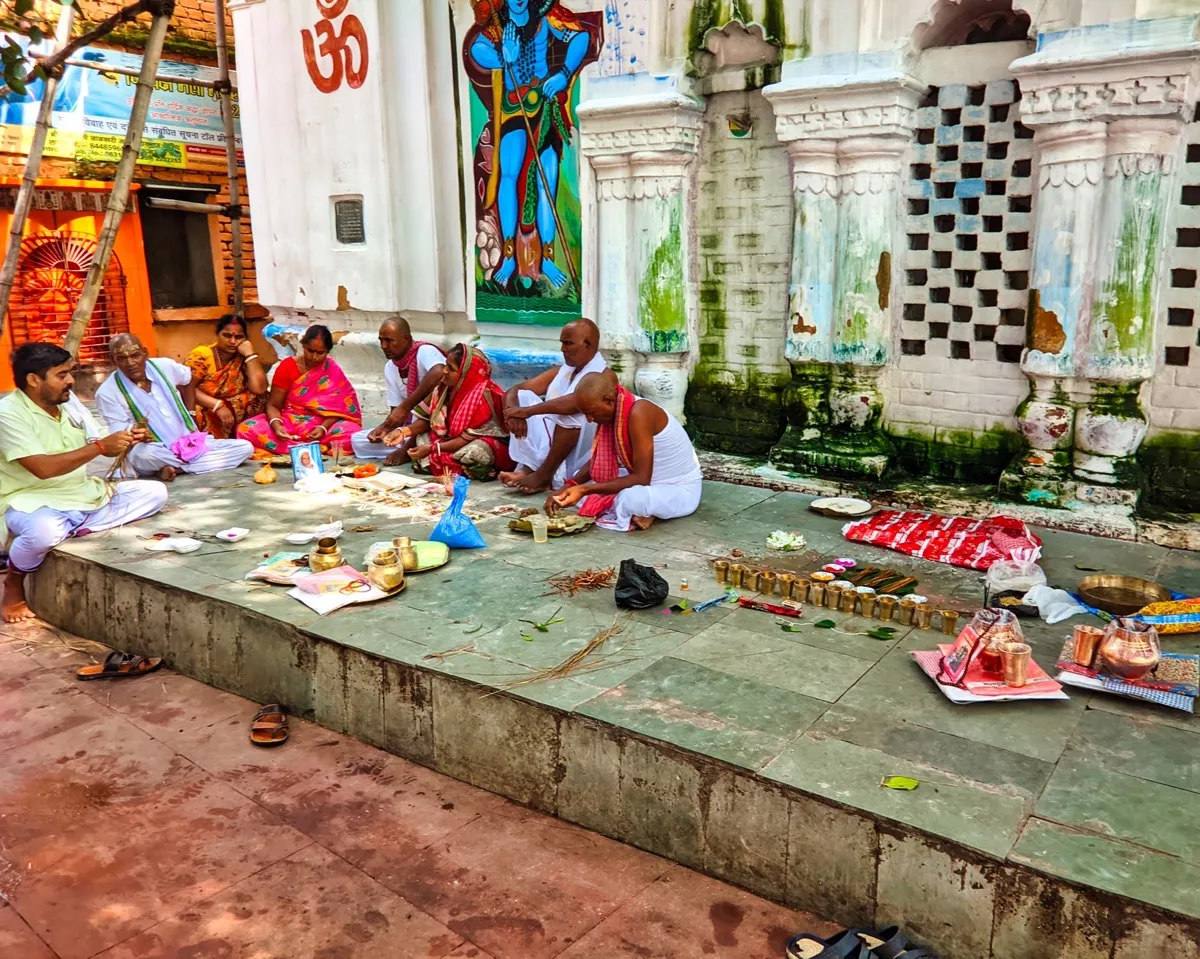
The Tarpan for Maha Bharani Shradh is performed with additional Yama-specific mantras alongside the standard ancestral offering formulas. The water offered is mixed with black sesame seeds (kala til) and kusha grass, as in all Pitru Tarpan. However, the volume of water offered is traditionally greater on Maha Bharani — three times the normal quantity — representing the triple-amplified merit of this day. Devotees who have performed Pind Daan previously will find the Maha Bharani Tarpan a particularly moving experience.
4. Pind Daan: The Central Offering of Maha Bharani
The Pind Daan on Maha Bharani follows the standard procedure but with enhanced mantras drawn from the Yajur Veda’s Pitru Yajnam sections. Each pinda is offered with the solemn invocation of Yama’s mercy for the ancestor’s liberation. At Triveni Sangam, the pindas are placed on the bank of the Ganga and then immersed in the sacred waters — the river itself serving as the cosmic messenger carrying the offering from the earthly plane to Pitru Loka and beyond.
5. Brahmin Bhoj with Expanded Daan
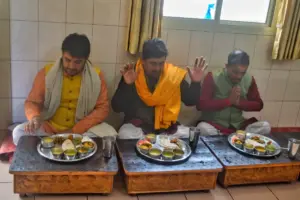
The Brahmin bhoj on Maha Bharani is traditionally more elaborate than on other Pitrupaksha days. In addition to the standard ritual meal, the offerings include sesame-based sweets (til laddoos), ghee, and a donation of a new cloth to each Brahmin. The charity given on Maha Bharani is believed to reach the ancestor in Pitru Loka in full and immediate measure — the Yama connection of this day ensures the fastest possible spiritual transmission of earthly offerings.
6. The Bharani Deepam (Sacred Lamp Offering)
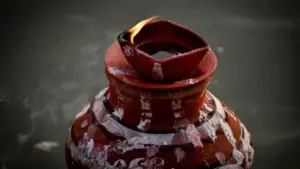
At dusk on Maha Bharani, it is a beautiful tradition to light a large ghee lamp — ideally a clay lamp with five wicks, representing the five elements — near a water body or in the home’s sacred space. This Bharani Deepam is offered to Yama with the prayer: “May this light illuminate the path of my ancestors. May they find peace, liberation, and your protection.” The lamp is allowed to burn until it extinguishes naturally, and is not blown out.
The Astronomical Significance of Bharani Nakshatra
Bharani Nakshatra spans 13°20′ to 26°40′ in the zodiac sign of Aries (Mesha). Its symbol is the yoni — the womb — representing the vessel that holds souls as they transition between lives. The nakshatra’s three stars (41, 39, and 35 Arietis in modern astronomy) form a triangle that ancient Vedic astronomers associated with the three realms through which souls pass: birth, life, and death.
When the Moon transits through Bharani during Pitrupaksha, it is as though the Moon itself descends into the ancestral realm — illuminating the darkness of Pitru Loka with its reflected solar light. The Moon governs the mind (manas), and as it passes through Yama’s nakshatra, the minds of the living and the consciousness of the departed are believed to be in their closest possible alignment. Prayers offered during this transit reach their destination with exceptional clarity and completeness.
This is why the Matsya Purana describes Maha Bharani as a day when even a small act of remembrance — a handful of sesame seeds, a glass of water offered at a river, or a heartfelt prayer — carries the weight of a major ceremony. The nakshatra itself amplifies every action in the direction of ancestral grace.
Significance in Hindu Scriptures
The scriptural basis for Maha Bharani’s extraordinary status is extensive:
- Garuda Purana (Preta Khanda): “Bharanyam shradham kritva Gayadanam labhate phalam” — Shradh on Bharani equals Gaya donation.
- Dharmasindhu: Recommends annual Bharani Shradh during Pitrupaksha as the most beneficial practice for all families.
- Matsya Purana: Describes Bharani as the nakshatra where Yama’s justice and mercy are in perfect balance — the day when liberation is most accessible to souls in Pitru Loka.
- Skanda Purana (Kashi Khanda): Describes how a Brahmin performed Bharani Shradh at the Ganga and his seven generations of ancestors were simultaneously liberated from Pitru Loka and elevated to Deva Loka.
- Yajur Veda (Pitru Yajnam): Contains specific mantras for Bharani-day ancestral offerings that are recited only by trained Vedic pandits.
The Brahma Purana contains a poignant narrative about a sage whose father — a learned man who had nonetheless accumulated karmic debts through pride — was trapped in a lower realm of Pitru Loka. Despite performing the standard Shradh for years, the sage’s father could not ascend. On the advice of Narada Muni, the sage performed a Bharani Shradh at a confluence of sacred rivers, invoking Yama directly. The next morning, the sage experienced a vivid dream in which his father appeared radiantly, freed from all bondage, and blessed the family with liberation across three generations.
Do’s and Don’ts for Maha Bharani Shradh
Follow These Practices
- Begin the day with the full Yama Vandana — it sets the correct spiritual frequency for the entire Maha Bharani ceremony
- Perform the rite at a sacred river confluence if at all possible; Triveni Sangam is the highest-merit location outside of Gaya itself
- Offer triple the normal quantity of water in Tarpan — the Matsya Purana recommends this specifically for Bharani Shradh
- Light the Bharani Deepam (five-wick ghee lamp) at dusk and allow it to burn out naturally
- Recite the Yama Ashtakam before and after the Shradh ceremony
- Fast for the day (or at minimum, avoid meat, alcohol, and heavily processed food) to maintain the ritual purity that Maha Bharani requires
- Invite the elderly members of the family to participate in the Shradh — their physical presence adds to the living side of the ancestral chain and enhances the rite’s power
Avoid These on Maha Bharani Shradh
- Do not treat Maha Bharani as a routine Shradh day — its special status requires extra preparation, extra reverence, and ideally the service of an experienced Vedic pandit
- Do not perform the ceremony hastily; the Yama Puja, Tarpan, Pind Daan, and Brahmin bhoj together require 3-4 hours when performed correctly
- Avoid using the Bharani day for any competitive, combative, or aggressive activities — the nakshatra’s energy amplifies all actions, and negative actions on this day are correspondingly amplified
- Do not allow the Bharani Deepam to be extinguished by wind or water; if it goes out before burning naturally, relight it
- Avoid arguing or raising disputes within the family on this day; the ancestor realm is at peak openness on Maha Bharani, and family discord pains the ancestors directly
Perform Maha Bharani Shradh with Prayag Pandits at Triveni Sangam
Maha Bharani is the single most important day in Pitrupaksha for obtaining the fullest spiritual benefit for your ancestors — and for your own family’s wellbeing. Prayag Pandits has been conducting Maha Bharani Shradh ceremonies at the Triveni Sangam of Prayagraj for many years. Our Vedic pandits are expert in the Yama Puja, the extended Bharani Tarpan, the Pind Daan with Bharani-specific mantras, and the complete Brahmin bhoj arrangements.
We also perform Maha Bharani Shradh on behalf of families who cannot travel — NRIs, those abroad, and those unable to attend due to health or other circumstances. The merit of a proxy Shradh at Triveni Sangam on Maha Bharani day is explicitly endorsed by the scriptural tradition: the quality of the location and the correctness of the pandit’s ceremony are what determine the efficacy, not the physical presence of the family.
Slots for Maha Bharani 2026 are limited and fill up quickly — it is one of the most requested ceremonies of the Pitrupaksha season. Contact us early to secure your family’s place at the Triveni Sangam on September 29, 2026.
For the complete Pitrupaksha 2026 calendar, read our comprehensive Pitrupaksha guide. Understand the full scope of Pind Daan and Shradh’s role in resolving ancestral debts. September 29 also covers Tritiya Shradh for those with Tritiya-tithi ancestors, and is preceded by Dwitiya Shradh on September 28.
🙏 Book Maha Bharani Shradh at Prayagraj
Frequently Asked Questions About Maha Bharani Shradh
Explore the complete Pitrupaksha observances in our Pitrupaksha guide. Read about the deep significance of Pind Daan at Gaya, understand how Shradh resolves ancestral debts, and see why Triveni Sangam is the land of moksha.
Related Services by Prayag Pandits
- 🙏 Pind Daan in Gaya (Pitrupaksha) — Starting from ₹7,100
- 🙏 Shradh at Prayagraj — Starting from ₹7,100
- 🙏 Tarpan in Prayagraj — Starting from ₹5,100