Key Takeaways
- What tripindi shradh is
- When a family needs it
- Tripindi, Narayan Bali or Parvana shradh — which rite
- When it is performed
In This Article
Tripindi Shradh is the rite performed when the annual shradh has gone unobserved for three consecutive years or more. Tri means three and pinda the offering: three pindas are offered, and the rite addresses the departed of three generations together. It is performed in one day, by five Brahmins reciting five suktas, and costs from ₹21,000 at Prayagraj.
This guide covers what establishes the need, how Tripindi differs from Narayan Bali and from an ordinary Parvana shradh, the tithis on which it may be performed, the vidhi, the samagri, where it is done and what it costs.
What tripindi shradh is
Three pindas are offered, one to each of the three deities the rite invokes — Brahma, Vishnu and Mahesh — and through them to the departed of the family’s three generations. Where ordinary shradh nourishes ancestors already settled in the pitru realm, Tripindi is for ancestors who have not settled: the tradition describes souls that become prabal, insistent, when the offerings owed to them stop arriving.
It covers the departed in every state — infant, young and old — and in whichever form the tradition holds them to be lingering. That breadth is the point of it: a family that has lost track of who was missed does not have to identify them individually.
When a family needs it
The trigger is a fact about the rites, not about your life. If the annual shradh, or the Pitru Paksha shradh, has gone unperformed for three consecutive years or more, Tripindi Shradh is the prescribed remedy. That is the condition the texts name, and it is the one a pandit will ask you about first.
A second condition is recognised: an ancestor held in the preta or pishach state after a death outside the natural course, where the last rites could not be performed properly. Where that is the case, note that Narayan Bali addresses the manner of the death itself and is usually performed first — see the comparison below.
If your family has kept the annual shradh and has had no such death, you do not need this rite.
Tripindi, Narayan Bali or Parvana shradh — which rite
This is the most common confusion in ancestral rites, and getting it wrong is an expensive mistake in both directions.
| Tripindi Shradh | Narayan Bali | Parvana Shradh | |
|---|---|---|---|
| What establishes the need | Shradh unperformed for three or more consecutive years | The manner of the death — accident, suicide, drowning, fire, snakebite | Nothing special; it is the ordinary annual and Pitru Paksha rite |
| What it does | Releases souls held from the ancestral realm and settles them | Provides symbolic last rites for a death outside the natural course | Nourishes ancestors already settled |
| Pindas | Three | None — the rite is havan-centred | Six, nine or twelve by tradition |
| Brahmins | Five, one per sukta | Five | Three to nine |
| Primary site in the texts | Pishach Mochan Kund, Varanasi | No exclusive site | Gaya preferred |
| If both are needed | After Narayan Bali | First | Resumes annually once either is done |
When it is performed
Tripindi Shradh may be performed on the Panchami, Ashtami, Ekadashi, Trayodashi, Chaturdashi or Amavasya of either paksha, in any month. It is avoided during Navratri, and it is not performed on the same day as a Tirtha Shradh.
| Date | Tithi | Why |
|---|---|---|
| 12 January | Krishna Chaturdashi | Makar Sankranti period |
| 29 March | Krishna Chaturdashi | Before Chaitra Navratri opens |
| 26 July | Krishna Chaturdashi, Shravan | Shravan carries Shiva’s month |
| 24 August | Krishna Chaturdashi, Bhadrapada | Immediately before Pitru Paksha |
| 26 September – 10 October | The Pitru Paksha fortnight | The peak window of the year |
| 22 November | Krishna Chaturdashi, Kartik | After Pitru Paksha, before the year closes |
The Shradh dates calendar carries the full Pitru Paksha tithi schedule.
Who performs it
Any living son of the family may act as karta, married or unmarried. A married couple performing it together is held to be particularly auspicious, and is the arrangement the purohits most often suggest. A widower may perform it.
The tradition holds that an unmarried woman or a widow should not act as karta for this rite alone, though she takes part fully as one of a couple. That is the convention our purohits follow; it is specific to Tripindi Shradh and does not carry across to shradh, tarpan or pind daan, where a daughter performs the rite without qualification. If this affects your family, raise it when you book and the pandit will set out the options rather than leaving you to guess.
The vidhi
- Shodhana. Purification of the karta and the ritual ground.
- Sankalpa. The vow, naming the karta’s gotra and the ancestors being addressed.
- Kalash sthapana. Five vessels are installed and consecrated.
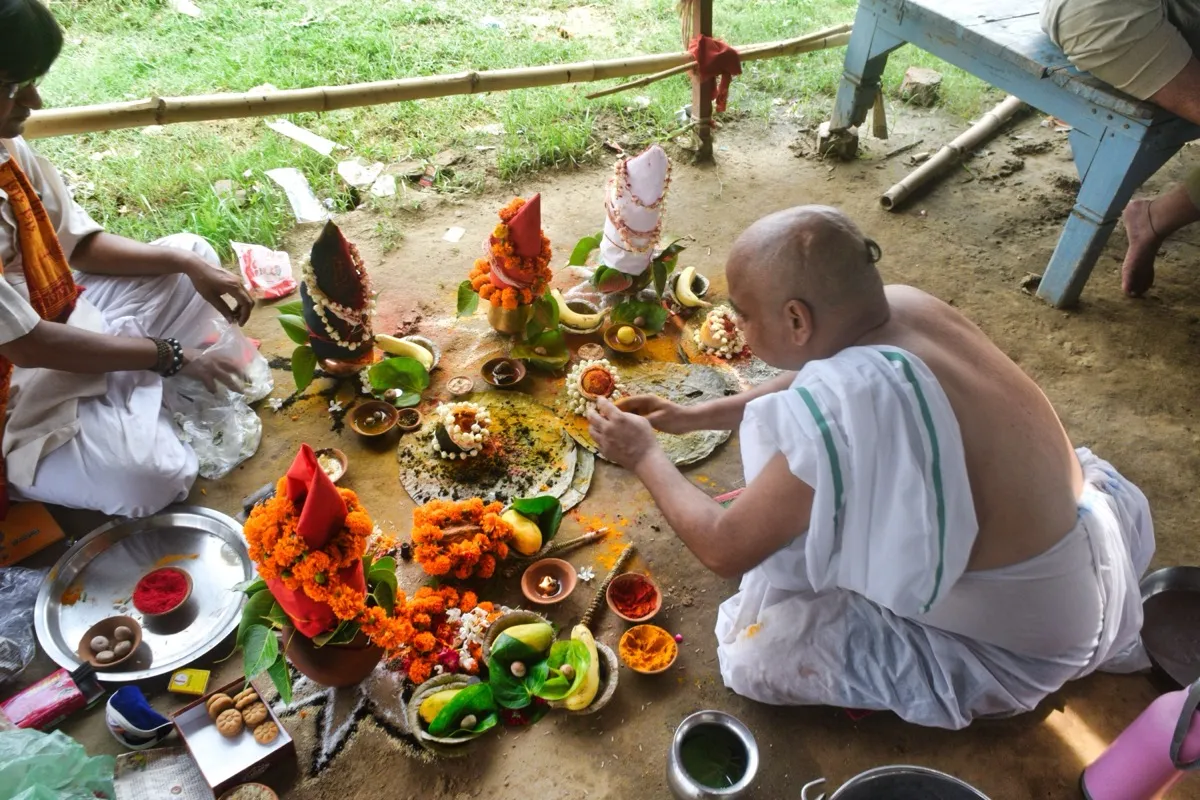
- The five suktas. Five Brahmins recite one sukta each — this is why the rite needs five and not fewer.
- Tarpan. Water with black sesame offered to the three generations.
- The three pindas. Offered to Brahma, Vishnu and Mahesh, and through them to the departed.
- Havan and completion. The fire offering closes the rite, followed by Brahmin bhoj and the immersion of the pindas.
Samagri
When you book through us the pandit arranges all of it. Performing independently, you will need: the five kalashas and their coverings; rice flour or cooked rice for the three pindas; black sesame, kusha grass and barley; cow’s milk, curd, ghee and honey; white flowers and tulsi; chandan, akshat, incense and camphor; darbha mats; unstitched white cloth for the karta; and the havan materials — samidha, ghee and the havan kund.
Where it is performed
Varanasi — Pishach Mochan Kund is the site the Kashi Mahatmya designates for releasing souls from the pishach state, and is textually primary for this rite. Prayagraj — the Triveni Sangam is the most accessible and carries the broad merit of the confluence and the Akshayavat. Gaya — the Vishnupad carries the widest generational reach of any ancestral tirtha. Haridwar is arranged on request, usually by families combining it with Narayan Bali there.
You may be told that Tripindi Shradh must be performed at Trimbakeshwar. The texts do not support that exclusively: the Dharma Sindhu and the Sahyadri Khanda of the Skanda Purana designate Trimbakeshwar as the primary site for Narayan Bali, while the Kashi Mahatmya names Pishach Mochan for this rite. Trimbakeshwar is a valid place to have it done; it is not the only one.
What it costs
| Where | Price | Note |
|---|---|---|
| Prayagraj — Triveni Sangam | ₹21,000 | One full day, five Brahmins |
| Varanasi — Pishach Mochan Kund | ₹21,000 | One full day, five Brahmins |
| Prayagraj — online | ₹22,000 | Full rite at the tirtha, family joins by video |
| Gaya — online | ₹30,999 | Full rite at the Vishnupad, family joins by video |
| Gaya — in person | ₹34,999 | One to two days |
| Haridwar | On request | Usually combined with Narayan Bali |
Each package covers dakshina for all five officiating Brahmins, the complete samagri, tirtha access, Brahmin bhoj, the immersion of the pindas and photographic documentation.
🙏 Tripindi Shradh at the Triveni Sangam
- Five qualified Brahmins, one per sukta
- Sankalpa in your gotra and your ancestors' names
- All samagri, Brahmin bhoj and pinda immersion
- Live video and a recording for families abroad
For families abroad
The rite is performed physically at the tirtha by the five Brahmins while the family joins by live video, with the sankalpa taken in your name and your ancestors’. A recording and photographs follow. Have ready the karta’s name and gotra, the names of the ancestors, and — the question that actually matters here — how many years it has been since the shradh was last performed. The guide for families abroad covers time zones and booking.
Common misconceptions
“Anyone can perform it as a general ancestral rite.” No. It answers a specific condition. Performing it where that condition does not exist spends a substantial sum to no purpose.
“It must be done at Trimbakeshwar.” Addressed above — that designation belongs to Narayan Bali.
“It replaces the annual shradh.” It does not. Tripindi settles what was missed; the annual shradh resumes afterwards and continues each year. The shradh guide sets out the annual obligation.
“Tripindi and Narayan Bali are the same thing.” They are not, and the comparison above sets out the difference. Where a family needs both, Narayan Bali is performed first — see the Narayan Bali guide.
After the rite
Resume the annual shradh on the death tithi, and the Pitru Paksha offerings each year. That is the whole of what is asked afterwards. Tripindi is performed once for the lapse it answers; it is not repeated annually, and a family that is keeping the ordinary rites does not need it again.
Book Your Sacred Ritual
Authentic ceremonies performed by Veda-trained pandits at sacred sites across India.



