The Rite That Releases What Cannot Be Left Behind
There are forms of grief that families carry quietly for years, sometimes for decades, without ever having a name for them. A grandfather who drowned and whose body was never found. An uncle who died in a factory accident before anyone could reach him. A young woman who took her own life, and whose family, overwhelmed by sorrow and social stigma, never performed the proper rites. The grief is spoken of, sometimes, in lowered voices — but the ritual response that could actually address what is happening spiritually is often unknown or left undone.
Narayan Bali Poojan is that response. It is one of the most profound ceremonies in the Vedic tradition — not a general ancestral offering, but a precise act of compassion directed at a soul that was denied the passage it deserved. You come to Prayagraj, stand at the edge of the Triveni Sangam where three rivers meet, watch your pandit build a symbolic body for your ancestor from sacred materials, hear the Vedic mantras that perform — in full, properly, with all the reverence that was missing the first time — the last rites for a life that ended badly. And then you watch that effigy enter the water and disappear.
Something changes in that moment. Families who have attended this ceremony often describe it as the first time they have felt that a particular burden, carried for as long as they can remember, has been set down.
Why Performing This Ritual in Person Matters
Narayan Bali can be performed online, and for many families in distant locations, that is the right choice. But if you are able to travel to Prayagraj and attend the ceremony in person, the experience is of a different order entirely.
Physical presence at a sacred site during a Vedic ritual is not simply traditional practice — it is recognized in the Vedic literature as carrying its own spiritual merit, called kshetra phal, the fruit of the sacred field. When you are physically at the Triveni Sangam, the vibration of the water, the sound of the mantras in open air, the sight of the immersion, and your own body’s presence in that field all contribute to the depth of the ceremony in ways that a screen cannot replicate. You are a witness in the truest sense — your consciousness is fully present to the act of liberation being performed for your ancestor.
For an ancestor who suffered, who was denied a proper farewell, there is something deeply right about a living family member making the effort to travel, to be present, to stand at the water’s edge and see the ceremony through with their own eyes. The effort itself is an act of love.
Prayagraj and the Triveni Sangam: The Land of Moksha
Prayagraj has been called Tirtharaj — the king of all pilgrimage sites — in the Vedic and Puranic literature. The Triveni Sangam, where the Ganga and Yamuna visibly meet and the underground Saraswati joins them invisibly, is a site of exceptional spiritual power. The Matsya Purana states that bathing at the Sangam, or performing sacred rites there, dissolves sin and liberates souls across generations. The Padma Purana describes it as one of the three places where liberation can be attained even in this age of Kali Yuga.
For the purposes of Narayan Bali, the Sangam’s power lies in its quality as a Moksha Kshetra — a field of liberation. The three rivers carry three distinct energies: the Ganga purifies, the Yamuna dissolves attachments through devotion, and the Saraswati — invisible but ever present — dissolves the ignorance and confusion that keeps souls bound. For an ancestor trapped in a state of Pret Yoni (limbo between death and rebirth), immersion of the Narayan Bali effigy at the Triveni Sangam combines these three liberating forces at once.
This is why Prayagraj is one of the principal sites prescribed in the Garuda Purana for Narayan Bali — alongside Gaya, Kashi, and Hardwar. Learn more about the spiritual significance of the Triveni Sangam and why it holds this position in the Hindu sacred geography.
Who Should Perform Narayan Bali?
Not every family will need this ritual. The Garuda Purana and Skanda Purana identify the specific circumstances that call for it. Narayan Bali is prescribed when:
- An ancestor died in an accident — road, industrial, agricultural, or otherwise
- An ancestor drowned or died in a fire
- A family member died by suicide
- An ancestor was murdered or died by violence
- A body was not recovered, and last rites were performed symbolically or not at all
- The last rites (Antim Sanskar) were performed incompletely, incorrectly, or by persons who did not know the proper procedures
- A child died in infancy, before the naming ceremony
- The family is experiencing persistent Pitru Dosha symptoms: financial losses, miscarriages, chronic illness, broken marriages, disturbed household atmosphere, or recurring nightmares
- An astrologer or learned pandit has specifically identified Pret Badha or severe Pitru Dosha in a family member’s horoscope
Preparing for Your Visit to Prayagraj
Coming to Prayagraj for Narayan Bali is a pilgrimage in itself. A little preparation before your visit will help the ceremony go smoothly and allow you to be fully present for it.
What to Bring
- A white or light-colored cotton dhoti or kurta for men; a plain white or light-colored saree or salwar for women. Avoid synthetic fabrics and dark colors, particularly black, on the day of the ceremony.
- A list of the ancestors for whom the ritual is being performed — name, relationship, and cause of death if known. This is used in the Sankalpa.
- Your family’s gotra (lineage name). If you do not know your gotra, our pandit will use Kashyap as the default, which is the standard Vedic practice.
- An open mind and a willingness to follow the pandit’s guidance throughout the ceremony. You do not need to memorize anything — the pandit will instruct you at each step.
What to Expect on the Day
Arrive at our designated meeting point near the Sangam at the time agreed with our team — generally early morning, before 8 a.m. Our team member will meet you and escort you to the ritual site. The ceremony is conducted at the Sangam itself, either at the ghat or, for the immersion portion, by boat to the actual point of confluence.
The ceremony runs approximately 4 to 5 hours. It begins with Ganesh Puja, then Navgraha Stuti, then the formal Sankalpa — the most important moment — followed by the construction and consecration of the Narayan Bali effigy, the performance of all stages of last rites over it, and finally the immersion at the Sangam. You will be asked to participate in certain moments: repeating mantras after the pandit, pouring water, or placing offerings. These participatory moments are not difficult — the pandit will guide you clearly.
Accommodation and Logistics
Prayagraj has accommodation options across all budget ranges, from simple dharamshalas near the Sangam to comfortable hotels in the Civil Lines area. Our booking team can provide guidance on suitable places to stay, and we can arrange transportation from your accommodation to the Sangam on the ceremony day. For those arriving by train, Prayagraj Junction (also called Allahabad Junction) is the main railway station, well-connected to all major cities.
What is Included
- Pre-ceremony consultation and Sankalpa documentation
- Complete Narayan Bali Poojan at Triveni Sangam, Prayagraj
- Experienced, qualified pandit who conducts the full ceremony
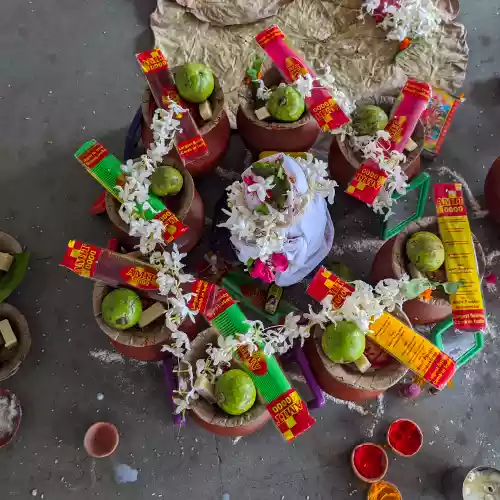
- All ritual samagri: flowers, til, kusha, darbha, sacred threads, diya, honey, five grains, aromatic substances, cotton cloth for effigy
- Narayan Bali effigy, constructed and consecrated during the ceremony
- Boat to the Sangam confluence for the immersion
- Brahmin who receives the ritual offerings on behalf of the departed soul
- Guidance and support from our team throughout your visit
What is Not Included
- Your travel to and from Prayagraj
- Accommodation in Prayagraj
- Meals for the visiting family (we can recommend nearby restaurants and food stalls)
- Additional rituals such as Tripindi Shradh or Pind Daan, if separately recommended (these are additional services with their own pricing)
- Photography or videography services (you are welcome to bring your own device to record)
Frequently Asked Questions
Can we perform Narayan Bali at Prayagraj during Pitrupaksha, or is it only for regular dates?
You can absolutely perform Narayan Bali at Prayagraj during Pitrupaksha, and doing so adds considerable merit to the ceremony. Pitrupaksha is the period when the Pitru Dwar — the ancestral gateway — is considered open, which intensifies the effect of all ancestral rites. That said, unlike Gaya, Prayagraj does not become overcrowded with Narayan Bali-specific ceremonies during Pitrupaksha, which means the experience is quieter and more personally focused. If you wish to perform the ceremony during Pitrupaksha, book early as slots are limited.
Do we need to be physically present for the entire 4-5 hours, or can we step away?
It is strongly recommended that the primary family member — typically the eldest son, or the nearest male relative of the deceased — remain present for the entire ceremony. Other family members may step away briefly if necessary. The Sankalpa requires at least one family member to be present and actively witnessing throughout. The ceremony is deeply moving, and most families find that they do not want to leave — it is not a passive or tedious process.
Can women participate in the Narayan Bali ceremony?
Yes. Women can and do attend Narayan Bali. In the tradition followed at Prayagraj, women observe and witness the ceremony and may be asked to participate in certain offering moments. In cases where a woman is the only family member available to perform the rite — for example, for a brother who died without leaving male heirs — our pandits accommodate this fully and know the appropriate variations in the ritual protocol.
Is this the same as Tripindi Shradh?
No. These are two distinct ceremonies with different purposes. Narayan Bali is specifically for souls who died unnatural deaths or whose last rites were incomplete. Tripindi Shradh is performed when three or more generations of ancestors have not received proper Shradh for an extended period. In some cases, both are recommended together, but they are separate rituals performed on separate occasions. Our pandit will help you understand which one your family’s situation calls for.
How far in advance should we book the physical ceremony?
We recommend booking at least 2 to 3 weeks in advance. This gives our team time to confirm the pandit, identify an auspicious date on the Panchang, and prepare all the ritual materials. It also gives you time to make your travel arrangements to Prayagraj without rushing. For ceremonies during Pitrupaksha or major Hindu festival periods, 4 to 6 weeks’ advance booking is recommended.






Manju Chauhan –
बहुत अच्छी सेवा। पंडित जी समय पर आए और सभी पूजन सामग्री लेकर आए। मंत्रोच्चार बहुत शुद्ध था। कुल मिलाकर एक संतोषजनक अनुभव रहा। Jai Shri Ram.
Rakesh Patel –
हमारे परिवार ने पहली बार ऑनलाइन पूजा करवाई। शुरू में थोड़ा संशय था लेकिन अनुभव बहुत अच्छा रहा। वीडियो कॉल की गुणवत्ता अच्छी थी और पंडित जी ने हमें पूजा में शामिल किया। Jai Shri Ram.
Abhishek Pathak –
प्रयाग पंडित्स से दूसरी बार पूजा करवाई। दोनों बार अनुभव शानदार रहा। उनकी टीम पुराने ग्राहकों को याद रखती है और व्यक्तिगत ध्यान देती है।
Kavita Tiwari –
We had been facing family issues for years and were advised to perform Narayan Bali. After the poojan at Prayagraj through Prayag Pandits, we felt a significant change in our household peace. Dhanyavaad.
Neha Yadav –
We had been facing family issues for years and were advised to perform Narayan Bali. After the poojan at Prayagraj through Prayag Pandits, we felt a significant change in our household peace.
Rohit Awasthi –
The Narayan Bali Poojan was conducted exactly as described in the Garuda Purana. All the required materials were arranged by the team. The 4-5 hour ceremony was performed with full devotion. Om Shanti.
Meena Singh –
We had been facing family issues for years and were advised to perform Narayan Bali. After the poojan at Prayagraj through Prayag Pandits, we felt a significant change in our household peace. Om Shanti.
Suresh Nath –
Very authentic Vedic ceremony. All materials were included as promised. Will definitely use their services again.
Sunil Deshmukh –
प्रयाग पंडित्सची सेवा उत्तम आहे. सगळं व्यवस्थित झालं. नक्की पुन्हा बुक करेन.
Savitri Dwivedi –
We had been facing family issues for years and were advised to perform Narayan Bali. After the poojan at Prayagraj through Prayag Pandits, we felt a significant change in our household peace.
Kavita Tiwari –
Complex ritual but the team made it simple for us. They explained what Narayan Bali is, why we needed it, and what to expect. The pandit was thorough and patient throughout the long ceremony.
Sunil Reddy –
We had been facing family issues for years and were advised to perform Narayan Bali. After the poojan at Prayagraj through Prayag Pandits, we felt a significant change in our household peace.
Seema Dubey –
The Narayan Bali Poojan was conducted exactly as described in the Garuda Purana. All the required materials were arranged by the team. The 4-5 hour ceremony was performed with full devotion. Dhanyavaad.
Rohit Awasthi –
We performed Narayan Bali Poojan on the advice of our family pandit. The ceremony took the full day but Prayag Pandits managed everything perfectly. The senior pandit was very knowledgeable about this complex ritual. Dhanyavaad.
Harshita Ojha –
Narayan Bali is a very specific ritual and finding the right pandit was our main concern. Prayag Pandits connected us with an experienced purohit who had performed this poojan many times. Very satisfied. Jai Shri Ram.
Ramesh Dubey –
The Narayan Bali Poojan was conducted exactly as described in the Garuda Purana. All the required materials were arranged by the team. The 4-5 hour ceremony was performed with full devotion. Dhanyavaad.
Gopal Menon –
The Narayan Bali Poojan was conducted exactly as described in the Garuda Purana. All the required materials were arranged by the team. The 4-5 hour ceremony was performed with full devotion.
विकास गुप्ता –
प्रयाग पंडित्स ने बहुत अच्छी सेवा दी। Booking से लेकर पूजा तक सब smooth रहा।
Pooja Mehta –
We are settled abroad and wanted to perform the puja in Prayagraj. Prayag Pandits made it possible. Grateful.
Kavita Tiwari –
सेवा उत्तम है। कोई छिपा हुआ खर्च नहीं। जो बताया गया वही किया गया। पंडित जी बहुत विनम्र और ज्ञानी हैं। दोबारा जरूर बुक करेंगे।