Rituals

Triveni Sangam – The Land of Moksha

Prakhar Porwal · 15 min read · Reviewed Apr 11, 2026
Key Takeaways
    In This Article

    There are places on this earth where the divine does not merely visit — it resides. Triveni Sangam in Prayagraj is one such place. Where three sacred rivers converge, where the weight of countless lifetimes of karma (accumulated actions and their consequences) is said to dissolve in a single dip, and where the boundary between the mortal world and the realm of the divine grows thin as a breath. For millions of Hindus across generations, a lifetime is not complete without standing at this sacred confluence at least once, feet in the holy water, hands folded in prayer, heart open to the infinite.

    This is not merely a geographical point on a map. This is Teerth-Raj — the King of all pilgrimages.

    Aerial view of Triveni Sangam at Prayagraj where three rivers meet
    The sacred Triveni Sangam at Prayagraj — where Ganga, Yamuna, and the invisible Saraswati converge

    The Sacred Confluence — What Is Triveni Sangam?

    Triveni Sangam is the holy meeting point of three rivers at Prayagraj, Uttar Pradesh — a city that has been a center of Hindu spiritual life since time before recorded memory. The word triveni breaks down with perfect simplicity: tri means three, and veni means braid or stream. Three sacred streams, braided together by divine will.

    Two of the rivers are visible to the human eye. The Ganga — mother of all rivers, pale and luminous, her waters carrying the faint silver-white quality that pilgrims have described for thousands of years. And the Yamuna — darker, quieter, her waters carrying a deep blue-green hue that stands in striking visual contrast to the Ganga’s fairness. When the two rivers meet, the line where their waters touch is visible even from a boat — a living, moving boundary between two divine personalities, two sacred energies flowing side by side before surrendering themselves to each other.

    The third river is Saraswati — invisible to the eye, flowing underground, known in the scriptures as the antarvahini (the one who flows within). Her presence at the confluence is a matter of deep faith and of scriptural authority. The Rigveda, the oldest of the four Vedas, speaks of Saraswati as a mighty river. Over millennia, she is believed to have gradually retreated from the surface of the earth — but her sacred current, say the shastras, still meets Ganga and Yamuna at this precise point in Prayagraj.

    To understand the full story and legend woven around this meeting of waters, you may explore the tale of Triveni Sangam in greater depth.

    Mythological and Scriptural Significance

    The sanctity of Triveni Sangam is not a recent tradition. It is layered into the very foundation texts of Hindu civilization.

    The most widely known story connecting Prayagraj to the divine is that of the Samudra Manthan — the churning of the cosmic ocean. In this great myth recorded in the Bhagavata Purana and Vishnu Purana, the gods and demons together churned the ocean of creation using Mount Mandara as a churning rod and the great serpent Vasuki as a rope. From this churning emerged Amrit — the nectar of immortality. The demon Rahu seized the pot of Amrit, and as the gods struggled to recover it, drops of this celestial nectar fell to earth at four places: Prayagraj, Haridwar, Nashik, and Ujjain. These four places became the sites of the Kumbh Mela — and of all four, Prayagraj is considered the most powerful, because it was here that the greatest number of drops fell.

    The Mahabharata calls Prayag the foremost of all tirthas (sacred crossing-places). The Matsya Purana, the Padma Purana, and the Skanda Purana all dedicate extensive passages to the glory of the Sangam. The Rigveda itself praises the confluence of the Ganga and Saraswati as a place of immense spiritual potency.

    Perhaps most significantly, Hindu tradition holds that Lord Brahma — the Creator — performed the first-ever Ashwamedha Yagya (the horse sacrifice, a ritual of cosmic sovereignty) at this very spot. This act of creation and consecration by Brahma himself is why Prayagraj earned the title of Teerth-Raj — King of all pilgrimage sites. To understand fully why Prayagraj is revered as Teerth-Raj, the scriptural and traditional explanations run remarkably deep.

    Spiritual Importance — The Gateway to Moksha

    At the heart of why pilgrims travel hundreds — sometimes thousands — of kilometres to reach Triveni Sangam lies one singular aspiration: Moksha.

    Moksha is the liberation of the soul from the endless cycle of birth, death, and rebirth — what the scriptures call samsara. It is the ultimate goal of human existence according to Hindu philosophy. And Triveni Sangam is one of the most powerful gateways to this liberation that the tradition recognises. The concept of Moksha is profound and multifaceted — but at the Sangam, it is made tangible, accessible, within reach of every devotee who arrives with a sincere heart.

    The scriptures declare that bathing at Triveni Sangam during auspicious occasions washes away the accumulated paap (sins and negative karma) of not just this lifetime, but of many previous lives. The Prayag Mahatmya section of the Matsya Purana goes so far as to say that even a sinful person who bathes at the Sangam with genuine repentance and devotion will find the path to liberation opened before them.

    For this reason, Triveni Sangam holds a place of supreme importance in the performance of ancestral rites. The souls of departed ancestors are believed to receive immense benefit when their descendants perform rituals at this sacred confluence. Asthi Visarjan in Prayagraj — the immersion of the ashes of the departed in the holy waters — is considered one of the most powerful acts of pitru seva (service to ancestors) a family can perform. Similarly, Pind Daan in Prayagraj, the offering of rice balls to nourish the souls of departed ancestors, carries a special sanctity when performed at the Sangam that few other places can match. Completing these duties here is believed to grant the ancestors sadgati — a good onward journey of the soul. Families can book our Asthi Visarjan 2D/1N package at Triveni Sangam for a complete ritual with stay and boat arrangements.

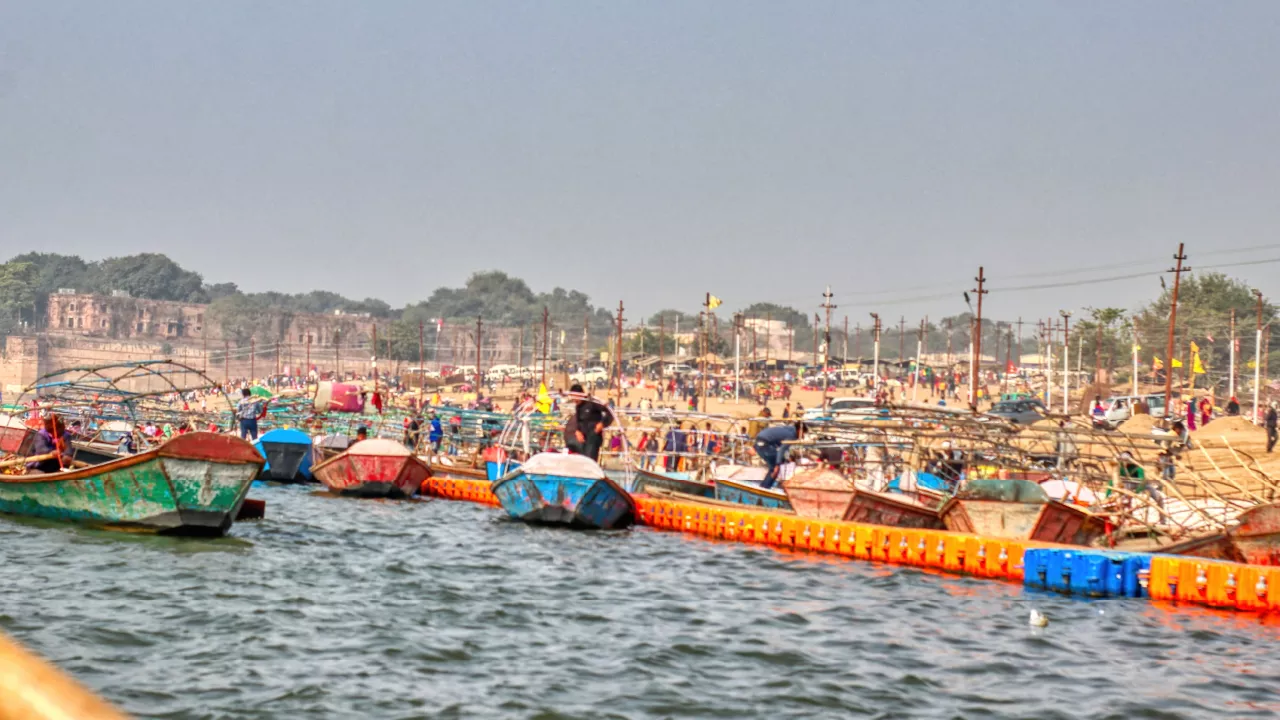
    Boats at Triveni Sangam during Magh Mela 2026 Prayagraj
    Devotees arriving by boat at Triveni Sangam during Magh Mela — a timeless sight at the confluence

    Rituals Performed at Triveni Sangam

    The range of sacred rituals that may be performed at Triveni Sangam reflects the completeness of the place — it serves devotees at every stage of life and every kind of spiritual need.

    Snan (Holy Bath)

    The most fundamental act at the Sangam is snan — the sacred bath. Pilgrims typically hire a small boat from one of the nearby ghats, row out to the precise meeting point of the rivers, and immerse themselves in the waters while reciting prayers. The ideal time for snan is at dawn, when the first light touches the water and the atmosphere of the Sangam is at its most serene and spiritually charged. During festivals such as Kumbh Mela and Magh Mela, the snan on specific auspicious dates — called shahi snan — carries particular merit.

    Asthi Visarjan

    Asthi Visarjan — the immersion of the mortal remains (ashes and bones) of a deceased person into sacred waters — is among the most important rituals a Hindu family performs after a death. Performing this at Triveni Sangam is considered exceptionally meritorious. The sacred waters receive the remains with grace, and it is believed the soul of the departed is aided in its journey beyond. Prayag Pandits provides experienced priests to guide families through Asthi Visarjan in Prayagraj with full Vedic rites.

    Pind Daan, Shradh, and Tarpan

    These three rituals form the core of pitru karma — one’s sacred duty toward departed ancestors. Pind Daan involves offering balls of cooked rice mixed with sesame and other sacred ingredients to the departed souls, providing them with nourishment in the afterlife. Shradh is the broader ritual of ancestral propitiation, performed especially during the Pitrupaksha fortnight. Tarpan Poojan is the offering of water, sesame seeds, and flowers to ancestors while reciting their names and gotras (ancestral lineages). All three carry extraordinary potency when performed at the Sangam, where the combined spiritual energy of three sacred rivers amplifies every act of devotion.

    Other Sacred Ceremonies

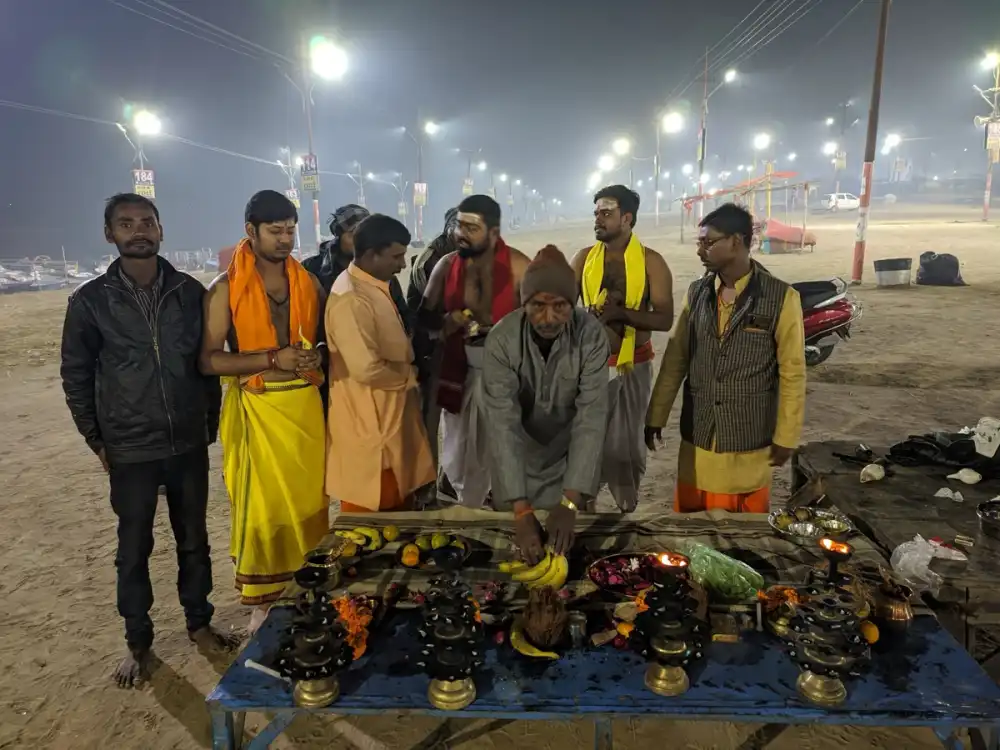
    Triveni Sangam is also the site of Mundan Sanskar (the first hair-cutting ceremony for young children, one of the sixteen samskaras or life rites of passage), Sumangali Pooja (prayers for the well-being of married women), Veni Daan (the sacred hair offering by married couples to pray for marital longevity), and various Sankalpa rituals where devotees take sacred vows in the presence of the holy waters. Pilgrims also release small clay lamps — diyas — on the water at dusk, a sight of quiet, breathtaking beauty that no visitor forgets.

    Kumbh Mela and Magh Mela — The Grand Gatherings

    No account of Triveni Sangam is complete without speaking of the Kumbh Mela — the largest peaceful human gathering on the face of the earth, held at Prayagraj every twelve years, with a Ardh Kumbh (half Kumbh) every six years. The Maha Kumbh Mela of 2025 witnessed over 400 million pilgrims across its duration — a number that surpasses the population of most nations on earth. This extraordinary assembly of humanity, drawn purely by faith, takes place precisely at Triveni Sangam.

    The most sacred moments of the Kumbh are the Shahi Snan dates — the royal bathing days — determined by precise astrological conjunctions. On these days, the akharas (traditional orders of Hindu monks and saints) process to the Sangam in grand ceremonial processions, and millions of ordinary devotees follow. The belief is that on these specific dates, the waters of the Sangam are transformed by a celestial energy that makes a single bath equivalent to the merit of years of spiritual practice.

    Throughout the year, the Magh Mela is held annually during the month of Magh (January-February), drawing hundreds of thousands of pilgrims who camp on the banks of the Sangam for days or weeks. The temporary city of tents and kalpavas (month-long spiritual retreats) that springs up along the banks every Magh is itself one of the remarkable spiritual sights of the subcontinent.

    How to Visit Triveni Sangam

    For those planning a pilgrimage to the Sangam, some practical guidance will help the visit be as meaningful as possible. Our detailed Prayagraj travel guide covers every aspect of planning a visit to this sacred city.

    Best Time to Visit

    The cooler months from October through March are the ideal time to visit Prayagraj and the Sangam. The waters are calmer, the heat manageable, and the Magh Mela period (January-February) brings the Sangam to its most spiritually charged state of the year. Avoid the peak summer months (April-June) when the heat in Prayagraj can be intense. The monsoon season brings flooding to the ghats and is not safe for boat rides to the confluence point.

    How to Reach the Confluence

    The Sangam is located about seven kilometres from Prayagraj city centre. The nearest ghat is Sangam Ghat, accessible by auto-rickshaw or taxi from the city. From the ghat, pilgrims take small wooden rowboats out to the actual confluence point — a journey of fifteen to twenty minutes across the water. Boat operators are available throughout the day. It is advisable to negotiate the fare beforehand and choose a licensed boatman. The experience of sitting in a small boat as the line between the two differently-coloured rivers comes into view is one that stays with a pilgrim for a lifetime.

    What to Carry

    Carry a change of clothes for after the snan. Bring a small lota (water vessel) for collecting Sangam water to carry home — a tradition followed by millions. Pack flowers, sesame seeds, and incense if you intend to perform even a basic offering. If you are coming for Asthi Visarjan, Pind Daan, or other formal rituals, it is strongly recommended to arrange for an experienced local pandit in advance rather than relying on finding assistance on the day.

    Why Triveni Sangam Holds a Special Place in Every Hindu’s Heart

    There is a reason that Hindus speak of the Sangam not just as a place they have visited, but as a place they have felt. In an age when much of spiritual life risks becoming routine or ceremonial, standing at the confluence of three rivers — one visible as silver, one as dark blue-green, and one invisible but present in faith — does something to the heart that is difficult to describe in ordinary language.

    It is the sensation of standing at the edge of the infinite. Of understanding, even briefly, that the rivers do not simply flow past — they carry with them the prayers and tears and ashes of uncountable generations of your ancestors, all of whom stood here before you, all of whom looked into these waters and asked the same questions about life, death, and what lies beyond. At the Sangam, those questions do not feel unanswered. They feel held.

    Whether you come to bathe in the sacred waters, to perform the last rites for a beloved family member, to fulfill a long-held vow, or simply to stand in a place where divinity feels close enough to touch — Triveni Sangam receives every devotee with the same grace that these rivers have offered for thousands of years.

    If you wish to arrange any ritual at Triveni Sangam — from a simple snan puja to a full Pind Daan or Asthi Visarjan ceremony — the pandits of Prayag Pandits are here to guide you with knowledge, care, and the full weight of Vedic tradition. We serve devotees from across India and from abroad, including NRI families who wish to fulfil their sacred duties from a distance. Reach out to us, and let the blessings of Triveni Sangam find their way to you and your family.


    Frequently Asked Questions about Triveni Sangam

    What is Triveni Sangam?

    Triveni Sangam is the sacred confluence of three rivers — the Ganga, the Yamuna, and the mythical underground river Saraswati — located in Prayagraj, Uttar Pradesh, India. The name comes from the Sanskrit words tri (three) and veni (braid or stream). It is one of the most revered pilgrimage sites in Hinduism and is considered the king of all tirthas (sacred crossing-places).

    Why is Triveni Sangam considered sacred?

    Triveni Sangam is considered sacred because of its references in ancient scriptures including the Rigveda, Mahabharata, and multiple Puranas. Hindu tradition holds that drops of Amrit (the nectar of immortality) fell here during the Samudra Manthan (cosmic ocean churning), and that Lord Brahma performed the first Ashwamedha Yagya at this spot. Bathing at the Sangam is believed to wash away accumulated sins and open the path to Moksha — liberation from the cycle of rebirth.

    What rituals can be performed at Triveni Sangam?

    A wide range of Hindu rituals can be performed at Triveni Sangam, including Snan (the sacred bath), Asthi Visarjan (immersion of the ashes of the deceased), Pind Daan (offering of rice balls to departed ancestors), Shradh (ancestral propitiation ceremonies), Tarpan (water offering to ancestors), Mundan Sanskar (first hair-cutting ceremony for children), and various Sankalpa (vow-taking) rituals. The Sangam is considered an especially powerful site for all rites related to the departed soul and ancestral duties.

    What is the best time to visit Triveni Sangam?

    The best time to visit Triveni Sangam is during the cooler months of October through March. The Magh Mela period (January-February) is particularly auspicious, with large gatherings of pilgrims and saints making the spiritual atmosphere exceptionally powerful. The Kumbh Mela and Ardh Kumbh Mela, held every six and twelve years respectively, are considered the most auspicious times of all. The months of April through June are very hot, and the monsoon season (July-September) can make boat access to the confluence point difficult due to flooding.

    How can I arrange rituals at Triveni Sangam from abroad?

    Many NRI and overseas Hindu families wish to perform sacred rituals at Triveni Sangam for their departed ancestors or as a fulfilment of religious vows but are unable to travel to Prayagraj in person. Prayag Pandits offers online booking and remote arrangement of all major rituals at the Sangam — including Asthi Visarjan, Pind Daan, Shradh, and Tarpan — performed by experienced local pandits on your behalf with full Vedic rites. You can contact us through our website to discuss your requirements and receive guidance on the appropriate ceremony for your family’s needs.

    Pind Daan Seva

    🙏 Book Pind Daan at Triveni Sangam, Prayagraj

    Starting from ₹5,100 per person
    • Pind Daan, Asthi Visarjan and Tarpan at the sacred Triveni Sangam
    • Experienced Vedic Purohits with complete ritual including Brahman Bhoj
    • Online poojan with live video call for those who cannot travel
    • Trusted by 10,000+ families across India and NRIs worldwide

    Can Women Perform Tarpan and Shradh at Triveni Sangam?

    Yes. While traditional Smriti texts prioritize male heirs for ancestral rites, modern practice and many scriptural authorities (including references in the Garuda Purana to Mata Sita performing ancestral rites) support daughters, wives, and granddaughters performing Tarpan and Shradh at the Triveni Sangam. Our pandits at Prayag Pandits regularly guide women through the complete ritual with full adherence to Vedic protocols.

    How Long Does the Shradh Ceremony Take at Triveni Sangam?

    A standard Shradh ceremony at the Triveni Sangam takes 2 to 4 hours depending on the ritual combination. Basic Pind Daan with Tarpan takes approximately 2 hours. A comprehensive ceremony including Pind Daan, Tarpan, Sankalpa, Brahmin feeding (Brahmin Bhoj), and Navagraha puja takes 3-4 hours. The ceremony includes a boat ride to the mid-confluence point where the Ganga, Yamuna, and Saraswati rivers merge — this sacred spot is where the pindas and offerings have maximum spiritual effect.

    Frequently Asked Questions

    How important is taking a holy bath at the Triveni Sangam before performing Pind Daan in Prayagraj?

    Taking a holy dip (snan) at the Triveni Sangam before performing Pind Daan in Prayagraj is considered highly important and auspicious, Beta. The confluence of Ganga, Yamuna, and Saraswati possesses immense purifying power. Bathing here cleanses the body and mind of the performer (Karta), making them fit to undertake the sacred ritual. It washes away sins and invokes the blessings of the holy rivers, enhancing the efficacy of the Pind Daan performed subsequently in Prayagraj. While circumstances might occasionally prevent it, a bath at the Sangam is an integral part of the traditional process for Pind Daan in Prayagraj.

    What are the main rituals involved in Shradh at the Triveni Sangam?

    The core rituals are similar to those performed elsewhere, but gain special potency here:

    • Sankalpa: Taking the vow near or at the Sangam, mentioning the ancestors' names and Gotra.
    • Triveni Snan: Taking a purifying dip at the confluence is an essential prelude.
    • Pind Daan: Offering Pindas (rice/barley balls with sesame, honey, etc.) representing the ancestors. Offering these at the Sangam is the central act.
    • Tarpan: Offering water mixed with black sesame seeds to satisfy the Pitrus.
    • Brahman Bhojan/Dakshina: Feeding or making offerings to learned Brahmins associated with the Sangam area.
    • Daan: Giving charity near the Sangam is also highly meritorious.
    How long does the Shradh ceremony typically take at the Triveni Sangam?
    • The time taken includes getting to the Sangam by boat, performing the main rituals (Sankalpa, Pind Daan, Tarpan), and returning.
    • The core ritual itself, guided by the Pandit, usually takes about 1.5 to 3 hours. If it involves more elaborate steps or subsequent Brahman Bhojan on the banks, it might take longer. Factor in boat travel time as well.
    What is the unique benefit of Pind Daan at the Triveni Sangam compared to other places?

    While Pind Daan is significant everywhere, performing it at the Triveni Sangam in Prayagraj carries exceptional weight. The confluence is a point of immense divine energy. It is believed that offerings made here:

    • Reach ancestors most effectively due to the combined power of the three sacred rivers.
    • Wash away the sins of the ancestors and the performer.
    • Grant profound peace and satisfaction (Tripti) to the departed souls.
    • Greatly aid in their journey towards Moksha (liberation), breaking the cycles of birth and death.
    • The act performed at this specific cosmic junction is said to appease the divine trinity (Brahma, Vishnu, Mahesh) simultaneously, invoking powerful blessings for the Pitrus.
    Why is Prayagraj Triveni Sangam the most significant place for Tarpan?

    The Triveni Sangam in Prayagraj is considered the holiest water body in Hinduism. The confluence of these three sacred rivers creates an unparalleled spiritual energy field. It is believed that Lord Brahma performed the first yajna (fire sacrifice) here. Performing Tarpan at the Sangam allows the offerings to merge into this supremely holy water, ensuring they reach the ancestors effectively, purifying their souls, washing away sins, and granting liberation, a benefit amplified by the site's 'Tirtharaj' status

    How is Tarpan typically performed at the Triveni Sangam in Prayagraj?

    Usually, the performer (Karta) and their family hire a boat with a Prayagwal Panda (priest). After reaching the Sangam point and often taking a purificatory dip, the Karta, facing south, follows the Panda's guidance. Using Kusha grass, they offer water from the Sangam (mixed with black sesame, barley) from their palms while chanting mantras and invoking the names and gotra of ancestors. The offering is poured directly into the confluence

    Can women perform Tarpan at Triveni Sangam Prayagraj?

    While traditionally a male duty, societal views are evolving. Women (daughters, wives, daughters-in-law) increasingly participate actively alongside male relatives. Some Prayagwal Pandas facilitate women performing the main rites, especially if no male heir is available, sometimes with minor variations (like using white sesame). The inclusivity often seen during Kumbh Melas further supports participation

    Is there a specific procedure for Asthi Visarjan at the Triveni Sangam?

    Yes, there is a reverent procedure typically followed:

    • Sankalpa: The Karta (usually the son or close relative performing the ritual) takes a vow (Sankalpa) guided by the Pandit, stating the name of the deceased, their Gotra, and the purpose of the ritual.
    • Purification: The ashes (asthi), usually kept in a holy cloth within an urn (Kalash), are purified with Ganga Jal (water from the Ganga), milk, and sometimes other sacred items like honey or ghee.
    • Puja: A brief Puja is performed, often involving prayers to Lord Vishnu, Lord Yama (God of Death), and the Pitrus (ancestors). Offerings like flowers, Tulsi leaves, and black sesame seeds might be made.
    • Immersion: Guided by the Pandit's mantras, the Karta reverently immerses the ashes into the waters of the Triveni Sangam.
    • Tarpan: Often, Tarpan (offering water with sesame seeds) is performed immediately after for the peace of the departed soul and other ancestors.
    • Daan: Giving Dakshina to the Pandit and Daan (charity) to the needy or boatmen is customary.
    Where to do asthi visarjan in Prayagraj or Allahabad?

    Prayagraj, formerly known as Allahabad, is a significant location for asthi visarjan due to the presence of the Triveni Sangam, the confluence of the holy rivers Ganga, Yamuna, and the invisible Saraswati. 


    The main places for asthi visarjan in Prayagraj include:

    • Triveni Sangam: The most sacred spot where the three rivers meet.
    • Dashashwamedh Ghat: One of the oldest ghats in Prayagraj.
    • Ganga Ghat: A ghat located on the banks of Ganga River.
    • Yamuna Ghat: A ghat located on the banks of Yamuna River.
    • Triveni Sangam ghat: A ghat near triveni sangam point.

    Best place to do asthi visarjan in prayagraj is triveni sangam point.

    Best pandit to do asthi visarjan in Prayagraj or Allahabad?

    Finding the best pandit for asthi visarjan in Prayagraj involves looking for someone who is experienced and knowledgeable about the Vedic rituals and traditions.


    Websites like Prayag Pandits & Prayag Samagam offer services of qualified pandits for conducting asthi visarjan. Since they are based in Prayagraj, they have joined the best pandits for asthi visarjan in prayagraj.


    It is advisable to choose pandits who can guide the family through each step of the ceremony and who are recognized for their genuine services.

    Share

    Book Your Sacred Ritual

    Authentic ceremonies performed by Veda-trained pandits with video proof at sacred sites across India.

    2,263+ families served Video proof included Since 2019
    About the Author
    Prakhar Porwal
    Prakhar Porwal Vedic Ritual Consultant, Prayag Pandits

    Prakhar Porwal is the founder of Prayag Pandits, a trusted platform for Vedic rituals and ancestral ceremonies. With deep roots in Prayagraj's spiritual traditions, Prakhar has helped over 50,000 families perform sacred rituals including Pind Daan, Shradh, and Asthi Visarjan across India's holiest cities.

    2,263+ families served · Operating since 2019
    Share
    Continue where you left off?

    Your Booking

    🙏 Add ₹0 more for priority scheduling

    No rituals selected yet.

    Browse Pooja Packages →
    Need help booking? Chat with us on WhatsApp