
Your cart is empty.
Browse Pooja Packages →Key Takeaways
In This Article
In the sacred month of Kartik, when rivers run cool and lamp-flames bow in evening winds, millions of Hindu households celebrate one of the most moving ceremonies in the Vaishnava calendar — Tulsi Vivah, the ceremonial marriage of the Tulsi plant to Lord Vishnu in the form of the Shaligram stone. Unlike many festivals whose origins are rooted in historical legend or regional custom, Tulsi Vivah draws its life-force from a deeply philosophical mythological narrative — the story of Vrinda, a faithful wife of extraordinary devotion, and her demon husband Jalandhar, whose invincibility rested entirely upon her pativrata dharma (the sacred vow of a chaste wife).
This story, narrated in detail in the Padma Purana, the Shiva Purana, and the Devi Bhagavata Purana, is not simply a tale of gods and demons. It is a meditation on the nature of dharma, the obligations that bind even the divine, and the mysterious ways in which the cosmos corrects itself when cosmic order is disturbed. Understanding this story is the key to understanding why Tulsi — a small, fragrant herb — holds the supreme position she does in every Hindu household, temple, and pilgrimage ritual.
Who Was Vrinda? The First Birth of Tulsi
The story of Tulsi begins with a girl named Vrinda, born into the royal house of the demon king Daityaraj Kalnemi of Mathura. From the earliest age, Vrinda was markedly different from the world she was born into. While the asura lineage was associated with arrogance, desire, and the relentless pursuit of power, Vrinda turned inward. She was drawn to Lord Vishnu with an instinctive and unwavering devotion that grew with every passing year.
From childhood, Vrinda performed tapasya — austerities — in Vishnu’s name. She fasted, chanted his names, offered flowers at his idol, and spent long hours absorbed in meditation on his form. The Padma Purana records that her devotion was so intense that even celestial beings admired her. As she grew into adulthood, she became renowned not only for her beauty and virtue but for the extraordinary spiritual power generated by her single-pointed devotion — a power that would, in the great irony of divine design, become both her greatest protection and the cause of her undoing.
Vrinda’s Marriage to Jalandhar
When Vrinda came of age, she was given in marriage to Jalandhar — a demon king of immense power whose origin, as we shall see, was itself extraordinary. Despite being an asura, Jalandhar was a devoted husband, and Vrinda entered married life resolved to fulfil the highest ideal of a pativrata wife. She transferred her spiritual energy entirely into her devotion to her husband’s wellbeing. Every day, she performed puja (worship) and observed strict vows for the long life and protection of her husband. It was this pativrata dharma — her flawless fidelity — that generated an invisible but impenetrable shield around Jalandhar, making him effectively invincible in battle.
The Birth of Jalandhar: Fire, Ocean, and the Wrath of Shiva
To understand Jalandhar’s story, we must go back a little further. The scriptures narrate that on one occasion, the sage Durvasa — famously short-tempered — gifted Lord Indra, the king of the gods, a divine garland of flowers from the celestial Parijat tree. Indra, in an act of casual disregard that would have consequences far beyond himself, placed the garland on his elephant Airavata’s trunk. The elephant carelessly flung it to the ground and trampled it. This slight against a divine offering enraged Durvasa, who cursed the Devas, stripping them of their tejas (divine radiance) and prosperity.
When Indra sought Lord Shiva’s help and intervention, the episode concluded with Guru Brihaspati mediating and the Devas offering apologies. But in the process, Lord Shiva — who had been drawn into the situation through the cosmic disturbance caused by the curse — released the fire from his third eye into the ocean. From the merging of Shiva’s divine fire with the vast waters of the primordial ocean, a boy was born. This child, nurtured by the ocean itself, grew to become the extraordinarily powerful demon king Jalandhar — literally “he who carries the waters within.”
Jalandhar’s origin meant he carried within him something of Shiva’s cosmic power and the ocean’s boundless energy. He quickly grew to become a ruler of staggering might, establishing his capital (also named Jalandhar, the modern city in Punjab bears traces of this legend) and extending his dominion. He had the confidence — some might say arrogance — of one who knew himself to be exceptional. And in one crucial respect, he truly was: he could not be slain as long as his wife Vrinda remained pativrata.
The War of the Devas and the Demon’s Conquest of Heaven
Emboldened by his invincibility, Jalandhar turned his eyes toward the heavens. When the Devas and the asuras were engaged in the great churning of the cosmic ocean (Samudra Manthan), Jalandhar asserted a claim to the treasures that emerged — after all, he had emerged from the ocean himself and considered its riches his birthright. The Devas rejected this claim with contempt, and war broke out.
The battle was catastrophic for the Devas. Jalandhar’s forces swept through their armies. He conquered Swarga (heaven), Prithvi (earth), and Pataal (the netherworld), becoming the undisputed lord of the three worlds. The gods fled and sought the counsel of Lord Vishnu. But Vishnu faced an impossible dilemma: Lakshmi — his consort, the goddess of prosperity — regarded Jalandhar as her brother, since both had emerged from the primordial ocean. A sacred fraternal bond of the cosmos tied Vishnu’s hands, and he could not directly raise arms against Jalandhar.
The gods then approached the great sage Narada, whose wisdom and strategic mind was unmatched. Narada conceived a two-pronged plan. First, he travelled to Jalandhar’s court and, with great eloquence and apparent admiration, described the unparalleled beauty of Parvati, Lord Shiva’s consort, and the magnificence of his divine abode on Mount Kailash. Jalandhar, whose arrogance had metastasised into limitless desire, immediately decided he must have both Parvati and Kailash. He sent an envoy demanding that Shiva surrender his wife and his home.
Lord Shiva’s fury at this insult was boundless. War was declared. But once again, Vrinda’s vow held — even Shiva’s armies could not defeat Jalandhar decisively. The cosmic machinery was stuck, and a more subtle solution was needed.
Parvati’s Encounter and the Divine Conspiracy
In the midst of this terrible war, Jalandhar attempted an act of profound transgression. Disguising himself as Lord Shiva, he approached Parvati in Kailash, hoping to deceive her. But Parvati’s divine awareness was absolute — she saw through his disguise immediately. Angered and horrified, she vanished from his presence using her maya (cosmic power) and went directly to Lord Vishnu.
Parvati’s demand was just and precise: if Jalandhar had dared to approach her with deception while disguised as her husband, then Lord Vishnu must do the same to Vrinda — approach her disguised as Jalandhar — to break the vow that protected the demon. It was a terrible request, fraught with moral complexity. Vishnu loved and honoured Vrinda as one of his most devoted followers. He had no desire to deceive her. Yet the cosmic balance demanded it. The Devas pleaded, and ultimately Vishnu agreed.
The Dharmic Dilemma at the Heart of the Story
The story of Vrinda presents one of Hinduism’s most profound ethical dilemmas: even the divine can be placed in situations where one dharma (cosmic order, protection of the universe) must override another (loyalty to a devotee, the sanctity of a woman’s vow). Vishnu’s act is not celebrated as a victory — it is treated with solemnity, and his acceptance of Vrinda’s curse without protest is seen as his acknowledgement of the wrong he committed, even in the service of a greater right.
The Breaking of Vrinda’s Vow: The Tragic Turning Point
Every time Jalandhar rode into battle, Vrinda would seat herself before her household shrine and begin her puja. She would not rise, would not abandon her prayer, until her husband returned safely home. This was her sankalpa — her sacred resolve — and as long as it held, the cosmic shield around Jalandhar held too.
Vishnu arrived at the palace in the perfect disguise of Jalandhar — his gait, his voice, his form all indistinguishable from the real demon king. Vrinda, deep in her puja and believing her husband had returned from battle, rose from her prayer, turned, and touched the feet of the one she believed to be her husband.
In that single moment, the sankalpa was broken. The invisible shield dissolved. And far away on the battlefield, Lord Shiva’s weapon found its mark. Jalandhar was slain.
The severed head of Jalandhar appeared at the palace. Vrinda stood in confusion, looking from the head to the figure before her. Then the figure before her shed its disguise. Lord Vishnu stood before Vrinda in his true form, head bowed, unable to meet her eyes.
Vrinda’s Curse Upon Vishnu: The Birth of Shaligram
Vrinda’s grief turned to rage with terrible swiftness. She understood everything in an instant — the deception, the conspiracy, the breaking of her vow. She had been cheated out of her dharma by the very god she had worshipped her entire life. The pain of this betrayal was absolute.
In her fury, Vrinda pronounced a shaap — a curse. She declared that just as Vishnu had behaved with the cold insensitivity of stone — with no feeling, no warmth, no regard for her devotion — he would become stone. And so Lord Vishnu became the Shaligram, the sacred black ammonite stone found in the Gandaki River in Nepal, which is to this day one of the holiest symbols of Vishnu in the Hindu world.
The cosmos shook. Lakshmi and all the gods came rushing to Vrinda, begging her to lift the curse. After some time, Vrinda relented — for the sake of creation and the cosmic order — and withdrew the curse. But in a remarkable act of spiritual integrity, Lord Vishnu accepted the period of the curse without resentment. He had done wrong, even in the service of right, and he bore the consequence with dignity. This acceptance is itself a profound teaching in the story.
Vrinda’s Self-Immolation and the Birth of the Tulsi Plant
With her husband gone and the deception revealed, Vrinda had nothing left to live for in this form. She gathered the head of Jalandhar, placed it in her lap, and walked into the funeral pyre. In an act of supreme pativrata devotion, she performed sati, joining her husband in death.
From the ashes of Vrinda’s body, a beautiful plant grew. Its leaves were fragrant, its form graceful, its nature pure and healing. Lord Vishnu — moved by Vrinda’s extraordinary devotion and the gravity of what had transpired — named this plant Tulsi (from the Sanskrit root meaning “the incomparable one”). He declared a series of eternal decrees:
- Tulsi would be worshipped in every Hindu home, placed in a Tulsi Vrindavan (the sacred plinth) at the centre of the household.
- No offering made to him — Vishnu — would be accepted without a Tulsi leaf placed upon it first. Without Tulsi, the offering would remain incomplete.
- He — Vishnu — in his Shaligram form, would be eternally married to Tulsi. Every year, in the month of Kartik, this divine union would be ceremonially celebrated and renewed — and this is the festival of Tulsi Vivah.
- Whosoever worships Tulsi with devotion shall receive the merit equal to performing a Kanyadaan — the highest gift a Hindu parent can give.
Thus, from betrayal and grief and grace, the sacred institution of Tulsi Vivah was born.
Why Tulsi Holds the Highest Place in Hindu Worship
The Padma Purana, Skanda Purana, and Vishnu Purana all devote considerable space to the glory of the Tulsi plant. Understanding Vrinda’s story explains why:
Tulsi as the Body of a Mahapativrata
Vrinda was not merely devoted — she was a mahapativrata, a woman of supreme wifely vow whose spiritual power held the cosmos in a particular state of balance for a prolonged period. The plant that grew from her body carries within it that accumulated spiritual energy. This is why Tulsi leaves are considered supremely purifying — they carry the tapas (austerity) of Vrinda’s entire lifetime of devotion.
Tulsi in Vishnu Puja: The Unbreakable Requirement
The theological principle that Vishnu cannot accept offerings without Tulsi is enshrined in all Vaishnava texts. When performing any puja or havan, a Tulsi leaf — ideally a mature leaf still attached to a small twig — is placed on the offering. The Vishnu Sahasranama, a thousand names of Vishnu recited in worship, repeatedly references this connection. The Tulsi Ashtakam, a devotional hymn, praises Tulsi as being dearer to Vishnu than even Lakshmi herself.
Tulsi as Medicine: The Ayurvedic Dimension
Tulsi (Ocimum tenuiflorum, or Holy Basil) is one of the most thoroughly researched medicinal plants in traditional Indian medicine. Ayurvedic texts recognise it as a rasayana — an herb that rejuvenates and promotes longevity. Modern science has confirmed its properties as:
- Adaptogenic: It helps the body adapt to physical and emotional stress.
- Antimicrobial: Active compounds including eugenol, methyl eugenol, and caryophyllene exhibit antibacterial, antiviral, and antifungal activity.
- Anti-inflammatory: Regular consumption of Tulsi leaves reduces inflammation markers.
- Respiratory support: Tulsi is widely used for coughs, colds, and bronchial conditions, earning it the name “Queen of Herbs.”
- Immunomodulatory: It strengthens the immune system over sustained use.
The practice of planting Tulsi at the centre of the home courtyard, often in the east-facing direction, means the household members inhale its medicinal vapours daily. The tradition of watering Tulsi every morning and circumambulating it three or seven times ensures a daily engagement with a plant that actively purifies the surrounding air and releases beneficial compounds.
The Tulsi Vivah Ceremony: What Happens and Why
Tulsi Vivah is observed between Prabodhini Ekadashi (the 11th day of Kartik Shukla Paksha, when Lord Vishnu awakens from his four-month Yoga Nidra sleep) and Kartik Purnima (the full moon). The most commonly observed date is Kartik Dwadashi, the day following Ekadashi, as on this day the Dwadashi tithi is considered most auspicious for the ceremony. In 2026, Tulsi Vivah falls on November 21. You can verify this date and check regional variations on the DrikPanchang Tulsi Vivah calendar.
The ceremony mirrors a traditional Hindu wedding in miniature, and this is deeply intentional — the cosmic marriage of Vrinda (now Tulsi) to Lord Vishnu (in the form of Shaligram) is being reenacted and consecrated afresh every year.
Step-by-Step Ritual Process
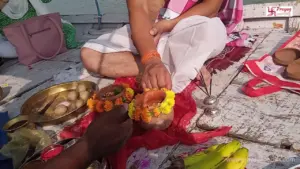
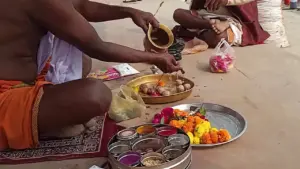
- Preparation of the Vivah Mandap: The Tulsi plant (which must be a mature, thriving Vrindavan Tulsi) is cleaned, and a small mandap is erected around it using banana stems, mango leaves, and marigold garlands. Rangoli patterns are drawn around the base of the Tulsi Vrindavan.
- Adorning the Tulsi Plant: The Tulsi plant is dressed as a bride — a small red chunari (scarf) is draped over its upper branches, tiny bangles may be placed around the pot, vermilion (sindoor) is applied symbolically, and a small floral garland adorns the plant. This dressing is done with the same reverence offered to a human bride.
- The Shaligram Stone: A Shaligram stone — the sacred black ammonite that represents Lord Vishnu — is bathed with panchamrit (a mixture of milk, curd, honey, ghee, and sugar), then dressed in a miniature dhoti or yellow cloth. It is placed on the mandap facing the Tulsi plant.
- Fasting: Women observing Tulsi Vivah maintain a fast throughout the day, breaking it only after completing the evening ceremony. Widows traditionally do not participate in the vivah rituals, though they may worship Tulsi separately.
- The Marriage Ceremony: A qualified priest chants Vedic mantras for the marriage. The key rituals include Var Mala (exchange of flower garlands), Saat Phere (seven circumambulations around a small fire or the Tulsi plant itself), Mangalsutra binding with a sacred thread, and Sindoor Daan.
- Prasad Distribution: Following the ceremony, prasad is distributed to all present — typically consisting of sweets, fruits, and panchamrit. The sacred agarbatti (incense) and deep (lamp) are circulated among devotees.
The Connection to Kartik Month and the Hindu Wedding Season
One of the most practically significant aspects of Tulsi Vivah is that it marks the official opening of the Hindu wedding season. For the four months of Chaturmas — from Ashadha Shukla Ekadashi (Devshayani Ekadashi) when Vishnu enters his cosmic sleep, to Kartik Shukla Ekadashi (Prabodhini/Devuthani Ekadashi) when he awakens — no auspicious ceremonies, including weddings, are traditionally performed. When Vishnu awakes and his own wedding to Tulsi is celebrated, the cosmic auspiciousness required for human weddings returns.
This is also why Tulsi Vivah is sometimes called Devuthani Ekadashi Vivah. The opening of the wedding season with a divine marriage is seen as a blessing upon all human marriages that will follow. Couples who perform Tulsi Vivah at home are believed to receive the punya (spiritual merit) of performing a Kanyadaan — even if they have no daughter of their own to give in marriage. This is a significant benefit for childless couples, or those who have only sons.
Regional Variations in Tulsi Vivah Traditions
While the core narrative and ceremony remain consistent across India, regional traditions add rich colour to the celebration:
Maharashtra
In Maharashtra, Tulsi Vivah is celebrated with exceptional grandeur. The ceremony closely mirrors a human wedding, with the Tulsi plant treated as the bride and formal wedding invitations sometimes even issued to neighbours and relatives. Traditional Arati songs specific to Tulsi Vivah are sung by women.
Gujarat
In Gujarat, the day is marked as the beginning of the festival season. Families light their homes with diyas, perform the ceremony, and the occasion often precedes the first major wedding bookings of the season. Women sing traditional garba and devotional songs in honour of Tulsi.
Uttar Pradesh and Prayagraj
In the sacred city of Prayagraj, Tulsi Vivah is observed with deep piety. Pandits at major temples and at the ghats of the Triveni Sangam perform the ceremony with full Vedic rites. Families often invite experienced pandits to conduct the ceremony at home, ensuring every ritual element is correctly performed according to the Smriti texts. For families who cannot have a pandit physically present, Prayag Pandits offers an Online Tulsi Vivah Package 2026 — a complete live ceremony performed by our pandits which you and your family can witness via video call.
South India
In Tamil Nadu and Karnataka, Tulsi is worshipped as Thiruvilakku or Brinda, and the ceremony has a distinctly Vaishnava character. The Tulsi plant is worshipped in temples dedicated to Vishnu on this day, and large temple processions mark the occasion.
Tulsi Vivah and the Significance of Kanyadaan
The concept of Kanyadaan — the gift of a daughter in marriage — is considered the highest possible act of daan (giving) in Hindu dharma. The Smriti texts and Dharmashastra literature declare that performing a Kanyadaan washes away all sins and grants the giver liberation from the cycle of rebirth. For parents who have no daughters, or for devout individuals who simply wish to accumulate this extraordinary merit, Tulsi Vivah provides the exact equivalent.
By sponsoring or performing the Tulsi Vivah ceremony — by giving the Tulsi plant (who is Vrinda, who is a devoted daughter of the cosmos) in marriage to Lord Vishnu — one is literally performing a Kanyadaan of the highest order. This is explicitly stated in the Padma Purana, and it is why daughterless families specifically seek to perform Tulsi Vivah each year with extra devotion.
The Deep Meaning of Shaligram: Why Lord Vishnu Remains as Stone
The Shaligram — the smooth black ammonite stone from the Gandaki River in Nepal’s Muktinath region — is one of the most revered objects in Vaishnavism. According to the Devi Bhagavata Purana and the Skanda Purana, Vishnu accepted Vrinda’s curse willingly as a form of penance for the deception he had perpetrated. The stone form embodies divine constancy and immovability — qualities that, ironically, make Vishnu as Shaligram an ideal eternal partner for Tulsi.
The Shaligram stone is naturally marked with sacred chakra (disc) patterns formed by the fossilised shells of ancient ammonites — these circular markings are considered the Sudarshana Chakra of Vishnu, eternally inscribed upon his stone form. No human hand shaped them; they emerged from the depths of geological time, which in the Hindu understanding means they carry the direct imprint of cosmic creation.
When Tulsi and Shaligram are placed together in worship, the union of the living plant and the primordial stone represents the union of prakriti (nature, the feminine cosmic principle, represented by the ever-growing, fragrant, living Tulsi) and purusha (the divine cosmic witness, unchanging, the Shaligram). This is the deepest theological meaning of Tulsi Vivah — it is not merely a story but a yantra in living form, enacted each year to rebalance and re-consecrate the sacred partnership at the heart of creation.
How to Honour Tulsi Vivah at Home
Whether you have a thriving Tulsi Vrindavan in your garden or a modest pot of Tulsi on your balcony, you can honour this festival meaningfully at home. Here is a condensed guide:
- Clean and decorate the Tulsi plant and its pot the morning before the ceremony. Wash away dead leaves and apply a fresh coat of paint to the Tulsi Vrindavan plinth if you have one.
- Prepare a Shaligram stone or a small image/idol of Lord Vishnu if a Shaligram is not available. Both are equally valid in home worship.
- Observe the fast for the day and break it only after completing the evening ceremony.
- Light a ghee lamp (not oil) for Tulsi — ghee lamps are specifically recommended in the scriptures for this occasion.
- Recite the Tulsi Ashtakam or Tulsi Stotra during the ceremony, or at minimum chant Om Namo Bhagavate Vasudevaya.
- Distribute prasad to family, neighbours, and anyone who visits.
- If you wish the ceremony to be conducted with full Vedic rites including Saptapadi, Laaja Homa, and proper mantras, invite an experienced pandit to perform the ceremony at your home. You can book a home Tulsi Vivah puja through Prayag Pandits directly, or if you live outside India, opt for our Online Tulsi Vivah Package for a complete live ceremony.
Most Popular
🙏 Book Tulsi Vivah Puja at Your Home
Starting from
₹5,100
per person
The Tulsi Vivah Legacy: A Story That Never Ends
The story of Vrinda and Jalandhar resonates across centuries because it refuses easy moral resolution. Vishnu did something wrong — and he knew it. Vrinda was devastated — and she had every right to be. Yet from that wrong, something of incomparable beauty and holiness was born. The Tulsi plant carries within it Vrinda’s devotion, her grief, her anger, her grace in withdrawing the curse, and her ultimate transformation from a demon’s wife into the eternal consort of the Supreme Lord himself.
Every year, when the lamps are lit and the Tulsi is dressed as a bride, we are not merely enacting a ritual. We are remembering Vrinda — a woman whose loyalty was so fierce it shaped the cosmos, whose love was so pure it survived betrayal and death, and whose spirit is present in every home in India, quietly growing toward the light, purifying the air, offering her leaves to the god who wronged her and whom she loved nonetheless. That is the true story of Tulsi Vivah.
To explore the sacred significance of the Kartik month further, or to understand the complete schedule of auspicious days and rituals connected to this holy season, visit our dedicated guides on Kartik Poornima and Dev Deepawali at Varanasi.
Book Your Sacred Ritual
Authentic ceremonies performed by Veda-trained pandits with video proof at sacred sites across India.
2,263+ families served
Video proof included
Since 2019
