Key Takeaways
- What is Haridwar Famous For? — The Essential Answer
- The Sacred Ganga — Why Haridwar's River is Different
- Har Ki Pauri — The Most Sacred Ghat in Haridwar
- The Famous Temples of Haridwar
In This Article
Ask any Hindu pilgrim what Haridwar is famous for, and the answer will come instantly — the Ganga, the Ganga Aarti, and the divine energy that makes every moment here feel like a brush with the eternal. Haridwar (also spelled Hardwar, literally “Gateway to Hari/God”) sits at the precise point where the River Ganga descends from the Himalayas onto the plains of northern India. This geographical fact alone has made Haridwar sacred for thousands of years — it is the place where the celestial river first touches the earth, still carrying the purity of Gangotri and the glaciers of Gaumukh. Everything that Haridwar is famous for flows from this one extraordinary reality: that here, the divine meets the mortal, and the boundary between heaven and earth becomes thin enough to cross.
What is Haridwar Famous For? — The Essential Answer
Haridwar is famous for seven things above all else: the Ganga Aarti at Har Ki Pauri, the Kumbh Mela (the world’s largest religious gathering), its ancient temples (Mansa Devi, Chandi Devi, Maya Devi), its role as a Pitru Tirth for ancestral rites including Asthi Visarjan and Pind Daan, its Ayurvedic heritage and herbal markets, its vibrant ashram culture, and the sheer spiritual electricity of its ghats where millions of devotees have bathed and prayed across the millennia. Each of these deserves to be understood in depth.
The Sacred Ganga — Why Haridwar’s River is Different
The Ganga that flows through Haridwar is not the same river that passes through Varanasi, Prayagraj, or Kolkata in terms of ritual purity. At Haridwar, Gangaji is barely 300 km from her glacial source at Gaumukh. The river here is cold, swift, emerald-green in the monsoon and turquoise-clear in winter — visually and spiritually distinct from the broader, more placid river of the plains. The Ganga at Haridwar is a young, fierce river, carrying the energy of the mountains.
Hindu scripture holds that bathing in the Ganga at Haridwar washes away the sins of seven lifetimes. The specific bathing ghat most associated with this promise is Har Ki Pauri — literally “the steps of Lord Hari (Vishnu).” According to tradition, this is where Vishnu’s footprint is enshrined, and where the holy Emperor Vikramaditya had his brother Bhartrihari meditate until his death, after which his ashes were immersed here. The ghat’s central feature is the Brahmakund — a small, specially demarcated pool where the Ganga’s current is held to be at its most potent.
For those performing Asthi Visarjan at Haridwar — the immersion of a deceased person’s ashes in the sacred river — the spiritual significance is profound. The Ganga at Haridwar is believed to carry the soul swiftly toward liberation, and families from across India, including a growing number of NRIs seeking Pind Daan at Haridwar, choose this city as the sacred site for these final rites.
Har Ki Pauri — The Most Sacred Ghat in Haridwar
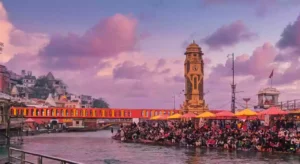
Har Ki Pauri is the spiritual heart of Haridwar and one of the most photographed sights in all of India. Every evening at sunset, thousands of devotees gather on the stepped stone ghats to witness the Ganga Aarti — a magnificent ceremony of fire, flowers, bells, and Sanskrit chanting performed by priests who wade into the river holding enormous multi-tiered brass lamps (deepaks) ablaze with dozens of cotton wicks. The scene — the roaring river, the flickering fire reflected in the water, the smell of incense and marigolds, the crowd pressing forward to offer their diyas — is impossible to adequately describe and must be witnessed in person.
The Ganga Aarti at Har Ki Pauri takes place twice daily — at dawn (Pratah Aarti) and at dusk (Sandhya Aarti). The evening aarti is the more elaborate of the two, typically drawing the largest crowds. It is performed at a fixed time that varies by season (around 6:00–7:30 pm), and the ceremony lasts approximately 45 minutes. Attending the Ganga Aarti is considered obligatory for any pilgrim visiting Haridwar — it is, simply put, one of the most spiritually intense experiences available anywhere in India.
The Famous Temples of Haridwar
Haridwar is ringed by ancient and powerful temples. The three most famous are the Shakti Peethas of the Siwalik Hills — each requiring a ropeway or steep climb to reach, and each rewarding the effort with extraordinary darshan and panoramic views of the city and river far below.
Mansa Devi Temple
Perched atop Bilwa Parvat (the Bilwa Hill), Mansa Devi Temple is one of the Sidhpeethas of Uttarakhand — a temple where the goddess is believed to fulfill the sincere wishes of her devotees. “Mansa” means desire or wish (from the Sanskrit manasa), and pilgrims tie sacred threads around a specific tree in the temple compound while making a vow. When the wish is fulfilled, they return to untie the thread. The tree, perpetually festooned with thousands of red threads, is one of the most evocative sights in Haridwar. The temple is accessible by ropeway (udan khatola) from the Mansa Devi ropeway station near Har Ki Pauri, or on foot up a paved stairway of approximately 1.5 km.
Chandi Devi Temple
Across the river on Neel Parvat (the Blue Hill), Chandi Devi Temple is dedicated to the fierce goddess Chandi — a form of Parvati who is said to have slain the demon generals Chanda and Munda at this spot. The temple was originally established by Adi Shankaracharya in the 8th century CE, with the main deity idol installed by the Kashmiri king Suchet Singh in 1929. The Chandi Devi ropeway is one of Haridwar’s most popular tourist attractions, offering sweeping views of the Ganga and the city. The trek on foot takes about 45 minutes through forested paths.
Maya Devi Temple
Unlike Mansa Devi and Chandi Devi, Maya Devi Temple is located within the city itself — close to the Haridwar railway station. It is one of the Sidha Peethas of India and one of the Shakti Peethas where the heart and navel of the goddess Sati are believed to have fallen when Lord Vishnu’s Sudarshana Chakra divided her body. The temple is ancient — believed to be over a thousand years old — and gives the city its older name: Mayapuri. This is the presiding goddess of Haridwar itself, and no visit to the city is considered complete without darshan at Maya Devi.
Daksha Mahadev Temple
In the Kankhal area of Haridwar, the Daksha Mahadev Temple marks the site of the legendary Daksha Yajna — the grand sacrifice performed by King Daksha (Sati’s father) to which Lord Shiva was not invited, and at which the goddess Sati immolated herself after being insulted. The subsequent grief and rage of Shiva forms the foundation of the Shakti Peetha tradition across India. The temple’s main idol depicts Shiva with Sati, and its historical and mythological significance makes it a profoundly important pilgrimage site within the Haridwar circuit.
Sapt Rishi Ashram and Sapta Sarovar
About 5 km upstream from the main city, the Sapt Rishi Ashram stands at the spot where, according to tradition, the seven great rishis (Kashyapa, Vashishtha, Atri, Vishwamitra, Jamadagni, Bharadwaj, and Gautama) meditated. The Ganga, unwilling to disturb their tapasya (penance), divided herself into seven streams — the Sapta Sarovar — to flow around them gently. The area is peaceful, less crowded than the main ghats, and provides a meditative counterpoint to Haridwar’s busier temples. The seven streams eventually re-merge downstream near Har Ki Pauri.
Haridwar as a Pitru Tirth — Ancestral Rites at the Ganga
One of the most important and lesser-known aspects of what Haridwar is famous for is its role as a Pitru Tirth — a sacred site for the performance of ancestral rites. The Ganga at Haridwar is considered one of the most powerful places to immerse the ashes of departed loved ones and to perform Pind Daan, Tarpan, and Shradh ceremonies for the peace of ancestral souls.
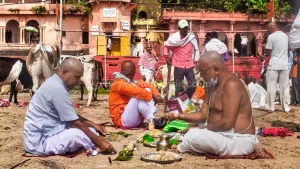
Asthi Visarjan at Haridwar — the ritual immersion of bone fragments and ashes (asthi) collected after cremation — is performed by families who bring their departed loved one’s remains to the Ganga. The priest (pandit) conducts the rites at the Har Ki Pauri ghat or one of the nearby designated asthi visarjan points, reciting the appropriate Vedic mantras while the ashes are gently released into the sacred current. Many families choose Haridwar for this final rite because of the city’s accessibility from Delhi and the northern plains, and because of the profound spiritual comfort offered by the Ganga’s presence.
Pind Daan at Haridwar — the offering of rice balls (pindas) to the ancestors — can be performed throughout the year and is especially meritorious during Pitrupaksha (the fortnight of ancestral rites in September–October). Prayag Pandits provides complete Pind Daan and Asthi Visarjan services at Haridwar with experienced local pandits who are well-versed in the specific Haridwar puja traditions.
🙏 Pind Daan u0026 Asthi Visarjan at Haridwar
The Kumbh Mela — Why Haridwar Hosts the World’s Largest Gathering
Haridwar is one of the four cities that hosts the Kumbh Mela — the others being Prayagraj, Ujjain, and Nashik. The Kumbh Mela at Haridwar occurs every twelve years (the Purna Kumbh) and every six years (the Ardha Kumbh), with the Maha Kumbh occurring once every 144 years. The rationale for Haridwar’s inclusion in the Kumbh circuit is astronomical: the festival occurs when Jupiter (Brihaspati) enters Aquarius and the Sun enters Aries — a specific planetary alignment that charges the Ganga with exceptional spiritual potency.
During the Kumbh Mela at Haridwar, the main bathing ghats — particularly Har Ki Pauri — see tens of millions of pilgrims bathing in the Ganga on the principal Shahi Snan (royal bathing) dates. The processions of naked Naga sadhus, the chanting of the Akharas, the millions of orange-clad devotees, the floating flower offerings on the Ganga — the Kumbh Mela at Haridwar is an experience that has no parallel anywhere on earth.
Ashrams and Yoga — Haridwar’s Spiritual Infrastructure
Haridwar has been a centre of Hindu spiritual education for centuries. Today, the city and the adjoining Rishikesh (22 km upstream) together host hundreds of ashrams, yoga centers, and spiritual retreat facilities. Some of the most renowned institutions in Haridwar include:
- Shantikunj (All World Gayatri Pariwar): A major spiritual organization founded by Pandit Shriram Sharma Acharya, focused on Gayatri mantra sadhana and social reform through spiritual practice. The ashram campus is expansive and hosts thousands of visitors for week-long and month-long retreats.
- Patanjali Yogpeeth: Founded by Baba Ramdev and Acharya Balkrishna, this massive campus near Haridwar has put the city on the global map for Ayurveda, yoga therapy, and natural medicine.
- Parmarth Niketan (primarily Rishikesh, accessible from Haridwar): One of the largest ashrams in the Himalayas, hosting international visitors for yoga teacher training and spiritual programs.
- Brahma Varchas Research Institute: Part of the Shantikunj campus, focused on the scientific study of Vedic knowledge and spiritual practices.
For those seeking to combine pilgrimage with structured spiritual practice, Haridwar offers month-long residential programs, Vedic chanting courses, Ayurvedic panchakarma treatments, and intensive yoga retreats at numerous institutions.
The Herbal Market and Ayurveda — Haridwar’s Ancient Medical Heritage
Haridwar has been a centre of Ayurvedic medicine and herbal trade for centuries. The city’s proximity to the Himalayas gives it access to medicinal plants, roots, and herbs that are rare or unavailable elsewhere. The main bazaar area near Har Ki Pauri is lined with shops selling churan (digestive powders), chyawanprash, herbal teas, Ayurvedic oils, tulsi products, and genuinely wild-harvested Himalayan herbs.
The Patanjali Megastore near the Patanjali Yogpeeth campus is one of India’s largest Ayurveda retail outlets and draws visitors specifically for its extensive product range. The Divya Pharmacy, also associated with Patanjali, manufactures and sells over 400 Ayurvedic formulations sourced from traditional Vedic recipes. A visit to Haridwar’s herbal market is both spiritually grounding and practically useful — most visitors return home with bags of herbs, oils, and Ayurvedic preparations that are simply unavailable in urban pharmacies.
Things to Do in Haridwar — Beyond the Ganga Aarti
While the Ganga Aarti at Har Ki Pauri is the centrepiece of any Haridwar visit, the city offers a full itinerary of spiritual and cultural experiences:
- Early morning holy dip at Har Ki Pauri Brahmakund: The most auspicious bath, ideally at sunrise. The water is cold year-round — bring a change of dry clothes.
- Ropeway rides to Mansa Devi and Chandi Devi: Both ropeways operate from early morning. Combine both in one day by starting with Mansa Devi (closer to Har Ki Pauri) and then crossing to Chandi Devi by auto.
- Darshan at Maya Devi Temple: Walk from Har Ki Pauri (15 minutes) or take an auto-rickshaw. Morning hours are less crowded.
- Visit Daksha Mahadev at Kankhal: 4 km from Har Ki Pauri, accessible by auto. Combine with the Sati Kund (the sacred pond associated with the Daksha Yajna story).
- Sapt Rishi Ashram and the seven Ganga streams: A peaceful 30-minute excursion upstream, ideal in the afternoon.
- Evening walk through Bara Bazaar: The main market stretching from the ropeway station toward the bus stand — filled with religious items, rudraksha malas, brass idols, and the best lemon soda stalls in northern India.
- Day trip to Rishikesh: 22 km upstream, Rishikesh is accessible by shared auto-rickshaw or taxi in 35–45 minutes. The Ram Jhula and Laxman Jhula suspension bridges, the Beatles Ashram, and the Rishikesh yoga scene make for a rich day trip.
Getting to Haridwar — Travel Connections
Haridwar is one of the best-connected pilgrimage cities in India:
- By Train: Haridwar Junction is a major railway station on the Northern Railway network. Direct trains from Delhi (3.5–5 hours), Dehradun (1.5 hours), Varanasi (overnight), and many other cities. The Jan Shatabdi Express and Mussoorie Express from Delhi are popular options.
- By Road: Haridwar is 214 km from Delhi on NH-334. The journey takes 4–5 hours by car depending on traffic. Regular bus services (UPSRTC and Uttarakhand Roadways) operate from Delhi’s Kashmiri Gate ISBT and Anand Vihar terminal.
- By Air: The nearest airport is Jolly Grant Airport in Dehradun (35 km from Haridwar), with daily flights from Delhi, Mumbai, and Bengaluru. Taxi transfers from the airport to Haridwar take approximately 45 minutes.
Related Services by Prayag Pandits
- 🙏 Pind Daan in Haridwar — Starting from ₹7,100
- 🙏 Asthi Visarjan in Haridwar — Starting from ₹7,100
- 🙏 Kaal Sarp Pooja at Haridwar — Starting from ₹7,100
Book Your Sacred Ritual
Authentic ceremonies performed by Veda-trained pandits at sacred sites across India.