Key Takeaways
- The Spiritual Significance of Mathura: A City Chosen by the Divine
- Major Temples of Mathura: Where Stone Breathes Devotion
- Mathura and the Mathura-Vrindavan Circuit: Planning Your Pilgrimage
- Mathura's Famous Festivals: The City That Celebrates Like No Other
In This Article
Mathura, known reverently as Brajbhoomi or the Land of Braj, stands as one of the most sacred cities in all of India. Situated on the western bank of the Yamuna River in Uttar Pradesh, Mathura occupies a singular place in the Hindu spiritual imagination — for it is here, some five thousand years ago by Puranic reckoning, that Bhagwan Shri Krishna took birth in the prison cell of the tyrant Kansa. That single cosmic event transformed this ancient city into an eternal pilgrimage destination, drawing millions of devotees, spiritual seekers, historians, and travellers from every corner of the world.
But to ask what Mathura is famous for is to ask what the ocean is famous for — the answer is vast, layered, and inexhaustible. Mathura is famous for its temples, yes. It is famous for its ghats, its festivals, its exquisite peda, its Holi celebrations that set the entire region ablaze in colour. Yet beyond all of these, Mathura is famous for something intangible: a spiritual energy, a bhakti-saturated atmosphere, a sense that the divine is not distant but utterly present. In this guide, we explore the full depth of what makes Mathura one of India’s most beloved sacred destinations.
The Spiritual Significance of Mathura: A City Chosen by the Divine
Mathura’s spiritual stature rests on its identity as the janmabhoomi — the birthplace — of Lord Krishna, the eighth avatar of Lord Vishnu and arguably the most beloved deity across all of Hindu tradition. The Bhagavata Purana, the Vishnu Purana, and the Harivamsha all narrate the extraordinary circumstances of Krishna’s birth: Devaki and Vasudeva imprisoned by the demon-king Kansa, the celestial announcement of the child who would end Kansa’s tyranny, and the miraculous midnight birth that shook the cosmos.
According to the Skanda Purana, Mathura is one of the Sapta Puri — the seven sacred cities that grant moksha to those who take their last breath there. The verse reads:
अयोध्या मथुरा माया काशी काञ्ची अवन्तिका। पुरी द्वारावती चैव सप्तैता मोक्षदायिकाः॥
(Ayodhya, Mathura, Maya (Haridwar), Kashi, Kanchipuram, Avantika (Ujjain), and Dwarka — these seven are the givers of moksha.)
For a Hindu devotee, simply walking the streets of Mathura is considered a sacred act. The entire region known as Braj Mandal — encompassing Mathura, Vrindavan, Govardhan, Barsana, Nandgaon, and surrounding villages — is regarded as the playground of the divine. Every hill, every forest grove, every body of water here is associated with an episode from Krishna’s childhood and youth. The spiritual geography of Mathura is, in this sense, a living scripture.
Major Temples of Mathura: Where Stone Breathes Devotion
The temple landscape of Mathura is extraordinarily rich. There are literally hundreds of temples within the city and its surroundings, each carrying its own history, mythology, and spiritual significance. Here are the most important ones that every pilgrim must visit.
1. Shri Krishna Janmabhoomi Temple Complex
The Shri Krishna Janmabhoomi is the holiest site in all of Mathura. This is the precise spot where Lord Krishna is believed to have been born — a small prison cell (Garbha Griha) that has been preserved and consecrated within an elaborate temple complex. The atmosphere inside is charged with an intensity that silences conversation and stills the mind. Devotees stand at the threshold of the original cell, marked by a stone platform, and feel the overwhelming weight of this divine moment across centuries.
The temple complex also houses the Keshav Dev Mandir, rebuilt multiple times after Mughal-era destruction, and a museum of Krishnaite art and artefacts. Aarti is performed here at dawn and dusk with remarkable devotional fervour. During Janmashtami, the midnight aarti at the Janmabhoomi draws hundreds of thousands of worshippers and is one of the most electrifying religious events in India.
2. Dwarkadhish Temple
Built in 1814 by Seth Gokul Das Parikh, the Dwarkadhish Temple is one of the grandest Vaishnava temples in North India. Dedicated to Lord Krishna in his majestic form as the King of Dwarka, the temple is renowned for its intricately carved sandstone facade, its soaring spire, and its elaborate ritual schedule. The temple follows the Pushtimarg tradition established by the great saint Vallabhacharya, and the shringar darshan — when the deity is dressed and adorned — is a spectacle of extraordinary beauty.
The Dwarkadhish Temple is particularly celebrated for its Holi and Janmashtami celebrations, which are conducted with a grandeur and devotional intensity that leaves pilgrims moved to tears.
3. Vishram Ghat and the Sacred Ghats of Mathura
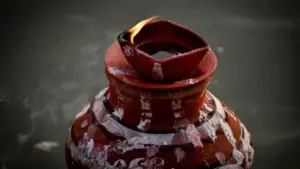
Vishram Ghat is the most sacred ghat in Mathura, located on the banks of the Yamuna. According to tradition, this is where Lord Krishna rested (vishram means rest) after slaying the demon Kansa. The ghat is lined with a series of temples and is the site of the famous Yamuna Aarti performed every evening at sunset — a ceremony of diyas, chanting, and conch shells that is deeply moving to witness.
Other significant ghats include Kans Kila Ghat, Assi Ghat, and Chakrateertha Ghat. Taking a holy dip in the Yamuna at Vishram Ghat during auspicious occasions — particularly during Pitrupaksha, Kartik Purnima, or Janmashtami — is considered immensely purifying. Just as pilgrims seek the sacred waters at the Triveni Sangam in Prayagraj, devotees at Vishram Ghat immerse themselves in the Yamuna’s grace.
4. Govind Dev Temple
Constructed in the 16th century by the Rajput king Man Singh I of Amber, the Govind Dev Temple in Vrindavan (just 15 km from Mathura) was once described as the tallest temple in India. Though its upper storeys were demolished during Aurangzeb’s reign, what remains is still architecturally magnificent. The deity of Govind Dev is believed to have been carved to resemble the actual likeness of Lord Krishna, as described by Vajranabha, Krishna’s great-grandson. Devotees who see the deity here often speak of an inexplicable sense of recognition — as though they are seeing someone they have always known.
5. Radha Kund and Shyam Kund
Located near Govardhan Hill, about 26 km from Mathura, Radha Kund and Shyam Kund are twin sacred ponds of immense spiritual significance. According to the Bhagavata Purana, these kunds were created by Radharani and Krishna themselves. The Gaudiya Vaishnava tradition regards Radha Kund as the holiest spot in all of creation — more sacred even than Vrindavan itself. Bathing in Radha Kund on Bahulastami, the eighth day of the dark fortnight of Kartik month, is considered equivalent to performing countless sacred pilgrimages.
Mathura and the Mathura-Vrindavan Circuit: Planning Your Pilgrimage
Experienced pilgrims never visit Mathura in isolation — they undertake the Mathura-Vrindavan circuit, a sacred journey through the interconnected holy sites of Braj. Here is the ideal way to structure this pilgrimage:
Day 1: Mathura — The Birthplace
Begin your pilgrimage at dawn with a holy dip at Vishram Ghat. Watch the sunrise over the Yamuna and attend the early morning aarti. Then proceed to the Shri Krishna Janmabhoomi for darshan. After the midday break, visit the Dwarkadhish Temple for the afternoon darshan and witness the magnificent shringar. In the evening, return to Vishram Ghat for the Yamuna Aarti — a ceremony that perfectly mirrors, in its own distinct way, the famous Ganga Aarti performed at the ghats of Varanasi.
Day 2: Vrindavan — The Land of Rasa
Vrindavan, 15 km north of Mathura, is where Krishna spent his youth — herding cows, playing his flute, and enacting the divine Rasa Lila with Radharani and the gopis. Must-visit temples here include the Banke Bihari Temple (famous for its unique darshan ritual where the curtain is pulled across frequently, as direct gaze at this form of Krishna is considered overwhelming), the ISKCON Temple, the Radha Damodara Temple (where the great saint Jiva Goswami resided), and the Madan Mohan Temple. Walk through the forests of Nidhivan at dusk, said to be where Krishna still dances his Rasa at night.
Day 3: Govardhan — The Sacred Hill
Govardhan Hill is where Lord Krishna performed the miraculous feat of lifting the mountain with the little finger of his left hand for seven days and seven nights, sheltering the people of Braj from Indra’s devastating rainstorm. Performing the Govardhan Parikrama — the circumambulation of the hill, approximately 21 km — is considered among the holiest acts a devotee can perform. En route, visit Radha Kund, Kusum Sarovar, and Manasi Ganga.
Day 4: Barsana and Nandgaon
Barsana, the birthplace of Radharani, and Nandgaon, the village of Nanda Maharaj where Krishna grew up, are the sites of the world-famous Lath Mar Holi — a pre-Holi celebration where women playfully beat men with sticks in a reenactment of Krishna’s teasing of Radha and the gopis. The Radha Rani Temple atop Barsana hill offers panoramic views of Braj and an atmosphere of extraordinary devotional intensity.
Mathura’s Famous Festivals: The City That Celebrates Like No Other
Mathura is famous above all else for the sheer exuberance and spiritual depth of its festival celebrations. Every festival in the Hindu calendar is observed here with special devotion, but two festivals stand out as defining the city’s identity.
Janmashtami: The Midnight Birthday of Krishna
Janmashtami, the celebration of Lord Krishna’s birth on the eighth day (ashtami) of the dark fortnight of the month of Bhadrapada, is the most sacred festival in Mathura. The celebration begins days in advance with devotional singing, recitations of the Bhagavata Purana, drama performances depicting Krishna’s life, and elaborate decorations at every temple.
At midnight — the precise hour of Krishna’s birth — the entire city erupts in celebration. At the Janmabhoomi temple, a golden cradle bearing the infant Krishna idol is rocked while devotees sing the Nanda Nanda Ananda Bhayo hymn in thunderous unison. The atmosphere is electric, tearful, and transcendent all at once. In 2025, Janmashtami falls on August 16.
If you are planning a pilgrimage to Mathura, combining it with your Prayagraj pilgrimage is an excellent way to deepen your spiritual journey across both sacred cities, as both are easily accessible from each other by road or rail.
Holi: The Festival of Colours Born in Braj
While Holi is celebrated across all of India, its spiritual and cultural home is Braj — and specifically Mathura-Vrindavan. The celebration here extends over nearly two weeks, beginning with the Lath Mar Holi at Barsana and Nandgaon, followed by the Phoolon wali Holi (Holi with flowers) at the Banke Bihari Temple in Vrindavan, and culminating in the grand colour celebrations on the festival day itself.
The theological meaning of Holi in Braj is profound: it commemorates Krishna’s playful teasing of Radha and the gopis, and the throwing of colours is understood as a participation in that divine play (lila). The joy that erupts at Holi in Mathura is not mere festivity — it is a form of bhakti, a direct participation in the eternal pastimes of the divine.
Other Significant Festivals in Mathura’s Calendar
Beyond Janmashtami and Holi, Mathura observes dozens of festivals throughout the year with great devotion:
- Annakut (Govardhan Puja): The day after Diwali, when a mountain of food is offered to Govardhan Hill as an act of thanksgiving
- Radhashtami: The birthday of Radharani, observed with particular grandeur in Barsana
- Sharad Purnima: The full moon night of the autumn season, believed to be the night of Krishna’s Rasa Lila — celebrated with all-night musical gatherings
- Kartik Purnima: When the Yamuna is illuminated with thousands of floating diyas in a spectacle of breathtaking beauty
- Basant Panchami: The first day of spring, when the entire Braj region is strewn with flowers
The Historical Legacy of Mathura: One of India’s Oldest Cities
Mathura’s history extends far beyond its association with Lord Krishna. Archaeological evidence confirms that Mathura was an important urban centre as far back as the 6th century BCE, making it one of the oldest continuously inhabited cities in the Indian subcontinent.
The Mathura Art School
Between the 1st and 3rd centuries CE, Mathura was the centre of one of the most important artistic traditions in ancient India — the Mathura Art School. Working in distinctive red sandstone quarried from Sikri, Mathura’s sculptors created some of the finest early images of the Buddha, the Jain Tirthankaras, and Hindu deities. The Mathura style — characterized by sensuous figures, diaphanous robes, and an emphasis on human vitality — was deeply influential on later Indian art traditions. The Government Museum in Mathura houses one of the finest collections of Mathura sculpture in existence.
Mathura Under the Great Dynasties
Mathura flourished under successive great empires. During the Mauryan period, Emperor Ashoka visited and left inscriptions attesting to the city’s importance. Under the Kushana dynasty (1st–3rd century CE), Mathura became a major cosmopolitan centre of trade, art, and religious exchange. The Chinese Buddhist pilgrim Xuanzang (Hieun Tsang), who visited in the 7th century CE, described Mathura as a thriving city of remarkable beauty with numerous Buddhist monasteries and Hindu temples.
The Gupta period (4th–6th century CE) was a golden age for Mathura’s temples and religious institutions. Under rulers like Chandragupta II, Mathura’s Vaishnava tradition reached new heights of sophistication. The city later passed through the hands of the Rajputs, the Ghaznavids, the Delhi Sultanate, and the Mughals — each leaving their mark on the city’s complex cultural tapestry.
The Contribution of the Six Goswamis of Vrindavan
In the 16th century, the great saint Shri Chaitanya Mahaprabhu sent his closest disciples — the Six Goswamis of Vrindavan (Rupa Goswami, Sanatana Goswami, Jiva Goswami, Gopala Bhatta Goswami, Raghunatha Bhatta Goswami, and Raghunatha Dasa Goswami) — to Vrindavan to rediscover and establish the lost sacred sites of Braj. They authored voluminous Sanskrit texts on Vaishnava theology and bhakti, established temples, and re-energized the entire Mathura-Vrindavan pilgrimage tradition. Their legacy continues to shape the devotional life of millions of Gaudiya Vaishnavas worldwide.
Mathura’s Cultural Life: Art, Music, and the Living Traditions of Braj
Mathura is not simply a city of temples — it is a living cultural ecosystem where art, music, dance, and craft traditions have been nurtured continuously for centuries, all in service of devotion to Lord Krishna.
Ras Lila: The Divine Dance Drama
The Ras Lila is a form of devotional dance-drama enacted by young performers (traditionally boys or young men playing both male and female roles) depicting scenes from Krishna’s life with Radharani and the gopis. Ras Lila performances in Mathura and Vrindavan are not mere theatrical entertainment — they are considered a form of worship, a direct offering to the divine. Attending a traditional Ras Lila performance during your visit is an experience of rare cultural and spiritual depth.
Dhrupad and Haveli Sangeet
The Haveli Sangeet tradition — a form of devotional classical music performed within the haveli (mansion-style) temples of the Pushtimarg — is one of Mathura-Vrindavan’s greatest musical treasures. Compositions in Braj Bhasha by poets like Surdas, Meerabai, and Vallabhacharya are sung to intricate classical ragas keyed to specific times of day and seasons, creating an extraordinarily refined devotional experience.
Handicrafts and Mathura’s Local Arts
Mathura’s craft traditions include:
- Stone carving: Artisans continue the ancient tradition of carving religious icons and decorative objects from the distinctive red Sikri sandstone
- Brassware: Intricately cast and engraved brass idols, lamps, and ritual vessels
- Wooden toys and Krishna figurines: Particularly the famous painted wooden toys from Vrindavan
- Textile weaving: Particularly the pitambar — yellow silk cloth used for dressing deities
The Famous Mathura Peda
No visit to Mathura is complete without savouring the famous Mathura Peda — a dense, sweet confection made from milk solids (khoya) flavoured with cardamom and often garnished with pistachios. The peda has been an integral part of Mathura’s culinary identity for centuries, traditionally prepared as prasad for Lord Krishna. The most authentic pedas are found in the ancient sweet shops around the Dwarkadhish Temple and Vishram Ghat. Other notable foods include aloo ke dahi wale paranthe (potatoes in yogurt-based flatbread) and the extraordinary variety of milk-based sweets.
How to Reach Mathura: Your Complete Travel Guide
Mathura’s connectivity is excellent, making it easily accessible from Delhi, Agra, and Prayagraj alike.
By Train
Mathura Junction and Mathura Cantonment stations are well-connected to all major Indian cities. From Delhi (150 km), frequent trains including Shatabdi and intercity expresses take approximately 2 hours. From Agra (58 km), the journey is about 45 minutes. From Prayagraj (500 km), the journey takes approximately 6–7 hours by express train.
By Road
Mathura is located on National Highway 19 (the Delhi–Kolkata highway), making road access excellent. From Delhi (150 km via Yamuna Expressway), the drive takes approximately 2–2.5 hours. The Mathura-Vrindavan distance is just 12–15 km and is easily covered by auto-rickshaw or e-rickshaw. Govardhan is approximately 26 km from Mathura.
By Air
The nearest airports are Agra Airport (approximately 65 km) and Indira Gandhi International Airport, Delhi (approximately 165 km). Both have taxis and prepaid cab services to Mathura.
Best Time to Visit Mathura
Mathura can be visited throughout the year, but the ideal seasons are:
- October to March: Pleasant weather, ideal for walking the ghats and exploring temples. Diwali, Govardhan Puja, and Kartik festivals fall during this period.
- July to August: Hot and humid but this is the time of Janmashtami — the most spiritually powerful time to be in Mathura. The monsoon also adds a lush beauty to the landscape.
- March: The Holi season — when the entire Braj region transforms into a carnival of colour and devotion.
- Avoid May and June: The heat in Mathura during these months can be extreme, with temperatures often crossing 45°C.
The Pitrupaksha Connection: Mathura as an Ancestral Rite Location
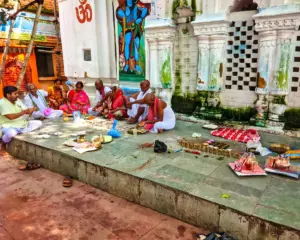
While Mathura is primarily associated with the bhakti tradition of Lord Krishna, it also holds significance for ancestral rites during the Pitrupaksha period. The Yamuna River at Vishram Ghat is considered highly sacred for Tarpan — the offering of water to departed ancestors. Many devout families, particularly those of the Vaishnava tradition, include Mathura in their Pitrupaksha pilgrimage circuit alongside Prayagraj and Gaya.
The auspiciousness of Mathura’s sacred waters — flowing from the Yamuna, sister river to the Ganga — makes ancestral rites performed here particularly potent. A pandit from Prayag Pandits can guide you through the proper Tarpan ritual at Vishram Ghat with the correct Vedic mantras and procedures, ensuring your ancestral offering reaches your forebears in the highest spiritual manner. To understand the full scope of the Pitrupaksha pilgrimage circuit, explore our guide to Pind Daan in Gaya and Pind Daan in Varanasi.
Practical Tips for Your Mathura Pilgrimage
To make the most of your visit to this sacred city, keep the following practical guidance in mind:
- Dress modestly: All temples require arms and legs to be covered. Women should carry a shawl or dupatta. Avoid synthetic or revealing clothing.
- Remove footwear: Temples, ghats, and many lanes require devotees to remove footwear. Carry a bag to store your shoes.
- Photography restrictions: Many temples, particularly the inner sanctum of the Janmabhoomi and Banke Bihari, prohibit photography. Respect these rules absolutely.
- No leather items: Many Vaishnava temples in Mathura prohibit leather items (belts, wallets, bags) from entering. Leave leather goods at your accommodation or use cloth alternatives.
- Vegetarian food only: Mathura is a strictly vegetarian city. All restaurants, dhabas, and food stalls serve only vegetarian food — a natural reflection of the Vaishnava tradition’s reverence for all life.
- Hire a local guide: The mythology, history, and customs of Mathura’s temples are deep and complex. A knowledgeable pandit-guide can enormously enrich your experience.
- Book your pandit in advance: If you plan to perform any puja, Tarpan, or ritual during your visit, book your Vedic pandit in advance to ensure an authentic and properly conducted ceremony.
🙏 Book Vedic Pandit Services in Mathura and Prayagraj
Mathura’s Connection to Prayagraj: Two Sacred Cities on One Spiritual Journey
Many pilgrims combine their visit to Mathura with a pilgrimage to Prayagraj, and this pairing makes profound spiritual sense. Mathura is the janmabhoomi of Lord Krishna, the place where divine incarnation began. Prayagraj is the Tirtharaj — the king of all pilgrimage sites — where the sacred Ganga, Yamuna, and the invisible Saraswati converge at the Triveni Sangam.
The Yamuna River, which one worships at Vishram Ghat in Mathura, flows onward to merge at Prayagraj’s Sangam — creating a beautiful spiritual continuity between the two cities. Devotees who bathe in the Yamuna at Mathura and then take the sacred dip at the Sangam in Prayagraj feel this river connection as a living thread of devotion. Our experienced pandits at Prayag Pandits can guide you through rituals at both locations, ensuring your pilgrimage is conducted with proper Vedic protocol at every step.
From Prayagraj, Mathura is approximately 5–6 hours by road or train — perfectly manageable as a two-day extension to any Prayagraj pilgrimage. We recommend consulting our Pind Daan in Prayagraj guide to understand the full scope of sacred services available at the Sangam before planning your combined circuit.
Conclusion: Mathura — A City That Lives in the Divine Presence
Mathura is not merely a city of the past — it is a city where the past, present, and the eternal are interwoven in every stone, every prayer, every splash of colour at Holi, and every lamp lit at Vishram Ghat. To visit Mathura is to step into a sacred geography where the divine has walked, played, and sung. It is a city that invites not just tourism but transformation.
Whether you come as a devotee seeking the darshan of Lord Krishna, as a pilgrim undertaking the full Braj Chaurasi Kos Parikrama, as a traveller drawn by history and art, or as someone performing ancestral rites on the Yamuna’s banks — Mathura will meet you where you are and take you somewhere deeper.
At Prayag Pandits, we have been guiding pilgrims through the sacred sites of North India for generations. Whether you need a learned Vedic pandit for a puja or Tarpan ceremony at Mathura, or you are planning a comprehensive pilgrimage that includes Prayagraj’s Triveni Sangam, we are here to ensure your spiritual journey is conducted with authenticity, reverence, and the deepest respect for our timeless traditions. Contact us today to begin planning your Mathura pilgrimage.
Book Your Sacred Ritual
Authentic ceremonies performed by Veda-trained pandits at sacred sites across India.