
No rituals selected yet.
Browse Pooja Packages →Key Takeaways
In This Article
Dwadashi Shradh, known in Hindi as Baras Shradh, is the ancestral rite performed for family members who departed this world on the Dwadashi Tithi — the twelfth day of either the bright (Shukla) or dark (Krishna) fortnight of the lunar month. In 2026, Dwadashi Shradh falls on Wednesday, 7 October 2026, during Pitru Paksha — the sacred fifteen-day period dedicated to ancestral rites. What makes Dwadashi Shradh additionally significant is that it is also the prescribed Shradh for those who had taken sannyasa (renunciation) before their death, as well as for individuals who died while observing a religious vow. This day is also notable in 2026 for coinciding with Magha Nakshatra, making October 7 a doubly auspicious day for ancestral observances.
What is Dwadashi Shradh?
In Hindu ancestral tradition, each Shradh tithi corresponds to the lunar day on which a family member passed away. The soul of the departed, according to Vedic belief, remains attuned to the energetic signature of the tithi of their death. Performing the Shradh on that same tithi creates a powerful alignment between the living and the departed, ensuring that the offerings of water (Tarpan), food (Pind Daan), and prayer reach the intended soul most effectively.
Dwadashi Tithi, the twelfth lunar day, carries the association with Lord Vishnu — since the Ekadashi (eleventh day) is the fasting day dedicated to Vishnu, the Dwadashi is traditionally the day of breaking that fast and making special offerings to Vishnu and to Brahmins. When a person passes on Dwadashi, they carry the spiritual imprint of this Vaishnava-associated tithi. Their Shradh on Dwadashi Shradh day within Pitru Paksha is considered especially aligned with liberation (moksha) rather than merely a comfortable rebirth.
Dwadashi Shradh has two special categories of beneficiaries beyond those who simply died on Dwadashi:
- Sanyasins and renunciants (संन्यासी): Those who had formally taken sannyasa — the fourth ashrama of life, marked by leaving all worldly ties and family — before their death. Even if a sanyasin died on a different tithi, their Shradh is traditionally performed on Dwadashi, in recognition of their spiritual status and their transcendence of regular householder rules.
- Vrat-nishtha individuals (व्रत-निष्ठ): Those who died while observing a religious vow or who were deeply committed to regular Ekadashi-Dwadashi observance in their lifetime are also sometimes honoured on Dwadashi Shradh.
The colloquial name Baras Shradh (from “baras” meaning twelve in Hindi-Urdu) is the common name used in Uttar Pradesh, Bihar, and Madhya Pradesh for this observance.
Dwadashi Shradh 2026 Date and Muhurat
In 2026, Pitru Paksha begins on Saturday, 26 September with Purnima Shradh and concludes on Saturday, 10 October with Sarva Pitru Amavasya. Dwadashi Shradh falls on Wednesday, 7 October 2026. Notably, this is also the day on which Magha Nakshatra prevails during Aparahna Kala in 2026, making it the day of Magha Shradh as well.
The auspicious timing for Dwadashi Shradh — as with all Pitru Paksha Shradhas — is during Aparahna Kala, the afternoon period. The two most precisely auspicious Muhurats within Aparahna are:
- Kutup Muhurat: Approximately 11:36 AM to 12:24 PM (solar time — exact timings should be verified from a Panchang for Prayagraj on October 7, 2026)
- Rohina Muhurat: Approximately 12:24 PM to 1:12 PM
The ritual concludes with Tarpan (water offering) which should be completed before the Aparahna Kala ends. If you have both Dwadashi Shradh and Magha Shradh to perform on this day (different ancestors requiring each), your pandit will sequence them within the available Aparahna window.
For those who observe Dwadashi Shradh at Prayagraj’s Triveni Sangam, the pre-dawn Ganga snan (bathing at the sacred river) is recommended on this day for additional purification before the rituals begin. The exact muhurat timings for Dwadashi Shradh can be verified on the DrikPanchang Pitrupaksha calendar.
Who Should Perform Dwadashi Shradh?
Dwadashi Shradh should be performed by any family that has an ancestor who departed this world on the Dwadashi Tithi — the 12th day of any lunar month (either Shukla or Krishna Paksha). To determine whether your ancestor died on Dwadashi, check their death date against a historical Panchang. Most traditional families in India maintain records of death tithis, and local pandits often keep community Panchang records as well.
Additionally, Dwadashi Shradh is appropriate for:
- Anyone who had formally taken sannyasa diksha (initiation into renunciation) from a recognized guru before death
- Those who lived as vanaprastha (forest-dwellers, the third ashrama) in their final years
- Those who died on Ekadashi and whose Shradh could not be performed on Ekadashi day (in some traditions, the Dwadashi serves as the alternate day)
The responsibility for performing Dwadashi Shradh falls primarily on the eldest son. In the absence of a son, the following persons are eligible in order: daughter’s son, grandson, a brother, brother’s son, or any close male relative. Daughters are also recognized as eligible performers in modern Dharmashastra interpretations and in families without male heirs.
If you are uncertain of your ancestor’s death tithi, or if no record exists, you should perform their Shradh on Sarva Pitru Amavasya on October 10, 2026. This universal day covers all ancestors without exception.
Rituals and Procedures for Dwadashi Shradh
The Dwadashi Shradh follows the standard Pitru Paksha Shradh sequence with the specific intent directed toward the Dwadashi-departed ancestor (or the sanyasin). Here is the complete procedure:
Pre-ritual purification: The performer bathes before sunrise or in the early morning hours. Wearing clean, white or light-colored clothing, they abstain from food and remain in a state of purity. Brahmacharya (celibacy) and avoidance of non-sattvic food from the previous day are observed.
Setting up the ritual space: A clean spot on the ground — ideally at the water’s edge — is prepared with kusha grass. Darbha grass is spread, and a copper or bronze vessel for water is placed ready. The ritual materials are assembled: black sesame seeds (kale til), barley (jau), kusha grass, flowers, incense, and the prepared pindas (rice or barley balls).
Sankalp (Vow of Intent): The pandit leads the Sankalp. The performer holds water, flowers, and sesame seeds in cupped hands and declares: their name, their father’s name, their gotra (lineage), the name(s) of the ancestor(s) being honored, and the stated intention to perform Dwadashi Shradh (or Sanyasi Shradh, if applicable) for the peace and liberation of those souls. The water is released to complete the Sankalp.
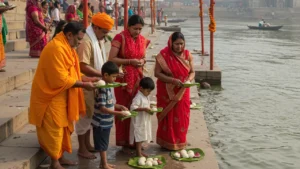
Pind Daan (पिण्ड दान): Pindas are prepared — firm balls of cooked rice (or barley), mixed with black sesame seeds, honey, and ghee. Three pindas are the minimum offering, representing the three generations: the departed, their father, and their grandfather. At Triveni Sangam, these pindas are offered with mantra recitation and then immersed in the sacred waters of the Ganga-Yamuna confluence.
Tarpan (तर्पण): Water with black sesame seeds, kusha grass, and barley is offered in a continuous stream from the right hand. The ancestral name and gotra are recited with each of the three offerings per ancestor. After Pind Daan, Tarpan is performed for all three paternal and three maternal generations, as well as for all departed souls in the family who may not have specific tithis known.
Brahmin Bhojan (ब्राह्मण भोजन): At least one Brahmin pandit is invited to partake in a sattvic meal. The Brahmins receive the meal with reverence — the tradition holds that the Brahmins, as vessels of Vedic knowledge and living representatives of the sacred, carry the spiritual food to the ancestors. Dakshina (money or items of value) is offered with folded hands at the conclusion of the meal.
Panch Bali (पञ्च बलि): Five portions of the cooked food are set aside before the family eats — for cows, crows, dogs, ants, and all other living beings. Feeding a crow is especially important as crows are believed to be messengers of the ancestral realm (Pitru Loka).
Special Note for Dwadashi Shradh of Sanyasins
If performing Dwadashi Shradh for a sanyasin (renunciant), the Sankalp should include the phrase referencing their sanyasa diksha. The food offerings should not include dairy products that the sanyasin may have personally renounced. Consult your pandit for the specific mantra variations used for sanyasi Shradh, which differ slightly from the standard household Shradh recitations.
Scriptural Significance of Dwadashi Shradh
The Dwadashi Tithi’s connection to Lord Vishnu gives Dwadashi Shradh a distinctive character among the Pitru Paksha observances. The Garuda Purana — the primary Puranic text dedicated to the science of death, afterlife, and ancestral rites — states that souls who departed on Vishnu-associated tithis (Ekadashi and Dwadashi) have a more direct pathway toward liberation than those who departed on other days. Performing their Shradh on the corresponding tithi reinforces this liberation pathway.
The Vishnu Purana describes Dwadashi as the day when Vishnu’s energy is most easily accessible in the material world — following the fast of Ekadashi, the Dwadashi becomes a day of spiritual fullness and divine abundance. Ancestors who carried Vaishnava devotion in their lives and departed on Dwadashi are believed to reside in elevated spiritual realms, and their Shradh on this day is as much an act of gratitude as it is a ritual of sustenance.
For sanyasins specifically, the Dharmasindhu elaborates on why Dwadashi is chosen: a renunciant, having abandoned the householder’s world, stands outside the normal system of family tithis. The Dwadashi — being the day that follows the supreme spiritual austerity of Ekadashi — represents the transition from tapas (austerity) to prasad (grace), which mirrors the sanyasin’s own journey from worldly striving to spiritual completion.
Do’s and Don’ts for Dwadashi Shradh
Do’s:
- Perform the ritual during Kutup or Rohina Muhurat within Aparahna Kala
- Use black sesame seeds (kale til) in all Tarpan water — they are essential for the offerings to be accepted
- Clearly state the Dwadashi connection (or sanyasa connection, where applicable) in the Sankalp
- Prepare sattvic food — rice, dal, kheer, vegetables — without onion or garlic
- Feed Brahmins, crows, cows, and other living beings before the family eats
- Perform Tarpan at a flowing river or sacred water body if possible
- Light a sesame-oil lamp (til tel diya) for the departed ancestor in the evening
Don’ts:
- Do not eat non-sattvic food: no onion, garlic, meat, fish, or eggs on this day
- Do not perform Shradh after sunset — all rituals must conclude within Aparahna Kala
- Do not use iron utensils — use copper or bronze for Tarpan and ritual vessels
- Do not grieve loudly or display excessive emotion during the rituals — the atmosphere should be peaceful and composed
- Do not skip Brahmin Bhojan — even if only one Brahmin is invited, the ritual requires this completion
Perform Dwadashi Shradh with Prayag Pandits at Triveni Sangam
Prayagraj has been the foremost center of Shradh and Pind Daan rites in the Hindu world for thousands of years. The ancient texts describe Prayag as Tirtharaj — the king of all pilgrimage sites — and specifically exalt the merit of Pind Daan performed at the Triveni Sangam. The Matsya Purana declares that Shradh at Prayag liberates 21 generations of ancestors — both those who have completed their journey and those still traversing the subtle realms between lives.
Our pandits at Prayag Pandits are specialists in the Prayagraj Shradh tradition, with generations of accumulated knowledge in Pitru Paksha rites. Whether you are performing Dwadashi Shradh for a householder ancestor, a sanyasin, or someone for whom you have recently discovered the Dwadashi tithi of their passing, we will ensure the ritual is performed with precision, authenticity, and devotion. We handle all ritual materials and guide you through each step at the sacred Sangam.
Pitrupaksha 2026
🙏 Book Dwadashi Shradh at Prayagraj
Starting from
₹5,100
per person
Related Shradh Tithis in Pitru Paksha 2026
Dwadashi Shradh on October 7 is preceded by Ekadashi Shradh on October 6. The day following brings Trayodashi Shradh on October 8, then Chaturdashi Shradh (Ghata Chaturdashi) on October 9, and finally the most important Sarva Pitru Amavasya on October 10. For the complete ritual framework, consult our Pitrupaksha Complete Ritual Guide. For in-depth understanding of the Pind Daan procedure, read How to Perform Pind Daan. Understand the ancestral debt that Shradh resolves through our article on Pind Daan and the Ancestors’ Debt.
Frequently Asked Questions about Dwadashi Shradh 2026
Related Services by Prayag Pandits
- 🙏 Pind Daan in Gaya (Pitrupaksha) — Starting from ₹7,100
- 🙏 Shradh at Prayagraj — Starting from ₹7,100
- 🙏 Tarpan in Prayagraj — Starting from ₹5,100
Frequently Asked Questions
What is the date of Dwadashi Shradh in 2026?
Dwadashi Shradh in 2026 falls on Wednesday, 7 October 2026. This day also coincides with Magha Shradh in 2026, making it a doubly significant day within Pitru Paksha.
Who should perform Dwadashi Shradh?
Dwadashi Shradh should be performed by families whose ancestor departed on the 12th lunar day (Dwadashi Tithi) of any month. It is also the prescribed Shradh for ancestors who had taken formal sannyasa (renunciation) before their death, regardless of their actual death tithi.
Why is Dwadashi Shradh performed for sanyasins?
A sanyasin, having renounced household life, no longer belongs to the regular system of family tithis. The Dharmashastra assigns Dwadashi — the day following the supreme Vaishnava observance of Ekadashi — as the most appropriate Shradh tithi for renunciants. This recognizes their spiritual status and their transcendence of ordinary householder cycles.
Is Dwadashi Shradh the same as Baras Shradh?
Yes. Baras Shradh is the Hindi colloquial name for Dwadashi Shradh, with 'baras' meaning twelve in the regional dialect of North India. The terms refer to the same observance.
What if I need to perform both Dwadashi Shradh and Magha Shradh on October 7?
If you have different ancestors who require Dwadashi Shradh and Magha Shradh respectively, both can be performed on October 7, 2026, as this day accommodates both observances. Your pandit will sequence the rituals appropriately within the Aparahna window. Plan to start early in the Kutup Muhurat to allow adequate time.
Book Your Sacred Ritual
Authentic ceremonies performed by Veda-trained pandits with video proof at sacred sites across India.
2,263+ families served
Video proof included
Since 2019
