
No rituals selected yet.
Browse Pooja Packages →Key Takeaways
In This Article
Ekadashi Shradh, also known as Gyaras Shradh, is the Shradh ritual performed for ancestors who departed from this world on the Ekadashi Tithi — the eleventh lunar day — of either Shukla Paksha or Krishna Paksha. In 2026, Ekadashi Shradh falls on Tuesday, 6 October 2026, during the sacred fifteen-day period of Pitru Paksha. For families whose loved ones passed on an Ekadashi, this day carries a special obligation and a profound spiritual opportunity to release ancestral souls toward higher realms. Performing Shradh on the correct tithi is believed to ensure that the offerings of food, water, and prayers reach the departed soul directly, bringing peace to both the ancestor and the living family.
What is Ekadashi Shradh?
In Hindu tradition, every individual’s Shradh is ideally performed on the lunar day (tithi) that corresponds to the day of their death. Ekadashi Tithi holds deep spiritual significance on its own — it is the day of Lord Vishnu, considered auspicious for fasting, worship, and liberation. When an ancestor departs on this tithi, it is believed that performing their Shradh on the corresponding Ekadashi within Pitru Paksha creates the most direct channel of connection between the living and the departed.
The term Ekadashi comes from Sanskrit, meaning “eleven” (eka = one, dashi = ten). It refers to the eleventh day of the lunar fortnight. Because the Hindu lunar calendar has two fortnights each month — the bright half (Shukla Paksha) and the dark half (Krishna Paksha) — Ekadashi occurs twice every month. Ekadashi Shradh during Pitru Paksha covers ancestors who died on either Shukla Ekadashi or Krishna Ekadashi throughout the year.
Ekadashi Shradh is also called Gyaras Shradh in the Hindi-speaking heartland of North India, with “gyaras” being the colloquial form of “eleven” in the regional dialect. Families in Uttar Pradesh, Madhya Pradesh, and Rajasthan commonly use this term. Whatever the regional name, the ritual significance and the scriptural basis remain the same across traditions.
Ekadashi Shradh 2026 Date and Muhurat
In 2026, Pitru Paksha begins on Saturday, 26 September and concludes on Saturday, 10 October with Sarva Pitru Amavasya. Within this sacred fortnight, Ekadashi Shradh falls on Tuesday, 6 October 2026.
The most auspicious time for performing Shradh rituals is during the Kutup Muhurat and the Rohina Muhurat, both of which fall in the late morning to midday period, extending through the Aparahna Kala (the afternoon period, roughly 12 noon to 3 pm by solar reckoning). The Shastras are explicit that Pitru Paksha Shradh must be performed during Aparahna Kala for the offerings to reach the ancestors most effectively. For the precise Kutup and Rohina Muhurat timings on October 6, 2026, devotees may refer to the DrikPanchang Pitrupaksha calendar.
After the main Shradh ritual, the Tarpan (तर्पण) — the offering of water mixed with sesame seeds (til), barley (jau), and kusha grass to the ancestors — is performed. Tarpan is the direct act of quenching the spiritual thirst of the departed souls and must ideally be done at a sacred river confluence. Prayagraj’s Triveni Sangam, where the Ganga, Yamuna, and the invisible Saraswati meet, is considered among the most powerful locations in all of India for Tarpan.
Who Should Perform Shradh on Ekadashi Tithi?
Ekadashi Shradh is specifically performed for family members whose tithivaar — the tithi on which they departed — was either Shukla Ekadashi or Krishna Ekadashi. In practical terms, if your grandfather, grandmother, parent, sibling, or any paternal or maternal ancestor passed away on the eleventh day of any lunar month, their Shradh during Pitru Paksha should be performed on Ekadashi Shradh day.
The scriptural responsibility for performing Shradh falls primarily on the eldest son of the deceased, following the Grihya Sutra traditions. However, in the absence of a son, the following persons are eligible to perform Shradh in order of preference: the grandson (पुत्र का पुत्र), the great-grandson, the wife of the deceased, a brother, a brother’s son, a sister’s son, a daughter, a daughter’s son, a disciple, and in some traditions, a close friend. Modern Dharmashastra commentaries also recognize daughters and their sons as fully eligible performers, particularly in families where no male heir exists.
If you are unsure of the exact tithi on which your ancestor departed, or if no records exist, you should perform their Shradh on Sarva Pitru Amavasya (October 10, 2026), which serves as the universal day for all ancestors regardless of their death tithi. The Amavasya Shradh ensures that no soul is left without offerings during Pitru Paksha.
Rituals and Procedures for Ekadashi Shradh
The rituals of Ekadashi Shradh, like all Pitru Paksha Shradhas, follow a structured sequence rooted in Vedic tradition. The Pinda Daan (offering of rice or barley balls called pindas) and Tarpan are the two central acts, supported by a series of preparatory and concluding rites.
Preparation (the night before and morning of): The performer should observe brahmacharya (celibacy), sleep on the floor or a simple bed, and avoid onion, garlic, meat, fish, and intoxicants. On the morning of Ekadashi Shradh, after bathing in a sacred river or at home with pure water, the performer should wear fresh white or light-colored clothing and apply a tilak of white sandalwood.
Sankalp (सङ्कल्प): The ritual begins with a formal declaration of intent. The performer states their name, lineage (gotra), the names of ancestors being honored, and the specific purpose of the Shradh. This sankalp is made with water, sesame seeds, and a flower held in cupped hands.
Pind Daan (पिण्ड दान): Rice or barley flour is cooked into firm balls (pindas) and mixed with sesame seeds, honey, and ghee. These pindas are offered to the ancestors with the recitation of mantras naming each ancestor. Three generations of paternal ancestors and three generations of maternal ancestors are traditionally honored.
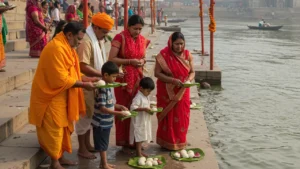
Tarpan (तर्पण): Water mixed with black sesame seeds, kusha grass, and barley is offered to the ancestors while reciting their names. This offering is made three times for each ancestor, ideally at the water’s edge. At Triveni Sangam, this act carries exceptional spiritual merit due to the confluence of three sacred rivers.
Brahmin Bhojan (ब्राह्मण भोजन) and Dakshina: Inviting Brahmins to share a meal prepared with love and devotion is considered equivalent to feeding the ancestors themselves. The Brahmins receive dakshina (offering) at the end of the meal. The food prepared must be sattvic (pure) — no onion, garlic, or non-vegetarian items.
Crow Feeding (Kak Bali): Crows are considered messengers of the ancestors in Hindu tradition. Before eating, a portion of the cooked food is placed on a leaf or stone for crows to eat. If a crow eats the offering, it is considered auspicious — the ancestors have accepted the Shradh.
Important Ritual Tip for Ekadashi Shradh
Ekadashi Shradh should ideally be performed during the Kutup or Rohina Muhurat, which falls in the mid-morning to midday hours. Always include black sesame seeds (काले तिल) in the Tarpan water — they are essential for the ritual to reach the ancestors correctly. Avoid performing Shradh after sunset.
Significance of Ekadashi Shradh in Hindu Scriptures
The importance of performing Shradh on the correct tithi is articulated clearly in the Garuda Purana, one of the principal Puranic texts dealing with death, the afterlife, and ancestral rites. The text describes in detail how the soul of a departed person — when properly honored through Shradh on their tithi — receives nourishment in whatever plane of existence they currently inhabit, whether that be Pitru Loka, a realm of rebirth, or any intermediate state.
The Vishnu Purana states: “Yatha vrishti-jalam tasmin devasthane prasidyati, tatha pitrinam dattam tattithau sarvagam bhavet” — meaning that just as rainwater flowing to a reservoir benefits the whole region, offerings made on the correct tithi reach all ancestors universally. The Ekadashi Tithi, being sacred to Lord Vishnu himself, adds an additional layer of spiritual merit (punya) to Shradh performed on this day.
The Dharmasindhu and Nirnayasindhu, which are authoritative medieval digests of Hindu dharmic law, both emphasize that performing Shradh on the tithi of the ancestor’s death is the most complete form of ritual fulfillment. Missing the correct tithi without a valid reason is considered a form of Pitru Rina — ancestral debt — which can manifest as obstacles in the lives of the living descendants.
Do’s and Don’ts for Ekadashi Shradh
Do’s:
- Perform the Shradh during Kutup or Rohina Muhurat, within Aparahna Kala
- Use black sesame seeds (काले तिल / kale til) in all Tarpan offerings
- Prepare sattvic food: rice, dal, vegetables cooked without onion or garlic
- Feed Brahmins, crows, cows, dogs, and ants as part of the Panch Bali (five shares)
- Recite the names and gotra of each ancestor during Sankalp and Pind Daan
- Maintain physical and mental purity throughout the day
- Perform Shradh at a sacred water body — a river confluence is most auspicious
Don’ts:
- Do not consume onion, garlic, meat, fish, eggs, or alcohol on this day
- Do not perform Shradh after sunset — the ritual must conclude before dusk
- Do not use iron utensils for Shradh rituals — prefer copper, bronze, or silver
- Do not quarrel, speak harsh words, or engage in worldly pleasures on this day
- Do not skip Brahmin Bhojan — it is considered integral to completing the ritual
- Do not wear footwear during the core ritual proceedings
- Do not use plastic bags or artificial materials when offering pindas to water
Perform Ekadashi Shradh with Prayag Pandits at Triveni Sangam
Prayagraj’s Triveni Sangam — the sacred confluence of the Ganga, Yamuna, and the mystical Saraswati — has been recognized since Vedic times as one of the most powerful locations for ancestral rites. The Matsya Purana declares that Pind Daan and Tarpan performed at Prayag grants liberation to 21 generations of ancestors. This is why thousands of families travel to Prayagraj specifically during Pitru Paksha to perform their ancestral Shradh.
Prayag Pandits brings together experienced Vedic pandits who are deeply rooted in the Prayagraj pandit tradition, with ancestral knowledge of Shradh and Pind Daan rituals going back generations. Whether you wish to perform a simple Tarpan or a full Pind Daan with Brahmin Bhojan on Ekadashi Shradh day, our pandits will guide you through every step with clarity, correctness, and devotion.
Pitrupaksha 2026
🙏 Book Ekadashi Shradh at Prayagraj
Starting from
₹5,100
per person
Related Shradh Tithis in Pitru Paksha 2026
Ekadashi Shradh is one of fifteen Shradh tithis observed during Pitru Paksha. The days immediately surrounding Ekadashi Shradh are Dwadashi Shradh on October 7 (also the day of Magha Shradh), Trayodashi Shradh on October 8, Chaturdashi Shradh on October 9, and the culminating Sarva Pitru Amavasya on October 10. If you are uncertain of the exact tithi of your ancestor’s passing, perform their Shradh on Amavasya — the universal day for all departed souls.
For a comprehensive understanding of the complete Pitru Paksha ritual cycle, read our detailed guide: Pitrupaksha: A Complete Ritual Guide. For the core Pind Daan ritual procedure, refer to How to Perform Pind Daan. To understand why ancestral debt matters and how Shradh resolves it, read Pind Daan, Shradh and the Ancestors’ Debt.
Frequently Asked Questions about Ekadashi Shradh 2026
Related Services by Prayag Pandits
- 🙏 Pind Daan in Gaya (Pitrupaksha) — Starting from ₹7,100
- 🙏 Shradh at Prayagraj — Starting from ₹7,100
- 🙏 Tarpan in Prayagraj — Starting from ₹5,100
Frequently Asked Questions
What is the exact date of Ekadashi Shradh in 2026?
Ekadashi Shradh in 2026 falls on Tuesday, 6 October 2026. It is observed during Pitru Paksha, the 15-day period of ancestral rites that runs from September 26 to October 10, 2026.
Who should perform Shradh on Ekadashi?
Anyone whose ancestor (parent, grandparent, or any paternal or maternal relative) passed away on Ekadashi Tithi — the 11th day of any lunar month — should perform their Shradh on Ekadashi Shradh day during Pitru Paksha. If you are unsure of the exact tithi, perform Shradh on Sarva Pitru Amavasya (October 10, 2026).
What is the difference between Ekadashi Shradh and regular Ekadashi fasting?
Regular Ekadashi fasting (Ekadashi Vrat) is a devotional practice to Lord Vishnu observed on the 11th lunar day. Ekadashi Shradh is an ancestral rite performed during Pitru Paksha specifically for ancestors who died on Ekadashi. The two are distinct practices — on Ekadashi Shradh day, you do not observe the Vrat fast; instead, you perform Shradh rituals and offer Brahmin Bhojan.
Can Ekadashi Shradh be performed at home?
Yes, Ekadashi Shradh can be performed at home with the guidance of a knowledgeable pandit. However, performing it at a sacred river or confluence — particularly Triveni Sangam at Prayagraj — significantly amplifies the spiritual merit of the ritual. If travel to a sacred site is not possible, performing it at home sincerely is also accepted.
What food is prepared for Ekadashi Shradh?
Sattvic (pure) food is prepared for Ekadashi Shradh — typically rice, kheer (rice pudding with milk and sugar), dal, vegetables, and puri or roti. No onion, garlic, non-vegetarian food, or leftover food should be used. The food is first offered to the Brahmins, then to crows, cows, and dogs, before the family partakes.
Book Your Sacred Ritual
Authentic ceremonies performed by Veda-trained pandits with video proof at sacred sites across India.
2,263+ families served
Video proof included
Since 2019
