Key Takeaways
In This Article
Every year, hundreds of thousands of Hindu pilgrims travel to the sacred cities of Prayagraj, Varanasi, and Gaya to perform some of the most important religious rites of their lives — Pind Daan, Asthi Visarjan, Shradh, Tarpan, and other ancestral ceremonies. They arrive with open hearts, deep grief, and a sincere desire to fulfill their duty to their departed loved ones. And a distressing number of them are met, at the very gates of these sacred cities, by individuals whose primary purpose is not to help them but to exploit them.
This is the problem that Prayag Pandits was built to solve. We are not simply a pandit booking service. We are a platform that exists specifically to protect the devout pilgrim from a system of fraud and exploitation that has been allowed to operate in India’s holiest places for far too long — and to ensure that the sacred rites they travel so far to perform are done correctly, authentically, and at a fair and transparent price.
Religious Fraud at India’s Holiest Places: The Problem We Set Out to Solve
Brahmins, Pandits, and Pandas have immense sacred significance in Hindu tradition. From the earliest Vedic age, the Brahmin class was entrusted with the knowledge and performance of the rituals upon which the welfare of the community depended. This responsibility was — and in many quarters remains — discharged with genuine scholarship, devotion, and service. Many of India’s pandits are deeply learned, spiritually committed men who carry the weight of this tradition with great seriousness.
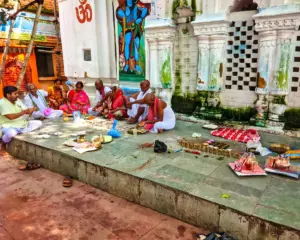
But at the pilgrimage sites — particularly at Prayagraj’s Triveni Sangam, at Varanasi’s ghats, and at Gaya’s Vishnupad Temple — a parallel system has long operated alongside the genuine practitioners. This system involves agents, touts, fixers, and a category of individuals who call themselves pandits or pandas primarily because this designation grants them access to pilgrims in vulnerable moments of grief and spiritual need. These individuals operate through a combination of confidence, aggression, and the exploitation of the pilgrim’s unfamiliarity with both the ritual and the place.
Dakshina — the voluntary offering made to a pandit for his services — is a sacred and beautiful tradition. In the genuine practice of dakshina, the devotee offers what they are able, and the pandit accepts with gratitude whatever is given. The amount is never specified in advance, never demanded, and never contested. It is an act of mutual respect between the devotee and the ritual specialist.
What happens at too many pilgrimage sites today is the opposite of this. Pilgrims are approached by individuals claiming to be their ancestral family’s hereditary pandas (pujaris assigned to specific families by gotra lineage), who demand not voluntary dakshina but specific, very large sums before the ritual has even begun. Amounts of ₹20,000, ₹50,000, and higher are demanded routinely. Pilgrims who refuse or ask to negotiate are threatened with spiritual consequences — told that their ancestors will be displeased, that the ritual will be ineffective, or that they will face misfortune. Some are surrounded by multiple individuals working in coordinated groups, making it nearly impossible for a lone pilgrim or small family to resist.

In some documented cases, pilgrims have been asked to surrender their gold ornaments when cash demands could not be met. In others, pilgrims who politely declined one agent have been physically directed to another agent who is part of the same network. And because these encounters happen at moments of deep emotional vulnerability — a family performing last rites for a parent, NRI visitors performing Pind Daan for a grandparent they barely knew — the pressure is almost impossible for the unprepared pilgrim to withstand.
This is the problem we started Prayag Pandits to address.
How Prayag Pandits Can Help You: Our Complete Services
Prayag Pandits offers a comprehensive range of sacred services at the major tirthas of India, performed by verified, trained pandits who operate under our supervision and accountability standards. Here is a complete overview of what we offer and how we protect you through every step of the process.
1. Pind Daan
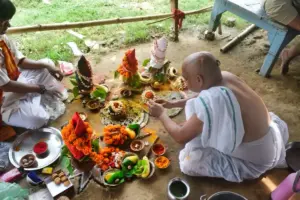
Pind Daan — the offering of rice-ball oblations (pindas) for the liberation of departed ancestors — is the most commonly requested service at Prayag Pandits. We perform Pind Daan at:
- Prayagraj (Triveni Sangam) — the most powerful Pind Daan location, where three sacred rivers meet
- Gaya (Vishnupad Temple and Falgu River) — the pre-eminent tirtha specifically for Pind Daan
- Varanasi (Manikarnika and Asi Ghat) — where Lord Shiva’s grace enhances every offering
- Badrinath (Brahmakapal) — the sacred site in the Himalayas for ancestral rites
- Ujjain — the city of Mahakaleshwar, where Shiva as lord of time presides over ancestral rites
2. Asthi Visarjan
Asthi Visarjan — the immersion of a deceased person’s ashes and bone fragments in a sacred river — is one of the most urgently needed services among grieving families. We perform Asthi Visarjan at Prayagraj, Varanasi, Haridwar, and other sacred rivers, including arrangements for families who cannot travel in person and need the rite performed on their behalf with full video documentation.
3. Ganga Poojan and Ganga Aarti
For pilgrims who wish to perform a formal Ganga Poojan at the Triveni Sangam or at Varanasi’s Dashashwamedh Ghat, our pandits perform the complete ritual with the proper mantras, the correct materials, and full guidance for the family’s active participation in the ceremony.
4. Rudrabhishek
Rudrabhishek — the sacred ablution of Lord Shiva with milk, honey, ghee, and other sacred substances accompanied by the Shri Rudram — is one of the most powerful Shiva worship rituals in the Hindu tradition. We arrange Rudrabhishek at Varanasi’s Kashi Vishwanath Temple and at other Shiva temples, with pandits trained in the correct Vedic recitation of the Rudram.
5. Brahmin Bhoj (Brahman Bhoj)
Brahmin Bhoj — the ritual feeding of qualified Brahmins as a part of Shradh, Pind Daan, or other ancestral ceremonies — is a required element of many Hindu rites. We arrange Brahmin Bhoj with verified Brahmins who meet the traditional qualification criteria, at Prayagraj and other locations.
6. Special Poojan and Yajnas
For more complex ritual requirements — including Mahamrityunjay Yajna, Mahaprayashchittam Sankalp, Shanti Poojan, and extended multi-day rituals — we provide fully qualified Vedic pandits who can guide families through the complete procedure with scholarly accuracy.
The Gaya Pind Daan Story: Why This Matters
Gaya is located about 100 km from Patna, the capital of Bihar. According to the religious stories, Goddess Sita performed Pind Daan at the bank of the Falgu river at Gaya for King Dashrath. The story tells that when Sita Ji was asked for proof of her performance of the rite, she said that the Falgu river, a tulsi plant, and a cow were present at the site to witness the ceremony. These three witnesses, however, denied this — and Sita Ji cursed all three in consequence. Lord Rama then performed Pind Daan for his beloved father, and since then the tradition of Pind Daan at Gaya has been followed with particular reverence.

At Gaya today, the pilgrim who arrives without prior arrangement faces the most aggressive system of unauthorized pandas in all of India. The hereditary Gaya pandas (pujaris assigned to specific families by surname and gotra) have operated their exclusive territory claims for generations, and independent pilgrims are routinely subjected to demands that can reach ₹50,000 or more for a single day’s Pind Daan. Our pandits perform Gaya Pind Daan at completely transparent, pre-agreed prices — and the ritual itself is conducted with the full traditional procedure, not a truncated version designed to process pilgrims as quickly as possible.
What Makes Prayag Pandits Different: Our Five Commitments
1. Transparent Pricing — No Surprises, No Demands
Every service we offer has a published price on our website. This price includes the pandit’s fees, the ritual materials (samagri), and all associated costs. There are no hidden additions, no demand for extra dakshina during the ritual, and no ambiguity about what you will be asked to pay. You know the complete cost before you book, and the price does not change after the booking is confirmed. This alone represents a revolution in how pilgrimage services are delivered in India.
2. Verified, Trained Pandits
Every pandit in the Prayag Pandits network has been personally verified — their qualifications, their character, and their ritual knowledge have been assessed before they are admitted to our platform. We do not work with touts, agents, or individuals whose primary qualification is territorial claim over a ghat. Our pandits are scholars of the relevant traditions who perform the rituals correctly, completely, and with genuine devotion.
This is particularly important for complex rites like Narayan Bali, Pind Daan for Akal Mrityu cases, or multi-day Shradh sequences during Pitrupaksha. These rituals have specific procedural requirements that only a properly trained pandit can fulfill — and an incorrectly performed ritual is not merely useless but can be spiritually counterproductive.
3. More Than 50% More Affordable Than Unauthorized Alternatives
Our services are consistently priced at more than 50% less than what unauthorized pandas and touts typically demand from pilgrims at the ghat. This is not because we cut corners on the ritual — it is because we have eliminated the layers of intermediaries, agents, and fixers whose commissions are embedded in the inflated prices demanded by the informal system. You pay the fair price for the actual service, nothing more.
4. Complete Documentation for NRI Families
For NRI families who are performing Pind Daan, Asthi Visarjan, or Shradh on behalf of a parent or grandparent while living abroad, we provide full video and photographic documentation of every ritual. You receive a complete visual record of the ceremony — the pandit, the sacred site, the ritual materials, and the key moments of the rite — so that you have the confidence of knowing the ceremony was genuinely performed as ordered. This service is not available from the informal system and has been one of the most valued aspects of our service for NRI clients worldwide.
Frequently Asked Questions
Why should I book with Prayag Pandits instead of finding a pandit at the ghat?
When you arrive at Prayagraj, Varanasi, or Gaya without a prior booking, you are immediately approached by touts, agents, and unauthorized individuals who will demand very large sums of money for ritual services. You have no way to verify their qualifications, no agreed price, and no recourse if the ritual is performed incorrectly or incompletely. With Prayag Pandits, you book in advance at a fixed, transparent price, your pandit is verified and trained, and you have our direct support if anything goes wrong. It is the safest, most dignified way to perform your sacred ceremony.
Does Prayag Pandits perform ceremonies for NRI families who cannot travel to India?
Yes. We regularly perform Pind Daan, Asthi Visarjan, and other rites on behalf of NRI families from the US, UK, Canada, Australia, Singapore, Malaysia, and other countries. We provide full video and photographic documentation of the ceremony so that the family has a complete record of the ritual being performed. The family participates via video call wherever possible. This service has helped hundreds of NRI families fulfill their ancestral obligations that would otherwise have been impossible to perform.
How are Prayag Pandits prices fixed and what is included?
All our service prices are published on the website and include the pandit's fees, all ritual materials (samagri), and any associated site arrangements. There are no hidden additions, no demands for extra dakshina during the ritual, and no ambiguity. The price you see is the price you pay. Our standard Pind Daan packages start from Rs. 5,100 and vary by location and the extent of the ceremony required.
Can Prayag Pandits arrange rituals during Pitrupaksha?
Yes. We specialize in Pitrupaksha services at Prayagraj, Gaya, Varanasi, and Haridwar. During Pitrupaksha — the 16-day ancestral observance period — demand for qualified pandits is extremely high and the pilgrimage sites are most crowded, making the risk of encountering unauthorized operators highest. Booking with Prayag Pandits in advance of Pitrupaksha is strongly recommended to secure your preferred date and location.
What if I do not know my family's gotra or the details required for Pind Daan?
Do not worry. Our pandits are experienced in guiding families who are unfamiliar with the ritual requirements. We will help you determine the necessary information before your ceremony and guide you through the process step by step. If you do not know your gotra, we use the standard prescribed alternatives that the Shastras sanction for such situations. No family should be prevented from performing their sacred obligations by lack of procedural knowledge — that is precisely what our pandits are there to provide.
How to find best pandit to do Pind Daan in Prayagraj?
Prayagraj is known for its learned pandits and priests who are well-versed in the Vedic rituals of Pind Daan. Choosing the right pandit is crucial for the proper execution of the ceremony.
Some factors to consider when selecting a pandit for Pind Daan in Prayagraj include:
- Experience and knowledge: Look for pandits who have years of experience in conducting Pind Daan rituals and have a deep understanding of the Vedic scriptures and mantras.
- Reputation and reviews: Best to look for video reviews on youtube. Check for pandits or organizations that have a good reputation and positive reviews from previous clients. Referrals from friends or family can also be helpful.
- Language proficiency: If you have a language preference for the rituals, make sure the pandit is fluent in that language and can explain the significance of the rituals.
- Transparency in pricing: Ensure that the pandit or the organization is transparent about the costs involved and provides a detailed breakdown of the charges.
View our Pind daan package in Praygaraj here.
What are the accommodation options like specifically near the Sangam area for pilgrims?
- Prayagraj city has many hotels, and staying close to the Sangam enhances the spiritual experience. Near the Ghats (like Qila Ghat, Saraswati Ghat, Ram Ghat) and in areas like Daraganj, you will find:
- Numerous Dharamshalas and Ashrams: Run by various religious communities and trusts, offering basic but clean lodging at very nominal costs. These are often the preferred choice for pilgrims focused solely on rituals.
- Panda Accommodations: Some Prayagwal Pandas offer lodging facilities (sometimes basic rooms within their homes or dedicated guest areas) for the families (Yajmans) they serve. This can be convenient as they guide you through all rituals.
- Budget Guesthouses: Plentiful in the lanes leading to the ghats, offering simple private rooms.
- Tented Cities: During major events like Magh Mela or Kumbh Mela, vast tented cities are erected near the Sangam, providing temporary accommodation of various comfort levels.
- Booking in advance, especially during peak times like Pitru Paksha or Magh Mela, is highly recommended
What rules to follow for Pind Daan in Prayagraj?
Pind Daan is a sacred ritual that requires adherence to certain rules and guidelines as per Hindu traditions. Here are some key rules to follow:
- Eligibility: Pind Daan is typically performed by the eldest son or a male relative of the deceased. In the absence of a male heir, the daughter or the wife can perform the ritual.
- Dress code: Wear clean, simple, and preferably white or light-colored clothes. Men should ideally wear a dhoti and kurta, while women can wear a saree or a suit.
- Fasting: The person performing the Pind Daan is expected to fast on the day of the ceremony until the rituals are completed. Some also observe a partial fast the day before.
- Offerings: The main offerings for Pind Daan include black sesame seeds, barley, kusha grass, and water. These are offered along with the pind (rice balls) to the ancestors.
- Rituals: The ceremony may involve multiple rituals such as tarpan (offering water), pind daan (offering rice balls), and shraadh (invoking ancestors). Follow the pandit's instructions carefully during each step.
- Timing: Consult with the conducting organization regarding the timings. Pind daan can be done from early morning up until early evening. Contact us to know more.
- Respect and devotion: Maintain a respectful and devoted attitude throughout the ceremony. Focus on the prayers and the significance of the ritual.
It's important to consult with the pandit or the organization conducting the Pind Daan for any specific rules or customs that need to be followed. Adherence to these rules and performing the Pind Daan with sincerity and devotion is believed to bring peace and salvation to the departed soul.
View our pind daan pooja package here.
Book Your Sacred Ritual
Authentic ceremonies performed by Veda-trained pandits with video proof at sacred sites across India.