Key Takeaways
- What Is Brahmakapal?
- The Scriptural Significance of Pind Daan at Badrinath
- Who Should Perform Pind Daan at Brahmakapal?
- The Complete Pind Daan Procedure at Brahmakapal
In This Article
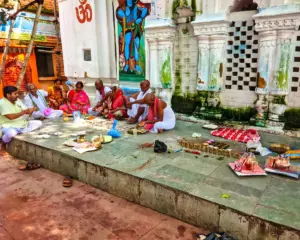
Among the most sacred sites for Pind Daan in all of Hindu tradition, Brahmakapal at Badrinath occupies a position of extraordinary spiritual power. Unlike other Pind Daan sites in India, Brahmakapal is not a covered hall, a temple precinct, or a riverside ghat in the conventional sense. It is an open-sky platform — a flat, exposed stone terrace on the banks of the Alaknanda River, with the Himalayan peaks rising directly above it and the sacred temple of Lord Badrinath just metres away. Here, with the mountain wind carrying your prayers, the roar of the Alaknanda filling the air, and the peaks of Neelkanth and Narayan Parvat standing witness, you offer pindas to your ancestors in one of the most powerful acts of ancestral devotion possible in human life.
It is said in the Skanda Purana that Pind Daan performed at Brahmakapal grants moksha — liberation from the cycle of rebirth — to the souls of departed ancestors. Not merely peace, not merely a favourable rebirth, but complete liberation. This is why Hindu families have journeyed to Badrinath for centuries with this single sacred purpose, and why the experience of Pind Daan at Brahmakapal remains one of the most spiritually transformative acts a person can undertake in their lifetime.
What Is Brahmakapal?
The word Brahmakapal is derived from Brahma (the Creator in the Hindu Trinity) and kapal (skull or flat platform). The name carries deep mythological resonance. According to the Brahma Purana and oral tradition preserved by Badrinath’s Rawal (head priest), this is the spot where Lord Brahma first performed Pind Daan for his own ancestors at the beginning of creation. By doing so, Brahma established the template for all ancestral rites performed by humans thereafter. The kapal in the name also refers to a flat stone — the platform itself is sacred ground.
Physically, Brahmakapal is located on the left bank of the Alaknanda River, approximately 400 metres upstream from the main Badrinath temple. The platform is flat and spacious enough to accommodate many families simultaneously. The Alaknanda rushes past at close range, and the waters here are considered especially purified by their proximity to Badrinath Dham. Immersing the pindas and offering tarpan (water libation) in the Alaknanda at this precise location is considered the culmination of the Pind Daan ritual.
The Scriptural Significance of Pind Daan at Badrinath
The sacredness of Pind Daan at Brahmakapal is not a matter of local custom or regional tradition alone — it is supported by explicit references in multiple Hindu scriptures:
The Skanda Purana and Moksha Guarantee
The Skanda Purana, one of the eighteen Mahapuranas, contains a dedicated section on the significance of the Badrikashrama region. It explicitly states that ancestral rites performed at Brahmakapal bestow moksha upon the souls of the ancestors for whom they are performed. The text notes that the combined power of the Alaknanda’s sacred waters, Lord Vishnu’s proximity in his Badrinath form, and the cosmic energy of the Himalayan tirtha makes this location uniquely efficacious for liberation-granting rituals.
The Brahma Purana and Brahma’s First Pind Daan
The Brahma Purana narrates the episode of Lord Brahma performing Pind Daan at this very spot for his ancestors. When the Creator himself performed ancestral rites here, the location became permanently charged with the energy of that act. Any ritual of the same kind performed here subsequently participates in that original, cosmic act of ancestral worship.
Vishnu’s Blessing at Badrinath
Lord Vishnu himself presides over Badrinath in the form of Badrivishal. Since Vishnu is also Narayan — the cosmic being from whom all of creation emerges and into whom it returns — performing Pind Daan in his immediate vicinity is believed to place the departed souls directly within his compassionate gaze. The Garuda Purana emphasises that ancestral rites performed in the presence of Lord Vishnu are unfailingly heard and answered.
Who Should Perform Pind Daan at Brahmakapal?
Brahmakapal Pind Daan is most commonly performed in specific circumstances, though any Hindu wishing to honour their ancestors may do so:
- For ancestors who died of unnatural causes — accidental death, drowning, fire, or sudden illness. Such souls are believed to require special rituals for liberation, and the power of Brahmakapal is particularly effective for these situations.
- For ancestors who did not receive proper last rites — families who were separated during Partition, wartime, or other circumstances where cremation or proper Shradh could not be performed.
- During a general pilgrimage to Badrinath — since Badrinath is one of the Char Dham pilgrimage sites, many families perform Pind Daan at Brahmakapal as an integral part of their Char Dham Yatra, even if their ancestors received normal last rites.
- To fulfil the last wish of a deceased parent or grandparent — elders in many Hindu families specifically request that their Pind Daan be performed at Brahmakapal.
- During Pitrupaksha — the 16-day period of ancestral worship (September 26 – October 10, 2026) is the most auspicious time for Pind Daan at any sacred site, including Brahmakapal.
The ritual is traditionally performed by the eldest son, but in his absence, any male member of the family — son-in-law, grandson, nephew — or, in specific circumstances supported by contemporary pandit guidance, a female family member may serve as the karta (performer).
The Complete Pind Daan Procedure at Brahmakapal
Understanding the ritual before you arrive helps you participate fully and purposefully. The pandit guides you through each step, but knowing what is happening and why makes the experience far more meaningful. Here is the complete procedure for Pind Daan at Brahmakapal, Badrinath:
Step 1: Ritual Purification (Shuddhi)
Before arriving at Brahmakapal, take a bath in the Tapt Kund — the natural hot spring adjacent to the Badrinath temple. This spring, heated by geothermal activity, is considered sacred and its waters purifying. Bathing here constitutes the ritual purification required before performing ancestral rites. Wear clean, preferably white or light-coloured clothes after bathing.
Step 2: Sankalpa — The Sacred Declaration
The pandit begins with the Sankalpa, the formal declaration of intent. This involves:
- Stating the current date in the traditional Hindu calendar (tithi, paksha, month, year)
- Declaring the location: Brahmakapal, on the banks of the Alaknanda, Badrikashrama, in the Himalayan tirtha
- Naming yourself (the karta), your gotra, and your father’s name
- Naming the ancestors for whom the ritual is being performed — ideally three generations on both the paternal and maternal sides
- Declaring the purpose: the peace, upliftment, and moksha of the departed souls
The Sankalpa is the spiritual contract of the ritual. It activates the intention and directs the ritual’s power toward its specific recipients.
Step 3: Preparation of the Pindas
Under the pandit’s guidance, you prepare the pindas — the sacred rice balls at the heart of the ritual. The ingredients are:
- Cooked rice (plain, no salt or spices) or barley flour
- Black sesame seeds (kala til) — the most important ingredient, associated with the ancestors and the planet Saturn (Shani)
- Honey and ghee — to provide sweetness and nourishment
- Kusha grass — the sacred grass associated with ancestral rites, used as a seat and in the hands during ritual
- Gangajal or Alaknanda water — to bind the mixture
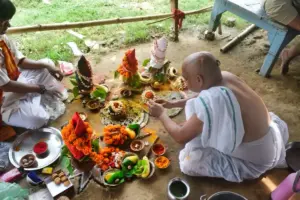
These are mixed together and formed into smooth, round balls approximately the size of a lime. Typically, one pinda is offered for each ancestor named in the Sankalpa. The pandit arranges these on a banana leaf or on the kusha mat.
Step 4: Tarpan — The Water Offering
Before offering the pindas, Tarpan is performed. Standing at the edge of the Brahmakapal platform, facing south (the direction of the ancestral realm), you hold water mixed with black sesame seeds in cupped hands and allow it to flow through your fingers into the Alaknanda. The pandit recites the ancestors’ names and gotra as you offer each stream of water. This ritual quenches the spiritual thirst of the ancestors and prepares them to receive the fuller offering of pindas.
Step 5: Pinda Offerings
The prepared pindas are placed on the platform with specific mantras recited by the pandit. You offer each pinda with both hands, with the intent of providing a subtle, temporary body to the departed soul for the duration of the ritual, through which the soul can receive the nourishment and prayers being offered. After all pindas are offered, they are immersed in the Alaknanda with prayers for the ancestors’ liberation.
Step 6: Brahmin Bhoj and Dakshina
A complete Pind Daan concludes with Brahmin Bhoj — feeding a learned Brahmin. It is believed that whatever is offered to a worthy Brahmin reaches the ancestors directly. Our pandit facilitates this arrangement. After the meal, dakshina (alms) and, if possible, clothing or other useful items are offered to the Brahmin.
The Best Time for Pind Daan at Brahmakapal
Several factors determine the ideal timing for performing Pind Daan at Brahmakapal:
Time of Day
Pind Daan at Brahmakapal should ideally be performed during the Aparahna Kaal (the afternoon period, roughly between 12:00 noon and 3:00 PM). The specific auspicious windows within this period are:
- Kutup Muhurat — approximately 11:55 AM to 12:45 PM. This is considered especially powerful for ancestral rites.
- Rohina Muhurat — approximately 12:45 PM to 1:35 PM. Also highly auspicious.
- Full Aparahna Kaal — approximately 1:35 PM to 4:00 PM.
Rituals should not be performed after sunset, during eclipses (without specific additional rites), or on Amavasya (new moon) for the first Shradh of a recently deceased person unless specifically guided by a pandit.
Most Auspicious Seasons
- Pitrupaksha (September 26 – October 10, 2026) — The most sacred period for ancestral rites across all of India. Performing Pind Daan at Brahmakapal during Pitrupaksha combines the power of the most auspicious fortnight with the most powerful Pind Daan site in the Himalayas. This is also the period when the Badrinath temple is open (the temple closes in mid-November for winter).
- Shravana and Bhadrapada months (July–September) — The monsoon and post-monsoon Himalayan months, when the Alaknanda is in full flow and the environment carries extra spiritual potency.
- Amavasya (new moon day) — Every Amavasya throughout the year is auspicious for Tarpan and Pind Daan for all ancestors.
- Gaya Trayodashi (Magha Shradh) and Mahalaya Amavasya — Specific tithi dates known to be of particular importance for comprehensive ancestral rites.
The Badrinath Temple Season
Badrinath Dham is open only between late April/early May and mid-November each year (the exact dates are announced annually based on the Hindu calendar). Brahmakapal is accessible only during this open season. The temple typically opens around Akshaya Tritiya and closes around Bhai Dooj. Do not plan your visit outside this window — the site is inaccessible in winter due to heavy snowfall.
For families planning a broader pilgrimage, Badrinath Pind Daan pairs naturally with Haridwar (a natural halt on the way) and can be combined with visits to Prayagraj and Gaya as part of a comprehensive ancestral pilgrimage circuit. Our complete guide to Pind Daan procedures covers what to expect across all major sites.
How to Reach Brahmakapal, Badrinath
Badrinath is located in the Chamoli district of Uttarakhand, at an altitude of approximately 3,133 metres above sea level. The journey is a pilgrimage in itself. Here is a complete route guide:
By Air
The nearest airport is Jolly Grant Airport, Dehradun, approximately 315 km from Badrinath. From Dehradun, hire a taxi or take a shared jeep to Badrinath via Rishikesh–Devprayag–Srinagar–Rudraprayag–Chamoli–Joshimath route. Journey time from Dehradun is typically 10–12 hours by road.
By Train
The nearest railway stations are Haridwar (approximately 315 km) and Rishikesh (approximately 295 km). Both are well-connected to major cities across India. From Haridwar or Rishikesh, take a taxi, bus, or shared jeep to Badrinath.
By Road
Badrinath is connected by a well-maintained National Highway (NH-58 / NH-7) from Rishikesh. The route passes through:
- Rishikesh → Devprayag (confluence of Bhagirathi and Alaknanda) → Srinagar (Garhwal) → Rudraprayag (confluence of Alaknanda and Mandakini) → Chamoli → Joshimath → Badrinath
The road is scenic but includes many hairpin bends and mountain sections that require careful driving. State-run buses (GMOU/UPSRTC) operate from Haridwar and Rishikesh to Badrinath during the temple season. Private taxis and shared jeeps are also readily available. Journey time from Rishikesh is approximately 9–10 hours, depending on road conditions.
Important Road Travel Notes
- The route is susceptible to landslides during the monsoon (July–August). Always check road conditions before travel.
- Joshimath (approximately 46 km before Badrinath) is the last major town with facilities. Plan your supplies and any additional overnight stay here if needed.
- The Char Dham Yatra registration is mandatory for pilgrims on this route. Register online at the Uttarakhand Tourism portal before travel.
Accommodation and Facilities at Badrinath
Badrinath town, though small, has a reasonable range of accommodation options during the temple season:
- Dharamshalas — Run by the Badrinath-Kedarnath Temple Committee and various religious trusts. These offer basic accommodation at very low cost or free for pilgrims. Available on a first-come, first-served basis.
- Budget hotels and guesthouses — Numerous private guesthouses operate in Badrinath offering rooms from approximately ₹600–2,000 per night.
- Mid-range hotels — GMVN (Garhwal Mandal Vikas Nigam) operates tourist rest houses in Badrinath. Book in advance through the GMVN website, especially for Pitrupaksha and peak summer season.
- Deluxe hotels — Limited options; Joshimath has a slightly wider range if you prefer a more comfortable base.
All basic food is available in Badrinath — simple vegetarian meals, prasad, and snacks. The altitude and religious character of the town mean that non-vegetarian food and alcohol are neither available nor appropriate.
Pind Daan at Brahmakapal vs. Other Sacred Sites
Families often ask how Brahmakapal Pind Daan compares with other sacred sites. The answer depends on your specific purpose and circumstances:
- Gaya (Bihar) — Considered the supreme site for Pind Daan in Hindu tradition, specifically for liberating ancestors from the cycle of rebirth (Pitru Rin). The Vishnu Pada temple here holds unique significance. See our guide to Pind Daan cost in Gaya.
- Prayagraj (Triveni Sangam) — Exceptionally powerful for Tarpan, Pind Daan, and Asthi Visarjan. The confluence of three sacred rivers makes it uniquely potent. Learn about Triveni Sangam — the land of moksha.
- Brahmakapal, Badrinath — Uniquely powerful for moksha of ancestors who died of unnatural causes, or as part of the Char Dham Yatra. The open-sky setting, the proximity to Lord Badrinath, and the Alaknanda’s sacred waters create a combination found nowhere else.
- Varanasi — The city of Lord Shiva, where Pind Daan and Kaal Bhairav darshan together are believed to free souls from any remaining karmic burden. Read about Kashi — the spiritual hub of India.
Families planning a comprehensive ancestral pilgrimage often visit two or more of these sites. Prayag Pandits can arrange services at all of them. Our complete Pitrupaksha guide covers the full picture of ancestral worship traditions and which sites are most appropriate for specific circumstances.
Many families perform Pind Daan at multiple sites over the course of their lifetime or during a single comprehensive pilgrimage. Brahmakapal is a non-negotiable stop for those performing the Char Dham Yatra.
🙏 Book Pind Daan at Brahmakapal, Badrinath
Planning Your Badrinath Pind Daan with Prayag Pandits
Undertaking a Himalayan pilgrimage for Pind Daan requires careful planning. Prayag Pandits handles the ritual aspects completely, and our sister organisation Prayag Samagam can assist with travel arrangements. Here is what we provide:
- Pre-trip pandit consultation — A call with the pandit to discuss the ritual, confirm your ancestor details (names and gotra), and clarify any questions
- Confirmed pandit booking — Your pandit is assigned and confirmed before you travel, with his contact details
- All samagri arranged at Brahmakapal — No need to carry ritual materials from home
- Fixed, transparent pricing — ₹11,000 (sale price; regular ₹19,999) — all-inclusive with no on-site add-ons
- Flexible payment — UPI, bank transfer, card payments, international wire transfer for NRIs
- Travel guidance — Route planning, Char Dham Yatra registration, accommodation recommendations, and emergency contact details for the mountain region
A Ritual Unlike Any Other
Those who have performed Pind Daan at Brahmakapal describe it as one of the most extraordinary experiences of their spiritual lives. The setting — the open mountain sky, the rushing Alaknanda, the presence of Lord Badrinath directly behind — creates a context in which the act of offering pindas to your ancestors feels not like a ceremony being performed for you, but like a genuine communication with the departed, a real reaching across the boundary between the living and the dead.
The families who travel to Brahmakapal carry with them the weight of ancestral obligation — the knowledge that a parent, grandparent, or loved one passed away and now depends on these rites for their ultimate peace. Completing those rites at this extraordinary place, with full Vedic procedure and the guidance of a learned pandit, is among the most meaningful acts of love and duty a person can perform in their lifetime.
Contact Prayag Pandits today to begin planning your Brahmakapal Pind Daan. Whether you are planning a full Char Dham Yatra or specifically travelling to Badrinath for this ritual, we will ensure the experience is spiritually fulfilling and logistically seamless. May the blessings of Lord Badrivishal and the peace of your ancestors be upon your family.
Related Services by Prayag Pandits
- 🙏 Pind Daan at Badrinath / Brahmakapal — Starting from ₹11,000
- 🙏 Pind Daan in Brahmakapal Badrinath — Starting from ₹10,999
- 🙏 Online Pind Daan at Brahmakapal Badrinath — Starting from ₹10,999
Book Your Sacred Ritual
Authentic ceremonies performed by Veda-trained pandits at sacred sites across India.