
No rituals selected yet.
Browse Pooja Packages →Key Takeaways
In This Article
Introduction: Honouring the Ancestors with Reverence and Ritual
Pitrupaksha, also known as Shraddha Paksha, is a sacred 16-lunar-day period in the Hindu calendar dedicated to honouring our ancestors (Pitrus). It is a time of remembrance, gratitude, and performing rituals to ensure our ancestors’ souls find peace and salvation. According to the sacred scriptures, satisfying our ancestors during this period helps us absolve ourselves of Pitru Rin (ancestral debt) and receive their invaluable blessings for health, wealth, and prosperity.

At Prayag Pandits, we have guided generations of families through these profound rituals at the holy Sangam in Prayagraj. This guide is designed to provide you with a complete understanding of Pitrupaksha 2026, including the precise dates, tithi calendar, auspicious timings, and the correct way to perform the rituals.
Pitrupaksha 2026: Final Verified Dates
- Pitrupaksha Begins: Saturday, September 26, 2026 (Purnima Shraddha)
- Pitrupaksha Ends: Saturday, October 10, 2026 (Sarva Pitru Amavasya)
Pitrupaksha 2026: The Definitive Tithi Shraddha Calendar
The Shraddha for an ancestor is performed on the lunar day (tithi) on which they passed away. Prayag Pandits presents the final, verified calendar for 2026.
Note: There may be some overlap of tithis (such as Tritiya and Chaturthi on September 29). It is always best to consult a pandit for the precise day based on the ancestor’s time of death.
Auspicious Timings (Muhurat) for Shraddha Rituals
Prayag Pandits recommends performing Shraddha rituals during the Aparahna Kaal (afternoon period). The most auspicious muhurats within this period are:
- Kutup Muhurat: Roughly between 11:55 AM and 12:45 PM.
- Rohina Muhurat: Follows the Kutup Muhurat, roughly between 12:45 PM and 1:35 PM.
- Aparahna Kaal (Full Afternoon): Generally from approximately 1:35 PM to 4:05 PM IST.
What Is Pitrupaksha? The Scriptural and Philosophical Foundation
Pitrupaksha falls in the Hindu month of Bhadrapada (or Ashvin Krishna Paksha in some regional calendars), during the waning fortnight of the moon. The period is also known as Mahalaya Paksha, Apara Paksha, and Pitri Paksha in different regional traditions.
The philosophical basis of Pitrupaksha rests on the concept of Pitru Rin — the ancestral debt. According to Hindu philosophy, every individual is born with three fundamental debts: Deva Rin (debt to the gods), Rishi Rin (debt to the sages), and Pitru Rin (debt to the ancestors). Just as we repay the gods through worship and the sages through study and teaching, we repay our ancestors through Shradh rituals. If you are approaching these traditions for the first time, our guide covering What is Shradh — its scriptural basis, the correct procedure, and its connection to Pind Daan — provides the foundational context for everything done during Pitrupaksha.
The Garuda Purana — the primary scripture on death, afterlife, and ancestral rites — describes in detail the journey of the soul after death and the importance of the rites performed by the living for the departed. It specifically states that the souls of ancestors remain in a liminal state between their death and their eventual rebirth or liberation. During Pitrupaksha, these souls are believed to descend closer to the realm of the living, making this the most potent period for rituals to reach them.
The Vishnu Purana adds that when a family performs Shradh with full faith and correct procedure, the ancestors are so satisfied that they bless every member of the family with longevity, prosperity, good health, and spiritual merit (punya). Conversely, the neglect of ancestral rites is described as a cause of Pitru Dosha — ancestral afflictions that manifest as persistent family difficulties, health issues, and obstacles.
Who Are the Pitrus? Understanding Our Ancestors
In Hindu cosmology, the Pitrus (ancestors) are not merely the biological grandparents and great-grandparents of a family. They encompass:
- Vasu Pitrus — Those who died within the last generation (parents)
- Rudra Pitrus — Those who died two generations ago (grandparents)
- Aditya Pitrus — Those who died three generations ago (great-grandparents)
- Extended ancestors — Great-great-grandparents, uncles, aunts, departed siblings, and others who have passed and for whom no one else is performing rites
Shraddha is ideally performed for up to three generations of ancestors on both the paternal and maternal sides. Sarva Pitru Amavasya (October 10, 2026) allows for the comprehensive Shradh of all ancestors regardless of their specific tithi of death.
Special Shraddha Days Within Pitrupaksha
While every tithi has its own Shraddha, certain days within Pitrupaksha carry exceptional significance:
Maha Bharani (September 30, 2026)
When Panchami Shraddha coincides with the Bharani nakshatra, it is called Maha Bharani — one of the most powerful single days in the entire Hindu ancestral calendar. The Bharani nakshatra is ruled by Lord Yama, the god of death and the presiding deity of the ancestral realm. Performing Shradh on Maha Bharani is said to confer the merit of a thousand ordinary Shradhs. Families who know this day especially flock to Prayagraj, Gaya, and Haridwar. See our detailed guide: Maha Bharani Shradh 2026.
Avidhava Navami / Matru Navami (October 4, 2026)
Navami Shraddha is specifically dedicated to the souls of women ancestors — mothers, grandmothers, and all female relatives who have passed. Avidhava Navami is particularly for mothers who died as suhagan (with their husbands living). This is a day of deep emotional significance for families performing Shradh for female ancestors. Our full guide: Navami Shradh 2026.
Magha Shraddha (October 7, 2026)
This Shraddha is observed when Dwadashi coincides with the Magha nakshatra. It is considered equivalent in spiritual merit to performing Shraddha at Gaya. Particularly recommended for families unable to travel to Gaya for their ancestral rites. See: Magha Shradh 2026.
Ghata Chaturdashi (October 9, 2026)
The penultimate day of Pitrupaksha is dedicated to those who died by violence — in battle, by accident, by drowning, by murder, or any other sudden or traumatic death. Such souls are believed to require special ritual attention for liberation. See: Chaturdashi Shradh 2026.
Sarva Pitru Amavasya — October 10, 2026
The final and most important day of Pitrupaksha. If you do not know the tithi of an ancestor’s death, or if you have missed performing Shraddha on a specific day, you can perform the rituals for all your ancestors on Sarva Pitru Amavasya. It is a day of universal salvation, ensuring that no soul is left unattended. This is the single busiest day at every sacred Shradh site across India. See our complete guide: Sarva Pitru Amavasya 2026.
The Complete Ritual Guide: How to Perform Shraddha
The primary rituals performed during Pitrupaksha are Tarpan, Pind Daan, and Brahman Bhoj. Here is a step-by-step guide.
1. Tarpan: The Offering of Water
Tarpan is the ritual of offering water to the ancestors to quench their thirst in the afterlife.
- What you need: Water, black sesame seeds (kala til), and kusha grass.
- The Process: The Karta (the male head of the family performing the ritual), after taking a bath and wearing clean, white clothes, should face south. Water mixed with black sesame seeds is offered from the palm, flowing over the thumb, while chanting the names and gotra of the ancestors. Prayag Pandits suggests that this offering be made for the last three generations of ancestors.

2. Pind Daan: The Offering of Food
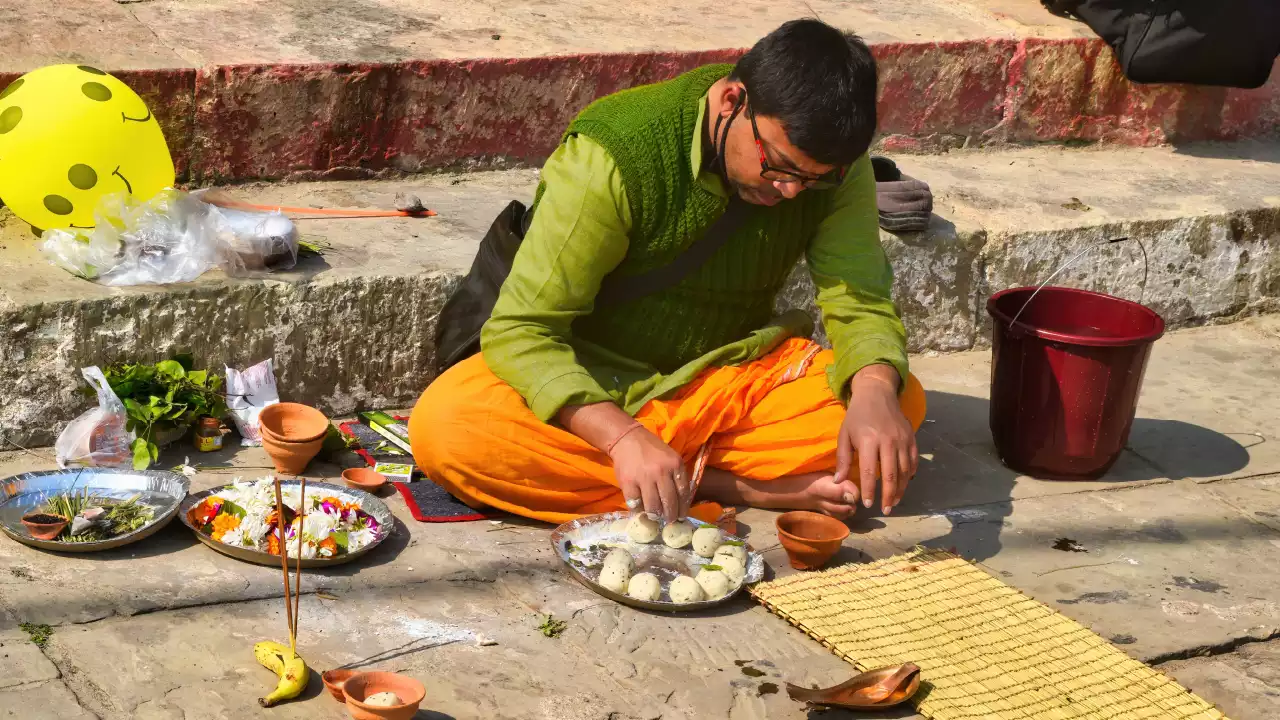
Pind Daan is the offering of pindas (rice balls) which are believed to nourish and provide a subtle body to the departed soul.
- What you need: Cooked rice, barley flour, black sesame seeds, honey, and ghee.
- The Process: These ingredients are mixed to create round balls called pindas. These are offered with utmost devotion, inviting the ancestors to accept the offering. While it can be done at home, performing Pind Daan at holy sites like Prayagraj (Triveni Sangam), Gaya, or Varanasi holds immense significance. At Prayag Pandits, we believe the confluence of the Ganga, Yamuna, and Saraswati rivers makes it a powerful gateway for these offerings to reach the Pitrus.

3. Brahman Bhoj: Feeding the Learned
It is believed that whatever is offered to a worthy Brahmin during Pitrupaksha reaches the ancestors directly.
- The Process: Invite a learned and pious Brahmin to your home. Serve them a pure, sattvic meal (without onion, garlic, or excessive spices) with respect and humility. The meal should ideally include kheer, puri, and vegetables. After the meal, offer them dakshina (alms) and clothes.
4. Feeding Animals
It is also customary to offer food to a crow (believed to be a messenger of Yama, the god of death), a cow, and a dog before the family partakes in the meal.
Types of Shradh: Understanding the Different Forms of Ancestral Worship
Shradh is not a single uniform ritual. The Dharmashastra texts describe multiple forms, each suited to different circumstances, intentions, and resources of the performing family:
Nitya Shradh
Nitya means daily. This is the practice of offering water (Tarpan) to ancestors every day, particularly on Amavasya (new moon day) and in certain traditional households, every morning after bathing. It is the simplest and most continuous form of ancestral worship.
Naimittika Shradh
This is Shradh performed on specific occasions — anniversaries of an ancestor’s death (Mrityu tithi), during Pitrupaksha, on solar and lunar eclipses, and on other astronomically significant days. The rituals during Pitrupaksha fall under this category.
Kamya Shradh
Kamya means desire-oriented. This Shradh is performed with a specific intention — for the birth of a son, for financial recovery, for recovery from illness. It is performed at specific sacred sites known to grant those particular boons.
Vriddhi Shradh (Nandi Shradh)
Performed on auspicious occasions like births, marriages, and upanayanas, this Shradh thanks the ancestors and seeks their blessings for the new beginning. It is performed before the auspicious ceremony, not during the inauspicious period of mourning.
Sapindana Shradh
This is a critical ritual performed approximately one year after a person’s death (on the first death anniversary). It formally merges the soul of the recently deceased with the collective community of ancestors, completing their transition from preta (ghost-like liminal state) to pitru (honoured ancestor). It is one of the most important post-death rites in Hindu tradition.
Parvana Shradh
The most complete form of Shradh, involving all the constituent rites — Tarpan, Pind Daan, Brahmin bhoj, and Dakshina — performed together at a sacred site like Prayagraj during Pitrupaksha. When families perform Shradh at the Triveni Sangam during this period, they typically perform Parvana Shradh.
The 16 Days of Pitrupaksha: Which Day Is Right for Your Ancestor?
The tithi (lunar day) on which a person passed away determines on which day of Pitrupaksha their Shradh should be performed. Here is a quick reference:
- Died on Purnima (full moon): Purnima Shradh — September 26
- Died on Pratipada (1st lunar day): Pratipada Shradh — September 27
- Died on Dwitiya (2nd): Dwitiya Shradh — September 28
- Died on Tritiya (3rd): Tritiya Shradh — September 29
- Died on Chaturthi (4th): Chaturthi Shradh — September 29 (overlapping with Tritiya)
- Died on Panchami (5th): Panchami Shradh — September 30
- Died on Shashthi (6th): Shashthi Shradh — October 1
- Died on Saptami (7th): Saptami Shradh — October 2
- Died on Ashtami (8th): Ashtami Shradh — October 3
- Died on Navami (9th) — especially for women: Navami Shradh — October 4
- Died on Dashami (10th): Dashami Shradh — October 5
- Died on Ekadashi (11th) or was a Vaishnava: Ekadashi Shradh — October 6
- Died as a sannyasi / Magha nakshatra: Dwadashi / Magha Shradh — October 7
- Died young (child or young adult): Trayodashi Shradh — October 8
- Died by violence or accident: Chaturdashi Shradh — October 9
- Tithi unknown, or for all ancestors: Sarva Pitru Amavasya — October 10
Important Do’s and Don’ts During Pitrupaksha
To maintain the sanctity of this period, Prayag Pandits recommends following certain guidelines.
Do’s (What to Do):
- Perform Shraddha with full faith and a pure heart.
- Offer food that your ancestors were fond of during their lifetime.
- Perform rituals under the guidance of a knowledgeable pandit.
- Maintain celibacy and a calm, spiritual temperament.
- Donate food, clothes, and money to the needy in the name of your ancestors.
- Visit sacred rivers — the Ganga, Yamuna, or Triveni Sangam at Prayagraj — for Tarpan if possible.
- Light a lamp (diya) at home in the evening during Pitrupaksha as an offering of light to the departed.
Don’ts (What to Avoid):
- Do not start any new venture, purchase property, or conduct auspicious ceremonies like weddings or housewarmings.
- Avoid cutting hair, shaving, or cutting nails during this period.
- Refrain from consuming non-vegetarian food, alcohol, onion, garlic, and masoor dal.
- Do not use iron vessels for cooking or offering food. Use brass, copper, or silver instead.
- Avoid using harsh language or getting into arguments.
- Do not perform Shradh rituals after sunset.
The Best Places to Perform Pitrupaksha Rituals
While Shradh can be performed anywhere with sincere devotion, the Hindu scriptures identify certain sacred sites as especially powerful for ancestral rites. The merit of performing Shradh at these locations is multiplied manifold:
Prayagraj: King of All Tirthas
Prayagraj — the confluence of the Ganga, Yamuna, and the invisible Saraswati — is described in the Matsya Purana as “Tirthanan uttamam” — the best among all pilgrimage sites. For Pitrupaksha rituals, Prayagraj holds supreme importance. Our pandits at the Triveni Sangam perform Tarpan, Pind Daan, and complete Shradh rituals throughout the 16 days. For full details on our Prayagraj services, see our Pind Daan in Prayagraj page.
Book online: Reserve Pind Daan at Triveni Sangam for Pitrupaksha 2026 via our Pind Daan in Prayagraj booking page (₹7,100 onwards, full samagri and Vedic rites included).
Gaya: The Moksha-Giver
Gaya in Bihar is the supreme site for Pind Daan in all of Hinduism. The Vishnu Pada temple here, built over the footprint of Lord Vishnu, is where Pind Daan is most efficacious for granting moksha to ancestors. Pitrupaksha sees hundreds of thousands of families at Gaya. See our Gaya Pind Daan guide.
Book online: Our Gayawal pandits perform Pind Daan at Vishnupad Temple, Akshay Vat, and Phalgu River on your behalf — see pricing and book via our Gaya Pind Daan booking page (₹7,100 onwards).
Varanasi (Kashi)
The eternal city of Lord Shiva. Performing Shradh at Varanasi, combined with Kaal Bhairav darshan, is believed to free ancestors from any remaining karmic burden. See our Varanasi guide.
Book online: For ritual booking at Manikarnika and Harishchandra ghats, see our Pind Daan in Varanasi (₹7,100) and Asthi Visarjan in Varanasi (₹5,100) booking pages.
Brahmakapal, Badrinath
The open-sky platform on the Alaknanda River where Lord Brahma himself first performed Pind Daan. Especially recommended for ancestors who died of unnatural causes. See our complete guide to Pind Daan at Brahmakapal, Badrinath.
Book online: Pind Daan at Brahmakapal requires a guided trek with experienced pandits — view package details and book via our Pind Daan in Brahmakapal Badrinath booking page (₹10,999).
Haridwar
The gateway to the Char Dham, where the Ganga descends from the mountains onto the plains. Haridwar’s Har Ki Pauri ghat is a major site for Pitrupaksha rituals, especially for families in northern and western India.
Book online: Perform Shradh and Pind Daan at Har Ki Pauri with our Pind Daan in Haridwar and Asthi Visarjan in Haridwar (₹7,100) booking pages.
Pitru Dosha: What It Is and How Pitrupaksha Rites Help
Pitru Dosha is described in Hindu astrology and the Dharmashastra texts as the consequence of ancestral souls being unsatisfied — typically due to inadequate last rites, premature or traumatic death, or neglect of Shradh over generations. Symptoms ascribed to Pitru Dosha include:
- Persistent health problems within the family, especially among children
- Financial difficulties that do not resolve despite sincere effort
- Delayed marriage or problems in marital life
- Difficulty conceiving children
- A persistent sense of ancestral unease or strange dreams involving the deceased
Performing complete Shradh rituals — especially Pind Daan at a powerful tirtha like Prayagraj, Gaya, or Badrinath — during Pitrupaksha is described in the scriptures as the primary remedy for Pitru Dosha. The rites satisfy the ancestors, who then withdraw any affliction and bestow blessings instead. For families experiencing severe Pitru Dosha, our pandits may recommend specific additional rites like Narayan Bali, Nagbali, or Tripindi Shradh.
Pitrupaksha for NRIs: Performing Ancestral Rites from Abroad
For the Hindu diaspora living outside India, the sacred obligation of ancestral rites remains as strong as for families within the country. Prayag Pandits offers a complete NRI puja service that allows families worldwide to fulfil their Pitrupaksha duties:
- Live video Pind Daan: Your pandit performs Tarpan and Pind Daan at Triveni Sangam, Prayagraj, while you participate via a secure live video call. The pandit addresses your ancestors by name and gotra throughout.
- Full documentation: Post-ceremony photos and a summary report are shared with the family.
- International payment: UPI, bank transfer, PayPal, and international card payments accepted.
- All languages: Services available with English-speaking, Hindi-speaking, and regional language (Odia, Bengali, Tamil, Malayalam, Gujarati) pandits.
The shastra is clear that proxy rituals performed with sincere intent and correct procedure are fully efficacious. You do not need to be physically at the tirtha for the ritual to reach your ancestors.
How Prayag Pandits Can Assist You
For centuries, Prayagraj has been the foremost centre for ancestral rites. The power of performing rituals at the Triveni Sangam is unparalleled.
Prayag Pandits is here to help you fulfil your duties towards your ancestors, even if you cannot travel. We offer:
- Online Ritual Services: Our experienced pandits can perform Tarpan and Pind Daan on your behalf in Prayagraj. You can participate via a live video call.
- Booking Expert Pandits: If you are visiting Prayagraj, we can arrange for a learned pandit to guide you through all the rituals seamlessly.
- Personalised Guidance: We provide consultations to help you understand the specific rituals required for your family.
- City-specific Pitrupaksha packages: We offer dedicated packages for Prayagraj, Gaya, Varanasi, Haridwar, and Badrinath. See our complete range of Pitrupaksha Pind Daan services.

Pitrupaksha at Prayagraj: What to Expect on the Ground
Prayagraj during Pitrupaksha is an extraordinary experience — the city transforms into a concentrated site of ancestral devotion. The ghats along the Yamuna and Ganga fill with families from every state in India, each carrying their particular customs, languages, and the weight of ancestral love. The Triveni Sangam itself becomes the focal point, with hundreds of boats carrying families to the confluence for Tarpan and Pind Daan.
For first-time visitors, understanding the logistics of Pitrupaksha at Prayagraj helps ensure a smooth, undistracted experience:
- Arriving at the Sangam: The main ghat for boat access to the Sangam is Sangam Ghat. From there, government boats and authorised private boats take families to the exact confluence point. Prayag Pandits arranges the complete boat logistics as part of the service.
- Timing your visit: Arrive by 10:30 AM to complete your ritual within the Aparahna Kaal. The Kutup Muhurat starts at approximately 11:55 AM and is the single most auspicious window. Do not plan to arrive at the ghat at 11:00 AM — the boat journey, settling in, and Sankalpa all take time.
- Crowd management: Sarva Pitru Amavasya is exceptionally crowded. If you are performing for the final Amavasya, plan to arrive by 9:00 AM. Pitrupaksha weekdays are significantly less crowded than weekends.
- Dress code: Men should wear dhoti (white or unstitched cloth) for the ritual. Women should wear a sari or salwar kameez in white or light colours. Avoid black and dark colours during Pitrupaksha. Do not wear leather accessories during the ritual.
- After the ritual: After completing Pind Daan and Tarpan, families often visit the Allahabad Fort (Akbar’s Fort, within which the famous Patalpuri Temple and Akshayavat Tree are located), then take darshan at Hanuman Temple or Alopi Devi Mandir before departing Prayagraj.
Shradh Food Traditions: The Sattvic Offerings of Pitrupaksha
Food is central to Pitrupaksha in a way that is specific and intentional. The offerings made to Brahmins during Brahmin Bhoj, the food left for crows, cows, and dogs, and the family’s own dietary restrictions during this period all carry precise spiritual meaning.
The Sattvic Diet During Pitrupaksha
The entire Pitrupaksha period calls for a sattvic diet — pure, simple, vegetarian food that does not stimulate aggression or excessive pleasure. The items specifically avoided are:
- Non-vegetarian food in any form
- Alcohol and intoxicants
- Onion (pyaaz) and garlic (lahsun) — these are considered tamasic and inauspicious during rituals
- Masoor dal (red lentils) — traditionally avoided in ancestral rites
- Stale food — fresh cooking is required for ritual offerings
Traditional Shradh Food Offerings
The food offered to Brahmins during Brahmin Bhoj has specific traditional components considered most pleasing to ancestors:
- Kheer (rice pudding made with milk) — one of the most auspicious offerings
- Puri (deep-fried flatbread)
- Vegetables — sattvic preparations without onion or garlic
- Kala til ke laddu — sweets made with black sesame seeds, deeply associated with ancestral rites
- Fruits — bananas, seasonal fruits
Whatever food your ancestor particularly loved during their lifetime may be prepared and offered as part of the Brahmin Bhoj. The intention is that through the Brahmin — who represents the divine in this ritual — the essence of the offering reaches the ancestor.
Book for Pitrupaksha 2026
🙏 Pind Daan u0026 Tarpan at Triveni Sangam
Starting from
₹7,100
per person
Frequently Asked Questions About Pitrupaksha 2026
Honouring your ancestors is not just a ritual; it is a connection that transcends time. To understand how Pitrupaksha connects generations in India's sacred cities, May the blessings of your Pitrus always be upon you and your family.
For any guidance or to book a service for Pitrupaksha 2026, please get in touch with Prayag Pandits today.
Frequently Asked Questions
When exactly is Pitrupaksha 2026?
Pitrupaksha 2026 begins on Saturday, September 26, 2026 (Purnima Shraddha) and ends on Saturday, October 10, 2026 (Sarva Pitru Amavasya / Mahalaya Amavasya). The period spans 16 lunar days and is the most sacred fortnight of the year for ancestral worship.
On which tithi should I perform Shradh for my father / mother / grandparent?
Shradh is performed on the same tithi (lunar day) of the Krishna Paksha in Pitrupaksha on which your ancestor passed away. For example, if your father passed away on Saptami (the 7th day of any lunar fortnight), his Shradh during Pitrupaksha 2026 should be performed on Saptami Shraddha (October 2, 2026). If you are unsure of the tithi, or the ancestor died on Amavasya, perform their Shradh on Sarva Pitru Amavasya (October 10, 2026). Consult a pandit if you are uncertain.
What is the significance of Sarva Pitru Amavasya? Is it more important than the individual tithis?
Sarva Pitru Amavasya (October 10, 2026) is the most important single day of Pitrupaksha. On this day, Shradh can be performed for ALL ancestors simultaneously, regardless of their individual tithis of death. It is particularly important for families who: do not know the exact tithi of an ancestor's death; missed performing Shradh on the correct individual tithi; or wish to perform a comprehensive Shradh for all deceased family members at once. It is also called Mahalaya Amavasya and is the final day when the period of maximum ancestral presence concludes.
Can I perform Pitrupaksha rituals at home, or must I go to a sacred site?
Shradh rituals can be performed at home with a pandit, near any river or water body, or at a sacred tirtha. The scriptures confirm that the sincerity of the ritual (shraddha — faith) is the primary factor, not the physical location. However, performing Pind Daan and Tarpan at a sacred site like Prayagraj, Gaya, Varanasi, or Badrinath is believed to multiply the merit many times over. If travel is not possible, our NRI service allows you to participate via live video call while our pandit performs the ritual at Triveni Sangam, Prayagraj.
What is Pitru Dosha, and can Pitrupaksha rituals remedy it?
Pitru Dosha is the astrological and spiritual condition believed to arise from unsatisfied ancestors — typically due to incomplete last rites, premature death, or lack of regular Shradh over generations. Its effects are described as persistent family difficulties: health problems (especially in children), financial obstacles, and delays in marriage or conception. Performing complete Shradh during Pitrupaksha — especially Pind Daan at a powerful tirtha — is the primary Dharmashastra remedy for Pitru Dosha. For severe cases, additional specialized rites (Narayan Bali, Tripindi Shradh) may be recommended by a pandit.
Who should perform the Shradh ritual in the family?
Traditionally, Shradh is performed by the eldest son of the deceased (the Karta). In the absence of a son, the next eligible performers are: grandson, son-in-law, nephew, or any male relative. In the complete absence of male heirs, contemporary pandit guidance and certain Dharmashastra texts support a daughter or other female relative performing the rite. The key requirement is that the person performing the Shradh does so with sincere faith (shraddha), correct procedure, and the proper Sankalpa (declaration of intent), ideally under a pandit's guidance.
How far in advance should I book Pitrupaksha services at Prayagraj?
We strongly recommend booking at least 4–6 weeks before your intended date. Pitrupaksha is our busiest period, and the final days — especially Sarva Pitru Amavasya (October 10) — are the most heavily booked. Early booking ensures your preferred date, time, and language preference for the pandit. For NRI families participating via video call, we can accommodate more flexible scheduling, but advance booking is still advisable.
Is online / proxy Pind Daan valid according to Hindu scriptures?
Yes. The Dharmashastra texts explicitly provide for proxy performance of rituals when the principal performer (karta) is unable to be present in person — due to illness, distance, or other unavoidable circumstances. The condition is that the proxy (our pandit) acts with the full authority granted by the karta, the Sankalpa names the karta and their ancestors correctly, and the karta participates in intent and prayerfully. Our live video call format satisfies these requirements. Many respected scholars and the Shankaracharya tradition confirm the validity of properly performed proxy rituals.
Book Your Sacred Ritual
Authentic ceremonies performed by Veda-trained pandits with video proof at sacred sites across India.
2,263+ families served
Video proof included
Since 2019
