Key Takeaways
- What Is Pitrupaksha? Definition and Core Meaning
- The Scriptural Foundation: What the Puranas Say
- The Lunar Calendar Science: Why the Krishna Paksha of Ashwin?
- The Principal Rituals of Pitrupaksha: A Detailed Examination
In This Article
Of all the observances in the Hindu calendar, Pitrupaksha holds a position that is simultaneously the most solemn and the most compassionate. For 16 days each year, during the waning fortnight of the Bhadrapada month, Hindu tradition turns its collective attention to those who are no longer physically present — the ancestors, the departed, the ones who came before and made the present generation possible. This is not mourning. It is something closer to active love directed across the boundary of death: a formal, scripturally grounded practice of remembrance, gratitude, and spiritual nourishment.
This article explores the deep significance of Pitrupaksha in Hindu traditions — drawing on the Garuda Purana, the Brahma Purana, the Mahabharata, and the living ceremonial traditions practiced at the sacred sites of Prayagraj, Varanasi, and Gaya. It examines why this particular fortnight was chosen, what the lunar calendar science says about its timing, what the principal rituals involve and why, and how Pitrupaksha connects to the broader Hindu understanding of death, karma, and liberation.
What Is Pitrupaksha? Definition and Core Meaning
The word Pitrupaksha breaks into two Sanskrit components: Pitru (ancestors, forefathers) and Paksha (fortnight, lunar half-month). Together, the term designates the fortnight dedicated to the ancestors. It is also known by several other names in different regional traditions:
- Shraddha Paksha — the fortnight of Shraddha (ancestral rites)
- Pitri Paksha — alternative transliteration of the same concept
- Mahalaya Paksha — after the Mahalaya Amavasya that concludes it
- Apara Paksha — in some regional traditions, denoting the “other-side fortnight”
- Kanagat — in North Indian regional usage
Pitrupaksha occurs in the Krishna Paksha (waning/dark fortnight) of the Bhadrapada month in the Hindu lunar calendar, falling in September or October in the Gregorian calendar. In 2026, Pitrupaksha begins on September 26 (Purnima) and concludes on October 10 (Sarva Pitru Amavasya). The concluding day, Mahalaya Amavasya or Sarva Pitru Amavasya, is considered the single most important day in the entire ancestral rites calendar.
The Scriptural Foundation: What the Puranas Say
Pitrupaksha is not a folk custom that evolved gradually without scriptural sanction — it is elaborately described and ritually prescribed in some of Hinduism’s most authoritative texts. Understanding these scriptural foundations illuminates why the tradition carries the weight it does.
The Garuda Purana: The Principal Scriptural Authority
The Garuda Purana is the most important text for understanding Pitrupaksha. This Mahapurana, narrated by Lord Vishnu to the divine eagle Garuda, deals specifically with the journey of the soul after death, the nature of the afterlife realms, the experiences of departed souls, and the rites that the living can perform to benefit those who have passed on.
Several key teachings of the Garuda Purana directly underpin Pitrupaksha observance:
- The departed soul exists in a subtle realm (Pitru Loka) between physical deaths, where it experiences states of hunger, thirst, and restlessness if not nourished by the offerings of its descendants.
- The pinda (rice ball) offered during Pind Daan provides actual subtle nourishment to the departed soul’s subtle body over the 16 days of Pitrupaksha — with each day’s offerings building upon the previous day’s.
- The water offered during Tarpan quenches the spiritual thirst of the ancestors in Pitru Loka.
- The specific mantras recited during Shraddha create vibrations that directly reach the subtle realm and direct the offering to its intended recipient.
- Performing Shraddha during Pitrupaksha — particularly at a major Tirtha — carries exponentially greater spiritual efficacy than the same rites performed at other times.
The Brahma Purana: The Cosmic Framework
The Brahma Purana provides the broader cosmological context for Pitrupaksha. It describes the three principal debts (rins) with which every person is born — the debt to the gods, the debt to the sages, and the debt to the ancestors (Pitru Rin) — and specifies that Pitru Rin is among the most fundamental because it is the very foundation of one’s existence. The Brahma Purana also describes the mechanism by which satisfied ancestors (tripta Pitrus) bestow blessings on their descendants: health, prosperity, harmonious family relations, good progeny, and the removal of karmic obstacles.
The Brahma Purana further specifies the consequences of neglecting Pitru Rin — a condition known as Pitru Dosha — and lists Pitrupaksha Shraddha as the most important corrective practice. Performing Pind Daan during this fortnight is described as satisfying not merely the three immediately departed generations but all ancestors across seven generations simultaneously.
The Mahabharata: Karna and the Origin of Pitrupaksha
One of the most cited narratives explaining the origin of Pitrupaksha appears in the Mahabharata. The great warrior Karna, known for his extraordinary generosity in life, died in the Kurukshetra war and found himself in the realm of Yama. When offered food in that realm, he found that everything placed before him was gold and precious gems — beautiful but inedible. He questioned Yama about this.
Yama explained that Karna had donated gold and wealth all his life but had never performed Shraddha for his ancestors — and therefore the realm could only offer him what he had given to others, which was gold rather than food. Karna requested an opportunity to return to the earthly realm and correct this omission. Lord Indra granted him 16 days to return and perform the ancestral rites. These 16 days, according to this narrative, became Pitrupaksha.
The story is not merely a folklore explanation — it encodes a core teaching about the nature of Pitru Rin: that generosity in the present generation does not automatically fulfill the obligation to the past generation. The ancestral debt requires its own specific acknowledgment.
The Vishnu Purana: The Role of Shraddha in Cosmic Order
The Vishnu Purana frames Shraddha within the larger concept of cosmic order (Dharma). It describes how the universe is maintained through a system of reciprocal obligations: humans serve the gods through yajna, serve the sages through study and propagation of knowledge, and serve the ancestors through Shraddha. When any of these obligations is neglected, the corresponding dimension of cosmic order becomes disturbed. The Vishnu Purana describes Shraddha as one of the five great yajnas (Pancha Maha Yajna) that form the foundation of householder dharma.
The Lunar Calendar Science: Why the Krishna Paksha of Ashwin?
The timing of Pitrupaksha is not arbitrary — it reflects a sophisticated understanding of the relationship between cosmic cycles and the subtle planes of existence. The specific choice of the Krishna Paksha (waning fortnight) of Bhadrapada (or by some regional calculations, Ashwin) encodes multiple layers of meaning.
The Bhadrapada-Ashwin Transition: The Liminal Season
Pitrupaksha falls at the transition between the monsoon season and autumn — a liminal time in both the natural and the sacred calendar. Agriculturally, this is the period after the primary rains, when the earth is richly nourished but before the harvest begins. It is a time of completion and preparation, of clearing and making ready. In the Hindu sacred calendar, this in-between quality makes the period particularly suited to communication with in-between states — including the intermediate realm (Bardo in Tibetan tradition, Pitru Loka in Hindu) where souls reside between lives.
The Waning Moon and Its Esoteric Significance
The Krishna Paksha — the waning, dark fortnight — is consistently associated in Hindu tradition with ancestral and lunar energy, with interiority and withdrawal, with the world of the dead. This is in contrast to the Shukla Paksha (waxing, bright fortnight), which is associated with the gods, with growth, and with the world of the living. The Chandogya Upanishad describes the moon as the gateway through which souls travel between the earthly realm and the ancestral realm — making the moon’s phases directly relevant to when these communications are most effective.
The Brahma Purana describes the waning fortnight as the time when the ancestors descend closest to the earthly plane, awaiting the offerings that their descendants will make. The gates between Pitru Loka and the earthly realm are said to be especially permeable during these 16 days. This is why Shraddha performed during Pitrupaksha carries far greater potency than the same rites performed on an ordinary day.
The Number Sixteen: Significance in Vedic Numerology
The 16-day duration of Pitrupaksha carries its own significance. In Vedic cosmology, 16 is the number of kalas (phases or parts) of the full moon. The Chandogya Upanishad describes the soul as having 16 kalas, like the moon. The Garuda Purana describes how the 16 pindas offered across the 16 days of Pitrupaksha rebuild the subtle body of the ancestor — one layer per day — providing it with the complete nourishment needed for its onward journey. The number is not coincidental but cosmologically precise.
The Principal Rituals of Pitrupaksha: A Detailed Examination
Pitrupaksha encompasses several distinct but interrelated ritual practices. Each has its specific purpose, its specific procedure, and its specific scriptural basis.
Tarpan: The Water Offering
Tarpan derives from the Sanskrit root tarp, meaning “to satisfy” or “to nourish.” It involves offering water mixed with black sesame seeds (til), barley (jau), and sometimes milk to the ancestors. The practitioner stands facing south — the direction associated with Yama, the deity of death and the south being the direction of the realm of the dead — and pours water from cupped palms toward the earth while chanting the names of the ancestors.
The Tarpan formula identifies the ancestor by name, gotra (lineage), relationship to the performer, and the specific libation being offered. The precision of this identification matters: it is what ensures the offering reaches its intended recipient rather than any passing soul. This is why knowing your gotra and the full names of departed ancestors is important before attempting Tarpan.
Black sesame seeds have a specific role beyond their ritual symbolism. The Garuda Purana describes them as possessing the ability to absorb and neutralize negative energies, ensuring the purity of the offering in transit through the subtle realms. Their use is non-negotiable in the traditional procedure.
Shraddha: The Ceremonial Feeding
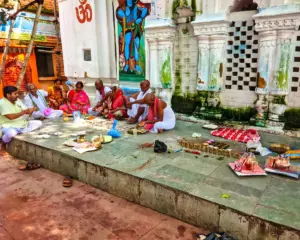
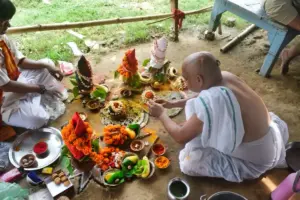
Shraddha (from the Sanskrit shraddha, meaning faith or sincere reverence) is the broader ceremonial framework within which Tarpan and Pind Daan take place. A full Shraddha ceremony includes the preparation of specific foods, the invitation of qualified Brahmins to represent the ancestors, the ritual feeding of those Brahmins, the offering of food to crows (considered messengers of the ancestors), and the donation of food and clothing to the poor.
The food prepared for Shraddha follows specific guidelines: it should be sattvic (pure, vegetarian), freshly cooked, and prepared with devotion. The Dharmashastra texts specify which foods are particularly appropriate — kheer (rice pudding with milk), sesame-based preparations, and various grains — and which are to be avoided. The quality of attention and intention with which the food is prepared is considered as important as the specific ingredients.
Pind Daan: The Offering of the Soul’s Sustenance
Pind Daan is the most elaborate and spiritually significant of the Pitrupaksha rites. Pinda refers to a ball of cooked rice mixed with sesame, honey, and ghee; Daan means offering. These rice balls are prepared and formally offered to the ancestors with specific mantras, then released into a sacred body of water.
The Garuda Purana’s account of pindas is detailed: each pinda represents the physical and subtle components of the ancestor’s existence and provides nourishment at multiple levels simultaneously. When prepared with correct materials and consecrated with correct mantras, the pinda becomes a multi-dimensional offering that satisfies the ancestor’s various bodies and supports their progress toward liberation. The ritual is traditionally performed at a Tirtha — a sacred site where the connection between earthly and subtle planes is especially potent. Varanasi, Gaya, and Prayagraj are the three primary Pind Daan tirthas.
The Significance of the Crow in Pitrupaksha
The crow (kaka) occupies a uniquely important role in Pitrupaksha tradition. According to the Puranic texts, crows are described as emissaries of Yama — capable of moving between the worlds of the living and the dead. An ancestor who wishes to communicate acceptance or satisfaction with the offerings made in their name can do so through the agency of a crow.
During Pitrupaksha, families place food offerings on their terrace or in an open area for crows. If a crow accepts the food — particularly if it takes the offering directly from a family member’s hand — it is considered a powerfully auspicious sign that the ancestors have received the rites with satisfaction. If crows do not accept the offering, the family is advised to consult a pandit about whether the ceremony was properly conducted or whether additional rites may be needed.
Special Days Within Pitrupaksha: The Tithi System
Within the 16 days of Pitrupaksha, each day (tithi) has its specific significance and its recommended audience — that is, each day is particularly auspicious for performing rites for ancestors who died on or around that same lunar date. This tithi system makes Pitrupaksha a highly personalized observance rather than a generic ancestral fortnight.
Maha Bharani: For Deceased Fathers
The day within Pitrupaksha that falls on the Bharani Nakshatra is known as Maha Bharani and holds special significance. Bharani is the Nakshatra governed by Yama, the deity of death. Rites performed on Maha Bharani are considered especially potent for recently deceased fathers and for all ancestors whose death tithi cannot be specifically identified. The day amplifies the standard rites manifold.
Matru Navami (Ashtami/Navami): For Deceased Mothers
In 2026, Navami falls on October 4. This day is specifically dedicated to performing Shraddha for deceased mothers. A woman who died as a Sumangali (with her husband still living) — considered an auspicious passing — has her rites particularly recommended on this day. Many families perform separate Shraddha for the maternal lineage on this day in addition to or instead of the day matching the mother’s specific death tithi.
Chaturdashi: For Accidental and Violent Deaths
The 14th day of Pitrupaksha (Chaturdashi, falling on October 9 in 2026) is designated for Shraddha on behalf of those who died in accidents, through violence, by drowning, by fire, or in other inauspicious or sudden circumstances. Such souls are believed to have a particularly strong connection to the earthly realm due to the abruptness of their departure, and the Chaturdashi rites are specifically designed to provide them with peace and release.
Sarva Pitru Amavasya: The Universal Day
The final day of Pitrupaksha — Sarva Pitru Amavasya on October 10, 2026 — is the single most important ancestral rites day in the entire Hindu calendar. “Sarva” means all — this is the day when rites can be performed for all ancestors simultaneously, regardless of their individual death tithis. It is the recommended day for families who are unable to observe individual tithi Shraddha throughout the fortnight, and for addressing ancestors whose specific death dates are unknown. Performing Pind Daan at Prayagraj Triveni Sangam on this day is considered among the most meritorious acts in Vedic tradition.
Pitrupaksha and Pitru Dosha: The Connection
One of the most practically significant aspects of Pitrupaksha tradition is its role in addressing Pitru Dosha — the ancestral affliction that arises when the chain of Shraddha observance has been broken. Understanding Pitru Dosha and how Pitrupaksha addresses it helps explain why this seemingly ancient practice remains deeply relevant for modern families.
Pitru Dosha manifests in several recognizable patterns: persistent financial difficulties that do not respond to ordinary efforts, unexplained health problems particularly in male members of the family, difficulties in the birth or welfare of children, recurring patterns of family conflict and relationship breakdown, and what might be described as a persistent “unlucky” quality to the family’s fortunes across generations. These are not punishments administered by angry ancestors — they are energetic imbalances, blockages in the flow of ancestral blessing.
The remedy consistently recommended across the Puranas and the living tradition is sincere, properly conducted Shraddha — particularly during Pitrupaksha and particularly at a major Tirtha. Prayag Pandits has guided thousands of families in addressing Pitru Dosha through proper Pind Daan and Tarpan ceremonies at Prayagraj, Varanasi, and Gaya. The tradition of performing these rites at Prayagraj Triveni Sangam — where the sacred confluence of three rivers amplifies every ritual action — is particularly recommended for resolving persistent Pitru Dosha.
Regional Traditions of Pitrupaksha Across India
While the core practice of Pitrupaksha is consistent across Hindu traditions, regional variations in customs, foods, and emphasis reflect the diversity of Indian sacred culture.
- North India (UP, Bihar, MP): The primary focus is on Pind Daan at the major Tirthas — Prayagraj, Varanasi, and Gaya. The Triveni Sangam at Prayagraj sees hundreds of thousands of pilgrims during Pitrupaksha. Traditional foods offered include kheer, puri, and colocasia (arvi) preparations.
- West Bengal (Mahalaya): The final day of Pitrupaksha — Mahalaya — is observed with particular intensity in Bengal. The famous Mahalaya radio broadcast of Mahishasura Mardini is an institution, and the day is observed with Tarpan at the Ganges from dawn. This day also marks the beginning of the Durga Puja preparations.
- Tamil Nadu (Aadi Amavasai): Tamil tradition observes a monthly Amavasya observance for ancestors and places particular emphasis on the Mahalaya Amavasya equivalent. The Rameswaram Tirtha is the primary pilgrimage site in Tamil tradition for ancestral rites.
- Maharashtra: Pitrupaksha observance includes specific foods (particularly colocasia and bitter gourd preparations) associated with the ancestors. Many Maharashtra families observe complete vegetarianism and abstain from auspicious activities throughout the fortnight.
- South India generally: The month of Aadi (July-August) has its own ancestral observance, and Mahalaya Amavasya is observed with Tarpan at rivers and the sea. The Sethu Tarpan at Rameswaram is especially significant.
Pitrupaksha in the Modern Context: Why It Matters Today
One might ask: in a contemporary world shaped by scientific materialism and the demands of modern professional life, why should these ancient practices matter? The answer is both spiritual and psychological.
From the spiritual perspective, the metaphysical framework described in the Puranas — the existence of subtle realms, the ongoing relationship between the living and the departed, the efficacy of mantra-based offerings — is either true or it is not. Hindu tradition invites the practitioner to engage with it experientially rather than accepting or rejecting it theoretically. Thousands of families across every generation have found, through direct experience, that sincere Pitrupaksha observance produces results that are not explicable through ordinary cause and effect. Ancestors who had been neglected for generations, families restored after periods of unusual misfortune, the sense of resolution and peace that follows sincere Shraddha — these testimonies are too consistent across too many families to be dismissed.
From the psychological perspective, Pitrupaksha addresses something that modern culture handles poorly: the acknowledgment of death, the integration of grief, and the maintenance of connection with those who have gone before us. In a culture that tends to move away from death as quickly as possible, the 16 days of Pitrupaksha create a structured annual space for sitting with mortality, honoring those we have lost, and situating ourselves within a lineage that extends both before and after our individual lives. This is psychologically healthy in ways that modern grief therapy is only beginning to articulate.
How to Observe Pitrupaksha: A Practical Summary
For families wishing to observe Pitrupaksha sincerely, here is a practical summary of the recommended practices:
- Identify the relevant tithi: Find the lunar tithi on which each ancestor passed away and plan to perform their Shraddha on the corresponding day of Pitrupaksha. If multiple family members passed on different tithis, Sarva Pitru Amavasya is the universal solution.
- Arrange a qualified pandit: Contact Prayag Pandits well in advance — particularly during Pitrupaksha 2026, when demand is highest. A pandit who knows the correct procedure, the full Sankalpa formulas, and the complete mantra sequence is essential.
- Travel to a Tirtha if possible: Prayagraj Triveni Sangam, Varanasi, or Gaya are the recommended sites. If travel is not possible, perform Tarpan at the nearest river or water body with a qualified pandit.
- Observe dietary restrictions: Throughout Pitrupaksha, many families observe complete vegetarianism. At minimum, avoid meat, fish, eggs, and alcohol during the fortnight.
- Avoid auspicious ceremonies: Weddings, house-warmings, and other celebratory events are traditionally not held during Pitrupaksha. This is a time of interiority and ancestral focus.
- Feed the poor and Brahmins: Distributing food, clothing, and other necessities to those in need during Pitrupaksha is a direct way of extending the merit of your rites to the widest possible circle of benefit.
Frequently Asked Questions About Pitrupaksha Significance
Conclusion: The Eternal Significance of Pitrupaksha
The significance of Pitrupaksha in Hindu traditions is not confined to the religious dimension — though that dimension is profound and scripturally rich. It extends into the human dimension of how we hold our dead: whether we let them recede into forgetting or maintain them in active, loving memory; whether we treat death as an absolute ending or as a transition into a different mode of existence that still permits care, communication, and service.
The Garuda Purana, the Brahma Purana, the Mahabharata, and thousands of years of living tradition all converge on the same teaching: our ancestors need us, we need our ancestors, and the 16 days of Pitrupaksha are the annual window when this mutual need can be most fully and effectively addressed. The rituals of Tarpan, Shraddha, and Pind Daan are the tools through which this exchange takes place — tools refined over millennia by the accumulated wisdom of scholars and practitioners who approached this work with absolute seriousness.
Pitrupaksha 2026 runs from September 26 to October 10. For complete guidance on performing ancestral rites during this sacred fortnight at Prayagraj Triveni Sangam — including online services for families who cannot travel — contact Prayag Pandits. Our pandits will guide you through every aspect of this sacred observance with the knowledge and reverence it deserves.
Further reading: Spiritual Significance of Pitrupaksha 2026 | Pind Daan 101: Complete Guide | Pind Daan in Varanasi: Commemorating Ancestral Souls
Book Your Sacred Ritual
Authentic ceremonies performed by Veda-trained pandits at sacred sites across India.