Key Takeaways
- The Scriptural Foundation: What the Puranas Say About Gaya
- The Legend of Gayasur: How a Demon's Body Became Sacred Ground
- The Vishnupad Temple: The Heart of Pind Daan in Gaya
- The Falgu River: The Sacred Stream of Ancestral Offerings
In This Article
When a Hindu family decides to perform Pind Daan, one question arises above all others: why Gaya? Of the 55 sacred tirthas in India where Shradh karma may be performed, Gaya Ji in Bihar holds a position that no other place can claim. The Vayu Purana, Agni Purana, Vishnu Purana, and the Mahabharata all speak with one voice — Pind Daan in Gaya liberates the souls of ancestors across seven generations, frees the performer from Pitru Dosha, and grants the entire family the blessings of Moksha. This is not custom or folklore; it is scriptural dharma, recorded in India’s most authoritative sacred texts for thousands of years.
In this guide, we explore in depth every reason why Gaya is the supreme destination for ancestral rites — from the legend of Gayasur and Lord Vishnu’s footprint at the Vishnupad Temple, to the sacred Falgu River, the immortal Akshayavat tree, the 54 vedis (ritual altars) scattered across the city, and the annual Pitru Paksha Mela that draws hundreds of thousands of devoted pilgrims every year.
The Scriptural Foundation: What the Puranas Say About Gaya
The sanctity of Pind Daan in Gaya is not based on tradition alone — it rests on direct references in some of Hinduism’s oldest and most revered scriptures. Understanding these references is the first step to understanding why every devout Hindu family aspires to perform ancestral rites at Gaya Ji at least once.
Vayu Purana: Seven Generations Liberated
The Vayu Purana contains one of the most direct and oft-cited declarations about Gaya: “He who offers Pind Daan at Gaya frees his ancestors — both those who came before and those who will come after — across seven generations, from the suffering of lower planes and leads them to the realm of Vishnu.” Seven generations is not a metaphor here. The scripture is precise — three generations above (father, grandfather, great-grandfather) and three below (son, grandson, great-grandson), in addition to the performer himself. This collective liberation is called kula-uddharana, the upliftment of the entire lineage, and it is a gift available only at Gaya.
Agni Purana: The Supremacy of Gaya Shradh
The Agni Purana explicitly ranks the tirthas for Shradh performance and places Gaya at the apex. It declares that performing Shradh at Gaya even once is equivalent to performing it at all other tirthas combined. The text also notes that a person who cannot travel to Gaya may perform Shradh at Prayagraj or Varanasi, but that these are secondary substitutes — Gaya remains the mukhya teertha, the primary sacred site for Pitru karma.
Vishnu Purana and the Mahabharata
The Vishnu Purana identifies Gaya as a place where Lord Vishnu himself is present in the form of Pitru Devata — the divine embodiment of all ancestors. This is why Gaya is called Pitru Tirtha, the teertha of the ancestors. The Mahabharata (Vana Parva) records Yudhishthira’s pilgrimage to Gaya Ji during the Pandavas’ forest exile, where it is described as the holiest place for ancestral rites among all places on earth. The text names the region as Gayapuri and describes the sacred Phalgu (Falgu) River as the life-giving artery of the city’s spiritual power.
The Legend of Gayasur: How a Demon’s Body Became Sacred Ground
The story of Gaya’s origin is among the most extraordinary in all of Hindu sacred lore. It begins with a demon named Gayasur — a being of immense austerity and devotion who performed such intense tapasya (penance) that even the gods grew alarmed. Gayasur’s penance was directed at Lord Vishnu, and the boon he sought was remarkable: he wanted his own body to be so sacred that anyone who touched it, saw it, or walked across it would attain Moksha instantly.
Lord Vishnu granted the boon, and Gayasur’s body became the holiest ground on earth. So holy, in fact, that the gods faced a crisis — if everyone attained liberation merely by touching Gayasur’s body, the populations of heaven and hell would be disrupted. The divine world would be emptied and the cosmic order would collapse. Lord Brahma and the assembled gods descended to earth and asked Gayasur to lie down so that a great yagna (sacred fire ritual) could be performed on his body. Gayasur agreed.
As the yagna progressed, Gayasur’s body began to tremble. Lord Vishnu placed his right foot directly on the demon’s chest to hold it still. That divine footprint became the Vishnupad — the sacred footprint of Lord Vishnu that pilgrims venerate at the Vishnupad Temple in Gaya to this day. The demon’s body, lying beneath the earth of Gaya, is the reason why the entire city — its soil, its river, its trees — is considered sacred. Every grain of earth at Gaya carries the spiritual potency of Gayasur’s sacrifice and Vishnu’s blessing.
The Vishnupad Temple: The Heart of Pind Daan in Gaya
No discussion of Pind Daan in Gaya is complete without speaking about the Vishnupad Temple — the most sacred structure in the city and the focal point of all ancestral rites performed here. The temple houses a 40 cm footprint impression set in solid rock, believed to be the actual footprint of Lord Vishnu placed on Gayasur’s chest. This footprint is enshrined within an octagonal basin made of silver, and devotees pour sacred water, milk, flowers, and offerings onto it as part of their Pind Daan ceremony.
The current structure of the Vishnupad Temple was built in 1787 CE by Queen Ahilyabai Holkar of Indore, who was among the most prolific temple builders of her era. The temple rises 30 metres above the banks of the Falgu River and is visible from much of the city. Gaya city, situated in Bihar, receives hundreds of thousands of pilgrims annually, particularly during the Pitrupaksha fortnight. Its distinctive shikhara (spire) is a landmark that has guided pilgrims for centuries. The temple is managed by a community of hereditary priests called Gayawals, whose families have been performing Pind Daan rites for generations and carry deep knowledge of the scriptural procedures involved.
During Pitru Paksha, the area around the Vishnupad Temple becomes one of the most intensely spiritual environments in the entire country. Thousands of families gather at the ghats adjoining the temple, and the air is thick with the recitation of mantras, the smell of sesame seeds and rice, and the gentle sound of water. For families performing Pind Daan in Gaya, the Vishnupad Temple is the mandatory starting point of the ritual journey.
The Falgu River: The Sacred Stream of Ancestral Offerings
The Falgu River (also spelled Phalgu) flows through the heart of Gaya and is one of the most sacred rivers in Hindu tradition — despite the unusual fact that its surface is often dry or barely visible, its water flowing underground for much of the year beneath a wide sandy bed. This paradoxical nature — a sacred river that runs largely unseen — has itself become part of its spiritual meaning.
The Falgu is associated with a famous episode from the Ramayana. When Lord Rama, Sita Mata, and Lakshmana travelled to Gaya Ji to perform Pind Daan for King Dasharatha (who had died during the separation from Lord Rama), an interesting event occurred. Lord Rama and Lakshmana went to gather materials for the rite, leaving Sita Mata alone at the river. King Dasharatha’s spirit appeared, and Sita Mata performed the Pind Daan herself, using sand from the Falgu riverbed as the pind. The offerings were accepted.
When Lord Rama returned and performed the formal Pind Daan, it was not accepted in the same way. Dasharatha’s spirit confirmed that Sita’s offering had already granted him liberation. Sita Mata called upon the Falgu River, the Akshayavat tree, a cow, and a Brahmin as witnesses to what had occurred. When the Falgu River gave false testimony (as did the others), Sita Mata cursed the river to flow underground, which is why the Falgu is a subterranean river to this day.
Despite — or perhaps because of — this legend, the Falgu’s sandy banks are considered supremely sacred for Pind Daan. The very sand of the Falgu is used to make pinds when other materials are insufficient. Offering Pind Daan on the banks of the Falgu, particularly near the Vishnupad Temple ghats, is the central ritual act for every family that visits Gaya Ji.
Akshayavat: The Immortal Banyan Tree of Gaya
Within the Vishnupad Temple complex stands one of the most revered trees in all of Hindu sacred geography — the Akshayavat, the Immortal Banyan Tree. Akshaya means that which never perishes or diminishes, and the tree’s name reflects its theological status: offerings made in its presence are believed to become akshaya — imperishable, eternal, inexhaustible in their spiritual merit.
The Akshayavat is mentioned in multiple Puranas as one of five sacred imperishable trees in India (the others being the Akshayavat at Prayagraj, the Vata Vriksha at Gaya Bodh Gaya, the Vanshivat at Vrindavan, and the Siddhavat at Ujjain). The Gaya Akshayavat is particularly significant because its association with Pitru karma is ancient and unbroken. Pilgrims tie sacred threads to its branches, pour water at its roots, and make offerings of sesame seeds and rice as part of the Pind Daan ritual.
Performing Pind Daan at the Akshayavat is considered one of the 54 key acts within the full Gaya Shradh. For families doing the comprehensive rite across multiple days, the Akshayavat puja is an indispensable component. Even for families performing a single-day ceremony, a brief prayer at the Akshayavat is standard practice.
The 54 Vedis of Gaya: Why the Entire City is a Tirtha
What makes Gaya uniquely powerful among all the tirthas in India is the presence of 54 vedis — sacred ritual altars — distributed across the city and its surrounding areas. No other pilgrimage site in India has anything comparable. Each vedi has its own presiding deity, its own scriptural reference, and its own specific benefit for the souls of the ancestors. Performing the complete Gaya Shradh involves visiting and making offerings at all 54 vedis, a journey that typically takes three to five days.
Among the most important vedis are:
- Vishnupad Vedi — The supreme vedi at the Vishnupad Temple, where Lord Vishnu’s footprint is enshrined. All Pind Daan at Gaya begins here.
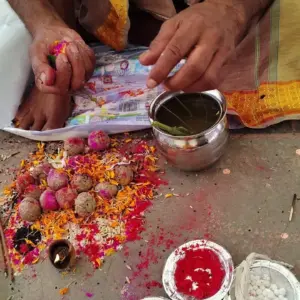
- Phalgu (Falgu) Vedi — On the sandy banks of the Falgu River, where pinds made of sesame, rice, and barley are offered to ancestors.
- Akshayavat Vedi — At the immortal Banyan tree within the Vishnupad complex.
- Brahma Kund Vedi — A sacred tank associated with Lord Brahma, where water offerings are made.
- Pretshila Vedi — On a prominent rocky hill called Pretshila, where offerings are made for ancestors who died by unusual or untimely means.
- Ramshila Vedi — Associated with Lord Rama’s visit to Gaya Ji, on a hill bearing his name.
- Manglagauri Vedi — The temple of Sati’s breast (one of the 18 Shakti Pithas), situated in Gaya and integral to the complete pilgrimage.
- Bodhgaya Vedi — About 10 km from central Gaya, at the site where Lord Buddha attained enlightenment. This vedi is significant for both Hindus and Buddhists.
When families book Pind Daan through Prayag Pandits, our experienced Gayawal pandits guide the entire family through the relevant vedis based on the number of days available, ensuring that the ancestral rites are performed with full scriptural compliance.
Lord Rama’s Visit to Gaya Ji: The Divine Precedent
Few acts carry more spiritual authority than following the example of Lord Rama. According to Hindu tradition — and consistent across multiple versions of the Ramayana — Lord Rama himself came to Gaya Ji in the Treta Yuga to perform Pind Daan for his father, King Dasharatha. This divine act established Gaya as the supreme destination for Pitru karma.
The logic for devout Hindus is compelling: if Lord Rama, the seventh avatar of Lord Vishnu, chose to travel to Gaya specifically for his father’s Pind Daan — despite having access to all of creation — then there must be something uniquely powerful about this place. The Ramayana episode is not merely historical narrative; it is a theological statement that Gaya is the highest teertha for ancestral rites, endorsed by the Lord himself.
It is also worth noting that Sita Mata’s independent act of performing Pind Daan at Gaya established an important precedent: women can and do perform Pind Daan. The scriptural ban on women performing certain rites does not apply to Gaya, where tradition and accepted practice allow female family members to participate fully in the ceremony.
What is Pitru Dosha and Why Gaya Removes It
Pitru Dosha is one of the most commonly diagnosed astrological and spiritual afflictions in Hindu families. It arises when ancestors have not received proper last rites, when they died in unusual circumstances (accident, suicide, premature death), when their souls are trapped in lower planes, or when the family has failed in its duty to perform annual Shradh. The effects of Pitru Dosha are believed to manifest as recurring health problems, financial instability, relationship difficulties, obstacles in children’s education or marriage, and a general sense of stagnation that persists despite best efforts.
Gaya is specifically prescribed for the removal of Pitru Dosha because of a unique scriptural provision: Pind Daan at the Vishnupad Temple and Falgu River in Gaya grants liberation even to ancestors who died in circumstances that would normally require special additional rites. The spiritual power of the location amplifies the effect of the ritual beyond what is achievable elsewhere. Families dealing with Pitru Dosha are specifically directed to Gaya in all the major astrological and ritual texts of Hinduism.
The annual Pitru Paksha Mela at Gaya — the 16-day period aligned with the dark fortnight of the lunar month Bhadrapada (typically September–October) — is the most auspicious time to address Pitru Dosha. During these 16 days, the barrier between the living and ancestral worlds is believed to be thinnest, and the efficacy of Pind Daan reaches its peak. Lakhs of families from across India and the world travel to Gaya specifically to remove Pitru Dosha during this period.
Pitru Paksha Mela at Gaya: The World’s Largest Ancestral Rites Festival
Every year, in the fortnight leading up to Sarva Pitru Amavasya, Gaya transforms into what may well be the world’s largest gathering dedicated to ancestral rites. The Pitru Paksha Mela draws anywhere from 8 to 15 lakh pilgrims in a single 16-day period — families from every state in India, from the Indian diaspora worldwide, from Hindu communities in Nepal, Sri Lanka, Mauritius, Fiji, and beyond.
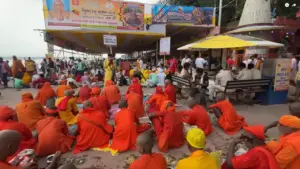
The atmosphere during Pitru Paksha at Gaya is unlike anything else in the Hindu ritual calendar. The Vishnupad Temple ghats are lined with thousands of families performing their rites simultaneously. The Gayawal priests — the hereditary priestly community of Gaya — work from dawn to sunset guiding families through the complex multi-step ritual. The city’s infrastructure expands to accommodate the influx: temporary camps, expanded transportation, additional police and medical personnel, and an entire ecosystem of samagri (ritual material) vendors who supply the exact materials needed for each vedi.
Booking in advance is essential during Pitru Paksha. Pind Daan in Gaya for Pitrupaksha 2026 should be arranged weeks in advance to secure a qualified pandit who speaks your regional language and can guide the family through the ceremony with the care and knowledge it deserves. Prayag Pandits coordinates these bookings and handles all logistics on behalf of families who wish to focus entirely on the spiritual dimension of their visit.
Gaya and Buddhism: A Dual Sacred Heritage
Gaya’s sacred status is not limited to Hinduism. Approximately 10 km south of the central city lies Bodhgaya, the site where Prince Siddhartha Gautama attained enlightenment beneath the Bodhi tree and became the Buddha. For Hindus, this connection adds another layer of sanctity — the Buddha is the ninth avatar of Lord Vishnu according to the Dashavatar tradition, and Bodhgaya is therefore a sacred site for both Vaishnavas and Buddhists.
Many families performing Pind Daan in Gaya extend their visit to include Bodhgaya, taking blessings at the Mahabodhi Temple (a UNESCO World Heritage Site), offering prayers at the Bodhi tree, and visiting the various monasteries established by Buddhist communities from Thailand, Japan, China, Myanmar, Sri Lanka, and Tibet. This dual heritage makes Gaya one of the most spiritually layered destinations in all of Asia — a place where two of the world’s great dharmic traditions converge on the same sacred ground.
Gaya vs. Prayagraj vs. Varanasi: Understanding the Hierarchy of Tirthas
A common question among families planning ancestral rites is: which is better for Pind Daan — Gaya, Prayagraj, or Varanasi? The scriptural answer is clear, though the practical answer depends on circumstances.
Gaya is the supreme teertha for Pitru karma. The Puranas consistently place it at the top of the hierarchy for Pind Daan. The unique combination of the Vishnupad, the Falgu River, the 54 vedis, and the Gayasur legend gives it a spiritual potency that no other teertha matches for ancestral rites specifically. If a family can travel to Gaya, that is the preferred option.
Prayagraj (Triveni Sangam) is described in scripture as equal to Gaya for Tarpan (water libation offerings) and highly meritorious for Shradh in general. Its significance is enhanced during Pind Daan at Prayagraj during Pitru Paksha, when the sacred confluence of Ganga, Yamuna, and the invisible Saraswati creates particularly powerful conditions for ancestral rites.
Varanasi (Kashi) is the city of Lord Shiva and is especially significant for those who died away from sacred waters — performing Pind Daan in Varanasi alongside Asthi Visarjan (immersion of ashes) at the Ganges is a powerful combined rite. The Gaya-Varanasi-Prayagraj combination is considered the gold standard for Pitru karma, and many families perform the 3-in-1 Pind Daan package at Prayagraj, Varanasi, and Gaya to cover all three major tirthas.
Who Should Perform Pind Daan in Gaya?
Traditionally, Pind Daan in Gaya is performed by the eldest son of the family, but Hindu scripture and accepted practice are more inclusive than this rule suggests. Any close family member — son, daughter, brother, sister, grandson, granddaughter, wife, or husband — may perform the rite. In the absence of family members, a trusted representative can perform it on behalf of the family. Prayag Pandits regularly assists NRI families who cannot travel to India but wish to have Pind Daan performed by proxy at Gaya.
There is no age restriction. Children as young as 8 or 10 years may participate (though the primary performer should be an adult). Women are welcomed at Gaya — this is consistent with the precedent established by Sita Mata. Families in which only female members remain are fully entitled to perform the rite, and this is a matter of settled practice at the Vishnupad Temple ghats.
The timing of Pind Daan at Gaya can be any day of the year — unlike some tirthas that are only optimal during specific periods, Gaya accepts Pind Daan year-round. The most auspicious time is during Pitru Paksha (September–October), followed by Amavasya (new moon) days, and then Ekadashi tithi. However, if a family member has recently passed and the rites must be performed promptly, any day at Gaya is considered appropriate.
What Does Pind Daan in Gaya Cost in 2026?
The cost of performing Pind Daan in Gaya varies depending on the scope of the ceremony, the number of days, and the number of participants. Prayag Pandits offers straightforward, transparent packages with no hidden charges or on-site pressure for upgrades.
- Standard Pind Daan in Gaya: Starting at ₹7,100 (sale price) — includes pandit, all puja samagri, and guidance through the core rituals. Book here
- Pitrupaksha Pind Daan in Gaya (single person): Starting at ₹7,100 during the Pitru Paksha period. Book here
- Pind Daan in Gaya for Two Persons: ₹13,000. Book here
- Platinum Package (extended 3-day ceremony): ₹11,000 — includes all 54 vedi visits across multiple sessions. Book here
- Pitrapaksha Special Pind Daan — 3 Days: ₹31,000 — comprehensive three-day ceremony with multiple pandits and Brahmin Bhoj. Book here
- Online Pind Daan in Gaya: Starting at ₹11,000 — performed by our Gaya pandits with live video streaming for families who cannot travel. Book here
🙏 Book Pind Daan in Gaya with Expert Pandits
How to Reach Gaya for Pind Daan
Gaya is well connected to all major Indian cities, making it accessible for pilgrims from across the country and abroad.
By Air
Gaya International Airport (IATA: GAY) operates flights to/from Delhi, Kolkata, Mumbai, and several international routes, particularly to Nepal and Southeast Asia. During Pitru Paksha, additional charter and seasonal flights are often available.
By Train
Gaya Junction is a major railway station on the Grand Chord Line. Express trains connect Gaya to Patna (2 hours), Kolkata (5–6 hours), Delhi (10–12 hours), Varanasi (3–4 hours), and Prayagraj (5–6 hours). During Pitru Paksha, special pilgrim trains are operated by Indian Railways.
By Road
Gaya is connected by NH 22 and NH 19. It is approximately 100 km south of Patna (2.5 hours), 250 km from Varanasi (5 hours), and 350 km from Prayagraj (7 hours). AC buses and private taxis are available from all these cities.
Complete Your Duty to Your Ancestors at Gaya Ji
The question of why to do Pind Daan in Gaya ultimately has one answer that speaks louder than all the scriptural citations and historical details: Gaya is where the ancestors wait to be released. The entire city — its soil, its river, its temples, its sacred trees — has been consecrated by millennia of devotion, by the divine footprint of Lord Vishnu, by the earth of Gayasur’s sacrifice, and by the prayers of countless generations of families who came here to honour those who came before them.
When you perform Pind Daan in Gaya, you are not merely performing a ritual. You are completing a sacred contract between the living and the departed — the deepest act of love, gratitude, and dharma that a child can offer a parent, that a grandchild can offer a grandparent, that a family can offer to all those who built the foundations of its existence. Understand the deep significance of Pind Daan in Gaya and let us help you make this sacred journey with confidence, comfort, and complete ritual authenticity.
To book your Pind Daan at Gaya Ji, reach out to Prayag Pandits. Our team of experienced pandits and coordinators is ready to guide your family through every step of this profound sacred journey. For families who cannot travel, our online Pind Daan service brings the full power of Gaya Ji to you, wherever you are in the world. You may also explore our dedicated services for NRI families who wish to fulfil their ancestral duties from abroad.
Book Your Sacred Ritual
Authentic ceremonies performed by Veda-trained pandits at sacred sites across India.