Varanasi — the eternal city of Lord Shiva — is the most sacred destination in Hinduism for the immersion of a loved one’s ashes. This guide covers every step: from collecting the Asthi to the final immersion in the Ganges, along with ghats, timing, materials, costs, and online options for families who cannot travel.
Asthi Visarjan is a sacred Hindu ritual that involves immersing the ashes and bone fragments (Asthi) of the deceased in the holy river Ganges at Varanasi. It is among the most profound acts a family performs for a departed loved one — the final, irreversible act of physical release, which Hindu tradition believes opens the path to Moksha (liberation) for the departing soul. Varanasi, known also as Kashi and Benares, is universally recognised in Hindu scripture as the supreme destination for this rite. Lord Shiva himself is believed to whisper the Taraka Mantra — the mantra of liberation — into the ear of every soul that departs from Kashi, granting them direct passage to the divine realm regardless of their karma in life.
This complete stepwise guide covers everything a family needs to know before, during, and after performing Asthi Visarjan in Varanasi: the scriptural significance of Kashi for last rites, the best ghats for the ceremony, the complete ritual procedure from beginning to end, the materials required, the timing and legal considerations, special guidance for NRI families, online Asthi Visarjan options, and answers to the most frequently asked questions. Whether you are planning this ceremony for the first time or looking to ensure it is done with complete authenticity and care, this guide is for you.
Why Varanasi? The Scriptural Significance of Kashi for Asthi Visarjan
Varanasi’s supreme status in Hinduism for last rites is not merely a cultural preference — it is grounded in some of the faith’s most authoritative texts. The Kashi Khanda of the Skanda Purana — the most comprehensive Purana devoted to the sacred city of Kashi — declares that the city is the personal abode of Lord Shiva and that no soul that departs from within its boundaries can be subject to rebirth. The text famously states: “Kasya Moksho Na Jayate” — “In Kashi, liberation is not merely possible; it is certain.”
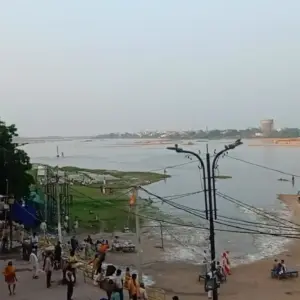
This extends to the ashes of those who die elsewhere but are brought to Varanasi for immersion. The act of Asthi Visarjan in Varanasi brings the departed within the sacred geography of Kashi, extending to them the city’s liberating grace. The Ganges at Varanasi — flowing northward at this stretch, which is itself considered highly auspicious — carries the ashes from the mortal world and dissolves them into the timeless, purifying waters that Hindus regard as the physical manifestation of divine grace.
Beyond the Puranic authority, there is the living tradition of thousands of years of Hindu families who have made this journey. Varanasi’s ghats — particularly Manikarnika Ghat, considered the oldest continuously operating cremation ghat on earth — represent an unbroken continuum of sacred practice stretching back to the earliest epochs of Hindu civilisation. When a family brings their loved one’s ashes to the Ganges at Varanasi, they are joining a river of devotion that has been flowing for millennia.
The Best Ghats for Asthi Visarjan in Varanasi
Varanasi has 88 ghats along the Ganges, each with its own character, deity association, and ritual significance. For Asthi Visarjan, not all ghats are equally appropriate — tradition, practicality, and scriptural guidance point to a specific set of ghats as the most suitable.
1. Manikarnika Ghat — The Mahashamshan
Manikarnika Ghat is the most sacred cremation and Asthi Visarjan ghat in Varanasi — and arguably in all of India. The fires of Manikarnika are said to have been burning continuously for thousands of years without interruption, tended by the Dom community whose hereditary role is the management of cremation fires. The ghat derives its name from the legend that Sati’s earring (manikarnika) fell here as Lord Shiva carried her body, making it one of the Shakti Pithas.
For Asthi Visarjan, Manikarnika is the primary ghat. The immersion is performed on the stone steps, either by the family wading into the water or from a boat at the water’s edge. The pandit guides the family through the final mantras and the immersion itself. During busy periods such as Pitru Paksha or after large-scale disasters or epidemics, Manikarnika can be very crowded — advance booking with an experienced pandit service is strongly advisable.
2. Harischandra Ghat
Harischandra Ghat is the second major cremation ghat in Varanasi, named after the legendary King Harischandra who worked here as a servant in his period of supreme trial. It is slightly less crowded than Manikarnika and considered equally appropriate for Asthi Visarjan. Many families from specific regional communities — particularly from Maharashtra and Karnataka — have a tradition of using Harischandra Ghat.
3. Assi Ghat
Assi Ghat, at the southernmost end of the main ghats, marks the confluence of the Assi rivulet with the Ganges. It is considered particularly auspicious and is less chaotic than the central cremation ghats. Many families from South India prefer Assi Ghat, and it is a popular location for both Asthi Visarjan and post-immersion Pind Daan ceremonies.
4. Dashaswamedh Ghat
Dashaswamedh Ghat is the most famous and visually spectacular ghat in Varanasi — it is where the nightly Ganga Aarti is performed and where Lord Brahma is believed to have performed the Dashashwamedha (ten-horse) yagna. While primarily a bathing and prayer ghat, Asthi Visarjan is also performed here and is entirely appropriate. Families performing Asthi Visarjan at Dashaswamedh often combine it with participation in or witnessing of the evening Ganga Aarti on the same day.
5. Raja Ghat
Raja Ghat is quieter and less visited by tourists, making it a peaceful option for families who prefer a more private ceremony. It is a legitimate and appropriate ghat for Asthi Visarjan, and its relative calm can make the experience more meditative and personally meaningful for grieving families.
Complete Stepwise Guide to Performing Asthi Visarjan in Varanasi
Step 1: Collecting the Asthi (Ashes and Bone Fragments)

After cremation, the remaining bone fragments and ashes — collectively called Asthi — are collected from the funeral pyre. This is typically done on the third, seventh, or ninth day after the person’s death, depending on regional custom. Some communities collect on the third day (particularly in North India), while others wait until the seventh or ninth.
The Asthi are collected carefully — usually by the chief mourner (eldest son or next of kin) — sifted to separate bone from ash where possible, and placed in a Kalash (a sacred copper or clay pot). The Kalash is sealed and wrapped in clean white or red cloth. In many traditions, the Kalash is kept in a clean, respectful space in the home — not in a bedroom, not near food preparation areas — until the day of travel to Varanasi.
If the body was cremated in a modern electric crematorium rather than a traditional wood-fire pyre, the ashes are typically returned to the family in a sealed container. These are equally appropriate for Asthi Visarjan — the form of cremation does not affect the validity of the immersion rite.
Step 2: Book a Pandit in Advance

Booking a qualified pandit in advance is one of the most important steps a family can take, and one that is unfortunately often skipped by families who assume they can simply arrive at the ghat and engage a local priest on the day. While this is technically possible, it exposes grieving families to the well-documented problem of unqualified, mercenary “pandas” who overcharge, rush the ceremony, and lack knowledge of regional rites.
When you book Asthi Visarjan in Varanasi through Prayag Pandits, you receive a confirmed appointment with a qualified pandit who speaks your regional language (Hindi, Tamil, Telugu, Kannada, Marathi, Gujarati, Odia, Bengali, or Punjabi), all puja samagri (materials) prepared in advance, a coordinator who meets the family at the ghat, and a ceremony that follows the correct procedure for your specific community.
Step 3: Travel to Varanasi

Varanasi (Kashi) is well connected to all major Indian cities. Lal Bahadur Shastri International Airport (VNS) serves Varanasi with flights from Delhi, Mumbai, Bengaluru, Hyderabad, Kolkata, and Chennai. Varanasi Junction railway station is a major hub on the Eastern and North Eastern Railway networks. By road, Varanasi is accessible via NH19 (Delhi–Howrah highway) and is approximately 125 km from Prayagraj (2.5–3 hours) and 300 km from Patna (5–6 hours).
For families combining Asthi Visarjan in Varanasi with Pind Daan in Gaya, the standard itinerary is: Varanasi first (Day 1 for Asthi Visarjan), then Gaya (Day 2–3 for Pind Daan), which are approximately 3.5 to 4 hours apart by road. Prayag Pandits coordinates combined Varanasi + Gaya ceremonies as a single package. You may also consider the Varanasi Asthi Visarjan Package (2D/1N) at ₹12,500, which includes hotel accommodation and a cab transfer.
Step 4: Navigating to the Ghat

Varanasi’s old city — the area around the ghats — is one of the most densely populated and labyrinthine urban environments in India. The narrow lanes (called gallis) that lead from the main roads to the ghats can be disorienting for first-time visitors, and vehicular access is restricted in many areas close to the waterfront. This is another reason why having a local coordinator is invaluable.
When you book through Prayag Pandits, a coordinator meets your family either at your hotel or at a specified landmark and escorts you directly to the correct ghat. They handle navigation, manage the flow of the family group (which can include elderly members, young children, and people in different states of grief), deal with any entry requirements, and ensure that you arrive at the ghat on time and in the correct frame of mind for the ceremony. Families who attempt to navigate the ghats independently — particularly during peak seasons like Pitru Paksha — regularly report getting lost, arriving late, or being approached by touts and unofficial guides.
Step 5: Performing the Asthi Visarjan Puja

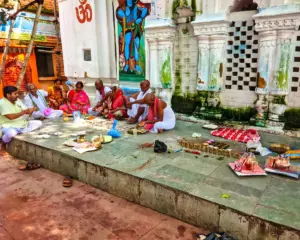
The puja at the ghat is the heart of the Asthi Visarjan ceremony. The pandit prepares a clean ritual space on the ghat steps and arranges the puja samagri. The full puja sequence includes:
- Sankalpa (Intention Setting): The chief mourner states their name, gotra, the name of the deceased, and the intention of the rite. The pandit recites the formal Sanskrit sankalpa and the family member repeats the key phrases.
- Puja of the Asthi Kalash: The Kalash containing the ashes is worshipped with flowers, kumkum (red vermilion), chandana (sandalwood paste), and incense. Rice, black sesame seeds (kala til), and water are offered to the Kalash.
- Ganga Puja: The sacred Ganges river is formally invoked and worshipped. The pandit recites the Ganga Stotram and specific verses from the Kashi Khanda acknowledging the river’s divine nature.
- Recitation of the Pitra Mantras: The pandit recites mantras for the peace of the departed soul, addressing them by name. The Mahamrityunjaya Mantra, the Gayatri Mantra adapted for the departed, and specific Pitru Shanti mantras are recited. Family members may be asked to offer Tarpan (water libations) from their cupped palms during this section.
- Offering of Pinda (Rice Ball): A small pinda — a ball of cooked rice mixed with black sesame, honey, and Ganges water — is prepared and offered to the departed. This is the Pind Daan component of the ceremony. For families who wish to perform a full, extended Pind Daan in addition to Asthi Visarjan, this should be arranged as a separate ceremony, ideally also at Prayagraj or Gaya.
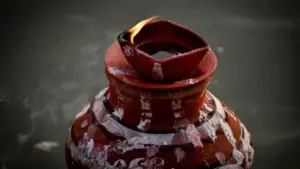
- Final Prayers and Aarti: A brief aarti is offered to the Ganges, and the family members offer flowers and a diya (clay lamp) to the river as a final gesture of love and release.
Step 6: Immersing the Ashes

After the puja is complete, the Kalash containing the ashes is taken to the water’s edge. Depending on the depth and flow of the river at the specific ghat, the family either wades into the shallows and immerses the ashes directly, or they board a small ceremonial boat and perform the immersion in mid-river.
The immersion itself — the moment when the Kalash is opened and the ashes are released into the current of the Ganges — is the most emotionally and spiritually charged moment of the entire ceremony. For many family members, particularly those who may not have been present at the cremation, this is the moment of final goodbye. The pandit will be present and guiding the mantras throughout, but there is also space for the family to simply be present, to grieve, and to feel the profound significance of this final physical act.
Once the ashes are released, the Kalash itself is immersed in the river. The cloth that covered it is also offered to the Ganges. Flowers and additional sacred materials are scattered on the water. The moment the last trace of the physical remains has been released to the sacred river, the soul is considered to have been formally committed to the care of the divine.
Step 7: Post-Visarjan Rituals and Ganges Bath

After the immersion, tradition prescribes that all family members who participated in the ceremony take a bath in the Ganges. This is both a ritual purification act and an act of blessing — the Ganges at this point is believed to carry the combined grace of the departed soul’s liberation and the merit generated by the ceremony. Even those who prefer not to immerse fully typically perform achamana — sipping a small amount of Ganges water — and wash their hands and face.
Following the bath, many families perform additional rites:
- Pind Daan: A complete Pind Daan ceremony, if not already done as part of the Asthi Visarjan puja. For families performing the full last rites sequence, Pind Daan at Varanasi is followed by Pind Daan at Gaya for the most comprehensive ancestral liberation. Book Pind Daan in Varanasi
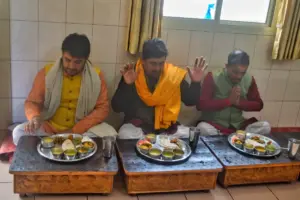
- Brahmin Bhoj: The feeding of Brahmins (usually 5, 11, or 21 in number) as an act of ancestral merit. The Brahmins represent the ancestors, and feeding them is considered equivalent to feeding the departed souls themselves.
- Donation (Daan): Giving donations of food, clothing, or money to the needy at the ghat is considered highly meritorious after Asthi Visarjan.
- Visiting the Kashi Vishwanath Temple: Many families conclude the day with a visit to the Kashi Vishwanath Temple — the supreme Shiva temple of Varanasi — to offer prayers for the departed soul’s liberation and to receive the blessings of Lord Vishwanath directly.
Step 8: Online Asthi Visarjan — When You Cannot Travel to Varanasi

For families who cannot travel to Varanasi — whether due to geographic distance, health limitations, work constraints, financial considerations, or bereavement circumstances — Prayag Pandits offers a complete Online Asthi Visarjan in Varanasi service at ₹7,100. The service operates as follows:
- You ship or courier the Asthi Kalash to our Varanasi address (we advise on packaging and any legal requirements).
- Our team confirms receipt and schedules the ceremony for your chosen date.
- On the ceremony day, you join via WhatsApp video call or Zoom at the specified time.
- You make the sankalpa (formal intention statement) directly with the pandit via video.
- You watch the entire ceremony live — the puja at the ghat, the mantras, and the actual immersion of the ashes in the Ganges.
- After the ceremony, you receive a photo gallery and the ceremony recording.
This service is particularly used by NRI families. For detailed guidance on Asthi Visarjan for non-resident Indians, see our dedicated Asthi Visarjan for NRI page.
Here is a video of how Asthi Visarjan in Varanasi is organised by Prayag Pandits:
Materials Required for Asthi Visarjan Puja
When you book through Prayag Pandits, all puja samagri is included and prepared by our team in advance. If you are organising independently, the following materials are required for the Asthi Visarjan puja:
- Asthi Kalash (the pot containing the ashes, sealed with cloth)
- Kusha grass (sacred ritual grass used to purify the ceremony space)
- Black sesame seeds (kala til) — essential for all Pitru karma
- White sesame seeds (safed til)
- Cooked rice (akshat)
- Barley (jau)
- Honey (madhu)
- Flowers — white or yellow preferred (marigold and white lotus are traditional)
- Kumkum (red vermilion) and chandana (sandalwood paste)
- Incense sticks (agarbatti)
- Clay diyas (lamps) with cotton wicks and ghee
- Gangajal (Ganges water) — available at the ghat itself
- A new or clean white dhoti for the chief mourner
- Tulsi leaves (sacred basil)
Timing: When is the Best Time for Asthi Visarjan in Varanasi?
Asthi Visarjan can be performed at any time of year at Varanasi. However, certain times are considered particularly auspicious:
- Morning hours (Brahma Muhurta and early morning): The period from 4:00 AM to 8:00 AM is considered the most spiritually potent time for all sacred rites. Early morning Asthi Visarjan at the Manikarnika or Assi ghats, when the Ganges is calm and the city is still in its pre-dawn quiet, is a profoundly moving experience.
- Pitru Paksha (September–October 2026): The 16-day period of Pitru Paksha, particularly Mahalaya Amavasya (the final day), is the single most auspicious period for all ancestral rites including Asthi Visarjan. Performing the immersion during Pitru Paksha amplifies the spiritual benefit significantly.
- Amavasya (New Moon) days: Every Amavasya is considered a propitious day for ancestral rites. Monthly Amavasya Asthi Visarjan is available through our service throughout the year.
- Within one year of death: While there is no hard scriptural deadline, it is considered most appropriate to perform Asthi Visarjan within the first year after a person’s death. Many families do it within 10–13 days (before Sapindikaran), though for practical reasons it is often done when the family can travel.
Legal Considerations for Carrying Ashes to Varanasi
Within India, there are no legal restrictions on transporting cremated remains (Asthi) by road, rail, or air. Airlines typically allow Asthi Kalash as carry-on luggage when it is properly sealed and declared. Inform the airline at check-in, present the death certificate and cremation certificate if requested, and carry the Kalash in a clean bag that can be visually inspected at security if needed. Avoid placing the Kalash in checked baggage if possible, as mishandling of checked bags could result in spillage.
For NRI families sending ashes from abroad to India, regulations vary by country. In most countries, cremated remains can be shipped internationally as cargo. A death certificate, cremation certificate, and a customs declaration of the contents are typically required. Some countries require additional clearances. Prayag Pandits can advise on the specific requirements from your country of residence and provide the necessary receiving address and documentation at the India end.
Asthi Visarjan Packages and Pricing in Varanasi (2026)
- Standard Asthi Visarjan in Varanasi: ₹5,100 (regular ₹11,000) — complete puja + immersion at ghat. Book here
- Asthi Visarjan Package at Varanasi: ₹10,599 (regular ₹15,000) — extended ceremony with additional rituals. Book here
- Varanasi Asthi Visarjan Package (2D/1N): ₹12,500 (regular ₹15,000) — includes hotel accommodation and cab transfer. Book here
- Online Asthi Visarjan in Varanasi: ₹7,100 (regular ₹11,000) — live video ceremony for families who cannot travel. Book here
🙏 Book Asthi Visarjan in Varanasi — In-Person or Online
Frequently Asked Questions About Asthi Visarjan in Varanasi
Completing the Sacred Duty: Your Next Steps
Asthi Visarjan in Varanasi is the culmination of the final rites for a departed soul — the moment when the physical remains are formally entrusted to the sacred Ganges, and the soul is released from its last earthly connection. It is an act of profound love and devotion, and it deserves to be performed with the same care, reverence, and scriptural integrity that all the previous rites were given.
Prayag Pandits has been guiding families through this sacred ceremony in Varanasi for years, with a team of qualified pandits who bring both deep scriptural knowledge and genuine human compassion to every ceremony they conduct. We understand that Asthi Visarjan is not a routine service call — it is among the most significant moments in a family’s spiritual life. Our coordinators are trained to support grieving families with patience, sensitivity, and unwavering professionalism.
If you have questions about the ceremony, need guidance on combining Asthi Visarjan with Pind Daan at Prayagraj or Pind Daan at Gaya, or wish to discuss the specific requirements of your family’s tradition and community, please reach out to our team. We are here to ensure that this final act of love for your departed family member is performed with the fullness it deserves — in the eternal city of Kashi, on the banks of the sacred Ganges, in the presence of the Divine.