Key Takeaways
- Why Prayagraj Is the Most Sacred Site for Asthi Visarjan
- Understanding Asthi Visarjan: The Ritual Explained
- Prayag Pandits Service Packages: What Is Available and at What Price
- Complete Cost Breakdown: Asthi Visarjan Package Cost from Malaysia to Prayagraj
In This Article
When a loved one leaves this world, Hindu tradition calls for one final sacred act — the immersion of their mortal remains in holy waters. For Malaysian Hindu families, this sacred duty, known as Asthi Visarjan, carries a question that weighs on every heart: where should we go, and what will it cost to do this with the honour and reverence our departed deserves?
Prayagraj — the ancient Tirtha Raja, King of all Pilgrimage Sites — stands above every other destination for Asthi Visarjan. The Triveni Sangam, where the sacred Ganga, Yamuna, and the invisible Saraswati converge, is described in the Padma Purana as the supreme gateway to liberation. When ashes are immersed here, tradition holds that the soul is released from the cycle of rebirth and attains moksha — the ultimate spiritual freedom.
This guide walks you through the complete Asthi Visarjan package cost from Malaysia to Prayagraj — every rupee and ringgit, from ritual fees to flights to accommodation — so you can plan this sacred pilgrimage with clarity, calm, and confidence.
Why Prayagraj Is the Most Sacred Site for Asthi Visarjan
Not all rivers grant the same spiritual merit. The Shastras — Hindu sacred texts — establish a clear hierarchy of tirthas (pilgrimage sites), and Prayagraj stands at the very apex. Three specific reasons make it unmatched for Asthi Visarjan:

- The Triple Confluence: The Ganga, Yamuna, and the subterranean Saraswati meet at the Sangam. Each river carries distinct divine qualities — the Ganga grants purification, the Yamuna bestows devotion, and the Saraswati confers wisdom. The union of all three amplifies their spiritual power manifold.
- Scriptural Supremacy: The Padma Purana states: “Tirthanam uttamam tirtham Prayagam tirthanayakam” — “Among all holy places, Prayagraj is the best, the leader of all pilgrimage sites.” This is not a regional claim; it is a pan-Hindu scriptural declaration.
- Moksha for the Departed Soul: When ashes are immersed at the Sangam, the Garuda Purana describes this as completing the soul’s final journey. The waters carry the remains to the cosmic ocean, and the accumulated merit of the Sangam itself assists in the soul’s liberation.
Learn more about why this sacred confluence holds such significance: Asthi Visarjan in Prayagraj: The Ultimate Guide.
The Prayagwal Tradition: Priests Who Serve the Entire Hindu World
Prayagraj’s hereditary priests, known as Prayagwals or Teerthapurohitas, have served pilgrims from every region of the Hindu world for centuries. They maintain specific liturgical knowledge for Tamil, Telugu, Malayali, Maharashtrian, and Bengali communities, ensuring that your family’s regional traditions and customs are honoured alongside the universal Vedic rites.
When you book through Prayag Pandits, you are assigned a qualified Tirth Purohit who understands the emotional weight of this occasion. He will guide your family through every step — from the sankalpa (declaration of intent) to the final immersion — with patience, reverence, and genuine care.
Understanding Asthi Visarjan: The Ritual Explained
Before planning costs, it helps to understand exactly what happens during Asthi Visarjan. This is not a hurried ceremony; it is a complete ritual sequence that may take two to three hours when performed properly. Read our full explanation of the Asthi Visarjan ceremony for a deeper understanding of each step.
- Arrival and Preparation: The family arrives at the appointed ghat. The chief mourner (generally the eldest son or a designated male family member) bathes in the sacred waters as a purification rite.
- Tonsuring (Mundan): In most traditions, the chief mourner undergoes a ritual head-shaving performed by a local barber at the ghat. This act symbolises the shedding of ego and worldly attachment, signalling sincere surrender to the ritual.
- Sankalpa: The priest performs the sankalpa — a formal declaration in Sanskrit naming the deceased, stating their gotra (lineage), and announcing the family’s intention to perform Asthi Visarjan for the soul’s liberation.
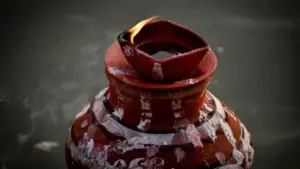
- Asthi Pooja: The ashes, carried in a clean earthen pot or cotton cloth, are worshipped with flowers, incense, and mantras. This step honours the mortal remains as a vessel that once housed the divine soul.
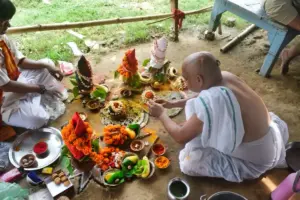
- Pind Pooja and Tarpan: Rice-ball offerings (pindas) are made to the departed, and water libations (tarpan) are offered to ancestors across three generations. These acts nourish the soul during its transition.
- 84 Daan and Gau Daan: Symbolic charitable offerings are made in the name of the deceased — these are understood in the tradition to transfer merit directly to the departed soul.
- The Immersion: The family boards a private boat to the midpoint of the Sangam, where the ashes are reverently immersed. Flowers are strewn on the water. The priest recites the final liberation mantras. This is the moment that fulfils the entire purpose of the pilgrimage.
Special Considerations for South Indian and Tamil Families from Malaysia
Malaysia’s Hindu community is predominantly Tamil and South Indian in heritage. The Asthi Visarjan ceremony accommodates regional traditions that may differ from North Indian practice. Prayag Pandits is experienced in these nuances, and our pandits adapt the ceremony to honour your family’s specific customs.
- Vedic Rigour: South Indian Brahmins — particularly Iyers and Iyengars — are known for strict adherence to Vedic injunctions. Our pandits employ Sanskrit mantras in their original form and follow the full procedural sequence without abbreviation, ensuring the highest level of ritual purity and authenticity.
- Ritual Circumambulation: During the Shradh ceremony that often accompanies Asthi Visarjan, South Indian families traditionally circumambulate the offerings in the anti-clockwise direction (apsavya), the direction prescribed for ancestral rites. Our priests are familiar with this practice and follow it when the family’s tradition calls for it.
- Distribution of Offerings (Dan): The allocation of gifts and fees to the traditional attendants follows specific protocols for South Indian families — our pandits understand these community-specific arrangements and handle them with discretion.
- Pilgrimage Timing: Tamil devotees commonly perform ancestral rites during the great festival of Shivaratri and around specific harvest months. If your family follows these traditions, our team can align the ceremony date accordingly.
Prayag Pandits Service Packages: What Is Available and at What Price
Prayag Pandits offers a structured range of Asthi Visarjan packages designed for families with different needs — from those who simply need the core ritual performed at the ghat, to families who want a complete 2-day guided experience with accommodation and all logistics handled. Here is every option, with exact current prices:

Ritual-Only Packages (You Arrange Your Own Travel and Stay)
om Basic Asthi Visarjan — Ghat Ceremony
boat Premium Asthi Visarjan — With Private Boat at Triveni Sangam
Online Asthi Visarjan — For Families Who Cannot Travel to India
Sometimes travel is not possible — whether due to health, visa constraints, family obligations, or the sudden and unexpected nature of a bereavement. Prayag Pandits offers a fully authenticated online Asthi Visarjan service where our pandit performs the complete ceremony at the Triveni Sangam on your family’s behalf, with live video streaming via WhatsApp or Zoom.
video Online Asthi Visarjan — Live Streamed from Triveni Sangam
Complete Travel Packages — Ritual Plus Stay and Transfers
For Malaysian families travelling to Prayagraj for the first time, our 1-night/2-day packages take care of everything. You arrive, we handle all logistics — hotel pick-up, ghat transfer, ritual, meals, and drop-off — so your family can focus entirely on prayer and remembrance.
hotel Asthi Visarjan Package — 2 Days / 1 Night with Stay and Transfers
star Silver Seva Package — 1 Night / 2 Days
gold-star Gold Seva Package — 1 Night / 2 Days
platinum-star Platinum Seva Package — 1 Night / 2 Days
Complete Cost Breakdown: Asthi Visarjan Package Cost from Malaysia to Prayagraj
Beyond the ritual package, your total expenditure for this pilgrimage includes airfare, accommodation (if not already included in your package), local transport, and personal expenses. Here is a realistic, transparent breakdown for a family of 2–4 travelling from Kuala Lumpur.
1. Airfare: KUL to Prayagraj (IXD)
There are no direct flights from Kuala Lumpur (KUL) to Prayagraj (IXD). All routes involve one or two stopovers, most commonly through Bengaluru (BLR), Hyderabad (HYD), or Delhi (DEL). The total journey takes 12 to 22 hours depending on the layover city and connection times.
| Route | Stopover City | Approx. Duration | Estimated One-Way Fare (INR) | Estimated Return Fare (INR) |
|---|---|---|---|---|
| KUL → BLR → IXD (IndiGo / AirAsia) | Bengaluru | 12–15 hrs | ₹13,875 – ₹20,605 | ₹34,490 – ₹45,000 |
| KUL → HYD → IXD (IndiGo) | Hyderabad | 15–17 hrs | ₹11,000 – ₹25,000 | ₹35,000 – ₹50,000 |
| KUL → DEL → IXD (Air India / IndiGo) | Delhi | 14–18 hrs | ₹18,000 – ₹28,000 | ₹40,000 – ₹55,000 |
| KUL → BKK → BLR → IXD (Multi-stop) | Bangkok + Bengaluru | 18–22 hrs | ₹22,000 – ₹36,900 | Not recommended |
Key booking tips for Malaysian families:
- Book at least 40–60 days in advance for the best fares. Last-minute fares can be 40–60% higher.
- Avoid peak pilgrimage seasons (October–November for Pitrupaksha aftermath, January for Makar Sankranti) for lower prices; but if the ritual timing is religiously prescribed, prioritise the correct date over cost.
- Use Skyscanner or Google Flights set to “IXD” — Prayagraj’s airport code. Some portals still list it as Allahabad (ALD); both search terms give the same results.
- If you find cheap connections via Chennai (MAA) or Mumbai (BOM), these are also viable options with good onward connections to Prayagraj.
2. Visa Requirements for Malaysian Nationals
Malaysian citizens require a valid visa to enter India. The most convenient option for a short pilgrimage visit is the Indian e-Visa (e-Tourist Visa).
- Apply at: indianvisaonline.gov.in — the official Indian government portal.
- Processing time: 3–5 business days. Apply at least 10 days before travel to be safe.
- Validity: 1-year multiple entry (180 days per visit) or 5-year multiple entry options available.
- Fee: Approximately USD 25 for 1-year, USD 40 for 5-year (INR equivalent varies).
- Documents needed: Valid passport (6 months validity beyond travel date), passport photo, proof of travel, and hotel booking confirmation.
- Important: The e-Visa is valid for entry through designated airports only — Prayagraj’s Bamrauli Airport (IXD) is an approved e-Visa port of entry.
3. Accommodation Near Triveni Sangam
Prayagraj offers a wide range of accommodation suited to pilgrims and families. Most families performing Asthi Visarjan stay for one night, arriving the evening before the ceremony and departing the morning after. Here is a practical overview of options within easy reach of the Sangam:
- Budget guesthouses near Triveni Sangam: ₹800 – ₹1,500 per night. Basic but clean; suitable for small families who want to be close to the ghats. Areas: Daraganj, Sangam Ghat colony.
- Mid-range hotels (3-star): ₹2,500 – ₹5,000 per night. Comfortable rooms, reliable AC, proximity to the city centre. Hotel Allahabad Regency, Hotel Prayag Inn, and Kanha Shyam are popular choices.
- Premium hotels (4-star and above): ₹6,000 – ₹12,000 per night. Options include Prayagraj Marriott (Civil Lines area), Hotel Kanha Shyam Deluxe, and The Grand Hotel. AC shuttle services to the Sangam can be arranged.
- Dharamshalas (Pilgrimage Rest Houses): ₹300 – ₹800 per night. Several regional dharamshalas near the Sangam accept all communities. Functional and spiritually appropriate — but facilities are basic.
If you have booked a Prayag Pandits 1N/2D package, accommodation is already included. There is no need to arrange it separately.
4. Complete Budget Table: Total Asthi Visarjan Package Cost from Malaysia
This table covers a 1-night/2-day trip for a family of two adults from Kuala Lumpur. Figures are in Indian Rupees with approximate Malaysian Ringgit equivalents based on an exchange rate of approximately ₹18 per RM 1 (verify current rates before travel).
| Expense Category | Estimated Cost (INR) | Estimated Cost (MYR) | Notes |
|---|---|---|---|
| Return Airfare (per person) | ₹35,000 – ₹52,000 | RM 1,950 – RM 2,900 | Book 40–60 days in advance for best rates |
| Indian e-Visa (per person) | ₹2,100 – ₹3,400 | RM 120 – RM 190 | USD 25–40 per person |
| Ritual Package (Premium with boat) | ₹5,100 | RM 285 | Covers complete ceremony for one family |
| OR: 2D/1N Complete Package | ₹13,500 – ₹20,999 | RM 750 – RM 1,170 | Ritual + stay + transfers — per family, not per person |
| Accommodation (if not in package) | ₹2,500 – ₹6,000 | RM 140 – RM 335 | Per night for 2 people |
| Local Transport (if not in package) | ₹1,500 – ₹3,000 | RM 85 – RM 170 | Airport transfers + ghat transfers |
| Meals and Personal Expenses | ₹2,000 – ₹4,000 | RM 110 – RM 225 | Per person for 2 days |
| TOTAL (Ritual Only + Independent Travel) | ₹45,000 – ₹72,000 | RM 2,500 – RM 4,000 | For 1 person; add ~₹38,000 per additional traveller (airfare) |
| TOTAL (2D/1N Complete Package) | ₹50,000 – ₹80,000 | RM 2,800 – RM 4,450 | For 2 adults; includes everything except international airfare |
Best Time to Perform Asthi Visarjan
Hindu tradition specifies auspicious periods for Asthi Visarjan, but there is also a strong understanding that this rite should not be indefinitely delayed. Here is what the tradition says about timing:
Most Auspicious Periods
- Within 10 days of cremation: Ideally, Asthi Visarjan should be performed within the first 10 days of the shava samskar (cremation). If this is not possible for logistical or travel reasons, it may be performed at any auspicious date thereafter.
- Pitrupaksha (September–October): The 16-day period of Pitrupaksha, dedicated to ancestral rites, is considered highly auspicious for all forms of Asthi Visarjan and Shradh. Performing the immersion during Pitrupaksha carries amplified merit. Read our comprehensive Malaysia pilgrimage guide for details on combining Asthi Visarjan with Pind Daan during Pitrupaksha.
- Ekadashi and Purnima: The eleventh day (Ekadashi) and full moon (Purnima) of each lunar fortnight are auspicious for all sacred rites at the Sangam.
- Makar Sankranti (January): One of the holiest days at Prayagraj, particularly significant if this is the first auspicious opportunity after a bereavement.
- Any day is valid: The tradition is unambiguous — the power of the Triveni Sangam itself sanctifies any day for Asthi Visarjan. If your family cannot wait for a specific auspicious date, you may proceed at any time and still receive the full spiritual benefit of this sacred act.
Avoid These Periods
- Adhika Maas (Leap Month): Some families prefer not to perform Asthi Visarjan during the extra month added to the Hindu lunar calendar. However, scholars differ on this, and our pandits can advise based on your family’s tradition.
- Peak Kumbh periods: Practically speaking, the area near the Sangam is extremely crowded during major Kumbh Mela bathing dates. While spiritually powerful, the logistics can be challenging. We advise booking well in advance during these periods.
Step-by-Step Booking Process from Malaysia
Booking with Prayag Pandits from Malaysia is straightforward. Here is exactly what to do:
- Choose your package: Select the package that suits your family — ritual-only, online ceremony, or a complete 2D/1N package. Review the options and prices listed above.
- Book online or via WhatsApp: Visit the product page and book directly online, or WhatsApp our team at +91 7754097777. Our team includes staff who communicate in English and can assist Tamil-speaking families.
- Confirm the ceremony date: Share your preferred travel dates. We confirm pandit availability and will suggest the most auspicious date within your travel window if needed.
- Arrange your flights and visa: Book your KUL–IXD flights and apply for the Indian e-Visa using the guidelines above. Share your arrival details with our team so we can arrange airport pick-up (if included in your package or requested separately).
- Prepare the ashes for travel: Seal the ashes in an airtight container, gather your documentation (death certificate, cremation certificate), and keep them in your carry-on baggage.
- Arrive in Prayagraj: Our representative meets you at the airport or your hotel. If you are arranging your own accommodation, we recommend arriving the evening before the ceremony so you are rested and prepared.
- Day of ceremony: Our team picks you up and takes you to the ghat. The pandit meets you, explains each step, and conducts the complete ritual. The entire ceremony at the Sangam takes 2–3 hours.
- After the ceremony: You are returned to your hotel or the airport. We provide a written summary of the prayers performed and a small packet of sacred Ganga Jal to take home to family members who could not travel.
What Happens on the Day: A Family’s Experience at the Triveni Sangam
Many families from Malaysia arrive at Prayagraj with a mixture of grief, reverence, and practical anxiety — not knowing what to expect at the ghat. Here is an honest, practical account of what the day looks like.
You arrive at the ghat early in the morning — ritual timings are typically between 6:00 AM and 10:00 AM. The air carries the scent of marigolds, camphor, and river mist. The Sangam is vast and unhurried; even during busy periods, the atmosphere near the water is one of solemn peace.
Your pandit greets you, introduces himself, and takes a few minutes to understand your family’s gotra, the name of the deceased, and any specific regional traditions you follow. He is experienced with Tamil, Malayali, and South Indian customs, so you do not need to worry about cultural mismatch.
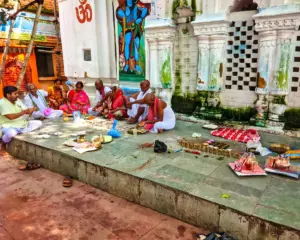
The ritual begins on the ghat steps. After the chief mourner’s bath, the pandit conducts the full sequence — you participate at each step by repeating Sanskrit declarations after the priest, making offerings with your own hands, and offering flowers to the sacred urn carrying the ashes.
When it is time for the immersion, you board a private boat with your family and the pandit. The boat moves to the Sangam point where the three rivers meet — you can see the distinct colours of the Ganga (clear blue-green) and Yamuna (darker green) flowing together. The pandit chants the moksha mantras as you — with your own hands — release the ashes into the sacred waters.
It is an act of profound spiritual completion. For most families, this is also a moment of deep emotional release. The pandit concludes with prayers for the departed soul’s liberation and peace.
You return to the ghat for the final rituals on land, and the ceremony concludes within 2–3 hours. Your pandit gives you Ganga Jal, some prasad, and the assurance — drawn from scripture — that this act has fulfilled your sacred duty completely.
Considering Varanasi for Asthi Visarjan? Here Is How It Compares
Some Malaysian families — particularly those of Tamil heritage — ask about performing Asthi Visarjan from Malaysia at Varanasi (Kashi) instead of Prayagraj. Both are supremely sacred. Here is a brief comparison to help you decide:
- Varanasi (Kashi): The city of Lord Shiva. The Ganga at Varanasi is believed to grant moksha to any soul whose remains are immersed there. The Manikarnika Ghat is the most famous cremation and immersion site in all of Hinduism. South Indian pilgrim communities have historically strong ties to Varanasi — the Kedar Ghat area was built specifically for South Indian devotees and follows South Indian temple architecture. If your family has a tradition of performing rites at Kashi, this connection is worth honouring.
- Prayagraj (Triveni Sangam): The confluence of three rivers carries the combined power of three sacred streams. The Padma Purana ranks Prayagraj above all other tirthas. The boat journey to the Sangam midpoint is a uniquely powerful experience — your ashes are immersed at the exact point where three rivers merge, which no other site in India can offer.
Prayag Pandits serves both locations. If you are unsure, WhatsApp us at +91 7754097777 and our team will help you choose based on your family’s specific traditions and circumstances.
Frequently Asked Questions
Performing Pind Daan After Asthi Visarjan: Completing the Ancestral Rites
Many families from Malaysia choose to combine their Asthi Visarjan pilgrimage with Pind Daan — the offering of rice-ball oblations to the departed soul and to ancestors across multiple generations. This combination is recommended by the shastras and ensures that your loved one receives both the liberation of ash immersion and the nourishment of ancestral offerings.
Prayagraj is one of the most powerful sites in all of Hinduism for Pind Daan. The Matsya Purana describes it as the place where offerings to ancestors cross the boundaries of birth, death, and cosmic time. Our complete 2026 guide to Pind Daan from Malaysia addresses the most practical concerns and options available today.
For many families, the journey of ancestral rites begins with Asthi Visarjan — the immersion of ashes that marks the soul’s departure from the physical world. This act is the foundation. It signals to the cosmos that the family has fulfilled their duty, that the mortal remains have been returned to the sacred elements, and that the soul is free to begin its journey.
From Malaysia, this pilgrimage is entirely manageable with proper planning. The logistics — flights, visa, accommodation, ritual booking — are all straightforward when taken step by step. What remains is simply your family’s intention: to honour your loved one with the dignity and sanctity that Hindu tradition has prescribed for thousands of years.
Prayag Pandits has served hundreds of NRI families from Malaysia, Singapore, the UK, the US, Canada, and Australia. We understand the particular challenges of planning a sacred pilgrimage from abroad — the time pressure, the documentation concerns, the unfamiliarity with Prayagraj’s geography, and the emotional weight of the occasion. We are here to make every step as simple and as sacred as it deserves to be.
To begin planning, browse our complete Asthi Visarjan guide, read about the ritual in detail, or explore our Asthi Visarjan packages for Malaysian families. When you are ready, WhatsApp us at +91 7754097777 — our team is available to answer every question and to walk alongside your family through this most sacred of duties.

Book Your Sacred Ritual
Authentic ceremonies performed by Veda-trained pandits at sacred sites across India.