

No rituals selected yet.
Browse Pooja Packages →Key Takeaways
In This Article
When a family in Delhi, Noida, Gurugram, Faridabad, Meerut, or anywhere across the National Capital Region faces the responsibility of immersing the ashes of a departed loved one, a journey to Haridwar or Prayagraj can feel overwhelming — particularly in the raw days following a death. Yet the Hindu scriptures are unambiguous: the ashes and bone remnants of the deceased must be immersed in the Ganga for the soul to complete its liberation journey. This is where Garhmukteshwar — the sacred town known as Garh Ganga on the banks of the holy Ganga in Hapur District, Uttar Pradesh — offers an answer that is both geographically accessible and spiritually profound.
At just 90 kilometres from Delhi, Garhmukteshwar is the nearest point on the Ganga from the capital — the first place where the divine river touches the earth after her descent from the Himalayas and her passage through Haridwar and Rishikesh. For millions of families in Delhi NCR, Haryana, Rajasthan, and western Uttar Pradesh, Garh Ganga is the natural and scripturally valid destination for Asthi Visarjan (immersion of ashes), Pind Daan, and Tarpan. Families wishing to perform this ritual can book our Asthi Visarjan package at Garh Mukteshwar with experienced local pandits.
The History and Mythology of Garhmukteshwar
The name Garhmukteshwar reveals its spiritual character: Garh means fort or stronghold, Mukti means liberation, and Ishwar means Lord Shiva. The town is named for the temple of Mukteshwar Mahadev — Lord Shiva as the bestower of liberation — that stands at its heart. This etymology itself proclaims the town’s sacred purpose: it is a place where souls come to be freed from the cycle of birth and death.
The ancient name of this town was Shivaballavpura, meaning “the city beloved of Shiva.” The transformation of this name to Garhmukteshwar is connected to a legend of profound spiritual significance recorded in the Puranic tradition. In this story, the Ganas — the divine attendants of Lord Shiva — were cursed by the sage Durvasha to take the form of vampires (pretas) after they mistook the meditating sage for a bear and ridiculed him. Durvasha told them that their curse would end when they reached the holy teerth of Shivballabh in the northern province of India.
The Ganas eventually found their way to this very spot on the Ganga’s banks, where they bathed in the sacred river and worshipped Mukteshwar Bhagwan (Lord Shiva). During the month of Magha, they performed the most rigorous penance — standing in the cold river water while chanting mantras. Goddess Chintamurti (a form of Shakti) was pleased and restored them, granting them the divine form of Shiva himself. Through this liberation of Shiva’s own Ganas, the town received its name Garhmukteshwar — and its permanent identity as a place where liberation is bestowed.
This legend is not merely mythological decoration — it is the spiritual foundation that explains why Garhmukteshwar is considered a valid and powerful teerth for liberation rites. A place where the Ganas of Shiva themselves were freed from the preta state through sacred ritual and immersion in the Ganga is naturally the right place for humans seeking liberation of their own departed loved ones’ souls.
Why Garh Ganga Is the Natural Choice for Delhi NCR Families
The practical realities of post-death ritual logistics are significant. In the immediate days following a death, when families are in mourning, the idea of an eight-hour journey to Haridwar, an even longer journey to Prayagraj, or a nine-hour drive to Varanasi can feel genuinely prohibitive. The 13-day mourning period in Hindu tradition requires the family to remain in a state of ritual purity and domestic simplicity — undertaking a long pilgrimage journey while managing grief, domestic responsibilities, and travel logistics is deeply challenging.
Garhmukteshwar, at approximately 1.5–2 hours from central Delhi by road, changes this equation entirely. A family from Delhi, Noida, Ghaziabad, or Meerut can make the journey, perform the complete Asthi Visarjan ritual at Brij Ghat, and return home the same day. This accessibility has made Garhmukteshwar the de facto first choice for Asthi Visarjan among families from these regions for generations.
Beyond sheer distance, Garhmukteshwar has a particular cultural resonance for families from Haryana, western Uttar Pradesh, Rajasthan, and Punjab. The town has historically been the teerth destination for these communities for ancestral rites — it is where families’ Panda records (ancestral pilgrimage registers) have been maintained for generations. Many families find that visiting Garh Ganga connects them not just to the departed soul but to generations of ancestors who visited this same ghat for the same sacred purpose.
Asthi Visarjan at Garh Ganga: The Complete Procedure
Asthi Visarjan — the immersion of the deceased’s bones and ashes in a sacred river — is the final physical act of the Hindu death rites. Here is how it is performed at Garh Ganga (Brij Ghat), Garhmukteshwar:
Step 1: Arrival and Preparation
Upon arriving at Brij Ghat, the family is received by the officiating purohit (priest). The family should carry the asthi kalash (the urn containing the ashes and bone fragments collected after cremation) wrapped in clean white cloth. The family members performing the ritual should be in clean, preferably white, clothing and should have abstained from meat, alcohol, onion, and garlic since the day of the death. The priest will ask for the name, gotra, and family details needed for the Sankalp.
Step 2: The Sankalp
The ceremony begins with the Sankalp — a formal declaration of purpose and identity. The priest leads the performing family member (traditionally the eldest son, though any family member may perform this) in stating their name, gotra, the name of the deceased, the deceased’s relationship to the performing family member, the date and manner of death, and the purpose of the ritual: to grant the departed soul liberation and peace.
The Sankalp is the most important part of any Hindu ritual — it is the declaration of intent that directs the spiritual energy of the ceremony to its intended recipient. Even if other aspects of the ceremony are abbreviated due to circumstances, the Sankalp must be complete and accurate.
Step 3: Puja and Offerings
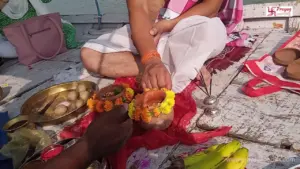
The priest leads the family in a puja that includes offerings of flowers, incense, sesame seeds (til), kusha grass, rice, and water (tarpan) to the departed soul and to the deities of the sacred river. Vedic mantras are chanted invoking Lord Vishnu (in his aspect as the sustainer and liberator), Lord Shiva (as Mukteshwar, the bestower of liberation), and the Ganga Mata herself. The Ganga is regarded in this context not merely as a river but as a divine mother who receives the physical remnants of the deceased and transforms them into a pathway to liberation.
Step 4: The Immersion
The family descends the ghat steps to the river’s edge. The performing family member (or designated individual) wades into the Ganga to a point where the water is at least waist-deep. The asthi kalash is then opened and the ashes and bone fragments are gently released into the flowing river water, accompanied by the recitation of final mantras and the offering of flower petals. This moment — the actual immersion — is considered the most sacred and emotionally significant of the entire ceremony. The soul, represented by its physical remnants, is surrendered to the Ganga and through her to the cosmic cycle of liberation.
Step 5: Final Prayers and Tarpan
After the immersion, the family performs Tarpan — the offering of water cupped in the hands and poured back into the river — for the departed soul and for all ancestors. This is accompanied by the recitation of the departed’s name and gotra, and the request that the Ganga carry the soul’s merits and the family’s prayers to the divine realm. Flower petals are scattered on the water. The ceremony concludes with a final prayer for the soul’s peace, liberation, and onward journey.
What to Bring for Asthi Visarjan at Garh Ganga
Asthi kalash (urn with ashes) — wrapped in clean white cloth. A list of the deceased’s details: name, gotra, date of death, manner of death. White clothes for the performing family members. Cash for the priest’s dakshina and any ghat fees. Optional: flowers, sesame seeds (til), and kusha grass (available at the ghat too). All other puja materials are typically arranged by the priest at the ghat.
Pind Daan at Garhmukteshwar: Combining Rites in One Visit
Many families choose to perform both Asthi Visarjan and Pind Daan at Garh Mukteshwar in a single visit. This is not only practical but spiritually comprehensive — it completes the two key post-death obligations simultaneously. Pind Daan involves the offering of rice balls (pinda) to the departed soul and ancestors, providing them with nourishment and merit for their onward journey. When performed on the banks of the Ganga immediately after Asthi Visarjan, the merit of both acts combines powerfully.
Prayag Pandits offers a dedicated Pind Daan at Garh Mukteshwar (Garh Ganga) package at ₹7,100 (sale price from ₹11,000), which includes a learned priest for the complete ceremony, all puja materials, and the formal Sankalp. This package can be combined with Asthi Visarjan in the same visit. Families who cannot be present in person can also arrange this online — our pandits perform the ceremony on their behalf with video documentation and Sankalp in the family’s name.
The Sacred Brij Ghat: Where the Ceremony Is Performed
Brij Ghat is the principal ghat at Garhmukteshwar where Asthi Visarjan and other ancestral rites are performed. Located at the confluence point most closely associated with the Mukteshwar Mahadev temple, Brij Ghat has been in continuous use for ancestral rituals for centuries. The ghat has stone steps descending to the river, a canopied area for the puja preparation, and several experienced local priests who specialise specifically in Asthi Visarjan and Pind Daan ceremonies.
The Ganga at Brij Ghat flows with particular clarity and force — this stretch of the river is wide, the current is steady, and the water has not yet been as extensively impacted by the urban pollution further downstream. Many devotees and pandits consider the Ganga here to retain a particular nirmalta (purity) and pavitrata (sanctity) that makes it especially receptive for liberation rites.
There is also a famous Deepotsav (festival of lamps) held at Brij Ghat every year on Kartik Purnima (the full moon of the month of Kartik), when thousands of oil lamps are floated on the river — a reminder of the deep living tradition of this sacred site and its continuing spiritual vitality.
Asthi Visarjan Timing and Auspicious Dates
Asthi Visarjan should ideally be performed within three days of cremation, though most families take between three and thirteen days. The scriptures are clear that the ashes should not be kept beyond the 13-day mourning period. If circumstances delay the performance, the ritual can still be performed up to one year after the death — and in some circumstances even after several years if the family was genuinely unable to perform it earlier.
The most auspicious times for Asthi Visarjan at Garh Ganga are:
- Within the 13-day mourning period — the traditional and most recommended time
- Amavasya (new moon day) each month — particularly auspicious for all Pitru rites
- Pitrupaksha (September-October) — the most powerful 16-day window for ancestral rites of all kinds
- Magha month — the month of Magha (January-February) is particularly associated with Garh Ganga’s own tradition, as per the Puranic story of the Ganas’ liberation
- Ekadashi (the 11th lunar day of each fortnight) — auspicious for rites connected to Lord Vishnu and liberation
However, if the death has occurred and the family is ready, Asthi Visarjan should not be unnecessarily delayed in pursuit of a “more auspicious” date. The first priority is to perform the ritual as soon as the family can practically do so. Our priests at Garh Ganga are available throughout the year, and Prayag Pandits can coordinate your visit on any date you choose.
How to Reach Garhmukteshwar from Delhi and NCR
Reaching Garhmukteshwar is straightforward and takes approximately 1.5–2 hours from central Delhi under normal traffic conditions:
By Road (Recommended)
From Delhi, take the NH58 (Delhi-Haridwar highway) toward Ghaziabad and Meerut. After Ghaziabad, continue toward Hapur. At Hapur, take the turnoff toward Garhmukteshwar. The road is well-marked and the town is clearly signposted. The total distance from Connaught Place (central Delhi) is approximately 90 km. From Noida or Ghaziabad, the journey is closer to 60–70 km. From Meerut, Garhmukteshwar is only about 40 km.
Private cars, taxis, and hired tempo travellers (for larger family groups) are the most comfortable options. Auto-rickshaws from Hapur bus stand to Garhmukteshwar are available for smaller groups.
By Bus
Direct buses run between Delhi (Anand Vihar ISBT and Kaushambi bus stand) and Garhmukteshwar throughout the day. The journey takes approximately 2–2.5 hours by bus due to more frequent stops. UP Roadways and private operators both serve this route.
By Train
The nearest railway station to Garhmukteshwar is Hapur Junction, which is well-connected to Delhi (Anand Vihar and New Delhi stations) with multiple daily trains. From Hapur, auto-rickshaws and taxis take about 20–25 minutes to reach Brij Ghat.
Garh Ganga vs. Haridwar for Delhi Families: Which to Choose?
Both are valid and powerful Ganga teerths. Garh Ganga (Garhmukteshwar) is closer (90 km from Delhi vs 210 km to Haridwar) and can be completed as a same-day visit. Haridwar has greater Pitru Teerth status and is preferred for families who can spare an overnight trip or who wish to combine Asthi Visarjan with a longer pilgrimage. For families in acute mourning who simply need to complete the rites as soon as possible, Garh Ganga is the ideal choice. Prayag Pandits can facilitate the ceremony at either location — contact us to discuss which best fits your family’s situation.
Online and Remote Asthi Visarjan at Garh Ganga for NRI Families
For Non-Resident Indian families whose loved one has passed away in India but who themselves are abroad — or whose ashes have been kept pending a visit that keeps getting delayed — Prayag Pandits offers a fully supported remote arrangement for Asthi Visarjan at Garh Ganga.
The ashes can be sent to our office in Prayagraj via registered post or courier, accompanied by details of the deceased and the performing family member’s information for the Sankalp. Our priests then travel to Garh Ganga or the designated teerth and perform the complete ceremony with the proper Sankalp in the family’s name. A video recording is provided, along with a certificate of completion and the prasad dispatched to your international address.
This service is also available for families in India who are unable to travel — due to health, distance, or other circumstances. The Garuda Purana’s provision for proxy performance of rites ensures that such arrangements are fully scripturally valid, as long as the Sankalp is properly taken in the family’s name. See our complete guide to understanding Asthi Visarjan for more on this option.
Asthi Visarjan at Multiple Teerths: Is It Necessary?
Some families ask whether Asthi Visarjan should be performed at multiple teerths — for example, at Garh Ganga, Haridwar, and Prayagraj — to maximise the spiritual benefit for the departed soul. The short answer is: performing the ritual at any one sacred Ganga teerth is scripturally complete and sufficient. There is no requirement to visit multiple locations.
However, if the family’s circumstances allow, and if they wish to honour the departed soul with additional acts of merit, performing Asthi Visarjan at Prayagraj (Triveni Sangam) is considered the most spiritually powerful option due to the unique sanctity of the three-river confluence. Similarly, Asthi Visarjan at Varanasi is considered especially powerful due to the city’s identity as the realm of Lord Shiva and as a place where liberation itself dwells.
For families who have already performed Asthi Visarjan at Garh Ganga and wish to do additional rites for added merit, combining Pind Daan at Prayagraj during the next Pitrupaksha or Amavasya is an excellent and complete approach.
Delhi NCR Families
🙏 Book Asthi Visarjan at Garh Ganga / Pind Daan at Garh Mukteshwar
Asthi Visarjan starting from | Pind Daan at ₹7,100
₹5,100
per person
Book Asthi Visarjan at Garh Ganga with Prayag Pandits
At Prayag Pandits, we understand that Asthi Visarjan is not merely a ritual — it is a family’s final act of love and duty toward someone they have lost. We approach every ceremony with deep sensitivity to the grief that families carry, combined with the precision and knowledge that these sacred rites demand.
Our experienced priests at Brij Ghat, Garhmukteshwar are available throughout the year. We can arrange the ceremony on short notice — we understand that death does not follow a convenient schedule — and we provide complete logistical guidance so families arriving from Delhi NCR know exactly where to go, what to bring, and what to expect. For NRI families, our remote arrangement service ensures that no soul remains without this final act of care because of geographical distance.
For related ancestral rites, explore our guides on Pind Daan at Garh Mukteshwar, what is Asthi Visarjan, Asthi Visarjan at Prayagraj, Asthi Visarjan at Varanasi, and Tarpan Poojan. Contact us today through our enquiry form or by phone — we are here to guide your family through every step of this sacred process.
Frequently Asked Questions
Where is Garhmukteshwar (Garh Ganga) located and how to reach it?
Garhmukteshwar is located in Hapur district, Uttar Pradesh, approximately 100 km east of Delhi and 50 km from Meerut. It sits on the western bank of the Ganga river where the Ganga emerges into the plains from the lower Himalayan foothills. How to reach: (1) By train — nearest station is Garhmukteshwar (GMS), well-connected from Delhi, Moradabad, and Lucknow, (2) By road — 2-3 hour drive from Delhi via NH-9 (the Delhi-Meerut Expressway then NH-9), (3) By car/taxi — Delhi to Garhmukteshwar costs ₹2,500-₹4,000 one-way. The town is small but well-signposted. From the railway station or bus stand, it is 2-3 km to the main ghats. Our Garh Ganga Asthi Visarjan packages include pickup arrangements from Delhi or Meerut.
Why is Garhmukteshwar (Garh Ganga) famous for Asthi Visarjan?
Garhmukteshwar is one of the 14 most sacred Asthi Visarjan sites in India, specifically praised in the Skanda Purana and Brahma Purana. The name "Garh Ganga" refers to the ancient fort (garh) where the Ganga first enters the plains — making it the westernmost point where Ganga water retains its Himalayan purity. The site is believed to be where King Bhagirath first performed ancestral rites for his 60,000 cursed ancestors (the story of Ganga's descent). The adjacent Mukteshwar Mahadev Temple is said to be the spot where Shiva himself accepted the Ganga on his head. Asthi Visarjan at Garh Ganga is considered especially powerful for families in North India who cannot travel to Varanasi or Prayagraj — the spiritual merit is considered equivalent.
What is the cost of Asthi Visarjan at Garh Ganga (Garhmukteshwar)?
Garh Ganga is one of the most economical options for Asthi Visarjan. Our basic Asthi Visarjan packages start from ₹5,100 per day, including: pandit dakshina, all puja samagri (rice, sesame, kusha grass, cow milk), the complete scriptural vidhi at Brijghat or the Mukteshwar Ghat, Ganga Aarti participation, and a basic completion certificate. Standard packages with Brahmin Bhoj for 5 Brahmins, extended Tarpan, and video documentation range from ₹8,100 to ₹11,000. If combined with Pind Daan, the combined ceremony ranges from ₹7,100 to ₹15,000. For Delhi-based families, Garh Ganga offers significant savings compared to Haridwar or Varanasi while providing full scriptural legitimacy.
Which ghat at Garh Ganga is best for Asthi Visarjan?
Brijghat is the primary and most famous ghat at Garh Ganga (Garhmukteshwar), named after Lord Krishna (Brij = Vrindavan region) who is believed to have visited the spot. It is the widest and most accessible ghat, with a large bathing area and dedicated Asthi Visarjan platform. Mukteshwar Ghat, adjacent to the Mukteshwar Mahadev Temple, is also highly sacred — it is believed to be the exact spot where King Bhagirath's ancestors were liberated. Shiv Ghat and Hanuman Ghat are smaller but quieter alternatives for families seeking a less-crowded ceremony. Our pandits can guide you to the ghat that best suits your preference and the specific time of day. All four ghats are equally valid scripturally for Asthi Visarjan.
Can I visit Garh Ganga for a day-trip Asthi Visarjan from Delhi?
Yes. Garh Ganga is one of the most convenient day-trip Asthi Visarjan destinations from Delhi. The typical day-trip timeline: Depart Delhi 6:00 AM (avoid peak traffic), Arrive Garh Ganga 9:00-9:30 AM, Ghat arrival and preparation 30 minutes, Complete Asthi Visarjan ceremony 1-2 hours, Brahmin Bhoj (if included) 30-45 minutes, Depart Garh Ganga 1:00 PM, Arrive back in Delhi 3:00-4:00 PM. Total day duration: ~9-10 hours. Many Delhi-based families specifically choose Garh Ganga for this reason — they can complete the entire sacred observance in a single day without overnight travel. Our day-trip package includes pandit coordination, samagri, and ritual documentation.
Can Pind Daan be performed at Garh Ganga along with Asthi Visarjan?
Yes, Pind Daan can be performed at Garh Ganga either alongside Asthi Visarjan or as a standalone ceremony. The Mukteshwar Mahadev Temple area and the Shiv Ghat are scripturally acceptable sites for Pind Daan. Combined Asthi Visarjan + Pind Daan packages at Garh Ganga typically range from ₹7,100 to ₹15,000 depending on Brahmin Bhoj and package depth. However, for major Pind Daan ceremonies aimed at liberating seven generations (Sapta Pitri), Gaya remains the scripturally-preferred site. Garh Ganga is best suited for: Asthi Visarjan (primary), annual Shraddha, Tarpan, and family ancestral offerings. For comprehensive Pind Daan with bahi tracing, travel to Gaya is recommended.
What Samagri are generally required for Asthi Visarjan?
The basic requirements are usually simple:
- The urn (Kalash) containing the ashes, wrapped in a clean cloth (preferably white or red).
- Flowers (especially white flowers).
- Black sesame seeds (kala til).
- Raw milk.
- A small amount of ghee and honey (optional, as advised by Pandit).
- Incense sticks (agarbatti) and a lamp (diya).
- Kusha grass.
- Water pot (Lota).
Most of these items are readily available near the Ghats. The Pandit you engage often helps arrange the necessary Samagri.
Who is eligible to perform the Asthi Visarjan ritual or can women perform it?
- Traditionally, the eldest son is the primary Karta (performer) for Asthi Visarjan, just as for funeral rites. In his absence, a younger son, grandson (son's son), or even a daughter's son can perform the ritual.
- Yes, women can definitely perform Asthi Visarjan. If there are no male descendants, or if they are unable to travel or perform the rites, a daughter, wife, daughter-in-law, or other close female relative can perform the immersion with full rights and reverence. The key is the bond of love and the faithful completion of the duty. We see many daughters and wives performing this sacred act here at Prayagraj
Book Your Sacred Ritual
Authentic ceremonies performed by Veda-trained pandits with video proof at sacred sites across India.
2,263+ families served
Video proof included
Since 2019
