
No rituals selected yet.
Browse Pooja Packages →Key Takeaways
In This Article
Magha Shradh is a uniquely special observance within Pitru Paksha — unlike other Shradh tithis that are based on the lunar day (tithi) of an ancestor’s death, Magha Shradh is determined by the nakshatra (lunar mansion) prevailing at the time of death. It is performed on the day when Magha Nakshatra prevails during Aparahna Kala (the afternoon period) within Pitru Paksha. In 2026, Magha Shradh falls on Wednesday, 7 October 2026 — the same day as Dwadashi Shradh — making it a particularly significant day of the Pitru Paksha fortnight. If your ancestor passed away when Magha Nakshatra was the prevailing lunar star, this is the designated day for their Shradh.
What is Magha Shradh? Understanding the Nakshatra Connection
The Hindu system of time reckoning is built on two parallel frameworks: the tithi (lunar day) and the nakshatra (lunar mansion). While most Shradh tithis within Pitru Paksha are calendar-based — Pratipada Shradh, Dwitiya Shradh, and so on — Magha Shradh is one of the few Shradh observances that is nakshatra-based rather than tithi-based.
The 27 nakshatras are the 27 segments of the sky through which the Moon passes during its monthly orbit. The Moon spends approximately one day in each nakshatra. Magha Nakshatra is the 10th of the 27 nakshatras, spanning from 0° to 13°20′ of Leo (Simha Rashi). Magha means “the great one” or “the mighty” in Sanskrit — it is one of the most powerful and auspicious nakshatras, presided over by the Pitrs (ancestral spirits) themselves.
The Grihya Sutras and the Dharmashastra literature identify Magha Nakshatra as the nakshatra of the ancestors — literally ruled by the Pitru Devas. This is precisely why Shradh performed when Magha Nakshatra is active carries extraordinary merit. When an ancestor departed from this world on a day when Magha Nakshatra was present, the bond between their departing soul and the ancestral realm was forged under Magha’s influence. Performing their Shradh under the same nakshatra completes a cosmological circle.
There is a rare and especially auspicious combination called Magha Trayodashi Shradh — when both Magha Nakshatra and Trayodashi Tithi prevail during Aparahna Kala on the same day. In 2026, this conjunction does not occur (Magha falls on Dwadashi), but in years when it does, it creates a powerfully sacred window for ancestral rites.
Magha Shradh 2026 Date and Muhurat
In 2026, Pitru Paksha spans from Saturday, 26 September to Saturday, 10 October. Within this fortnight, Magha Nakshatra prevails on Wednesday, 7 October 2026, coinciding with Dwadashi Tithi. Since both Magha Shradh and Dwadashi Shradh fall on the same day, this Wednesday is a doubly significant day in Pitru Paksha 2026.
The critical condition for Magha Shradh is that Magha Nakshatra must prevail during Aparahna Kala — the afternoon period that begins approximately 3/5ths of the way through the daylight hours (roughly 12 noon to 3 pm by solar calculation, though the precise time depends on the day length at your location). If Magha Nakshatra is present during this window, even if it transitions out before or after, the Shradh can be performed during that Aparahna period.
The two most auspicious Muhurats for Shradh rituals are:
- Kutup Muhurat — falls in the late morning, approximately 11:36 AM to 12:24 PM (local solar time)
- Rohina Muhurat — immediately follows Kutup, approximately 12:24 PM to 1:12 PM
After these Muhurats, the Tarpan ritual concludes the observance. For precise timings at your location or at Prayagraj, consult a local pandit or the DrikPanchang Pitrupaksha calendar for October 7, 2026.
Who Should Perform Magha Shradh?
Magha Shradh is performed for ancestors whose time of death coincided with the Magha Nakshatra being active — that is, the Moon was in the Magha segment of the sky when the person breathed their last. Determining this requires checking the birth and death records against a Panchang (Hindu almanac), specifically the nakshatra column for the date and time of death.
Given that the Magha Nakshatra spans approximately 24 hours every lunar month, and given that it coincides with Pitru Paksha once each year, a relatively large number of individuals may have died under Magha Nakshatra. However, because many families may not track nakshatra data for death dates, Magha Shradh is sometimes overlooked. A knowledgeable pandit can help you verify whether your ancestor’s death nakshatra was Magha by checking the death date against historical Panchang records.
If you know your ancestor died under Magha Nakshatra but you are unable to perform Magha Shradh specifically, their Shradh can be absorbed into the Sarva Pitru Amavasya on October 10, 2026. The Amavasya Shradh is the universal safety net — it covers all ancestors regardless of their death tithi or nakshatra.
Who traditionally performs the ritual? The Grihastha putra (householder son) bears the primary responsibility, but in his absence, the following persons are eligible: daughter, daughter’s son, brother, brother’s son, wife of the deceased, and in some Dharmashastra traditions, a close disciple. The intention and sincerity of the performer are considered as important as the ritual’s technical correctness.
Rituals and Procedures for Magha Shradh
The core rituals for Magha Shradh follow the standard Pitru Paksha Shradh protocol, with specific attention to nakshatra-based invocations:
Purification and Preparation: The performer bathes early in the morning, preferably in the Ganga or at a sacred river. White or light-colored clothing is worn. The home altar is cleaned, and a clean mat is placed for the ritual space. The performer observes physical and mental purity — no harsh speech, no worldly entertainment, no non-sattvic food consumption from the previous night.
Sankalp with Nakshatra Reference: Uniquely for Magha Shradh, the Sankalp (declaration of intent) specifically includes the statement that the Shradh is being performed under the auspices of Magha Nakshatra on behalf of the named ancestor who died under this nakshatra. The pandit leads this declaration, naming the ancestor, their lineage (gotra), and the nakshatra connection.
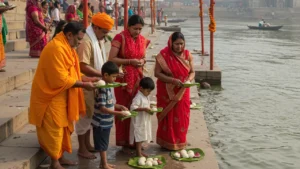
Pind Daan: Rice or barley pindas are prepared with sesame seeds, honey, and ghee. Three pindas are typically offered for each ancestor — one for the person being honored, one for their father, and one for their grandfather. At Triveni Sangam, pindas are offered at the water’s edge and then immersed in the sacred confluence.
Tarpan with Magha Invocation: Water mixed with black sesame seeds, kusha grass, and barley is offered in a continuous stream from the right hand. The ancestral name and gotra are recited with each offering. Since Magha Nakshatra is itself governed by the Pitr Devas, the Tarpan under Magha carries a heightened spiritual potency.
Panch Bali: Five shares of cooked food are set aside — for the cow (Go Bali), crow (Kak Bali), dog (Shwana Bali), the departed (Pitru Bali), and all living beings (Bhutagni Bali). Feeding a crow on Magha Shradh day is considered especially significant, as crows are considered messengers of the ancestral world.
Brahmin Bhojan: Qualified Brahmins are invited to partake in a sattvic meal. The Brahmins are seen as the visible representatives of the ancestral realm — feeding them is feeding the ancestors. Dakshina (offering) is given after the meal with gratitude.
Ritual Tip for Magha Shradh
For Magha Shradh, it is especially important that the Tarpan is performed while Magha Nakshatra is active during Aparahna Kala. Consult your pandit for the precise nakshatra timing at Prayagraj on October 7, 2026. The Sankalp should explicitly name the Magha Nakshatra connection to ensure the offerings reach the correct ancestral soul.
Significance of Magha Nakshatra in Hindu Tradition
Magha Nakshatra holds a unique and revered position in the Vedic nakshatra system. Its presiding deity is the Pitrs — the collective ancestral spirits — making it the only nakshatra directly governed by the ancestors themselves. The ruling planet of Magha is Ketu, associated with liberation, spirituality, and ancestral karma.
The Brihat Samhita of Varahamihira describes the Magha Nakshatra as the star of royal lineage, ancestral honor, and liberation from ancestral bondage. Individuals born under Magha Nakshatra are believed to carry strong ancestral energy, both as blessings and as unresolved karma from previous generations. This makes Magha-born individuals particularly called to perform Pitru Paksha rites with care and regularity.
The Atharva Veda contains hymns specifically addressed to the Pitrs under the Magha Nakshatra. The Vedic seers recognized that the window when the Moon passes through Magha — the ancestral asterism — is uniquely powerful for ancestral communication, ritual feeding, and the liberation of souls from lingering attachments. Performing Shradh during this window, especially when it falls within Pitru Paksha, creates what the tradition calls a Mahashradha Yoga — a great confluence of auspicious factors for ancestral rites.
Do’s and Don’ts for Magha Shradh
Do’s:
- Verify the Magha Nakshatra timing with a Panchang or your pandit for October 7, 2026
- Include the Magha Nakshatra reference explicitly in the Sankalp
- Use black sesame seeds, kusha grass, and barley in all Tarpan offerings
- Perform the ritual at a sacred river — Triveni Sangam at Prayagraj is ideal
- Feed crows, cows, and dogs before the family eats
- Invite at least one Brahmin for Bhojan and offer dakshina with sincerity
- Maintain mental calm and devotion throughout the day
Don’ts:
- Do not confuse the Magha Nakshatra timing with the Ekadashi or Dwadashi tithi timing — both fall on the same day but have different operational windows
- Do not use non-sattvic food: avoid onion, garlic, meat, fish, and intoxicants
- Do not perform Shradh after sunset
- Do not use iron utensils — use copper, bronze, or silver
- Do not engage in festive activities, entertainment, or worldly pleasures on this day
Perform Magha Shradh with Prayag Pandits at Triveni Sangam
The nakshatra-specific nature of Magha Shradh makes it one of the rituals that most benefits from the guidance of an experienced Vedic pandit. The Sankalp must be worded correctly, the nakshatra timing must be observed precisely, and the mantra recitations during Tarpan and Pind Daan must reference the Magha connection properly. An inexperienced performer risks either missing the auspicious window or conducting rituals that do not correctly identify the intended ancestor.
Prayag Pandits’ team of learned pandits has deep knowledge of both tithi-based and nakshatra-based Shradh traditions. We serve families at Triveni Sangam — the most sacred location for ancestral rites in the Hindu world — and can guide you through every aspect of Magha Shradh from the pre-ritual preparation to the final Tarpan.
Performing Magha Shradh at Prayagraj carries the double merit of the Magha Nakshatra and the sacred Sangam. The Matsya Purana and the Prayaga Mahatmya both declare that Pind Daan at the Triveni Sangam liberates 21 generations of ancestors. This is the gift you can give to your ancestor who departed under the auspices of Magha Nakshatra.
Pitrupaksha 2026
🙏 Book Magha Shradh at Prayagraj
Starting from
₹5,100
per person
Related Shradh Tithis in Pitru Paksha 2026
Magha Shradh on October 7 coincides with Dwadashi Shradh. The day before, October 6, is Ekadashi Shradh (Gyaras Shradh). Following October 7, the sequence continues with Trayodashi Shradh on October 8, Chaturdashi Shradh (Ghata Chaturdashi) on October 9, and the culminating Sarva Pitru Amavasya on October 10. For the full ritual cycle overview, read our Complete Pitrupaksha Ritual Guide and the detailed Pind Daan Procedure. Learn more about the deep spiritual significance of Prayagraj as a center for Pind Daan in our post on the significance of Pind Daan and why Triveni Sangam is the land of Moksha.
Frequently Asked Questions about Magha Shradh 2026
Related Services by Prayag Pandits
- 🙏 Pind Daan in Gaya (Pitrupaksha) — Starting from ₹7,100
- 🙏 Shradh at Prayagraj — Starting from ₹7,100
- 🙏 Tarpan in Prayagraj — Starting from ₹5,100
Frequently Asked Questions
What is the date of Magha Shradh in 2026?
Magha Shradh in 2026 falls on Wednesday, 7 October 2026. On this day, Magha Nakshatra prevails during Aparahna Kala, making it the auspicious window for this nakshatra-based ancestral rite.
How is Magha Shradh different from other Pitru Paksha Shradhs?
Most Pitru Paksha Shradhs are based on the lunar tithi (day) of the ancestor's death. Magha Shradh is unique because it is based on the Magha Nakshatra — the lunar mansion prevailing at the time of death. If your ancestor died when the Moon was in Magha Nakshatra, their dedicated Shradh is performed on Magha Shradh day, regardless of the tithi.
How do I know if my ancestor died under Magha Nakshatra?
You can verify this by checking the death date and time against a traditional Hindu Panchang (almanac). The Panchang lists the nakshatra for each day and time. A knowledgeable pandit can help you check historical Panchang records to determine if Magha Nakshatra was active when your ancestor passed. If you cannot verify, perform their Shradh on Sarva Pitru Amavasya (October 10, 2026).
What is Magha Trayodashi Shradh?
Magha Trayodashi Shradh is a rare and especially auspicious combination when both Magha Nakshatra and Trayodashi Tithi prevail during Aparahna Kala on the same day. In 2026, Magha Nakshatra falls on Dwadashi Tithi (October 7), not Trayodashi, so this particular conjunction does not occur this year.
Can I perform both Dwadashi Shradh and Magha Shradh on October 7, 2026?
Yes. Since both Dwadashi Shradh and Magha Shradh fall on October 7, 2026, a family may need to perform both if they have ancestors who died on Dwadashi Tithi and ancestors who died under Magha Nakshatra. A pandit will sequence the rituals appropriately within the Aparahna window.
Book Your Sacred Ritual
Authentic ceremonies performed by Veda-trained pandits with video proof at sacred sites across India.
2,263+ families served
Video proof included
Since 2019
