Key Takeaways
- What Is Akal Mrityu? The Hindu Scriptural Definition
- What Causes Akal Mrityu? Types Recognised in Hindu Dharma
- The Spiritual Consequences: What Happens to the Soul After Akal Mrityu?
- Effects on the Family: Why Akal Mrityu Affects the Living Too
In This Article
When a soul departs the physical world before its allotted time — through accident, violence, sudden illness, or other untimely causes — Hindu dharma recognises this as Akal Mrityu (अकाल मृत्यु), or premature death. Unlike a natural death where the soul completes its earthly journey and moves peacefully toward the next realm, a soul that suffers Akal Mrityu is believed to be unprepared for the transition. It departs without settling its karmic accounts, without the sacred rites that ease passage, and — according to the Garuda Purana — without the spiritual momentum needed to ascend to Pitra Loka. The grief this causes is felt on two levels: by the bereaved family left behind, and by the wandering soul itself.
Understanding Akal Mrityu is not about fear. It is about compassion — for the departed, and for the living who carry the burden of unresolved grief. Hindu tradition, in its extraordinary wisdom, has prescribed specific rituals to address exactly this situation. Before approaching these rituals, it helps to understand the broader framework of Hindu death rituals and what the scriptures prescribe at each stage of the soul’s journey. In this guide, we explore what the scriptures say about premature death, why these rituals matter, and how families can fulfil their sacred duty to release the departed soul from suffering.
What Is Akal Mrityu? The Hindu Scriptural Definition
Akal means “untimely” or “before its proper time.” Mrityu means death. Together, Akal Mrityu refers to any death that occurs before the natural conclusion of a person’s prescribed lifespan — what the Vedic texts call the ayu sanctioned by karma and the laws of the cosmos.
The Garuda Purana, one of the eighteen Mahapuranas and the primary Hindu scripture on the afterlife, dedicates extensive passages to the fate of souls who die prematurely. It describes two paths that await a departed soul: Pitra Loka (the realm of the ancestors), which is the gateway to eventual liberation, and Preta Yoni (the realm of wandering spirits), where souls are trapped in a state of unrest, unable to progress in the cosmic cycle.
A soul that dies naturally — supported by proper last rites, performed by family — typically enters Pitra Loka. A soul taken by Akal Mrityu, however, is believed to be at grave risk of entering Preta Yoni, where it remains until appropriate rituals are performed on its behalf by the living. This is not punitive — it is a reflection of the soul’s incomplete karmic state at the moment of unexpected departure.
What Causes Akal Mrityu? Types Recognised in Hindu Dharma
Hindu tradition recognises a range of circumstances that constitute Akal Mrityu. These are not merely physical causes of death — they indicate deaths that carry a heightened spiritual weight, deaths that break the natural cycle abruptly:
- Accidental death — Road accidents, falls, drowning, fire, electrocution, or any unforeseen fatal event
- Suicide (Atmahatya) — Considered among the most spiritually grave forms of Akal Mrityu; the Garuda Purana warns explicitly that the soul of one who takes their own life remains in extreme suffering
- Murder (Vadh) — Death by violence at the hands of another; leaves both victim and perpetrator with heavy karmic debts
- Death by poisoning — Whether from deliberate poison, contaminated food, or toxic substances
- Snake bite and venomous creatures — Specifically mentioned in the Garuda Purana as forms of Akal Mrityu
- Death in war — While dying in righteous battle (Dharma Yuddha) has its own sacred status, death in conflict outside dharmic context is treated differently
- Death due to epidemic or pandemic — Sudden mass deaths caused by disease (historically and in more recent times, including the Covid-19 pandemic) fall within this category
- Death during pregnancy or childbirth — A soul lost in these circumstances is afforded particular compassion in the scriptures
- Infant and child death — The death of a child before the age of religious maturity is a distinct form of Akal Mrityu with specific ritual prescriptions
It is important to note that recognising a death as Akal Mrityu is not about assigning blame. It is about identifying that the soul requires additional spiritual assistance to continue its journey.
The Spiritual Consequences: What Happens to the Soul After Akal Mrityu?
The Garuda Purana describes the condition of a Preta (wandering soul) in vivid terms. The soul that cannot progress becomes bound to the earthly plane — close to the places it inhabited in life, close to the family it loved, yet unable to communicate or move forward. This is not a peaceful state. The Preta is described as experiencing hunger, thirst, confusion, and longing — a shadow existence caught between worlds.
The Vishnu Smriti and the Atharva Veda also address premature death, noting that such souls require the active intervention of their descendants to find rest. The act of performing rituals for the departed is therefore not merely traditional sentiment — it is described in the scriptures as an urgent karmic obligation, a direct act of love that benefits both the performer and the departed.
Without these rituals, the Garuda Purana warns, the soul’s distress can manifest in the world of the living — through persistent misfortune, illness, blocked progress in life, and a pervasive sense of grief that does not lift. Families who have experienced unexplained difficulties following an untimely death may find this understanding offers both explanation and a clear path forward.
Effects on the Family: Why Akal Mrityu Affects the Living Too
The unresolved spiritual state of a soul lost to Akal Mrityu is believed to create ripple effects within the family lineage. This is not a matter of superstition but of cosmic interconnectedness — the Pitru Rin (debt to ancestors) is a fundamental concept in Vedic philosophy. When a family member’s soul is in distress, the family’s collective karmic field carries that disturbance.
Families who have not performed the prescribed rituals after an Akal Mrityu often report these recurring challenges:
- Persistent obstacles in marriages — Delays, complications, or discord in the marriages of family members
- Unexplained health problems — Chronic illness or repeated accidents affecting multiple family members
- Business and financial difficulties — Ventures that fail despite sound planning; money that does not stay
- Strained family relationships — Quarrels, estrangements, and breakdowns in family unity
- Haunting grief or depression — An inability to move on from the loss, often felt most strongly by the closest relatives
- Children born with difficulties — In some traditions, ancestral distress is seen as affecting subsequent generations until resolved
Performing the appropriate rituals does not guarantee that all difficulties will cease. But it fulfils the family’s dharmic duty, relieves the ancestral soul, and removes the spiritual obstruction that the unresolved death creates. Thousands of families who have performed these rites at Triveni Sangam, Gaya, and Kashi report a palpable sense of release — a lightness that follows the completion of the rituals.
The Prescribed Rituals for Akal Mrityu: What the Scriptures Recommend
Hindu dharma does not leave families without recourse. For every form of spiritual distress, the scriptures prescribe a remedy. In the case of Akal Mrityu, there are four primary rituals that work together to address the soul’s condition:
1. Narayan Bali Puja — The Foundational Rite for Premature Death
Narayan Bali Puja is the most important ritual specifically prescribed for Akal Mrityu. In this ceremony, Lord Vishnu (Narayan) is invoked as the supreme authority over all souls and their journeys. A symbolic effigy of the departed is created from Kusha grass, and the priest performs the full sequence of last rites — the rites that were either incomplete or impossible at the time of actual death — offering them symbolically to Lord Vishnu on behalf of the soul.
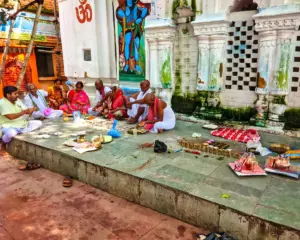
The Garuda Purana specifically states that Narayan Bali has the power to rescue a soul trapped in Preta Yoni and elevate it to Pitra Loka. The ritual takes approximately half a day to complete and must be performed at one of the designated Teertha Kshetras — Prayagraj (Triveni Sangam), Gaya, or Kashi are the most powerful. Prayag Pandits offers Narayan Bali Poojan at Prayagraj performed directly at the Triveni Sangam by experienced pandits. For families in western India or Maharashtra, Narayan Nagbali Puja at Trimbakeshwar is the traditionally prescribed location for this rite, where Brahmin priests trained in the complete Godavari-bank procedure conduct the ceremony at the Trimbakeshwar Jyotirlinga.
2. Tripindi Shradh — For Souls Neglected Across Three Generations
Tripindi Shradh is performed when the Shradh ceremonies (annual ancestral rites) have not been performed for three or more consecutive years — which often occurs in families affected by Akal Mrityu, particularly when the death occurred under traumatic circumstances that disrupted family rituals. The “Tri” (three) in Tripindi refers to the three divine forces — Lord Brahma, Lord Vishnu, and Lord Mahesh — who are propitiated together to grant relief to three generations of ancestors simultaneously.
This ritual is often performed in conjunction with Narayan Bali Puja. Together, they form a comprehensive spiritual intervention that addresses both the specific circumstances of the untimely death and the broader needs of the ancestral lineage.
3. Pind Daan — The Sacred Offering That Nourishes the Ancestral Soul
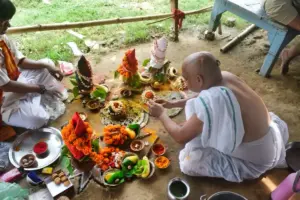
Pind Daan is the offering of rice balls (Pindas) mixed with sesame seeds, barley, honey, and other sacred ingredients to the ancestral souls. This ritual, when performed at Prayagraj, is considered particularly powerful because the Triveni Sangam — the confluence of the Ganga, Yamuna, and the invisible Saraswati — is described in the Matsya Purana as a point where the veil between the living world and the ancestral realm is at its thinnest.
For souls who died prematurely, Pind Daan addresses the Pitru Rin — the ancestral debt — and directly provides the soul with the spiritual sustenance it needs. The Vishnu Purana describes Pind Daan as “the most direct act of love a living person can perform for their departed ancestors.” When performed in the context of Akal Mrityu, it is combined with specific mantras and intentions that address the soul’s premature departure.
4. Asthi Visarjan — Immersion of Ashes at the Sacred Confluence
If the ashes (Asthi) of the departed have not been immersed at a sacred river following the cremation, this must be done as part of the complete ritual sequence. Asthi Visarjan at Triveni Sangam completes the physical element of the last rites and is an essential prerequisite to the other ceremonies. The Ganga is considered capable of purifying any karma accumulated through the circumstances of death.
Where to Perform These Rituals: The Most Sacred Teertha Kshetras
Not all places hold equal spiritual potency for these rites. The scriptures are specific about the locations where these rituals achieve their fullest effect:
- Prayagraj (Triveni Sangam) — The confluence of three sacred rivers is described as the most powerful Teertha in all of India. The Triveni Sangam is considered capable of granting liberation even to souls in the most difficult spiritual circumstances. The Prayaga Mahatmya in the Matsya Purana states that Pind Daan here is equivalent in merit to performing it at all other Teerthas combined.
- Gaya (Bihar) — Specifically renowned for ancestral rites. The Vishnupad Temple at Gaya is considered the most auspicious place for Pind Daan in all traditions. Lord Vishnu’s footprint here is said to have the power to grant moksha to 101 generations of ancestors.
- Kashi (Varanasi) — The city of Lord Shiva is the supreme Kshetra for liberation. Pind Daan at Varanasi is said to release the soul from the cycle of birth and death entirely. It is especially powerful for souls that died under particularly difficult circumstances.
For families who cannot travel to these locations in person, these rituals can be arranged through authorised pandits. We offer poojan services for NRIs and families abroad who wish to fulfil their ancestral obligations at the sacred Teerthas on behalf of their departed loved ones.
🙏 Narayan Bali u0026 Pind Daan for Akal Mrityu
How to Perform Pind Daan for a Soul Lost to Akal Mrityu
Performing Pind Daan for a premature death requires some modifications to the standard ritual procedure. A qualified pandit who specialises in these rites will guide the family through the following key aspects:
- Sankalp (Sacred intention) — The Sankalp recited at the beginning of the ritual specifically names the nature of the death and the intention to secure the soul’s liberation from Preta Yoni. The pandit must state this clearly in the Vedic invocation.
- Number of Pindas — For standard ancestral rites, a fixed number of Pindas are offered. For Akal Mrityu, additional Pindas are typically offered — the specific number varies by tradition and the pandit’s assessment.
- Mantras for premature death — Specific mantras from the Garuda Purana and the Rig Veda are recited during Pind Daan for Akal Mrityu, invoking Yama Dharmaraj’s compassion for the soul.
- Tarpan — The water offering (Tarpan) is performed in a specific manner for souls that died untimely, with sesame (tila) added in greater proportion as a purifying agent.
- Completion of the full sequence — For maximum efficacy, the full sequence of Narayan Bali, Tripindi Shradh, Pind Daan, and Tarpan should ideally be performed in one sacred pilgrimage rather than piecemeal.
For a complete step-by-step guide to the ritual process, see our detailed article on how to perform Pind Daan. Understanding the procedure helps families participate meaningfully rather than standing as passive observers.
Timing: When Should These Rituals Be Performed?
Unlike annual Shradh ceremonies, which are bound to the Pitrupaksha calendar, the rituals for Akal Mrityu can and should be performed as soon as possible. The Garuda Purana suggests that the first year following an untimely death is the most important period for intervention. However, the rituals remain spiritually effective regardless of how much time has passed since the death — there is no expiry on the family’s ability to help their departed ancestors.
Auspicious times that amplify the effect of these rituals include:
- Pitrupaksha (Shradh fortnight) — The fifteen days in the Hindu calendar specifically dedicated to ancestral rites. This is the most potent period for all ancestral rituals, including those for Akal Mrityu.
- Amavasya (New Moon day) — Every new moon day is considered auspicious for ancestral rites. Particularly powerful Amavasyas include Mahalaya Amavasya (Sarva Pitru Amavasya), Somvati Amavasya, and Mauni Amavasya.
- Solar eclipses (Surya Grahan) — Considered highly auspicious for Tarpan and Pind Daan, with the ritual merit multiplied many times over.
- Kumbh Mela and Magh Mela — Large-scale pilgrimage events at Prayagraj during which the spiritual power of the Triveni Sangam is said to be at its peak.
- Death anniversary (Mrityu Tithi) — The annual anniversary of the death is also a potent time to perform rites for the departed soul.
Can NRIs and Overseas Families Arrange These Rituals Remotely?
One of the most common questions we receive from diaspora families is whether these sacred rituals can be performed on their behalf by pandits at the Teertha, when they are unable to travel themselves. The answer — supported by both scriptural tradition and practical custom — is yes.
The tradition of Proxy Puja has been practised for centuries in Hinduism. The family member nominates the pandit as their representative, a Sankalp is recited naming the family and their intention, and the ritual is performed with full Vedic authenticity at the sacred location. photos are typically provided so that the family can witness the ceremonies.
Our NRI poojan services are specifically designed for this purpose. Many families in the United Kingdom, United States, Canada, Malaysia, and Singapore have arranged Narayan Bali and Pind Daan through us for their ancestors at Triveni Sangam — fulfilling a duty that would otherwise remain undone due to distance or circumstances.
The Deeper Meaning: Why These Rituals Are an Act of Love
It is easy to view these rituals purely through the lens of obligation or fear. But the deeper understanding offered by Hindu dharma is one of profound love and interconnectedness. The Bhagavata Purana teaches that the bonds between souls — particularly between family members — persist beyond physical death. When a family member performs Pind Daan for a departed ancestor, they are not performing an empty ceremony. They are actively extending love across the boundary that separates the living from the departed.
The Garuda Purana describes the moment a Preta receives the Pinda offerings: the soul experiences relief, nourishment, and the spiritual momentum to continue its journey. For a soul trapped in the confusion and suffering of Preta Yoni — particularly one that died without warning, without farewell, without the dignity of natural passing — this act of love from the living is described as transformative.
Families who have performed these rituals often describe a subjective shift in the household atmosphere — not just the satisfaction of having fulfilled a duty, but a genuine sense that something that was stuck has been released. This, the scriptures suggest, is the reality of the ancestral connection responding to compassionate action.
How Prayag Pandits Can Help Your Family
At Prayag Pandits, we have guided hundreds of families through the rituals for Akal Mrityu at Triveni Sangam, Prayagraj. Our pandits are trained in the specific procedures prescribed by the Garuda Purana and the Vishnu Purana, and approach each ceremony with the gravity and compassion it deserves. We understand that families coming to us are often grieving — sometimes for deaths that occurred years or even decades ago — and we take great care to ensure that the experience is both spiritually authentic and humanly sensitive.
We provide:
- Pre-ritual consultation to understand the nature of the death and determine the appropriate rituals
- Complete Narayan Bali Puja, Tripindi Shradh, and Pind Daan conducted at Triveni Sangam
- Coordination of Asthi Visarjan if required (including receiving ashes by post for NRIs)
- Full photo documentation for families who cannot attend in person
Book Narayan Bali and Pind Daan for Akal Mrityu
Prayag Pandits provides complete ritual packages for families seeking relief after an untimely death. Our pandits are trained in the full procedures prescribed by the Garuda Purana and perform these ceremonies at India’s most sacred Tirth Sthals:
- Narayan Bali Poojan at Prayagraj (Triveni Sangam) — ₹11,000 onwards. Performed at the Triveni Sangam — India’s most sacred Teertha for Akal Mrityu rites. The Prayag Mahatmya considers the Sangam the most potent site for liberating souls in spiritual distress. Includes full Sankalp, Vedic mantras, and ritual samagri.
- Online Narayan Bali Poojan, Haridwar — ₹35,000 onwards. Live-streamed Narayan Bali on the banks of the Ganga at Haridwar, performed by qualified Brahmin pandits. Suitable for families who cannot travel in person. Complete Vedic procedure, Sankalp in your family’s name.
- Narayan Bali Poojan in Haridwar (In-Person) — ₹31,000 onwards. Full in-person ceremony at Haridwar for families who wish to attend and participate. Includes ritual samagri, experienced pandit, and Brahmin bhojan.
- Pind Daan in Gaya — ₹7,100 onwards. For complete and permanent ancestral liberation, Pind Daan at Gaya’s Vishnupad Temple is the supreme remedy. Often combined with Narayan Bali for the most comprehensive relief to souls departed in difficult circumstances.
All packages include proper Vedic Sankalp, sacred ritual materials, and Brahmin bhojan. Remote participation with live video streaming is available for NRI families. Book Narayan Bali or speak with our pandit coordinator to determine the right combination of rituals for your family’s situation.
Ease the Soul’s Journey — Book Pind Daan for Akal Mrityu
When a loved one faces untimely death (Akal Mrityu), performing Pind Daan at a sacred tirtha is believed to bring peace to the departed soul. Prayagraj (Triveni Sangam) and Gaya (Vishnupad Temple) are the most powerful locations for this ritual.
Book Pind Daan in Prayagraj | Book Pind Daan in Gaya | Asthi Visarjan Services
Related guide: Narayan Bali Puja — Complete Guide, Cost, Vidhi & When to Perform
Book Your Sacred Ritual
Authentic ceremonies performed by Veda-trained pandits at sacred sites across India.