The ancient practice of Pind Daan — offering sacred rice-ball oblations for the liberation of departed ancestors — is not a medieval invention, a regional custom, or a sectarian addition to Hinduism. Its roots lie in the most ancient layer of Hindu sacred literature: the four Vedas themselves. For any seeker who wonders whether Pind Daan is scripturally grounded or merely traditional practice, a careful study of the Vedic corpus, the Brahmanas, the Aranyakas, and the earliest Smriti literature provides a definitive answer: the care of departed ancestors through food offerings and water libations is one of the central duties (dharma) of Hindu householder life, explicitly mandated across every major Vedic text.
This article presents a systematic survey of the mentions of Pind Daan and ancestral worship (Pitru Yajna) across the Vedic corpus — from the Rigveda’s hymns to the Fathers (Pitrus) to the Yajurveda’s precise ritual prescriptions, from the Atharvaveda’s protective mantras to the elaborate procedural detail of the Grihyasutras. For families seeking to understand the scriptural authority behind their ancestral obligations, this is the foundational reference.
Many Hindus today perform Pind Daan by family tradition without knowing that the ritual is directly commanded in the Vedas — texts that Hinduism regards as Shruti (divinely revealed, eternally valid). Understanding the Vedic mandate behind Pind Daan transforms it from a cultural obligation into a sacred duty whose spiritual potency is backed by the highest scriptural authority in Hinduism.
Introduction: Origin and Meaning of Pind Daan
Historical Context
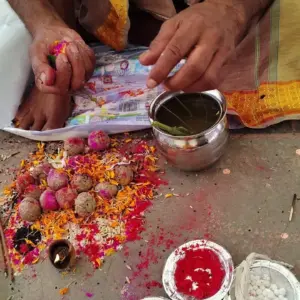
The custom of Pind Daan dates back to the earliest era of Vedic civilization. The term “Pinda” (Sanskrit: पिण्ड) denotes a rounded mass or ball — in this context, the rice-ball or barley-ball oblation offered to the soul of a deceased ancestor. “Daan” (दान) means an act of giving or charitable offering. Together, Pind Daan signifies the act of nourishing the departed soul through a physical offering that is believed to sustain its subtle body in the ancestral realm.
The Vedic worldview posits three intersecting debts (Rina) that every human being carries from birth: the debt to the gods (Deva Rina), the debt to the sages (Rishi Rina), and the debt to the ancestors (Pitru Rina). Of these, Pitru Rina is discharged specifically through the performance of Pind Daan, Shradh, and Tarpan. The Vedic sages regarded the failure to discharge this debt as a form of cosmic ingratitude — a disruption of the sacred chain of reciprocity that links the living to the dead and both to the divine.
The Ritual of Pind Daan

Procedure and Significance
Pind Daan is performed after a person’s death to aid the soul in achieving salvation (mukti) from the cycle of rebirth and death. This ritual is believed to release the soul from materialistic attachments, enabling it to proceed towards moksha (liberation). The Pinda offered represents the devotee’s body and the ancestor’s body simultaneously — a profound symbolic bridge between the world of the living and the world of the dead.
Key Elements of the Ritual
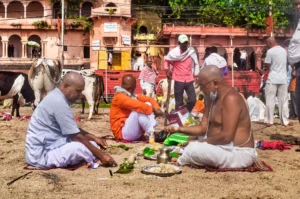
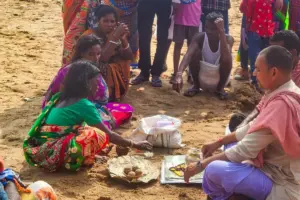
- The ritual involves offering Pindas (dough balls made of rice, wheat flour, milk, honey, and sesame seeds) along the banks of sacred rivers like the Ganges.
- Places like Gaya, Varanasi (Kashi), Prayagraj (Allahabad), Badrinath (Brahmakapal) and Ujjain are considered highly sacred for performing Pind Daan.
- Tarpan (water libation) offered with sesame seeds (til) accompanies the Pinda offering in every Vedic prescription.
- Mantras drawn from the Rigveda and Yajurveda are chanted throughout the ritual to invoke the Pitru Devatas and direct the offering to the correct ancestral soul.
Pind Daan in the Rigveda: The Oldest Vedic Layer
The Rigveda — the oldest of the four Vedas, composed and compiled between approximately 1500 and 1200 BCE — contains a complete hymn cycle dedicated to the Pitrus (ancestors) and the rites owed to them. The tenth Mandala of the Rigveda is particularly rich with material on death, the soul’s journey, and ancestral obligations.
Rigveda 10.15 — The Pitru Sukta
The fifteenth hymn of the tenth Mandala is the foundational Vedic text on ancestral worship. Known as the Pitru Sukta, it addresses the ancestors across three categories that would later be formalized in Smriti literature:
- Somapa Pitarah — ancestors who were initiated and drank Soma in their lifetimes, now dwelling in the highest ancestral realm
- Barhishada Pitarah — ancestors who maintained the sacred fire (agni) and performed yajna, now dwelling in the mid-realm
- Agnishvatta Pitarah — ancestors who did not maintain fire but are still worthy of offerings
Rigveda 10.15.1-11 invites these ancestral spirits to descend and accept the offerings of food, water, and oblations made at the yajna fire. The verse structure makes explicit that the offering of rice balls or grain-based oblations is the mechanism through which the living nourish the departed: “May the Pitrus who dwell in the realm of Yama accept these offerings of rice (anna) and grain (dhanya), offered with devotion and with water.”
Rigveda 10.16 — The Cremation Hymn
This hymn addresses the soul at the moment of cremation, instructing it to depart to the ancestral realm and accept the offerings that will be made by its descendants. Verse 10.16.12 is particularly significant — it explicitly references the offering of Pinda-like food oblations at the funeral, establishing the continuity between the cremation rite and the ongoing Shradh obligations: “Go to the Pitrus, go to the realm of Yama. Enter with joy into the realm of those who dwell there. Leave behind all corruption and return to home. Unite with a body, O soul.”
Rigveda 10.14 — Yama as Lord of Ancestral Realm
In this hymn, Yama — the lord of the dead — is addressed as the first ancestor who discovered the path (marga) that souls must travel after death. The hymn establishes the cosmological framework that undergirds all later Pind Daan practice: there is an ordered realm of the departed, it is accessible through proper ritual action, and the living have both the ability and the obligation to communicate with it through offerings. This is the Vedic theological foundation for why Pind Daan “works” — because the ancestors are real, their realm is real, and the Vedic channel of communication through fire and food oblation is real and sanctified by the highest authority.
Pind Daan in the Yajurveda: The Ritual Handbook
If the Rigveda provides the theological and hymnic basis for ancestral worship, the Yajurveda — the Veda of sacrificial formulas — provides the operational detail. The Yajurveda exists in two major recensions: the Krishna (Black) Yajurveda and the Shukla (White) Yajurveda. Both contain extensive prescriptions for the rites that constitute Pind Daan and Shradh.
Shukla Yajurveda (Vajasaneyi Samhita) — Books 19 and 21
The nineteenth book of the Shukla Yajurveda contains the mantras recited during the Pitryajna — the ancestral sacrifice that forms the Vedic prototype of what later tradition calls Pind Daan. The mantras prescribe the offering of cooked rice (odana) and barley gruel (karambha) to the departed ancestors, accompanied by specific invocations requesting that the ancestors accept the offerings and in return bestow longevity, prosperity, and offspring upon the living family.
Shukla Yajurveda 19.46 contains the direct mandate for the offering of food balls to the ancestors: “This rice-ball (pinda) I offer to thee, O Father; receive it in the realm of the dead. May it nourish thy subtle body. May our line continue and prosper through thy blessing.” This verse is considered one of the clearest direct Vedic mandates for Pind Daan as a named and specific practice.
Krishna Yajurveda (Taittiriya Samhita) — The Pitru Medha Section
The Taittiriya Samhita of the Krishna Yajurveda contains a detailed section on the Pitru Medha — the ancestral memorial sacrifice. Taittiriya Samhita 2.6.12 prescribes the preparation of Pinda from unhusked rice cooked with sesame seeds and mixed with honey and ghee — a formula that is virtually identical to the Pind Daan preparation still used today at Gaya and Prayagraj.
The continuity between this three-thousand-year-old Vedic prescription and the modern Pind Daan ritual performed at India’s sacred tirthas is one of the most striking examples of living Vedic tradition in the world. Families who perform Pind Daan at Prayagraj today are performing essentially the same ritual that the Vedic rishis codified in the Taittiriya Samhita.
Taittiriya Brahmana — The Pinda Pitryajna
The Taittiriya Brahmana (a prose explanatory text attached to the Krishna Yajurveda) contains an entire section called the Pinda Pitryajna — literally “the ancestral sacrifice of Pind Daan.” Taittiriya Brahmana 1.3.10 details the sequence of the rite: the preparation of the fire, the invocation of the ancestors by gotra (lineage) name, the offering of cooked grain oblations into the fire, and the final offering of the Pinda with water libation directly to the ancestral spirits. The text explicitly states that this rite must be performed on new moon days (Amavasya) — confirming the Vedic origin of the practice of performing Shradh on Amavasya that continues in Hindu households to this day.
Pind Daan in the Atharvaveda: Protection and Liberation
The Atharvaveda — the fourth Veda, whose content ranges from practical magic to philosophical speculation — contains several hymns that address ancestral obligations from a protective and apotropaic standpoint. Where the Rigveda honours the ancestors and the Yajurveda instructs the ritual, the Atharvaveda addresses what happens when ancestral rites are neglected.
Atharvaveda 18.1 — The Pitru Yajnas
The eighteenth book of the Atharvaveda contains elaborate hymns for the ancestral rites performed at death and in the months following. Atharvaveda 18.1.49-58 describes the offering of Pindas specifically to three categories of ancestors: those who died long ago (the remotest ancestors), those who died in the middle generation, and those who died most recently. This three-generation structure is the direct Vedic source of the later Dharmashastra rule that Pind Daan must honour three generations of paternal and maternal ancestors — a rule that governs Pind Daan procedure at Gaya, Prayagraj, and every major tirtha today.
Atharvaveda 6.120 — Against Pitru Dosha
This short but powerful hymn addresses the afflictions that befall a family when ancestral obligations are neglected — what later tradition calls Pitru Dosha. The Atharvavedic hymn prescribes specific protective mantras and food offerings to counteract these afflictions, establishing the Vedic precedent for the remedial rites (prayaschitta) performed today when Pitru Dosha is diagnosed. The existence of this hymn confirms that the concept of ancestral affliction from neglected rites is not a later Puranic elaboration but is rooted in the oldest stratum of Vedic religion.
Pind Daan in the Brahmanas and Aranyakas
The Brahmanas — the prose explanatory texts attached to each Veda — provide the most procedurally detailed accounts of Pind Daan in the entire Vedic corpus. Written to explain and justify the ritual prescriptions of the Samhitas, they offer a window into how the earliest Vedic community understood the theology and mechanics of ancestral worship.
Shatapatha Brahmana — The Pitru Paksha Section
The Shatapatha Brahmana (attached to the Shukla Yajurveda) is one of the largest and most important texts of the entire Vedic corpus. Its second Kanda (book) contains an extensive discussion of the Pitryajna, including the specific timing of ancestral rites — establishing that the period of the waning moon (Krishna Paksha) is most propitious for ancestral offerings because the deceased ancestors are believed to be closer to the earthly realm during this period.
This is the direct Vedic source of the institution of Pitrupaksha — the sixteen-day period of ancestral observance that falls in the Krishna Paksha of Bhadrapad month. The Shatapatha Brahmana 2.4.2.1-10 describes how the Pinda offerings must be made daily during this period, with the final Amavasya offerings being the most potent. Families who observe Pitrupaksha Shradh today are faithfully following a ritual structure laid down in the Shatapatha Brahmana more than two and a half millennia ago.
Aitareya Brahmana — The Pitru Loka Cosmology
Attached to the Rigveda, the Aitareya Brahmana provides the cosmological framework within which Pind Daan makes sense. It describes Pitru Loka (the ancestral world) as a real realm, accessible through the ritual channel established by Vedic sacrifice, where the souls of the worthy dead dwell in relative peace or suffering depending on whether their descendants have fulfilled their obligations. This cosmological grounding is what distinguishes Pind Daan from mere symbolic gesture — in the Vedic framework, the Pinda offering literally reaches the ancestor in Pitru Loka and nourishes its subtle existence there.
Pind Daan in Sacred Texts: The Puranic Amplification
Vedas and Puranas
The Vedas, being the foundational texts of Hinduism, lay the groundwork for rituals like Pind Daan. The Puranas — composed over the period 300 to 1000 CE — dramatically amplified and popularized these Vedic rites, making them accessible to all castes and adding extensive narrative and mythological material to explain their importance. Texts like the Garuda Purana (Pretakalpa), Matsya Purana, Vayu Purana, and Agni Purana each contain complete chapters on Pind Daan procedure and the consequences of its performance or neglect.
Texts like the Yoga Vashistha and Kurma Purana provide insights into the ritual’s deeper spiritual meanings. They emphasize the ritual’s role in liberating the soul and the ensuing peace and satisfaction for both the departed and their families. The Vishnu Purana adds the dimension of Gaya as the supreme tirtha for Pind Daan, explaining that the power of Vishnupad (Lord Vishnu’s footprint) at Gaya makes the Pinda offered there a thousand times more potent than at any other location.
The Grihyasutras: Vedic Householder’s Manual for Pind Daan
The Grihyasutras — the manuals of domestic ritual attached to each Vedic school — provide the most practically detailed prescriptions for Pind Daan in the entire Vedic literature. The Ashvalayana Grihyasutra (attached to the Rigveda), the Paraskara Grihyasutra (attached to the Shukla Yajurveda), and the Hiranyakeshi Grihyasutra (attached to the Krishna Yajurveda) all contain complete sections on Shradh and Pinda offering.
The Ashvalayana Grihyasutra (4.7) prescribes the preparation of Pinda from cooked rice, the invocation of the three generations of paternal ancestors by gotra and name, the offering of Pinda with water and sesame seeds, and the concluding Tarpan. The text specifies the exact mantras to be recited at each step — many of which are still in use by pandits performing Pind Daan at Prayagraj and Gaya today.
Pind Daan in Dharmashastra: The Legal Codification of Vedic Practice
The Dharmashastras — the texts of Hindu sacred law — represent the systematic legal codification of the Vedic prescriptions for ancestral worship. The most important of these for Pind Daan are Manusmriti, Yajnavalkya Smriti, and Vishnu Smriti.
Manusmriti — Chapter 3: The Law of Shradh
Chapter Three of the Manusmriti is entirely devoted to the Shradh and Pinda obligations of the Hindu householder. Manu (3.122) states: “By offering Pindas and water to the Pitrus three times annually — in the prescribed months, on Amavasya, and in the Pitru Paksha — one discharges the Pitru Rina completely and ensures the prosperity of one’s family.”
Manu (3.203) adds the crucial provision about place: “Pinda offered at Gaya, at Prayaga (Prayagraj), at Kurukshetra, or at the confluence of sacred rivers liberates not only the immediate ancestor but all ancestors for seven generations before and seven after.” This Smriti prescription is the direct authority behind the widespread practice of performing Pind Daan at the major tirthas rather than merely at home.
Yajnavalkya Smriti — The Most Systematic Account
The Yajnavalkya Smriti’s section on Shradh (Achara Adhyaya 1.217-268) is considered the most systematic and comprehensive account of Pind Daan procedure in all of Smriti literature. It covers: the eligible officiants (qualified Brahmins), the eligible recipients (the specific ancestors), the eligible times (monthly, annual, and Pitrupaksha), the eligible places (tirthas ranked by potency), the materials required (rice, sesame, kusha grass, water), and the specific mantras to be recited at each stage.
Yajnavalkya 1.254 provides the clearest statement in all Hindu legal literature of the doctrine of Pitru Rina: “Until the Pitru Rina is discharged through Shradh and Pinda, the soul of the householder itself is not completely free. The ancestor who does not receive Pind Daan becomes a Preta, and the descendant who does not offer Pind Daan incurs the guilt of Preta-making.” This verse explains why performing Pind Daan is not optional — it is a legal and spiritual obligation backed by the full weight of Vedic and Smriti authority.
The Mahakaleshwar Temple Context and Other Sacred Locations
In places like Ujjain, Pind Daan is intertwined with the local religious and cultural fabric. The Mahakaleshwar Temple in Ujjain, one of the twelve Jyotirlinga sites, represents the deep Vedic roots and the spiritual significance of Pind Daan in such sacred locations. Lord Mahakal (Shiva as the lord of time and death) is believed to be present at every moment of the Pind Daan performed in Ujjain, ensuring that the ancestral offering reaches the departed soul with maximum potency.
Table of Important Places for Pind Daan
| Place | Vedic / Puranic Significance |
|---|---|
| Gaya | Lord Vishnu’s Vishnupad; Lord Rama first performed Pind Daan here; Vayu Purana calls it the supreme Pitru Tirtha |
| Prayagraj | Triveni Sangam of Ganga, Yamuna, Saraswati; Matsya Purana says offerings here liberate 14 generations |
| Varanasi | Lord Shiva whispers Taraka Mantra at death; Kashi Khanda guarantees liberation to all who die here |
| Haridwar | Gateway of Lord Vishnu to Badrinath; Ganga descends from the Himalayas here at Har Ki Pauri |
| Badrinath (Brahmakapal) | Brahma’s skull (kapal) fell here; Skanda Purana prescribes this site specifically for Pind Daan for departed ancestors |
The Philosophical Underpinnings: Why Vedic Pind Daan Is Not Superstition
The Subtle Body Theory
The Vedic and Upanishadic framework for understanding what happens to the soul after death provides the rational basis for why Pind Daan is philosophically coherent rather than merely superstitious. Hindu metaphysics posits that the human being is not simply a physical body but a layered structure: the gross body (sthula sharira), the subtle body (sukshma sharira), and the causal body (karana sharira). At death, only the gross physical body is destroyed through cremation. The subtle body — which carries the impressions of desires, emotions, and unfulfilled karma — continues its journey.
The Pinda offering, according to this framework, literally nourishes the subtle body of the ancestor in its post-mortem journey. The Katha Upanishad (1.1.21) and the Brihadaranyaka Upanishad (6.2.15-16) both describe this post-mortem journey of the subtle body through the ancestral realm, confirming that the Vedic prescriptions for Pind Daan are grounded in a coherent metaphysical understanding of what happens to the human being after death — not in fear or superstition.
Pind Daan as Cosmic Reciprocity
At its deepest level, Pind Daan expresses the Vedic vision of the universe as a network of mutual obligation and reciprocity. The ancestors nourished their descendants through their lifetimes of effort, sacrifice, and care. The descendants nourish the ancestors after death through Pinda offerings and water libations. The gods and cosmic forces sustain both. This three-way circle of giving — between ancestors, descendants, and the divine — is what the Vedas call Yajna (cosmic sacrifice), and Pind Daan is its most intimate household expression.
🙏 Perform Pind Daan with Authentic Vedic Mantras
Conclusion: The Unbroken Vedic Thread
Pind Daan, as explored through the lens of the Vedas and their related texts, emerges as one of the most scripturally grounded practices in all of Hinduism. From the Pitru Sukta of the Rigveda to the ritual prescriptions of the Yajurveda, from the protective hymns of the Atharvaveda to the procedural detail of the Grihyasutras and the legal codification of the Dharmashastras — every layer of Vedic literature confirms and amplifies the obligation to nourish and liberate the departed through Pind Daan.
This is not a ritual that emerged from folk religion or later popular accretion. It is commanded in the oldest sacred texts of the Hindu tradition and has been performed with essentially the same materials, mantras, and intention for more than three thousand years. Performing it with faith and devotion is considered mandatory to ensure the salvation of departed ancestors — and the families of those ancestors who do so faithfully can take confidence that they are honouring one of the most venerable spiritual obligations in all of human religious history.