Key Takeaways
- The Vishnupad Mandir of Gaya: Abode of the Lord's Holy Footprint
- The Origin Story: Why Vishnu's Foot Rests in Gaya
- The Temple's Form: An Architectural Study
- The Holy Footprint: Shri Vishnupad
In This Article
The Vishnupad Mandir of Gaya: Abode of the Lord’s Holy Footprint
Om Shri Vishnave Namah.
Let us explore the hallowed precincts of the Vishnupad Temple Gaya Kshetra. Positioned by the sacred Phalgu River, this temple is the spiritual anchor of Gaya, a place made extraordinarily holy by the direct touch of Shri Hari Vishnu Himself. It stands not merely as a place of prayer, but as a powerful center for connecting with the divine and performing the most vital rites for our ancestors. Within its walls lies the very impression of Lord Vishnu’s foot, a mark left during a cosmic event that consecrated this ground forever.
The Origin Story: Why Vishnu’s Foot Rests in Gaya

To understand the Vishnupad Mandir, one must first understand the selfless sacrifice of Gayasur, as our Puranas like the Vayu Purana recount.
Gayasur’s Piety and the Cosmic Disturbance
An Unusual Asura: Gayasur, born of Asura lineage, possessed great virtue and was deeply devoted to Lord Vishnu. He performed intense austerities (tapasya) for millennia.
The Granted Boon: Pleased by his devotion, Lord Brahma granted Gayasur his wish: that his body become exceedingly pure, granting instant liberation (moksha) to anyone who saw or touched him.
Order Disrupted: This boon, though noble in intent, upset the cosmic law of Karma. Sinners gained moksha without deserving it, emptying the realms of Lord Yama and halting the natural cycle of existence.
The Appeal to Vishnu: The Devas, alarmed, sought Lord Vishnu’s help to restore balance.
The Divine Sacrifice and the Imprint
The Yagna Proposal: Lord Vishnu, knowing Gayasur’s devotion, devised a plan. He requested Gayasur’s supremely pure body to serve as the altar (vedi) for a grand yagna (fire sacrifice).
Gayasur’s Agreement: Honored, Gayasur laid his vast form upon the earth, his head in the region of present-day Gaya.
Stabilizing the Altar: As Brahma conducted the yagna, Gayasur’s body began to stir. To ensure the yagna’s success, Lord Vishnu placed a massive stone slab (shila) upon Gayasur to hold him steady.
The Final Touch: When even the shila proved insufficient, Lord Vishnu placed His own right foot firmly upon the slab over Gayasur’s head, rendering him completely immobile.
Gayasur’s Last Wish & Vishnu’s Promise: Pinned beneath the divine foot, Gayasur prayed that this spot, marked by the shila and Vishnu’s footprint, become the ultimate place for ancestral rites (shraddha and pind daan). Lord Vishnu granted this, declaring the place ‘Vishnupad’ within the holy Gaya Kshetra, promising that rites performed here would bring liberation to ancestors.
This divine event established the spot as supremely sacred, the future location for the Vishnupad Mandir.
The Temple’s Physical Form: Rani Ahilyabai’s Contribution
While the site’s holiness is ancient, the grand temple structure visible today is largely due to the pious efforts of Maharani Ahilyabai Holkar of Indore.
Need for a Worthy Structure: By the 18th century, previous structures needed renewal.
Royal Patronage: Rani Ahilyabai, a renowned patron of dharma and temple restoration across Bharat, undertook the rebuilding project.
Construction in 1787: Around the year 1787, she commissioned the present temple. Skilled artisans constructed it using large blocks of dark grey/black stone, reportedly sourced from quarries near Patharkatti. These stones were meticulously joined using iron clamps, ensuring durability.
A Lasting Edifice: Her work provided the magnificent and enduring structure that continues to receive millions of pilgrims.
🙏 Pind Daan at Vishnupad Temple, Gaya
The Temple’s Form: An Architectural Study
The Vishnupad Mandir presents a commanding presence, built in a style derived from the North Indian Nagar tradition but with distinct characteristics.
Overall Appearance: Approaching the temple, one is struck by its height (around 30 meters or 100 feet) and its solid, grey stone mass. It conveys a sense of immense age and profound stability, standing firm beside the often-dry bed of the Phalgu.
Building Material: The primary material is hard, dark grey granite or basalt. This choice of stone lends gravity and an ancient feel to the structure. The large, dressed blocks fit closely, displaying the skill of the 18th-century builders.
The Main Hall (Mandapa): Before the sanctum lies a large, pillared hall. This mandapa serves as a gathering space for devotees. It is open on its sides, allowing free movement of air and people. The pillars supporting the roof are carved from the same dark stone, solid and functional, bearing traditional motifs but perhaps less elaborate than seen in some other regions, emphasizing strength.
The Tower (Shikhara): Rising above the innermost shrine is the temple’s most recognizable feature: its tower. Unlike the more common curved shikharas, this tower is built on an octagonal base and rises pyramidally, tapering towards its peak. This octagonal design gives the Vishnupad Mandir a unique silhouette against the Gaya skyline. The tower culminates in a gilded kalash (pot-finial) topped by a fluttering saffron dhwaja (flag), symbols of auspiciousness and divine presence.
The Inner Sanctum (Garbhagriha): Deep within the temple structure lies the garbhagriha, the ‘womb-house’ containing the sacred object of worship. It is a relatively compact space compared to the outer hall, designed to focus all attention and energy onto the Vishnupad itself. The atmosphere here is intense, thick with devotion.
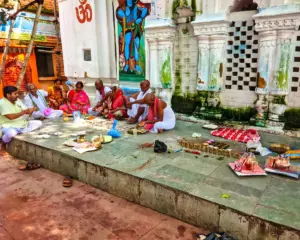
The Temple Courtyard: The main shrine is enclosed within a walled courtyard. Paved with stone, this courtyard provides space for circumambulation (parikrama) and houses several smaller shrines. These are dedicated to other important deities of the Hindu pantheon, including Lord Shiva (often as Gopaleshwar Mahadev), Goddess Parvati, Lord Ganesh, and Surya Narayan (the Sun God). Their presence makes the complex a representation of broader Hindu worship, centered around the primary Vaishnava icon.
The Holy Footprint: Shri Vishnupad
The very reason for the temple’s existence, the focus of all devotion here, is the Vishnupad – the footprint of Lord Vishnu.
Physical Nature: Housed within the garbhagriha, the footprint is an impression in a solid block of stone. It represents a right foot, approximately 40 centimeters in length. Devotees believe it bears auspicious marks (lakshanas) associated with Mahavishnu, such as the conch (shankh), discus (chakra), mace (gada), and lotus (padma), though these are not always easily discerned due to wear and offerings. For the faithful, this is not a mere symbol but the actual point of contact with the Lord.
The Silver Encasement: Protecting and beautifying the sacred footprint is a large basin or enclosure crafted from solid silver. Often octagonal or somewhat hexagonal in shape, this gleaming structure demarcates the holy impression. Devotees place their offerings – flowers, tulsi leaves, milk, water – into this basin, allowing them to symbolically touch or anoint the Lord’s foot.
Object of Supreme Veneration: This footprint is revered because it represents the culmination of Gayasur’s sacrifice and the fulfillment of Lord Vishnu’s promise. It is the tangible evidence of the divine event that sanctified Gaya specifically for ancestral liberation rites.
Experiencing the Temple: Atmosphere and Rituals
A visit to the Vishnupad Mandir engages all the senses and the spirit.
The Inner Atmosphere: Within the temple, especially near the sanctum, the air hums with energy. One hears the continuous chanting of mantras by the priests (pandas), the resonant sound of bells rung by devotees entering the sanctum or during aarti, and the murmur of prayers. The fragrance of burning incense (dhoop), camphor (karpura), ghee lamps, and fresh flower offerings (marigolds, roses, tulsi) permeates the space. It is an atmosphere charged with centuries of unwavering faith.
The Act of Darshan: Seeing the holy footprint is the goal for most visitors. Devotees usually queue, waiting their turn to enter the garbhagriha. Inside, under the guidance of the presiding priests, one offers prayers and makes offerings. The moment of seeing the Vishnupad, even if brief amidst the crowd, is often deeply moving. Receiving prasad – flowers or other items offered at the footprint and then returned – is considered a great blessing.
Tulsi’s Importance: Tulsi (holy basil) leaves and garlands hold special importance here, as Tulsi is exceedingly dear to Lord Vishnu. Offering Tulsi is a key part of worship.
Role of the Gayawal Pandas: The temple priests, known as Gayawals or pandas, play a central role. They belong to specific Brahmin families who have served at the temple for generations, maintaining genealogical records of pilgrim families (jajmans). They facilitate darshan, perform various pujas on behalf of devotees, and are the authorized guides for performing shraddha rites in Gaya. While essential for specific rituals, pilgrims seeking only darshan interact with them mainly within the sanctum.
Sacred Companions: Akshayavat and Phalgu River

The Vishnupad Mandir does not stand in isolation; its sanctity is amplified by its connection to other holy elements within or beside its premises.
Akshayavat – The Undecaying Banyan: Within the temple courtyard grows the ancient and profoundly revered Akshayavat. This banyan tree is believed to be immortal (“Akshaya” means undecaying). Performing pind daan and other rituals under its shade is considered exceptionally meritorious, multiplying the benefits manifold. Many believe that the Gaya pilgrimage rituals are incomplete without paying homage and performing rites at the Akshayavat, which stands as a living witness to countless generations fulfilling their ancestral duties.
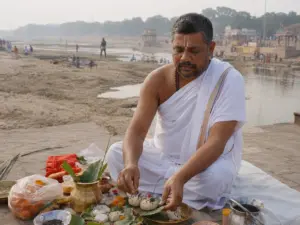
Phalgu River – The Subterranean Stream: The temple is situated right beside the Phalgu River. This river possesses a unique character – for much of the year, its waters flow beneath a wide, sandy bed (antahsalila). Despite the surface dryness, the riverbed’s sand is considered holy, and digging shallow pits often reveals water. Bathing ghats line the river bank near the temple. The Phalgu’s waters and sands are essential elements in the pind daan ceremony, making its location adjacent to the Vishnupad Mandir deeply significant. The river itself is seen as a sacred entity intrinsically linked to the temple’s purpose.
A Pilgrim’s Guide to Visiting the Vishnupad Mandir
To ensure a respectful and focused visit, here is some practical guidance:
Finding the Temple: It’s located in the older part of Gaya town. Auto-rickshaws and cycle rickshaws are common modes of transport. The final approach might involve navigating narrower streets bustling with activity related to the temple and pilgrimage rites.
Operating Hours: The temple generally opens its doors early, around 6:00 AM, and closes in the late evening, perhaps 8:00 PM or 9:00 PM. There might be a closure for rituals or rest in the afternoon. Always confirm the exact timings locally, as they can change, especially during festivals like Pitru Paksha.
Proper Attire and Conduct: Dress modestly. For men, dhotis, trousers, or kurtas are suitable. For women, sarees, salwar kameez, or long skirts covering shoulders and legs are appropriate. Remove footwear before entering the main temple area (storage facilities are usually available for a small fee). Maintain a quiet, reverent attitude. Avoid loud talk or disruptive behaviour. Photography inside the garbhagriha is generally prohibited; observe signs and instructions. Keep mobile phones switched off or silent.
Dealing with Pandas: Understand their role. If you plan detailed rituals (pind daan, specific pujas), you will need to engage a panda. It is wise to discuss the required services and the expected dakshina (offering) beforehand. If only visiting for darshan, interaction may be brief inside the sanctum. Treat them respectfully as custodians of tradition, while being clear about your needs. Remember they often hold ancient family records which might be of interest.
Offerings: Simple offerings like flowers, tulsi garlands, fruits, or sweets can be bought from vendors outside. Carry them with respect.
The Unwavering Sacredness of Vishnupad
The Vishnupad Mandir holds a place of paramount importance in Sanatana Dharma for several reasons:
Foremost Place for Shraddha: It is globally recognized as the primary center for performing pind daan, offering the highest assurance of peace and liberation for departed ancestors, fulfilling Lord Vishnu’s promise to Gayasur. Families planning a Gaya pilgrimage can book Pind Daan in Gaya through Prayag Pandits with experienced Gayawal Pandits who perform the full rite at Vishnupad and the Falgu River.
Direct Manifestation of Vishnu: The footprint provides a unique, physical connection to Lord Vishnu, drawing countless devotees seeking His blessings, protection, and grace.
Major Vaishnava Center: It ranks among the most important pilgrimage destinations for followers of Lord Vishnu.
Embodiment of a Cosmic Story: The temple perpetually reminds us of the power of devotion (Gayasur’s), the necessity of cosmic balance, and the boundless compassion of the Supreme Lord who established this site for universal benefit.
Conclusion: The Living Presence at Vishnupad
The Vishnupad Mandir is more than just stone and silver; it is a vibrant point of spiritual power. It is the location where the Lord of Preservation left His mark, establishing an eternal sanctuary for the solace of souls, both living and departed. Its dark stone structure houses a light that has drawn seekers for untold ages. To stand before the Vishnupad is to feel the pulse of ancient Bharat, to participate in timeless rituals, and to seek blessings at the very spot where the divine physically touched our world, offering liberation and peace through devotion and remembrance. May your pilgrimage here be filled with grace.
Jai Shri Hari!
Ritual planning: Pind Daan at Vishnupad Temple
Read also: Pretshila
🙏 Pind Daan at Vishnupad Temple, Gaya
Ritual, cost and booking information
This page owns Vishnupad Temple history, architecture and darshan. For the ritual itself, use the Vishnupad Pind Daan guide. For current price context, use the Gaya cost owner. To book the standard arrangement, go to the Gaya Pind Daan package.
Book Your Sacred Ritual
Authentic ceremonies performed by Veda-trained pandits at sacred sites across India.