



Veda-Trained Pandits
Experienced pandits guide the ceremony with care for your family’s tradition.
Pooja booking
Original price was: ₹31,000.00.₹21,000.00Current price is: ₹21,000.00.
Per pooja
Applicable taxes are shown in your booking. Optional additions are separate.
Exclusions
Thoughtfully arranged, personally guided
Experienced pandits guide the ceremony with care for your family’s tradition.
Stay in touch with our team for your booking details and ceremony arrangements.
See what your selected package includes. Optional additions are shown separately.
Share the date and timing that suit you. Our team confirms the final arrangements.
Experiences shared by our families
25 family reviews17 for this pooja · 8 from across our services
We had been wanting to perform Pind Daan for years but couldn’t travel to India. This online service was a blessing. The entire ritual was done as per shastras. Thank you Prayag Pandits team for your dedication. Dhanyavaad.
Booked this for my late father. Everything was arranged perfectly. The team was professional and respectful throughout.
First time performing Pind Daan and was nervous about the process. But the team guided us well. They explained what to wear, what to bring, and what mantras to recite. Everything went smoothly.
बहुत संतोषजनक सेवा। पंडित जी का वेद-शास्त्र का ज्ञान अद्भुत था। उन्होंने गरुड़ पुराण के श्लोकों का पाठ किया जो बहुत मार्मिक था। पूरा परिवार भावुक हो गया।
We booked this for our grandfather’s annual shradh. The ceremony was performed with great reverence. Pandit ji even shared stories from the Garuda Purana which were very enlightening for the younger generation. Om Shanti.
हमारे नाना जी के पिंडदान के लिए यह बुक किया था। सब कुछ परंपरागत तरीके से हुआ।
पंडित जी ने बहुत अच्छे से समझाया और पूजा करवाई। परिवार को बहुत शांति मिली।
Very authentic Vedic ceremony. All materials were included as promised. Will definitely use their services again.
We are settled abroad and wanted to perform the puja in Prayagraj. Prayag Pandits made it possible. Grateful.
Booked this for my mother-in-law’s teerth yatra. The arrangements were perfect from pickup to drop. The pandit performed all mantras correctly and with devotion. The poojan materials were all arranged by them. Very satisfied with the service. 🙏
पंडित जी ने बहुत अच्छे से समझाया और पूजा करवाई। परिवार को बहुत शांति मिली।
Very professional service. The pandit ji explained every step of the ritual which helped us understand the significance. Everything was arranged well including the samagri. We are grateful to Prayag Pandits for making this spiritual journey meaningful.
Good service overall. The pandit was on time and well prepared. He guided us through each step of the ceremony. The booking process was simple and the team was responsive on WhatsApp. Would recommend to others.
प्रयाग पंडित्स की टीम बहुत सहयोगी है। बुकिंग से लेकर पूजा तक सब कुछ सुव्यवस्थित था। पंडित जी ने मंत्रों के अर्थ भी बताए जो बहुत ज्ञानवर्धक था। Jai Shri Ram.
Excellent experience. We were worried about how to perform Pind Daan from abroad but the online option made it possible. The live video call was clear and we could participate in real time. The pandit was patient and answered all our questions.
Very professional service. The pandit ji explained every step of the ritual which helped us understand the significance. Everything was arranged well including the samagri. We are grateful to Prayag Pandits for making this spiritual journey meaningful. Om Shanti.
We had been wanting to perform Pind Daan for years but couldn’t travel to India. This online service was a blessing. The entire ritual was done as per shastras. Thank you Prayag Pandits team for your dedication. Dhanyavaad.
Watching the pandit perform the rituals in real-time by the Falgu River, mentioning my father's name... it felt like we were truly there. Immense gratitude to the entire team.
Being in the USA, travelling to India just for Tarpan during Pitru Paksha was becoming very difficult. Prayag Pandits offered a well-coordinated solution.
I was skeptical about performing such a sacred ritual online from Canada. But honouring my parents in Kashi was important. They were very patient and answered all my questions.
Living in Singapore, we felt disconnected from these essential rituals. The live stream option for Tarpan at Prayagraj gave us a profound sense of connection and peace.
It was deeply important for us in Australia that the rituals were performed correctly. The ceremony reflected the authenticity we sought and was performed by a knowledgeable priest.
The Pind Daan at Kashi was handled carefully, with the pandit following every step diligently. Very reassuring.
Arranging Asthi Visarjan from Bhubaneswar seemed complex, but Prayag Pandits made it seamless. The pandit called us before the ceremony to explain every step. Very professional.
During Pitru Paksha, we booked Shradh at Prayagraj. The coordination was flawless - from date selection to the pandit assignment. Our family felt at peace after the ceremony.
YOUR EXPERIENCE MATTERS
Tell us about your ceremony and the support you received. Your email address will stay private.
From your first choice to your booking
Review your package and any available additions, then add it to your booking.
Enter your contact details, preferred date and time. Add ancestral details if you wish.
Our team confirms the arrangements and shares your coordinator’s details 24 hours before the pooja.
Follow the participation and joining arrangements described in your package and shared by your coordinator.
There are situations in every family’s life when the annual Shradh ceremony is missed — sometimes for one year, sometimes for two, and sometimes, through circumstance or ignorance, for three years or more. When this happens, the tradition warns that the unsatisfied ancestors begin to experience distress, and that distress can manifest in the family of the living as what is known as Pitru Dosha. The remedy prescribed in the scriptures is clear and specific: Tripindi Shradh.
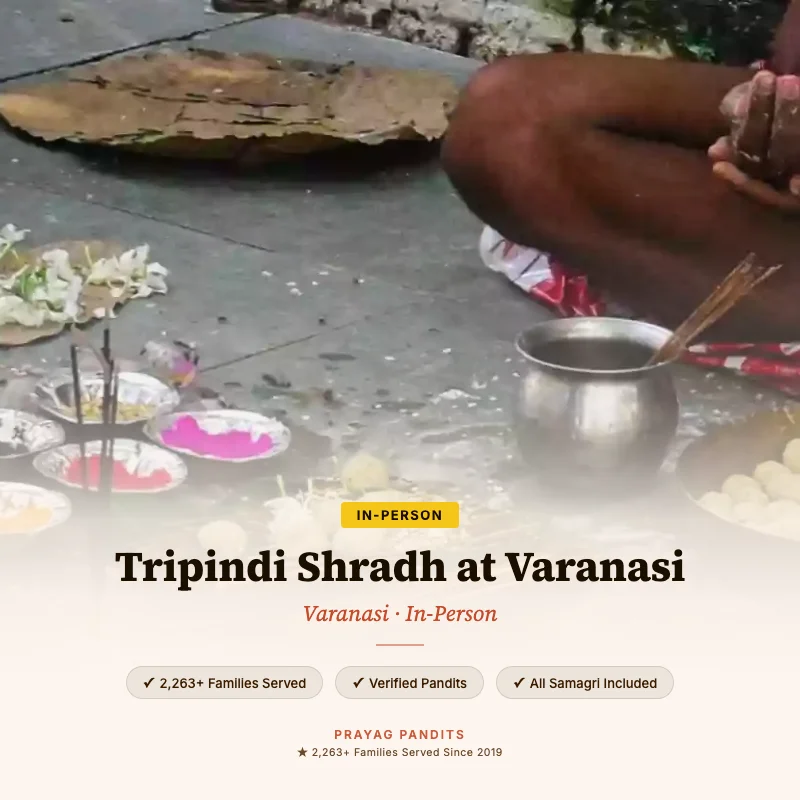
Our Tripindi Shradh at Varanasi package, conducted on the ghats of the most sacred city in the Hindu world, offers this remedy in its most complete and powerful form. At ₹21,000 (regular price ₹31,000), this is a comprehensive ceremony covering all three planes of the ancestral realm — performed by experienced Kashi pandits at the Ganges in the city where liberation is said to be always available.
The word Tripindi comes from two Sanskrit roots: tri (three) and pindi (from pind — the rice ball offering that nourishes the departed soul). Tripindi Shradh is a specialized form of Shradh that specifically addresses three categories of ancestral need:
The ceremony is performed in the names of the three great deities — Brahma, Vishnu, and Mahesh (Shiva) — who together govern the three planes through which all souls must pass after death. By invoking all three simultaneously, Tripindi Shradh addresses the ancestral need comprehensively, regardless of which realm the ancestor currently inhabits.
The Brahma Purana describes Tripindi Shradh in the following terms: “If a man has not performed Shradh for his father, grandfather, and great-grandfather for three years, the ancestors become agitated. He must then perform the Tripindi Shradh on the banks of the Ganga or at a great tirtha, offering Pind in the names of Brahma, Vishnu, and Mahesh. By this act, all three generations of ancestors are satisfied and freed from their distress.”
Every river in India is sacred for Shradh, but Varanasi — Kashi — holds a place entirely apart. It is the city where Lord Shiva himself whispers the Taraka Mantra into the ears of those who die within its boundaries, granting them moksha regardless of their past karma. The Kashi Khanda of the Skanda Purana devotes hundreds of shlokas to Varanasi’s special power over the cycle of birth and death.
For Tripindi Shradh specifically, Varanasi offers three distinct advantages:
To understand more about the spiritual depth of Shradh ceremonies and their scriptural basis, read our detailed guide: Shradh Karm 101 — A Deep Dive into Types, Rituals, and Philosophy.
Pitru Dosha is not merely a concept — it is described in detail across the Garuda Purana, Brahma Purana, and Vishnu Purana as a real condition with specific and observable manifestations. Families experiencing these patterns are traditionally advised to seek the remedy of Tripindi Shradh:
If three or more of these patterns are present in your family, Tripindi Shradh is among the strongest remedies available within the Hindu ritual tradition.
One of the most common misconceptions is that only the eldest son can perform ancestral rites. The scriptural tradition is actually quite flexible:
The intention and sincerity of the person performing the rite matters more than their position in the family hierarchy. Our pandits will guide whoever is performing the ceremony through the correct procedure for their specific relationship to the deceased.
The ceremony begins with a ritual bath in the Ganges at the assigned ghat. This physical immersion in sacred water is both a purification of the performer and a symbol of the connection between the living and ancestral realms through which the ceremony operates.
The pandit takes three separate Sankalpas — formal vows of intent — naming your ancestors and dedicating the ritual to each of the three deities who govern the three ancestral planes: Brahma (the realm of recent ancestors), Vishnu (the middle realm), and Mahesh or Shiva (the deepest realm where souls long unremembered may reside). This triple Sankalpa is what distinguishes Tripindi Shradh from ordinary Shradh.
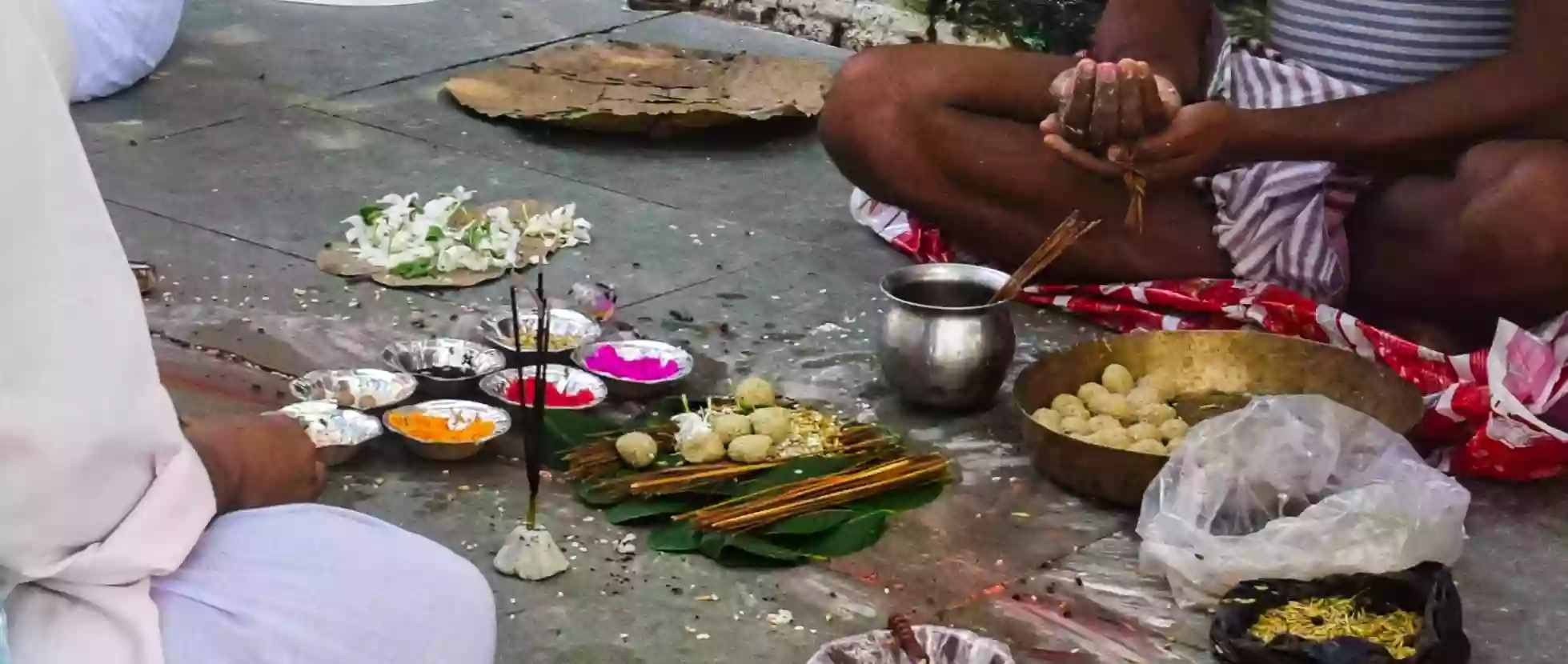
Three sets of Pind are prepared separately, each with specific ingredients appropriate to its intended destination. The first is for ancestors within three generations. The second reaches further back into the lineage. The third is a universal offering for any forgotten, unknown, or unnamed ancestor from your lineage across all generations. Each set is offered with specific mantras invoking the corresponding deity.
Water offering — Tarpan — is performed after the Pind offering. The performer stands in or at the edge of the Ganges, cups water mixed with sesame seeds and kusha grass, and releases it toward the south (the direction of the ancestors) while calling their names aloud. This direct calling of the ancestors by name is one of the most powerful elements of the ceremony.
Qualified Brahmins are fed in the name of the ancestors — this is the physical counterpart to the spiritual Pind offering. As the Brahmins eat, the ancestors are said to receive nourishment simultaneously. Dakshina is given as prescribed.
The ceremony concludes with prayers to the Ganges and to the presiding deity of the ghat, asking that the ceremony be accepted and the ancestors be released from whatever distress they may be in. The pandit recites the concluding Shradh mantras and blesses the family.
Tripindi Shradh can technically be performed anywhere by a qualified pandit. However, the scriptures are explicit that the same ceremony performed at a Maha Tirtha — a great pilgrimage site — carries many times more merit than the same ceremony performed at home or at an ordinary location. The Skanda Purana states that one Shradh performed on the Ganges at Varanasi is equivalent to performing the rite ten thousand times at an ordinary location.
The reason is simple: at a Maha Tirtha, the barriers between the realm of the living and the realm of the ancestors are thinner. The offerings reach more directly, the ancestors hear the calling of their names more clearly, and the liberation that follows is more complete. Varanasi, as the city presided over by Shiva — the lord of death — is the most powerful location for exactly this purpose.
To explore all our ancestral rite packages, including Pind Daan at Prayagraj, Gaya, and Nasik, visit our complete services page.
The traditional prescription is three years of missed annual Shradh. However, Tripindi Shradh can also be performed when Shradh has been missed for even one or two years if there are strong Pitru Dosha symptoms in the family, or when the family has had difficulty identifying or naming their ancestors correctly in previous ceremonies. It is also commonly performed as a comprehensive ancestral remedy alongside — or before — regular annual Shradh, to clear accumulated ancestral debt from the deeper lineage.
Tripindi Shradh can be performed throughout the year — it is not restricted to Pitrupaksha, unlike some other Shradh ceremonies. Any auspicious Shradh tithi (particularly Amavasya, Purnima, or a deceased ancestor’s death anniversary tithi) is appropriate. Pitrupaksha is the most meritorious time and the most commonly chosen, but performing it on any Amavasya in Varanasi is highly effective. Contact us with your preferred dates and we will confirm the most auspicious available muhurta.
This is more common than many families realize. The tradition provides for this exactly: the third Pind in Tripindi Shradh is specifically a universal offering for all forgotten and unnamed ancestors. During the Sankalpa for this third Pind, the pandit uses the formula “sarveshaam pitaraah” — for all ancestors — which covers those whose names are unknown. For the named ancestors, even approximate knowledge (a first name, a village, an approximate era) helps. Our pandit will guide you through this in the pre-ceremony consultation.
Regular annual Shradh (Pitrupaksha Shradh or death anniversary Shradh) is a maintenance rite — it nourishes and honors ancestors who are already at peace. Tripindi Shradh is a remedial ceremony — it specifically addresses ancestral distress caused by missed rites, forgotten lineage members, or ancestors stuck in difficult realms. After performing Tripindi Shradh, families are encouraged to resume regular annual Shradh to maintain the peace established by this more intensive ceremony.
The ceremony runs 3 to 4 hours. We schedule it during the morning hours when the ghat is most auspicious and the Ganga is at its most serene. Typically, we begin between 6:00 and 8:00 AM. Our team will confirm your specific start time at least two days before the ceremony date. We recommend arriving at the ghat 30 minutes before the start time to settle and prepare.
Yes. While the strongest tradition prescribes Tripindi Shradh primarily for the paternal lineage, it is entirely permissible and spiritually meritorious to include the maternal lineage as well. The pandit takes separate Sankalpas for each lineage and ensures that both sets of ancestors receive the offering. This comprehensive approach is actually preferred by many families who wish to settle all ancestral accounts in a single ceremony.
Tripindi Shradh in Varanasi (Kashi) costs ₹21,000 (regular price ₹31,000). The ceremony is performed at the sacred Kashi ghats by experienced pandits. All-inclusive: pandit fees, complete samagri, pind offerings for three generations, tarpan, and documentation. No hidden charges.