
No rituals selected yet.
Browse Pooja Packages →Key Takeaways
In This Article
Sarva Pitru Amavasya — the New Moon day that concludes Pitru Paksha — is the single most important day of the entire fifteen-day ancestral fortnight. In 2026, it falls on Saturday, 10 October 2026. This is the day when the door between the living and the ancestral realm is opened widest, when the accumulated energy of fifteen days of prayer and ritual reaches its highest point, and when every ancestor — known and unknown, remembered and forgotten, from every family across the world — can be reached through a single act of sincere devotion. It is also called Sarvapitra Moksha Amavasya, Mahalaya Amavasya, and simply Pitru Amavasya. Unlike the earlier tithis of Pitru Paksha, which are designated for specific categories of ancestors, Sarva Pitru Amavasya belongs to all departed souls without exception. If you have performed Shradh on every other tithi of Pitru Paksha, the Amavasya Shradh is still essential — it is the grand summation. If you have not been able to perform Shradh on any other day during the fortnight, the Amavasya Shradh alone can cover the entire obligation.
What is Sarva Pitru Amavasya?
The name Sarva Pitru Amavasya (सर्वपितृ अमावस्या) translates precisely as “the New Moon of All Ancestors.” Sarva means all, Pitru means ancestors or forefathers, and Amavasya is the New Moon day — the darkest night of the lunar month, when the Moon is invisible and the subtle energies between worlds are most permeable.
The Amavasya at the end of Pitru Paksha is unlike ordinary Amavasyas. Throughout the year, every Amavasya is considered appropriate for ancestral offerings — it is why many devout Hindus make Tarpan offerings on every monthly New Moon. But the Pitru Paksha Amavasya, occurring during the fortnight when the entire cosmic framework tilts toward the ancestral realm, carries exponentially greater power. The tradition compares it to a radio station broadcasting at maximum signal strength — every offering made on this day reaches its destination with full clarity.
The primary categories of ancestors for whom Sarva Pitru Amavasya Shradh is specifically performed include:
- Those who departed on Amavasya Tithi (the New Moon day of any month)
- Those who departed on Purnima Tithi (the Full Moon day of any month)
- Those who departed on Chaturdashi Tithi (specifically for families who could not observe Ghata Chaturdashi the previous day)
- All ancestors whose specific tithi is unknown — the Amavasya is the universal remedy for this very common situation
- All ancestors regardless of their tithi — even if every other tithi’s Shradh has been performed, the Amavasya covers the entire family line comprehensively
- Ancestors who died in foreign lands, in hospitals, far from home, or in circumstances that made proper death rites difficult or impossible
- Those for whom Shradh could not be performed in previous years
This universal quality of Sarva Pitru Amavasya means that it functions as what the tradition calls a sarva-samavesh — a complete inclusion — where no soul is left behind, no obligation is uncovered, and no family is unable to fulfill its ancestral debt simply because they lack information about their ancestor’s death tithi.
Sarva Pitru Amavasya 2026 Date and Muhurat
In 2026, Sarva Pitru Amavasya falls on Saturday, 10 October 2026. This is the last day of Pitru Paksha, which began on Saturday, 26 September 2026 with Purnima Shradh. The fifteen-day sacred fortnight concludes on this New Moon day.
The auspicious timing for Amavasya Shradh follows the same framework as all Pitru Paksha Shradhas — the Aparahna Kala, the afternoon period. The specific Muhurats within Aparahna are:
- Kutup Muhurat: Approximately 11:36 AM to 12:24 PM (verify from Panchang for Prayagraj on October 10, 2026)
- Rohina Muhurat: Approximately 12:24 PM to 1:12 PM
On Amavasya specifically, there is also the tradition of performing Tarpan during the pre-dawn hours — before sunrise — as an additional window of auspiciousness. Some families perform both a pre-dawn Tarpan at the river and the complete Pind Daan ritual during Aparahna Kala on the same day, creating a comprehensive observance that spans the full day of Sarva Pitru Amavasya.
The Prayag Pandits team at Triveni Sangam on Sarva Pitru Amavasya 2026 will be fully available from early morning through Aparahna Kala. Given that this is the most important day of Pitru Paksha and thousands of families come to Prayagraj specifically for this day, we strongly recommend booking your ritual date well in advance — ideally several weeks before October 10.
Who Should Perform Shradh on Sarva Pitru Amavasya?
The simple answer is: every Hindu family with departed ancestors. But more specifically, Sarva Pitru Amavasya Shradh is especially important for:
Families who could not perform Shradh on the correct tithi: Life circumstances — illness, travel, lack of awareness, or practical constraints — may have prevented the family from performing Shradh on the specific tithi of their ancestor’s death. The Amavasya Shradh removes the consequence of this omission entirely. The tradition explicitly states that Shradh performed with full devotion on Sarva Pitru Amavasya covers all ancestors for whom dedicated tithi Shradh was not possible.
Families who do not know their ancestor’s death tithi: In many families — particularly those where elders have passed without maintaining records, or where family members died far from home — the exact tithi of death is unknown. This is extremely common in both India and among NRI families. For all such families, Sarva Pitru Amavasya is the answer: it covers all ancestors universally, with or without tithi knowledge.
Families who want to honor the entire ancestral line: Even if a family has diligently performed Shradh on every tithi throughout Pitru Paksha, performing the Amavasya Shradh as well creates a comprehensive, all-inclusive final offering to the entire ancestral lineage going back seven generations — and in the elevated spiritual conditions of Prayagraj, the texts say this extends to 21 generations.
NRI and diaspora families who perform only one Shradh per year: For Hindus living abroad who can dedicate only one day to ancestral rites, Sarva Pitru Amavasya is the single most important day to choose. Read our guide for NRI families performing Pind Daan for more context on how to approach this from overseas.
Performers of Shradh: The primary responsibility rests with the eldest son of the deceased. In the absence of a son, the following persons are eligible in order: daughter’s son, the deceased’s brother, the brother’s son, the daughter, the daughter’s son, a disciple, and a close friend. In modern practice, daughters and sons-in-law are widely accepted as eligible performers, as confirmed by most contemporary Dharma scholars.
Complete Rituals and Procedures for Sarva Pitru Amavasya
The Sarva Pitru Amavasya Shradh is the most comprehensive ritual observance of the entire Pitru Paksha. Here is the full procedure:
The Night Before (Amavasya Eve): The evening before Amavasya, many families light a sesame-oil lamp (til tel diya) and place it near the threshold of the home. This is a welcoming signal to the ancestors, inviting them to be present during the following day’s ritual. Silence and devotion in the evening are encouraged.
Pre-Dawn Tarpan (Optional but Auspicious): Rising before sunrise on Amavasya and going to the nearest river for an early Tarpan is considered highly meritorious. At Prayagraj, many devotees take their bath at Triveni Sangam in the pre-dawn darkness on Sarva Pitru Amavasya. This early Tarpan is supplemental to — not a replacement for — the formal Aparahna Kala ritual.
Full-Day Sattvic Lifestyle: On Amavasya day, the performer observes complete purity — no non-sattvic food from the previous night, bath before sunrise, white or clean light-colored clothing, no television or worldly entertainment, and a mental state devoted entirely to the purpose of ancestral remembrance and gratitude.
Sankalp — The Most Comprehensive of the Fortnight: The Sankalp for Sarva Pitru Amavasya is the broadest and most inclusive of all Pitru Paksha Sankalps. It references all three paternal generations (father, grandfather, great-grandfather) and their wives, all three maternal generations, all other relatives who may have passed without proper rites, and explicitly includes a universal clause: “May this offering reach all departed souls of our lineage, known and unknown, those whose names we remember and those whose names time has erased.”
Pind Daan — The Grand Ancestral Feeding: On Sarva Pitru Amavasya, pindas are prepared for the full family ancestral line — typically seven to fourteen pindas for the complete paternal and maternal lineages. At Triveni Sangam, these pindas are offered into the sacred confluence of the Ganga and Yamuna. The immersion of pindas in the Sangam is considered one of the most powerful acts of ancestral liberation available to a living person.
Tarpan — The Universal Water Offering: Water with black sesame seeds, kusha grass, and barley is offered for each named ancestor and then in a comprehensive universal offering for all unnamed ancestors. The names of all three paternal and three maternal generations are recited. The final Tarpan of Pitru Paksha is made with a heartfelt prayer for the complete liberation of all souls in the family line.
Brahmin Bhojan — The Most Generous of the Fortnight: On Sarva Pitru Amavasya, Brahmin Bhojan is the most significant. Families that have the means invite multiple Brahmins to a full meal. The dakshina offered on this day is traditionally the most generous of the entire Pitru Paksha. Some families also donate clothing, rice, or other items to Brahmins on this day.
Panch Bali: The five-part food offering — to cows, crows, dogs, ants, and all living beings — is performed before the family eats. On Sarva Pitru Amavasya, the Kak Bali (crow feeding) is especially watched: if a crow eats from the offering, it is considered a sign that the ancestors have accepted the Shradh and are at peace.
Evening Lamp: As darkness falls on Amavasya evening, a lamp is lit — traditionally a sesame-oil lamp in an earthen diya — and placed at the main door of the home or near a tulsi plant. This is the farewell lamp for the ancestors, marking the close of Pitru Paksha and the return of the souls to their respective realms.
The Most Important Tip for Sarva Pitru Amavasya
If you can do only one thing during all of Pitru Paksha 2026, do it on October 10 — Sarva Pitru Amavasya. A complete Pind Daan and Tarpan on this day at Triveni Sangam, Prayagraj covers your entire ancestral obligation for the year. The Matsya Purana states that Shradh at the Triveni Sangam on Amavasya liberates 21 generations of ancestors. Book your pandit early — this is the most in-demand day of the entire Pitru Paksha season.
The Deep Significance of Sarva Pitru Amavasya in Scripture
No other day in the Hindu calendar has as many specific scriptural endorsements for ancestral rites as Sarva Pitru Amavasya. The ancient texts return to this day again and again as the supreme opportunity for ancestral liberation.
The Garuda Purana — the principal text on death, afterlife, and ancestral rites — states explicitly that a person who performs Shradh with devotion on Sarva Pitru Amavasya need not fear any Pitru Dosha (ancestral curse) or Pitru Rina (ancestral debt). The sincere observance of this single day, the text says, wipes away the accumulated Pitru Rina of multiple lifetimes. This is why the tradition places such emphasis on Amavasya as the final and most comprehensive Shradh day.
The Mahabharata contains the story of Karna — the great warrior who, after his death, discovered in the realm of the dead that he had never performed ancestral rites (Shradh and Tarpan) for his forefathers. In the aftermath of this discovery, he was granted a fifteen-day period to return to Earth and perform these rites — a period recognized as the origin of Pitru Paksha itself. The Mahabharata story emphasizes that the consequences of neglecting ancestral rites fall not just on the departed but on the living descendants — manifesting as obstacles, health problems, broken relationships, and persistent difficulties that resist ordinary solutions.
The Matsya Purana specifically exalts Prayag as the supreme location for Sarva Pitru Amavasya Shradh: “Prayage pind daanam ya kuryat amavasya tithou, pitrun tasya vimucchyante saptavimshat kula-kramat” — meaning “One who offers Pind Daan at Prayag on Amavasya Tithi liberates 27 generations of ancestors from their accumulated bonds.” Other texts give the figure as 21 generations — either way, the extraordinary scope of liberation available at Prayag on this day is without parallel.
The Vishnu Purana adds that on Sarva Pitru Amavasya, the Pitru Devas (the divine beings who govern the ancestral realm) are especially close to the earthly plane. Their receptivity to offerings is at its highest, and even a small, sincere offering made with genuine love on this day reaches them more completely than elaborate rituals performed at other times of year.
Pitru Dosha: When Missing Shradh Has Consequences
Many families come to Sarva Pitru Amavasya not with a history of regular Shradh observance, but with a feeling that something has been missing — persistent difficulties in life that seem to have no ordinary explanation, troubled relationships across generations, health issues that recur in the family line, or a general sense of blocked progress despite hard work. The traditional explanation for these patterns is Pitru Dosha — the imbalance created when ancestral souls have not received proper rites over years or generations.
Pitru Dosha is not a curse in the dramatic sense — it is better understood as an unpaid debt. When the living do not honor the departed with the proper rites, the ancestral souls remain in need. That need creates a kind of subtle tension in the family’s energetic field that can manifest as the difficulties described above. Sarva Pitru Amavasya Shradh — especially when performed at a place of extraordinary sacred power like Triveni Sangam — is the most direct and complete way to resolve this imbalance.
For families with known Pitru Dosha — identified through a Kundali reading or through the persistent patterns described above — a more comprehensive Pitru Paksha Puja package that includes additional mantras, a Shanti Havan, and multi-day rites may be appropriate. Our pandits at Prayag Pandits can assess your family’s needs and design an appropriate ritual sequence. Read our detailed guide on ancestral debt and Pind Daan for a deeper understanding of this concept.
Do’s and Don’ts for Sarva Pitru Amavasya
Do’s:
- Perform the ritual during Kutup or Rohina Muhurat within Aparahna Kala on October 10, 2026
- Include all known and unknown ancestors in the Sankalp — use the comprehensive universal clause
- Perform Tarpan at a sacred water body — Triveni Sangam, Prayagraj, is the most auspicious
- Prepare multiple pindas covering both paternal and maternal family lines
- Arrange for Brahmin Bhojan and offer generous dakshina on this most significant day
- Feed crows, cows, and dogs before the family eats
- Light a sesame-oil lamp in the evening as the farewell lamp for the ancestors
- Observe silence and inner devotion throughout the day
- Book your pandit and date well in advance — Sarva Pitru Amavasya is the most in-demand day at Prayagraj
Don’ts:
- Do not consume non-sattvic food — no onion, garlic, meat, fish, or alcohol
- Do not perform the ritual after sunset — all Shradh must conclude within Aparahna Kala
- Do not use iron utensils for the ritual
- Do not engage in festive celebrations, new purchases, or auspicious functions on Amavasya day — it is a day of ancestral remembrance
- Do not rush through the Sankalp — take time to name all ancestors you can remember
- Do not leave for home immediately after the ritual — take a few quiet moments at the Sangam in gratitude and prayer
Perform Sarva Pitru Amavasya Shradh at Triveni Sangam, Prayagraj
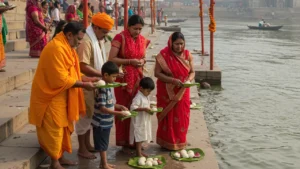
Prayagraj on Sarva Pitru Amavasya is a sight of profound spiritual power. Thousands of families from across India and from the Indian diaspora worldwide converge at Triveni Sangam on this day, their white-clad figures standing at the edge of the sacred waters, offering Tarpan to their ancestors in one of the most ancient and unbroken ritual traditions still practiced anywhere in the world. The air at the Sangam on Amavasya during Pitru Paksha carries the weight and the peace of uncountable generations of prayer.
Prayag Pandits has served families performing Sarva Pitru Amavasya Shradh at Triveni Sangam for generations. Our pandits — deeply rooted in the Prayagraj Shradh tradition and knowledgeable in the Sanskrit texts that govern these rites — guide you through the complete ritual with precision and devotion. We provide all ritual materials: sesame seeds, barley, kusha grass, the pinda ingredients, flowers, incense, and the sacred thread. We coordinate the Brahmin Bhojan arrangement. And we ensure that your time at the Sangam on this sacred day is spiritually fulfilling, not logistically stressful.
Whether you are a family performing Pitru Paksha rites for the first time or continuing a multi-generational tradition, whether you know all your ancestors’ tithis or none of them, whether you are coming from within Prayagraj or traveling from abroad — Sarva Pitru Amavasya Shradh at Triveni Sangam is the most complete ancestral offering you can make. Let us guide you through it.
Understand why Prayagraj holds this extraordinary position for ancestral rites in our post on Triveni Sangam: The Land of Moksha and the deep significance of Pind Daan. For the complete step-by-step ritual procedure, read our guide on How to Perform Pind Daan.
Pitrupaksha 2026
🙏 Book Sarva Pitru Amavasya Shradh at Prayagraj
Starting from
₹7,100
per person
Related Shradh Tithis in Pitru Paksha 2026
Sarva Pitru Amavasya on October 10 concludes a fifteen-day sequence of ancestral rites. The days immediately preceding it are Chaturdashi Shradh (Ghata Chaturdashi, October 9 — for those who died unnatural deaths), Trayodashi Shradh (October 8 — for Trayodashi-departed ancestors and children), Dwadashi Shradh (October 7 — for Dwadashi-departed ancestors and sanyasins), Ekadashi Shradh (October 6 — for Ekadashi-departed ancestors), and the Magha Shradh (also October 7 — for those who died under Magha Nakshatra). For the complete guide to all fifteen days of Pitru Paksha rituals, visit our Pitrupaksha Complete Ritual Guide.
Related Services by Prayag Pandits
- 🙏 Pind Daan in Gaya (Pitrupaksha) — Starting from ₹7,100
- 🙏 Shradh at Prayagraj — Starting from ₹7,100
- 🙏 Tarpan in Prayagraj — Starting from ₹5,100
Frequently Asked Questions
What is the date of Sarva Pitru Amavasya 2026?
Sarva Pitru Amavasya 2026 falls on 20 October 2026 (Tuesday). This is the Amavasya tithi in the Krishna Paksha of the Ashwin month — the final day of the 16-day Pitrupaksha period. The Amavasya tithi begins at 4:17 AM on 20 October and extends into the early morning of 21 October. The shubh muhurat for performing Shraddha is during the Aparahna Kaal (afternoon, roughly 12:45 PM to 3:30 PM) — the time specifically prescribed in the Smriti texts for ancestral offerings. Tarpan can also be performed in the morning. Our pandits conduct Sarva Pitru Amavasya Shraddha at Prayagraj, Varanasi, Haridwar, and Gaya with full scriptural authenticity.
What is special about Sarva Pitru Amavasya (Mahalaya Amavasya)?
Sarva Pitru Amavasya (also called Mahalaya Amavasya) is the most significant day in the entire Pitrupaksha period because it is the single day when Shraddha offerings are accepted by ALL ancestors — known and unknown, distant generations, those who died on forgotten tithis, and those whose names are lost to family memory. The scriptures state that on this day, the gates of Pitru Loka open fully and ancestors descend to receive offerings from their living descendants. Any family member who could not perform Shraddha on their specific ancestor's death tithi can offer it on Sarva Pitru Amavasya as a comprehensive "all-ancestors" Shraddha. This makes it the most practically useful day for busy families.
Can Sarva Pitru Amavasya Shraddha replace all the other tithi Shraddhas?
Traditionally, no — each ancestor should ideally be honoured on their specific death tithi during Pitrupaksha. However, when a family cannot observe individual tithi Shraddhas due to practical constraints, scriptures explicitly permit consolidating all ancestral offerings into a single Sarva Pitru Amavasya Shraddha. The benefit is nearly equivalent, especially when the ceremony is performed at a sacred tirtha like Prayagraj or Gaya with proper gotra invocation. For families who cannot remember every ancestor's exact death date, Sarva Pitru Amavasya is the recommended annual observance. Our Sarva Pitru Amavasya Shraddha package specifically invokes all ancestors of the family lineage in a single comprehensive ceremony.
What should you do (and not do) on Sarva Pitru Amavasya?
DO: (1) Wake up early and bathe in Ganga, Yamuna, or any flowing water, (2) Offer Tarpan (water with sesame seeds) to ancestors before sunrise or during the Aparahna Kaal, (3) Perform Pind Daan and Shraddha at a sacred tirtha or at home, (4) Feed Brahmins (Brahmin Bhoj) and donate to the needy, (5) Offer food to crows, dogs, and cows (considered messengers of Yama), (6) Light a ghee lamp and chant Pitru Sukta from Rig Veda. DON'T: (1) Avoid non-vegetarian food, onion, and garlic, (2) Don't start new ventures, purchases, or celebrations, (3) Avoid eating before completing Shraddha, (4) Don't ignore the day — unmarked ancestors are believed to suffer disappointment and may cause Pitru Dosh.
Why is Prayagraj particularly important for Sarva Pitru Amavasya Shraddha?
Prayagraj is uniquely suited for Sarva Pitru Amavasya because of the Triveni Sangam — the confluence of Ganga, Yamuna, and the mystical Saraswati. Scriptures state that offerings made at a Sangam (river confluence) carry seven times the merit of offerings made at a single river. Additionally, Prayagraj is one of the few tirthas where the Pitri Sukta mantra resonates through all three rivers simultaneously, reaching ancestors in all three loka realms. Maha Kumbh Mela has been held at Prayagraj precisely because of this cosmic confluence. Performing Sarva Pitru Amavasya Shraddha at Arail Ghat or Sangam Bhata during the Aparahna Kaal is considered one of the most spiritually powerful acts a descendant can perform.
Can NRI or overseas Hindus perform Sarva Pitru Amavasya Shraddha remotely?
Yes. Our Vedic-trained pandits perform Sarva Pitru Amavasya Shraddha on behalf of NRI families at Prayagraj, Varanasi, Haridwar, Gaya, and other sacred tirthas. You share your family gotra, the names of known ancestors, and any specific tithis you want invoked via WhatsApp or email. We conduct the complete ceremony on the Amavasya day during the Aparahna Kaal muhurat, performing Tarpan at the Triveni Sangam, offering pindas with the proper gotra invocation, and completing the Brahmin bhoj as per package. A video recording of the entire ritual is shared within 24-48 hours. Many families from the USA, UK, Canada, Singapore, Australia, and UAE use our Sarva Pitru Amavasya service as their primary annual ancestral observance.
Book Your Sacred Ritual
Authentic ceremonies performed by Veda-trained pandits with video proof at sacred sites across India.
2,263+ families served
Video proof included
Since 2019
