
अभी तक कोई अनुष्ठान नहीं चुना गया।
पूजा पैकेज देखें →मुख्य बिंदु
इस लेख में
After tarpan, the pandit prepares the pindas — round rice balls made from boiled rice mixed with sesame seeds, honey, and ghee. These pindas are placed at the riverbank with each ancestor’s name recited and the corresponding mantra chanted. For Ashtami Shradh, some pandits add a pinch of sacred ash (vibhuti) to the pindas in acknowledgment of the Shaiva energy of this tithi. The deep meaning behind Pind Daan becomes even more apparent when performed at a sacred confluence like Prayagraj.
Ashtami Shradh, observed on the eighth tithi of the dark fortnight during Pitru Paksha, holds a distinct place among the sixteen ancestral observances of the sacred fortnight. In 2026, Ashtami Shradh falls on Saturday, October 3, 2026. The eighth lunar day, Ashtami, is associated with Lord Shiva and with the fierce yet compassionate energy of transformation — making it especially significant for ancestors who departed this world in difficult or untimely circumstances. On this day, families perform the traditional Shradh rituals — tarpan, pinda daan, and Brahmin bhojan — to honour ancestors who died on an Ashtami tithi in any month and year, ensuring their peaceful progress toward liberation and freedom from the ancestral realm.
What is Ashtami Shradh?
Ashtami Shradh is one of the sixteen tithi-based Parvan Shradhas observed during the fortnight of Pitru Paksha. On the eighth day of the dark fortnight in Bhadrapada month, this Shradh is performed to offer tarpan and pindas to ancestors who passed away on any Ashtami tithi — Shukla Paksha Ashtami or Krishna Paksha Ashtami — across all twelve months of the Hindu year.
The number eight (ashta) has profound significance in the Hindu tradition. Ashtami is associated with the eighth form of Mother Durga (Mahagauri), with Lord Shiva’s eight manifestations (Ashtamurti), and with the eight directions (Ashtadik) that define the cosmic order. In the context of ancestral rites, the eighth tithi is understood as a day of powerful transformation — when the barrier between the world of the living and the world of the ancestors becomes especially permeable.
The Garuda Purana describes Ashtami as one of the specially auspicious tithis for Shradh because it falls at the midpoint of the lunar fortnight — a time when the lunar energy is transitioning from waxing to waning or vice versa, creating a window of spiritual receptivity. Ancestors honoured on Ashtami Shradh are believed to receive the offering with particular clarity and effectiveness. The importance of honouring our ancestral debt is underscored by the detailed instructions in these Puranic texts.
Ashtami Shradh 2026 Date and Muhurat
In 2026, Pitru Paksha runs from September 26 (Purnima Shradh) through October 10 (Sarva Pitru Amavasya). Ashtami Shradh in 2026 falls on Saturday, October 3, 2026.
The auspicious time windows for performing Ashtami Shradh are:
- Kutup Muhurat — approximately 11:36 AM to 12:24 PM. This is the primary and most spiritually potent window for all Shradh ceremonies, occurring when the sun is at its midday position and the ancestral realm is believed to be most accessible.
- Rohina Muhurat — approximately 12:24 PM to 1:12 PM. The second auspicious window, immediately following Kutup and equally valid for performing Shradh rituals.
- Aparahna Kala — the general afternoon period from approximately 1:12 PM to 3:36 PM. Shradh is permissible throughout this window when the earlier muhurats are unavailable.
Saturday (Shanivara) is associated with Saturn (Shani) in Vedic astrology — the planet that governs karma, time, and the ancestral inheritance we carry. Performing Ashtami Shradh on a Saturday in 2026 is considered doubly significant: the eighth tithi’s transformative energy combines with Saturday’s karmic authority to make this a particularly powerful day for ancestral liberation. For exact muhurat timings, devotees can verify dates on the DrikPanchang Pitrupaksha calendar.
Ashtami Shradh follows Saptami Shradh (October 2) and precedes Navami Shradh (Matru Navami) (October 4) — the special day for performing Shradh for deceased mothers. Families performing consecutive-day Shradh ceremonies can arrange the full sequence through Prayag Pandits.
Who Should Perform Shradh on Ashtami Tithi?
The primary requirement for Ashtami Shradh is straightforward: if any direct-line ancestor — paternal or maternal — passed away on the eighth lunar day of any month in any year, Ashtami Shradh during Pitru Paksha is when you honour them.
Beyond the primary tithi rule, the Dharmashastra tradition recognises several categories of ancestors for whom Ashtami Shradh carries special significance:
- Ancestors who died during illness or after prolonged suffering — the eighth tithi’s connection to Lord Shiva’s healing and transformative power makes it auspicious for such souls
- Ancestors who were devoted to Shiva or Shakti — particularly those who observed Shiva Ashtami fasts or were dedicated to a Shakti temple during their lifetime
- Ancestors for whom the last rites were not properly performed — the power of the Ashtami tithi is considered especially effective for resolving ritual incompleteness from the time of death
- Those performing Shradh for adopted family members or close friends who are no longer alive — while not directly related, such personal relationships can be honoured on this broad day of ancestral remembrance
As with all tithi-specific Shradh days, those who are uncertain about their ancestors’ death dates should plan to perform Shradh on the all-inclusive Sarva Pitru Amavasya (October 10, 2026). However, when the tithi is known, the corresponding day’s Shradh is always more precise and spiritually effective.
Ashtami Shradh Rituals and Procedures
The Ashtami Shradh ceremony follows the standard Parvan Shradha format, with certain traditional embellishments associated with the eighth tithi’s Shaiva and Shakta connections. The complete procedure is as follows:
1. Morning Purification
Rise before dawn and bathe at a sacred river, tank, or with Gangajal added to your home bath water. At Prayagraj, the morning bath at Triveni Sangam is itself a powerful act of purification that prepares both body and mind for the Shradh ceremony. Wear clean, preferably white clothing and avoid footwear during the actual ritual.
2. Invocation of Ancestors (Avahana)
Before the sankalpa, some families perform a brief avahana — a ritual invocation inviting the ancestors to be present and receive the offerings. This is done through specific mantras and the lighting of a sesame oil lamp in the southern direction (the direction of Yama, lord of the ancestors and death).
3. Sankalpa and Tarpan
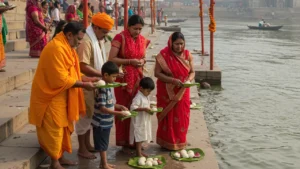
The formal ceremony begins with the sankalpa — the Sanskrit declaration of intent naming the performer, their lineage, and their ancestors. This is followed immediately by tarpan — the water offering with black sesame seeds and Kusha grass, poured through the right hand into the river or ritual vessel while reciting each ancestor’s name. The standard sequence honours the paternal grandfather (Pitamaha), great-grandfather (Prapitamaha), and great-great-grandfather (Vriddha Pitamaha), followed by maternal grandfather (Matamaha) and his lineage.
4. Pind Daan at the River
After tarpan, the pandit prepares the pindas — round rice balls made from boiled rice mixed with sesame seeds, honey, and ghee. These pindas are placed at the riverbank with each ancestor’s name recited and the corresponding mantra chanted. For Ashtami Shradh, some pandits add a pinch of sacred ash (vibhuti) to the pindas in acknowledgment of the Shaiva energy of this tithi. The deep meaning behind Pind Daan becomes even more apparent when performed at a sacred confluence like Prayagraj.
5. Brahmin Bhojan, Cow and Crow Feeding
The riverbank portion of the Shradh is followed by the Brahmin bhojan — a full sattvik meal served to a qualified Brahmin pandit with genuine devotion and care. Before the Brahmin eats, portions are set aside for the cow (go-gras), crows (kaka bali), dogs, and ants. After the meal, dakshina is offered with respect and without reluctance — the Brahmin’s satisfaction is considered direct satisfaction of the ancestors.
Significance in Hindu Scriptures
Ashtami Shradh’s authority is established across several important Puranic and Smriti texts. The Shiva Purana describes the eighth tithi as Lord Shiva’s special day, noting that all rites performed on Ashtami carry Shiva’s blessing for liberation (mukti) — the ultimate goal of all ancestral rites. When Shradh is performed on Ashtami, the ancestor’s soul is said to receive Shiva’s direct grace in addition to the family’s offering.
The Garuda Purana (Chapters 10-12) explains that ancestors who resided on Ashtami Tithi are among the souls for whom the Pitru Paksha Shradh has the most immediate effect — the eighth day being a temporal gateway through which offerings are transmitted with special efficiency. The Purana uses the metaphor of a well-oiled door: some tithis allow offerings to reach the ancestors easily, and Ashtami is described as one of those well-open doorways.
The Vishnu Dharmashastra states that failing to perform Shradh for an ancestor who died on Ashtami creates a specific form of Pitru Dosha associated with health obstacles and chronic illness in the family — particularly affecting the bones and joints. The prescribed remedy, as with all forms of Pitru Dosha, is to perform the missed Shradh with appropriate remedial rituals, ideally at a tirtha like Prayagraj or Gaya.
Do’s and Don’ts on Ashtami Shradh
Do’s
- Visit a Shiva temple in the morning before your Shradh ceremony and offer bilva leaves and water to the Shiva lingam
- Use black sesame seeds (kala til) generously — they are the most sacred ingredient in all Shradh offerings
- Light a sesame oil lamp (til tel ka diya) in the southern direction of your home on this day, in the name of your ancestors
- Recite the Maha Mrityunjaya Mantra 108 times on behalf of your ancestors — this mantra’s liberating energy is especially potent on Ashtami
- Donate medicines, blankets, or food to the needy in memory of ancestors who died after illness
- Chant the Pitru Stotram after completing the Shradh ceremony
Don’ts
- Do not perform Shradh if you are in a state of ritual impurity (ashaucha) — within 10 days of a birth or death in the immediate family
- Avoid non-vegetarian food, alcohol, onion, and garlic throughout the day of Shradh
- Do not perform the ritual half-heartedly or rush through it — the quality of devotion matters as much as the correct procedure
- Avoid Shradh after sunset — the evening belongs to a different spiritual realm and Shradh’s window closes with the afternoon
- Do not perform Shradh while wearing torn, dirty, or unclean clothing
- Avoid loud celebrations, music, or entertainment on this day of ancestral solemnity
Perform Ashtami Shradh with Prayag Pandits
The sacred Triveni Sangam at Prayagraj — where the Ganga, Yamuna, and invisible Saraswati rivers meet — is considered one of the supreme tirthas for all forms of ancestral worship. The Prayag Mahatmya specifically declares that Shradh at this location multiplies the merit of the ritual beyond measure, granting the departed ancestor swift liberation from the ancestral realm.
Prayag Pandits offers complete Ashtami Shradh services for Pitrupaksha 2026 at Prayagraj, Varanasi, and Gaya. Our experienced Vedic pandits are trained in the complete Parvan Shradha tradition — from the proper sankalpa and tarpan to authentic pinda preparation and the full Brahmin bhojan ceremony. We also provide services for families who cannot be physically present, arranging the ritual on their behalf with live video documentation.
Frequently Asked Questions about Ashtami Shradh
See our complete guides for adjacent Pitru Paksha days: Saptami Shradh 2026 (October 2) and Navami Shradh 2026 (Matru Navami) (October 4). The full calendar and significance of all sixteen ancestral days is covered in our Pitrupaksha Complete Ritual Guide.
Related Services by Prayag Pandits
- 🙏 Pind Daan in Gaya (Pitrupaksha) — Starting from ₹7,100
- 🙏 Shradh at Prayagraj — Starting from ₹7,100
- 🙏 Tarpan in Prayagraj — Starting from ₹5,100
अक्सर पूछे जाने वाले प्रश्न
Is Ashtami Shradh connected to Durga Ashtami or Shiva Ashtami?
Ashtami Shradh during Pitru Paksha is a separate observance from Durga Ashtami (during Navratri) or Shiva Ashtami fasts. However, the eighth tithi shares Shaiva and Shakta spiritual energy across all its manifestations. Performing a brief Shiva temple visit on the morning of Ashtami Shradh is considered auspicious and complementary to the ancestral ritual.
My grandfather died on Krishna Paksha Ashtami — should I perform Shradh on Pitru Paksha Ashtami or Shukla Paksha Ashtami?
Pitru Paksha's Ashtami Shradh (Krishna Paksha Ashtami of Bhadrapada) covers ALL Ashtami tithis throughout the year — both Shukla and Krishna Paksha Ashtami of every month. So yes, if your grandfather died on Krishna Paksha Ashtami in any month, Pitru Paksha Ashtami Shradh (October 3, 2026) is exactly the right day for his annual Shradh.
What is the Pitru Dosha associated with Ashtami ancestors?
According to the Vishnu Dharmashastra, neglected ancestors who died on Ashtami are said to generate a specific Pitru Dosha affecting the bones, joints, and physical vitality of descendants. This can manifest as chronic back pain, arthritis, unexplained fatigue, or persistent health issues across generations. The remedy is to perform Ashtami Shradh with complete ritual procedure, ideally at a tirtha like Prayagraj, and to recite the Maha Mrityunjaya Mantra 108 times for the ancestor.
Can I perform Ashtami Shradh and Navami Shradh on consecutive days?
Yes, absolutely. Many families perform Shradh on consecutive days during Pitru Paksha for different ancestors. Ashtami Shradh on October 3 and Matru Navami (Navami Shradh) on October 4 are completely independent ceremonies for different ancestors. If you have ancestors who died on both these tithis, you can arrange both through your pandit — either at the same location or at different locations if circumstances require.
How do I know if my ancestor died on Ashtami Tithi?
If you have the English calendar date of your ancestor's death, you can convert it to the Hindu Panchang tithi using any Hindu calendar converter (drikpanchang.com is reliable). Enter the death date and it will show the corresponding tithi. If you don't have the death date at all, use Sarva Pitru Amavasya (October 10, 2026) as your primary Shradh day, which covers all tithis.
अपना पवित्र अनुष्ठान बुक करें
भारत भर के पवित्र स्थलों पर वेद-प्रशिक्षित पंडितों द्वारा वीडियो प्रमाण सहित प्रामाणिक अनुष्ठान।
2,263+ परिवारों की सेवा
वीडियो प्रमाण शामिल
2019 से
