
अभी तक कोई अनुष्ठान नहीं चुना गया।
पूजा पैकेज देखें →मुख्य बिंदु
इस लेख में
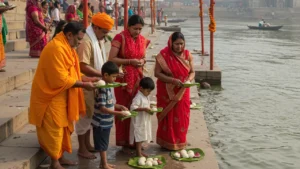
The Shradh day begins before sunrise with a purifying bath. At Prayagraj, devotees take a holy dip at the Triveni Sangam in the early morning — an act that simultaneously purifies the performer and opens the spiritual conduit between the living and the ancestors. After bathing, the performer wears clean white or unstitched clothing and performs a brief morning puja to the household deity before commencing the Shradh ceremony.
Dashami Shradh — the Shradh of the tenth lunar day during Pitru Paksha — falls on Monday, October 5, 2026. The tenth tithi, Dashami, carries the auspicious energy of completion and fulfilment: ten is the number of perfection in the decimal system, of the ten avatars of Vishnu (Dashavatar), and of the ten directions (Dashadik) that encompass all of existence. In the context of ancestral rites, Dashami Shradh honours family members who departed this world on the tenth lunar day of any month and year, and also provides a powerful opportunity for families to perform Shradh for ancestors whose exact death tithi is uncertain or has been forgotten across generations. With the sacred fortnight of Pitru Paksha approaching its final days, Dashami Shradh carries the weight of accumulated ancestral memory and the promise of liberation for souls faithfully remembered.
What is Dashami Shradh?
Dashami Shradh is one of the sixteen Parvan Shradhas observed during Pitru Paksha — the sacred fortnight in the dark half of Bhadrapada month dedicated entirely to ancestral worship and remembrance. As the tenth day of this fortnight, Dashami Shradh marks the final phase of Pitru Paksha before the concluding three days (Ekadashi, Dwadashi-Trayodashi, and Sarva Pitru Amavasya).
Dashami Shradh is also known as Dasami Shradh in some regional traditions. The Sanskrit word dashama means tenth, and this positional significance is reflected in the ritual’s character: just as the tenth day of many Hindu observances marks a pivotal moment (Vijayadasami, Dussehra, the tenth day of birth rituals), Dashami Shradh marks a turning point in Pitru Paksha — the beginning of the final stretch toward the universal offering of Sarva Pitru Amavasya on October 10, 2026.
The Garuda Purana — the primary Hindu scriptural authority on death, ancestral realms, and Shradh — places Dashami among the essential Parvan Shradha tithis, stating that ancestors who are honoured on their designated tithi during Pitru Paksha receive the offering with perfect clarity and completeness. Understanding our ancestral debt (Pitru Rin) helps us appreciate why these rituals carry such deep spiritual and karmic weight for the living family as well as for the departed souls.
Dashami Shradh 2026 Date and Muhurat
In 2026, Pitru Paksha begins on September 26 (Purnima Shradh) and concludes on October 10 (Sarva Pitru Amavasya). Dashami Shradh in 2026 falls on Monday, October 5, 2026.
The auspicious time windows for performing Dashami Shradh are:
- Kutup Muhurat — approximately 11:36 AM to 12:24 PM. The most sacred window for Shradh rituals, when the sun is at midday and the ancestral realm is most accessible to offerings from the living.
- Rohina Muhurat — approximately 12:24 PM to 1:12 PM. Immediately following Kutup, this is the secondary auspicious period fully valid for all Shradh karma.
- Aparahna Kala — the broader afternoon period from approximately 1:12 PM to 3:36 PM. Shradh may be performed throughout this window when the primary muhurats are unavailable.
Monday (Somavara) is associated with the Moon (Soma/Chandra) and with Lord Shiva. For the exact Dashami Shradh muhurat on October 5, 2026, devotees can verify timings on the DrikPanchang Pitrupaksha calendar. In Vedic tradition, the Moon is the lord of the ancestors — the Chandraloka (Moon world) is where many ancestral souls reside between rebirths. Performing Dashami Shradh on a Monday is considered especially potent: the lunar energy of Monday, combined with the tenth tithi’s energy of completion and fulfilment, creates a powerful confluence for ancestral liberation.
Dashami Shradh follows Matru Navami Shradh (October 4 — the special day for deceased mothers) and precedes Ekadashi Shradh (October 6). Together, these final days of Pitru Paksha form the most spiritually charged period of the entire fortnight.
Who Should Perform Shradh on Dashami Tithi?
The primary obligation to perform Dashami Shradh belongs to those whose direct-line ancestors — paternal or maternal — departed this world on the tenth lunar day of any month in any year. This includes both Shukla Paksha Dashami and Krishna Paksha Dashami across all twelve months of the Hindu calendar.
The Dharmashastra tradition also identifies several specific categories for whom Dashami Shradh carries particular relevance:
- Ancestors who were devoted to Lord Vishnu or Rama — the tenth avatar of Vishnu (Kalki) and the energy of the Dashami tithi are associated with Vaishnava traditions, making this day especially meaningful for families with Vaishnavite lineages
- Ancestors who passed away during or around the festival of Vijayadasami (Dussehra) — this festival falls on the Dashami tithi of Ashwin Shukla Paksha, and families who lost elders around this time may find Pitru Paksha Dashami particularly resonant
- Older family members whose precise death tithi is uncertain — Dashami’s character as a day of completion makes it suitable for offering Shradh with a broad intention covering multiple ancestors
- Families with ancestral connections to the Kshatriya tradition — the tenth day is associated with royal dharma and warrior traditions, and families from martial lineages traditionally honour their warrior ancestors on Dashami
At a sacred tirtha like the Triveni Sangam, the combined merit of the Dashami tithi and the tirtha’s eternal holiness amplifies the Shradh’s power beyond what any single calculation could measure. The Prayag Mahatmya repeatedly emphasises that even a brief, sincere act of ancestral remembrance at Prayagraj carries liberation-granting power.
Dashami Shradh Rituals and Procedures
The Dashami Shradh follows the standard Parvan Shradha format established in the Dharmashastra tradition. Here is the complete step-by-step procedure:
1. Dawn Bath and Morning Puja
The Shradh day begins before sunrise with a purifying bath. At Prayagraj, devotees take a holy dip at the Triveni Sangam in the early morning — an act that simultaneously purifies the performer and opens the spiritual conduit between the living and the ancestors. After bathing, the performer wears clean white or unstitched clothing and performs a brief morning puja to the household deity before commencing the Shradh ceremony.
2. Sankalpa — The Sacred Declaration
The formal Shradh ceremony begins with the sankalpa — the Sanskrit declaration of intent in which the performer states their full name, their father’s name, their gotra (ancestral lineage traced to a Vedic sage), the current Hindu calendar details (year, month, paksha, tithi, nakshatra), the sacred location, and the names of the specific ancestors being honoured. The sankalpa transforms the ritual from a general religious act into a precisely directed spiritual transmission to the named ancestors.
3. Tarpan — Water Offering for Ancestral Nourishment
Tarpan is the core water-offering ceremony of Shradh. The performer stands at the riverbank — or at a tarpan vessel if at home — and cups water mixed with black sesame seeds (kala til), barley (jau), and Kusha grass in the right palm. With each ancestor’s name recited, the water is poured through the hand in a slow, deliberate stream into the river or vessel. The standard sequence covers three generations of paternal ancestors (Pitamaha, Prapitamaha, Vriddha Pitamaha) and the corresponding maternal lineage. For Dashami Shradh, the tenth-day Tarpan is specifically intended for the Dashami-departed ancestor at the head of the offering.
4. Pind Daan — Offering the Body of Nourishment
Following tarpan, the pindas (rice balls) are prepared and offered. The pindas are made from cooked rice blended with sesame seeds, honey, ghee, and sometimes barley flour and Kusha grass tips. Each pinda is formed with care, named after the ancestor it represents, and placed at the riverbank with the corresponding mantra. The deep significance of Pind Daan lies in this: the pinda is understood as a temporary physical body for the ancestral soul, through which it can receive the energy of the offering. At Prayagraj, the pindas are placed at the Triveni Sangam where the sacred waters receive and transmit them to the ancestral realm.
5. Brahmin Bhojan — Feeding the Living Representative
A qualified Brahmin pandit is hosted for a full sattvik meal prepared without onion, garlic, or non-vegetarian ingredients. The Brahmin is treated as the living form of all ancestors — with the understanding that as he eats, the ancestors receive nourishment in the subtle realm. The meal should be served with genuine care: use proper utensils, serve with the right hand, and offer each dish with a word of respectful offering. After the meal, dakshina — a monetary gift, preferably including cloth — is offered with both hands and sincere gratitude.
6. Kaka Bali, Go-Gras, and Final Offerings
The Shradh concludes with three subsidiary offerings: kaka bali (food for crows, considered messengers of Yama and the ancestors), go-gras (food for a cow), and a small offering of food placed on the ground for ants. These three offerings extend the reach of the Shradh to all ancestral souls across different planes, not just the primary ancestors named in the sankalpa.
Significance in Hindu Scriptures
The scriptural basis for Dashami Shradh is found primarily in the Garuda Purana, the Vishnu Purana, and the Matsya Purana. The Garuda Purana (Pretakalpa) provides the most detailed treatment of tithi-based Shradh, listing Dashami among the Parvan Shradhas and stating that ancestors who died on the tenth lunar day receive their most effective nourishment and liberation when Shradh is performed on the tenth day of Pitru Paksha.
The Vishnu Purana connects the Dashami tithi to Lord Vishnu’s ten avatars (Dashavatar), suggesting that Shradh performed on this day receives Vishnu’s direct grace. The text states: “On Dashami, the ancestral souls who receive Shradh gain access to the Vishnu-loka, the highest of all ancestral realms, through the grace of the ten divine forms.” This connection to Vishnu makes Dashami Shradh especially significant for Vaishnava families.
The Matsya Purana adds that Dashami Shradh at a sacred tirtha — particularly at Prayagraj’s Triveni Sangam — serves as a complete ritual covering not just the primary ancestor but all secondary ancestors who may have been missed or inadequately honoured in previous years. This “completeness” quality of the tenth day makes Dashami Shradh a powerful opportunity for families who feel their ancestral obligations may have gaps.
Do’s and Don’ts on Dashami Shradh
Do’s
- Recite the Vishnu Sahasranama or a Vaishnava stotra on behalf of your ancestors — the Dashami tithi’s Vishnu connection amplifies this practice
- Use black sesame seeds (kala til) abundantly in all Shradh offerings — they are the most essential ingredient for ancestral rituals
- Offer a tulsi plant (or tulsi leaves) along with your pinda — tulsi is especially sacred to Vishnu and its presence in Dashami Shradh is considered auspicious
- Light ten small oil lamps (diyas) in your ancestors’ memory — the number ten on Dashami amplifies the lighting ritual
- Donate food to ten families or individuals in your ancestors’ names — the merit of ten-fold donation on Dashami is considered especially meritorious
- Visit a Vishnu temple on this day before or after the Shradh ceremony
Don’ts
- Do not eat meat, fish, eggs, onion, garlic, or any tamasic food on Dashami Shradh day
- Avoid starting new ventures, signing contracts, or making major financial decisions during Pitru Paksha
- Do not skip the Brahmin bhojan component — the ritual is incomplete without this essential step
- Avoid performing the Shradh during the hours of night — the entire ceremony must be completed within the afternoon window
- Do not use an iron vessel for tarpan — copper, brass, or silver are the correct metals
- Avoid sleeping or resting during the ritual — maintain alertness and devotion throughout
Perform Dashami Shradh with Prayag Pandits
The Triveni Sangam at Prayagraj — where the Ganga, Yamuna, and invisible Saraswati meet in an eternal confluence — has been the most revered location for ancestral rituals in India since the time of the Puranas. The Prayag Mahatmya in the Skanda Purana describes this sacred confluence as the point where the earthly and divine realms touch most intimately, making it the ideal location for sending the living family’s love and offerings to the ancestral soul.
Prayag Pandits offers complete Dashami Shradh services for Pitrupaksha 2026 at Prayagraj, Varanasi, and Gaya. Our qualified Vedic pandits perform the complete Parvan Shradha with proper sankalpa, tarpan, pinda daan, and Brahmin bhojan — ensuring that your ancestors receive a complete and authentic offering on their designated tithi. We serve both resident and NRI families, with live video documentation available for those who cannot travel to India.
Frequently Asked Questions about Dashami Shradh
See our complete guides for the adjacent Pitru Paksha days: Navami Shradh (Matru Navami) 2026 (October 4) and our Pitrupaksha Complete Ritual Guide for all sixteen days of this sacred fortnight. For earlier days in the batch, visit our guides for Panchami Shradh, Shashthi Shradh, Saptami Shradh, and Ashtami Shradh.
Related Services by Prayag Pandits
- 🙏 Pind Daan in Gaya (Pitrupaksha) — Starting from ₹7,100
- 🙏 Shradh at Prayagraj — Starting from ₹7,100
- 🙏 Tarpan in Prayagraj — Starting from ₹5,100
अक्सर पूछे जाने वाले प्रश्न
Is Dashami Shradh more important than other Shradh days?
Each Shradh day during Pitru Paksha is equally important for its specific ancestors — the one who died on Dashami Tithi benefits most from Dashami Shradh. However, Dashami carries a special quality of completeness and fullness that makes it a powerful day for comprehensive ancestral remembrance. Families who want to perform a broad-scope Shradh covering multiple unknown tithis often choose Dashami in addition to Sarva Pitru Amavasya.
What is the Vishnu connection to Dashami Shradh?
The tenth tithi (Dashami) is traditionally associated with Lord Vishnu through the concept of the Dashavatar — Vishnu's ten divine incarnations. The Vishnu Purana states that ancestors who receive Shradh on Dashami gain access to Vishnu's grace and have an accelerated path toward liberation through the spiritual merit of the tenth avatar's completeness. Reciting the Vishnu Sahasranama or offering tulsi on Dashami Shradh invokes this Vaishnava connection.
If I can only perform one Shradh day during Pitru Paksha 2026, which day should I choose?
If you can only perform Shradh on one day, the universally recommended choice is Sarva Pitru Amavasya (October 10, 2026) — the last day of Pitru Paksha, which covers all ancestors regardless of their death tithi. If you know your ancestor's specific tithi, perform Shradh on that day for the most precise and effective result. If you are uncertain, Amavasya is your safest and most complete option.
Can I perform Dashami Shradh for ancestors who died in a foreign country?
Yes, absolutely. Shradh is performed by the descendant for the ancestor's soul — the location of the ancestor's death does not affect the ritual's validity or effectiveness. What matters is the correct procedure, proper sankalpa naming the ancestor, and the sincerity of the offering. Many NRI families have their ancestors who passed abroad and perform their Shradh at sacred Indian tirthas like Prayagraj through pandits like Prayag Pandits.
How close to Sarva Pitru Amavasya is Dashami Shradh?
Dashami Shradh (October 5, 2026) falls five days before Sarva Pitru Amavasya (October 10, 2026). The final five days of Pitru Paksha — Dashami through Amavasya — are considered the most spiritually charged period of the entire fortnight, as the ancestors are believed to be drawing closest to the earthly realm in anticipation of Amavasya. Performing Shradh during these final days, especially on the specific tithi of your ancestor, is considered extraordinarily auspicious.
अपना पवित्र अनुष्ठान बुक करें
भारत भर के पवित्र स्थलों पर वेद-प्रशिक्षित पंडितों द्वारा वीडियो प्रमाण सहित प्रामाणिक अनुष्ठान।
2,263+ परिवारों की सेवा
वीडियो प्रमाण शामिल
2019 से
