अभी तक कोई अनुष्ठान नहीं चुना गया।
पूजा पैकेज देखें →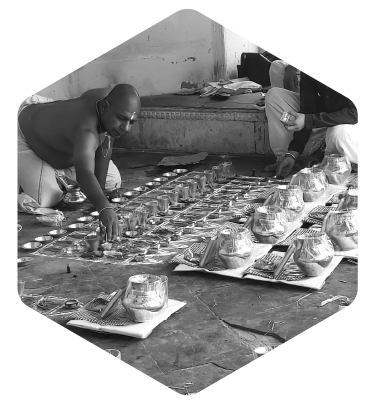
There are deaths that leave a family not just grief-stricken but deeply unsettled — an inexplicable heaviness in the house, recurring bad dreams, children falling ill without cause, or a feeling that the departed has not found peace. When death occurs in sudden, unnatural, or violent circumstances, the scriptures prescribe a specific remedy: Narayan Bali.
This is a two-part ritual — Narayan Bali and Nagbali — performed together to liberate souls trapped in a state of unresolved death, and to remove the dosha this unresolved state creates in the family's lineage.
Nagbali is performed alongside Narayan Bali when the ancestral disturbance is connected to the killing of a snake — particularly a large cobra — by an ancestor, whether intentionally or accidentally. The Naga (divine serpent) holds a significant place in Hindu cosmology, and such an act can create a naga dosha that passes through generations.
In practice, both rituals are performed together as a combined rite of three days at a specially qualified location. The most authoritative location for this ceremony in all of India is Trimbakeshwar — though our pandits also perform this at Gaya, Prayagraj, and Haridwar for families who cannot travel to Nashik.
Narayan Bali is a three-day ceremony. On the first day, preparatory rites and sankalpa (declaration of intent) are performed. On the second day, a symbolic cremation is performed — a human effigy made of darbha grass or atta (flour) is created, representing the departed soul, and the full Antyesti (last rites) procedure is enacted for it. This gives the soul the proper funeral rites it may have missed at the time of actual death.
On the third day, Pind Daan is performed and Narayan's blessings are invoked for the soul's liberation and the family's relief from dosha. Throughout the ceremony, Vedic hymns from the Garuda Purana and specific mantras from the Skanda Purana are chanted.
This is not a simple puja. It requires a pandit with specific training in these extended Vedic rites — someone who has performed this ceremony multiple times and understands its detailed procedure. Our pandits have performed hundreds of Narayan Bali ceremonies over the years.
We understand that many NRI families and those settled far from India experience the effects of pitru dosha without being able to easily travel for a remedy. We offer Online Narayan Bali — ₹35,000 — where our pandit performs the complete three-day ceremony at the sacred location on your behalf.
Throughout the ceremony, you are connected via video call and can participate in prayers and sankalpa from wherever you are. After the ritual, you receive a detailed ceremony report and photos from each day.
Many families who felt helpless about a loved one's troubled death have found relief through this service. The intention and devotion you bring to the ceremony, whether present or remote, is what matters most.
Our pandits often advise families to consider Narayan Bali when they describe:
We also offer Kaal Sarp Dosha remedies at Ujjain and Mangal Dosha puja for families dealing with other astrological afflictions. If you are unsure which ritual is right for your situation, speak with our pandit — they will guide you honestly.
Narayan Bali is a significant commitment — three days, at a sacred location, with proper Vedic procedure. We ask families to book at least two to three weeks in advance so the pandit can prepare properly. For Pitrupaksha bookings, please contact us at least a month ahead.
Call or WhatsApp us at +91 7754097777. Share the name and gotra of the departed, the circumstances of death, and your preferred location. Our pandit will speak with you in detail and guide you through the process.
Select your package and complete booking. Our team calls within 2 hours to confirm details.
Provide your gotra, departed soul's name, and any special requirements.
Experienced pandit performs the complete ceremony at the sacred site.
Full ceremony video on WhatsApp within 24 hours. Digital certificate shared via email.
The Garuda Purana and related scriptures classify these as Durmaran (requiring Narayan Bali): death by weapon strike or violence, suicide, drowning, fire, accident, sudden illness outside the normal life-span, snakebite, attack by wild animals (lions, tigers) or horned animals (bulls), lightning strike, black magic or sorcery (Maran, Mohan, Uchchatan), Brahmin's curse (Brahmadand), being touched by an untouchable at the moment of death, and any death where the scriptural last rites (Antyeshti) could not be completed properly. Families whose ancestors suffered any such death are traditionally advised to perform Narayan Bali at least once, ideally within the first year but any time afterward is also valid.
Narayan Bali is an ancestral liberation rite for ancestors who died an unnatural death (snakebite, fire, drowning, suicide). It performs a surrogate funeral using a wheat flour effigy. Nagbali absolves the sin of killing a cobra (Nag Hatya) through a symbolic funeral for the serpent. Narayan Bali can be performed at Prayagraj, Haridwar, and other tirthas. Nagbali is canonically restricted to Trimbakeshwar per Dharma Sindhu and Skandha Purana.
Narayan Bali Puja costs ₹31,000 at both Prayagraj and Haridwar with Prayag Pandits. This covers the complete 3-day ceremony including 3-5 pandits, all samagri, Brahmin bhoj, and documentation. The online option is ₹35,000.
The complete Narayan Bali ceremony spans 3 days. Day 1 covers Narayan Bali rituals with the five Kalashas, Day 2 covers Nag Bali rituals, and Day 3 includes purification prayers and Brahmin bhoj.
Narayan Bali can be performed any day, but Pitru Paksha (September 26 – October 10, 2026) is most auspicious. Amavasya days and the performer birth nakshatra days are also considered powerful.
Trimbakeshwar in Nashik is the most scripturally authoritative location for Nagbali specifically, as designated by the Dharma Sindhu and Skanda Purana. Prayagraj at the Triveni Sangam is equally authoritative for the broader Narayan Bali ritual and is preferred for families in North India given the power of the Ganga-Yamuna-Saraswati confluence. Haridwar and Gaya are also authoritative locations. The key is ensuring pandits at the chosen site are fully trained in the complete ritual sequence including all five suktas.
The Garuda Purana explicitly states that "the well-wishing sons, grandsons, and sapindas (close blood relatives)" must perform Narayan Bali to avoid Lokagarha — the spiritual condemnation that befalls a family when an ancestor dies unnaturally and is not liberated. When a son is unavailable, the hierarchy extends to grandsons, great-grandsons, the wife, daughter, daughter's son (Dauhitra), brother, and other sapinda relatives. If no family member can perform the ritual, a qualified Vedic priest may perform it on behalf of the family through a formal sankalpa naming the deceased and the gotra. We regularly conduct Narayan Bali on behalf of families — in person and for NRI families via remote arrangement.
Yes. Prayag Pandits offers Online Narayan Bali Puja at ₹35,000 where the 3-day ceremony is performed at Prayagraj on your behalf. You receive daily video updates and complete documentation.