
No rituals selected yet.
Browse Pooja Packages →Key Takeaways
In This Article
Among all the sixteen days of Pitru Paksha, Navami Shradh — also known as Matru Navami or Avidhava Navami — stands apart with a depth of emotional and spiritual significance that touches the hearts of families across India. In 2026, this sacred day falls on Sunday, October 4, 2026. The ninth tithi of the dark fortnight in Bhadrapada month is the one day in the entire Hindu calendar that is specifically and exclusively dedicated to performing Shradh for deceased mothers and married women who died before their husbands. If you have lost your mother, grandmother, or any other female ancestor who was a married woman at the time of her passing, Matru Navami is her designated day — the day her soul is most accessible to your love, your offerings, and your prayers for her liberation.
What is Navami Shradh — Matru Navami?
Navami Shradh is the Shradh of the ninth tithi (Navami) during Pitru Paksha. Like all tithi-based Shradh days, it honours ancestors who departed on the ninth lunar day of any month. But Navami Shradh carries an additional designation that makes it unique among all sixteen Shradh days: it is called Matru Navami — the Shradh day of the Mother.
It is also known as Avidhava Navami (avidhava means “one whose husband is still living” — i.e., a woman who died as a wife, not a widow). This day is the prescribed time for performing Shradh specifically for:
- Deceased mothers — regardless of which tithi they died on
- Deceased grandmothers and great-grandmothers
- Any female ancestor who was married at the time of her death (i.e., she died as a sauhagini or married woman, not as a widow)
- Female ancestors who died while their husbands were still living
The spiritual basis for this special designation comes from the Garuda Purana and Dharmasindhu, which recognize that the soul of a devoted wife and mother carries specific obligations and blessings to her family lineage. The Navami Shradh, when performed with genuine love and correct ritual procedure, is believed to release the female ancestor from the ancestral realm and grant her the liberation and peace she is owed.
Understanding the debt we owe our ancestors — especially our mothers — helps frame Matru Navami not as a ritual obligation but as a profound act of gratitude and love.
Why is Navami Shradh Called Matru Navami?
In Hindu cosmology, the mother occupies a supreme position — she is described as the first guru, the first form of the divine, and the most immediate channel through which the soul enters the world. The Taittiriya Upanishad places her above all other relationships with the declaration “Matru devo bhava” — honour your mother as God.
Given this exalted status, it would be spiritually incomplete for Pitru Paksha — the entire fortnight of ancestral honour — to not have a special day dedicated to deceased mothers. The ninth day, Navami, was designated specifically for this purpose by the Dharmashastra tradition. The ninth position carries its own spiritual symbolism: nine months of gestation, the nine forms of Devi, the nine planets — all connected to nurturing, creation, and cyclical care.
The “Avidhava” designation (for women who died before their husbands) is significant because in traditional Hindu society, a woman who dies while her husband lives is considered to have died at the height of her role and her blessings for the family. Such a woman’s Shradh is given special attention on Navami because her soul’s journey is intertwined with the family’s continued well-being — her blessings, if she is honoured properly, flow to her children and grandchildren in abundance.
Navami Shradh 2026 Date and Muhurat
In 2026, Pitru Paksha spans from September 26 (Purnima Shradh) to October 10 (Sarva Pitru Amavasya). Navami Shradh (Matru Navami) in 2026 falls on Sunday, October 4, 2026.
The auspicious time windows for Matru Navami Shradh are:
- Kutup Muhurat — approximately 11:36 AM to 12:24 PM. The primary window for all Shradh rituals; this midday period is when the sun’s position is said to facilitate the transmission of offerings to the ancestral realm.
- Rohina Muhurat — approximately 12:24 PM to 1:12 PM. The secondary auspicious period, equally valid for Matru Navami Shradh.
- Aparahna Kala — the broader afternoon period from approximately 1:12 PM to 3:36 PM. Permissible for the ceremony when the primary windows are unavailable.
Sunday (Ravivara) is associated with the Sun (Surya) — the life-giving force that sustains all existence, including the maternal principle. Performing Matru Navami on a Sunday is considered particularly auspicious for honouring mothers whose souls are connected to life, light, and nurturing energy.
Navami Shradh follows Ashtami Shradh (October 3) and precedes Dashami Shradh (October 5). Families wishing to perform Shradh on multiple consecutive days can arrange this through Prayag Pandits at Prayagraj.
Who Should Perform Shradh on Navami Tithi?
Navami Shradh has a broader eligibility than most other tithi-based Shradh days, because of the Matru Navami provision:
- Anyone whose mother has passed away — regardless of which tithi she died on — may perform Shradh on Matru Navami as a special offering for her soul
- Those whose paternal or maternal grandmother has passed away and who died as a married woman
- Those with aunts, sisters-in-law, or other close female relatives who died while married and whose death tithi is not specifically known
- Those whose ancestors died on Navami Tithi (the ninth lunar day of any month in any year) — this is the primary tithi-based obligation
- Families seeking to honour the collective female ancestors of their lineage — all the mothers, grandmothers, and great-grandmothers going back through the generations
The Dharmasindhu specifically states that if a son fails to perform Matru Navami Shradh for his deceased mother, the mother’s soul remains unsatisfied and the son incurs a specific form of Pitru Dosha — which can manifest as difficulties with women in the family, maternal health issues in future generations, and an absence of the “mother’s blessing” in all domestic endeavours.
Matru Navami Shradh Rituals and Procedures
The Matru Navami Shradh follows the standard Parvan Shradha format but with additional elements that specifically honour the female ancestor. Here is the complete procedure:
1. Morning Preparation and Invocation of the Mother
The day begins with a purifying bath. Many families on Matru Navami also perform a brief puja to a household deity or photograph of the deceased mother — lighting a lamp, offering flowers, and reciting her name three times to invite her presence. This personal invocation before the formal Shradh is a beloved tradition that transforms the ritual from obligation into intimate communion.
2. Sankalpa — Naming the Mothers
The sankalpa for Matru Navami specifically names the female ancestors being honoured. A son performing Shradh for his mother will state her name, her gotra (or his father’s gotra, to which she was joined by marriage), and his own lineage details. The sankalpa covers up to three generations of deceased mothers: the mother (Mata), the paternal grandmother (Pitamahi), and the paternal great-grandmother (Prapitamahi), as well as the maternal grandmother (Matamahi) if she has passed.
3. Tarpan for Female Ancestors
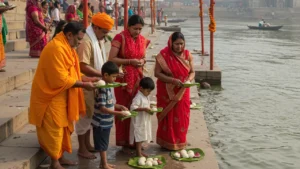
Tarpan for female ancestors is performed using water mixed with black sesame seeds and white flowers (especially white hibiscus or jasmine, which are associated with feminine purity). At the sacred confluence of Triveni Sangam, the water offered to a deceased mother is considered to reach her soul with especial directness, carried by the Ganga’s sacred current.
4. Pind Daan — Offerings Shaped with Love
For Matru Navami, the pindas are sometimes prepared with a mixture that includes milk and sugar in addition to the standard rice, sesame, and ghee — symbolising the sweetness and nourishment of a mother’s love. As each pinda is placed at the riverbank, the son or daughter recites the mother’s name and mentally offers her the pinda as a continuation of the family bond that death does not sever. The profound significance of Pind Daan is especially moving in the context of performing it for one’s own mother.
5. Special Offerings for the Mother
Beyond the standard Shradh format, Matru Navami Shradh often includes additional offerings that reflect the mother’s personal life and devotions:
- Offering the mother’s favourite foods (in a vegetarian, non-tamasic preparation) to the Brahmin as part of the bhojan
- Donating the mother’s favourite colour of cloth to the Brahmin’s wife or to a poor woman
- Feeding a cow — the mother goddess’s earthly symbol — with special care and affection
- Lighting a ghee lamp in her name and placing it near a tulsi plant if she was a tulsi devotee
6. Brahmin Bhojan with a Special Touch
The Brahmin bhojan on Matru Navami should include a woman’s favourite sweet dish if known — whether it is kheer, halwa, or another preparation. This sweet item is served first to the Brahmin with the explicit mention that it is offered in the memory of the deceased mother, and the Brahmin accepts it as a direct representative of the departed maternal soul.
Matru Navami Special Tip
On Matru Navami, many families bring their mother’s favourite saree or dupatta to the ritual site and offer it as part of the Brahmin dakshina — donating it to the Brahmin’s wife or to a poor woman in the mother’s name. This personal touch is believed to directly comfort the mother’s soul, and many families report dreaming of their mothers after this act of loving remembrance.
Significance in Hindu Scriptures
The scriptural foundation for Matru Navami is especially rich. The Garuda Purana (Pretakalpa, Chapter 14) includes a moving passage in which Garuda asks Vishnu about the special obligations to deceased mothers, and Vishnu responds by describing Navami Shradh as the day of the greatest maternal merit — the day on which a devoted son or daughter can do the most for their mother’s soul.
The Matsya Purana includes Matru Navami in its list of essential Shradh days, stating: “On Navami, the souls of women who lived as faithful wives (sauhaginis) are especially accessible. The offerings made to them on this day reach them directly, without impediment. The son who performs this Shradh with love earns his mother’s eternal blessing and protection.”
The Skanda Purana’s Prayag Mahatmya goes further, declaring that performing Matru Navami Shradh at the Triveni Sangam — the sacred meeting of the Ganga and Yamuna — grants a deceased mother immediate liberation (moksha). The two rivers are associated with masculine (Yamuna — solar) and feminine (Ganga — lunar) cosmic principles, and the confluence of these two rivers is said to provide a uniquely complete spiritual gateway for female souls seeking liberation.
Do’s and Don’ts on Matru Navami
Do’s
- Begin the day by remembering your mother — look at her photograph, speak to her as if she is present, and tell her of your love before beginning the formal ritual
- Prepare or include your mother’s favourite food in the Brahmin bhojan offering
- Donate a white or colourful saree (in your mother’s favourite colour) to a needy woman or to the Brahmin’s wife
- Offer white flowers — jasmine, white lotus, or white marigold — along with the standard sesame offerings
- Feed a cow with special reverence — offer her fresh grass and jaggery
- If your mother was devoted to a particular deity, perform a brief puja at that deity’s temple on this day as an additional honour
- Recite the Matru Panchakam of Adi Shankaracharya — a beautiful Sanskrit stotra of devotion to the mother
Don’ts
- Do not approach this ritual with grief that overwhelms you — your composure and devotion during the ritual is a gift to your mother’s soul. Grieve after, but during the ritual, be present and peaceful
- Do not skip the Brahmin dakshina — offering insufficient or reluctant dakshina diminishes the ritual’s effect
- Avoid all non-vegetarian food, alcohol, onion, and garlic on this day
- Do not perform the ritual if you are in ritual impurity (ashaucha)
- Avoid harsh words or arguments throughout the day — your mother’s Shradh day should reflect the peace she deserves
- Do not eat before the ritual is complete and the Brahmin has been properly fed and honoured
Perform Matru Navami Shradh with Prayag Pandits
Performing Matru Navami Shradh at the Triveni Sangam in Prayagraj is among the most powerful acts of love a child can offer their deceased mother. The confluence of the Ganga and Yamuna — the two rivers representing the cosmic mother principle in their most abundant forms — creates a spiritual field that is uniquely suited to ancestral rites for female souls.
Prayag Pandits offers complete Matru Navami Shradh services at Prayagraj, Varanasi, and Gaya, with particular sensitivity to the emotional dimensions of performing Shradh for a recently deceased mother. Our pandits guide you through every step — from the initial sankalpa naming your mother to the final Brahmin bhojan — with the care and reverence this day deserves. We also coordinate services for NRI and overseas families who wish to honour their mothers from abroad with live ceremony documentation.
Pitrupaksha 2026
🙏 Book Matru Navami Shradh at Prayagraj
Starting from
₹5,100
per person
Frequently Asked Questions about Navami Shradh (Matru Navami)
For adjacent days in the Pitru Paksha calendar, see our guides for Ashtami Shradh 2026 (October 3) and Dashami Shradh 2026 (October 5). The complete Pitru Paksha schedule and guidance for all sixteen ancestral days is in our Pitrupaksha Complete Ritual Guide.
Related Services by Prayag Pandits
- 🙏 Pind Daan in Gaya (Pitrupaksha) — Starting from ₹7,100
- 🙏 Shradh at Prayagraj — Starting from ₹7,100
- 🙏 Tarpan in Prayagraj — Starting from ₹5,100
Frequently Asked Questions
If my mother died on a different tithi (not Navami), should I still perform Matru Navami Shradh?
Yes. This is one of the most important aspects of Matru Navami: the Matru Navami provision applies to ALL deceased mothers, regardless of which tithi they died on. You should still perform your mother's primary Shradh on her death tithi during Pitru Paksha — but Matru Navami (October 4, 2026) is ADDITIONALLY designated for all deceased mothers. Many families perform both: the tithi-specific Shradh on the relevant day AND Matru Navami Shradh on October 4.
What is the difference between Matru Navami and Avidhava Navami?
They are different names for the same observance. Matru Navami emphasises the mother aspect — it is the Shradh day of all deceased mothers. Avidhava Navami specifically refers to women who died while their husbands were still living (avidhava = not-widow). Both names describe the same ninth tithi Shradh during Pitru Paksha. The dual name reflects the two populations this day serves: mothers in general, and specifically wives who predeceased their husbands.
Can a daughter perform Matru Navami Shradh for her deceased mother, or must it be a son?
A daughter can absolutely perform Matru Navami Shradh for her deceased mother. While the Dharmashastra tradition historically assigned Shradh performance to sons, the texts also recognize that daughters may perform Shradh when no son is available, and several traditions (especially in Bengal and South India) specifically encourage daughters' participation. The sincere love and devotion of a daughter for her mother is no less spiritually powerful than a son's.
My mother died very recently. Is it appropriate to perform Matru Navami Shradh so soon?
If your mother passed away within the past year, you may be in an extended mourning period. According to tradition, the primary Shradh observances (Uttar Kriya) for a recently deceased person are completed within the first year. Matru Navami Shradh can be performed even for a recently departed mother, and many families find it deeply comforting to honour their mother through this ritual even while grief is still fresh. Your pandit will guide you on any specific adjustments needed for a recent death.
Should I include both my paternal and maternal grandmothers in Matru Navami Shradh?
Yes, it is traditional and spiritually meritorious to include all deceased grandmothers in Matru Navami Shradh. The sankalpa covers your mother, paternal grandmother (Pitamahi), paternal great-grandmother (Prapitamahi), maternal grandmother (Matamahi), and maternal great-grandmother (Prapitamahi on the maternal side). Including all female ancestors who died as married women within the Matru Navami ritual is considered the most complete form of this observance.
Book Your Sacred Ritual
Authentic ceremonies performed by Veda-trained pandits with video proof at sacred sites across India.
2,263+ families served
Video proof included
Since 2019
