
अभी तक कोई अनुष्ठान नहीं चुना गया।
पूजा पैकेज देखें →मुख्य बिंदु
इस लेख में
Panchami Shradh is one of the most significant days during the sacred fortnight of Pitru Paksha 2026, falling on Wednesday, September 30, 2026. On this fifth tithi (lunar day) of the Krishna Paksha in Bhadrapada month, Hindu families perform sacred Shradh rituals to honour ancestors who departed this world on a Panchami date — whether in the Shukla Paksha or Krishna Paksha of any month. Also known as Kunwara Panchami, this day carries a particularly compassionate dimension: it is the designated day to perform Shradh for family members who died unmarried or without completing the full cycle of household life. If you have a father, brother, uncle, or any relative who passed away in youth before marriage, Panchami Shradh is their special day of remembrance and liberation.
What is Panchami Shradh?
The word Shradh (श्राद्ध) derives from the Sanskrit root shraddha — meaning faith, devotion, and sincerity. Panchami Shradh is performed on the fifth lunar day (Panchami Tithi) during Pitru Paksha, the sixteen-day period dedicated entirely to ancestral reverence in the Hindu calendar.
According to the Garuda Purana and Matsya Purana, every soul that departs on a specific tithi must be honoured through Shradh performed on that same tithi during Pitru Paksha. This ensures the departed soul receives pinda (ritual food offerings), tarpan (water libations), and dakshina (charitable donations made on their behalf), which sustain and liberate them in the realm of the ancestors (Pitru Loka).
Panchami Shradh is also called Kunwara Panchami because of its unique connection to those who died unmarried. In Hindu belief, a soul that departs before completing the grihastha ashrama (householder stage of life) — before marriage, before establishing a family — carries an unfulfilled longing. The Shradh performed on this day is believed to resolve that incompleteness, granting peace and forward movement to such souls. This is why Panchami Shradh holds deep emotional significance for families who have lost young sons, brothers, or other unmarried relatives.
Panchami Shradh 2026 Date and Muhurat
In 2026, Pitru Paksha begins on September 26 (Purnima Shradh) and concludes on October 10 (Sarva Pitru Amavasya). Panchami Shradh in 2026 falls on Wednesday, September 30, 2026.
The most auspicious time windows for performing Shradh rituals are:
- Kutup Muhurat — approximately 11:36 AM to 12:24 PM (local time). This is considered the most sacred window and is first preference for all Shradh karma.
- Rohina Muhurat — approximately 12:24 PM to 1:12 PM. Equally auspicious and accepted when Kutup Muhurat is unavailable.
- Aparahna Kala — the broader afternoon period from approximately 1:12 PM to 3:36 PM. Shradh may be performed throughout this window.
It is traditionally advised not to perform Shradh after sunset. For precise Panchami Shradh dates and muhurat timings, the DrikPanchang Pitrupaksha calendar is a reliable reference for all years. The rituals are specifically linked to the solar movement of the afternoon, when the sun is in a position that bridges the worlds of the living and the ancestors. Performing Shradh at dawn or night is considered inauspicious and spiritually ineffective.
If you are travelling to Prayagraj for Panchami Shradh, plan to arrive on September 29 to ensure you are rested and ready for the morning preparations. The rituals at Triveni Sangam typically begin with a holy bath before the Shradh ceremony commences.
Who Should Perform Shradh on Panchami Tithi?
The first and most important category of people who must observe Panchami Shradh are those whose ancestors departed on Panchami Tithi. This includes both Shukla Paksha Panchami and Krishna Paksha Panchami across all twelve months of the Hindu calendar. If your father, grandfather, mother, grandmother, or any direct-line ancestor passed away on a fifth lunar day, Panchami Shradh during Pitru Paksha is their annual day of offerings.
Beyond the tithi-based rule, Panchami Shradh holds a second, very specific eligibility: performing Shradh for unmarried ancestors. The Dharmashastra texts — particularly the Nirnaya Sindhu — specify that Kunwara Panchami is the appropriate occasion to honour:
- Sons, brothers, or male relatives who died before marriage
- Daughters or sisters who died unmarried
- Any young person who died before entering the householder stage of life
- Ancestors whose exact death tithi is unknown but who are believed to have been unmarried at the time of death
If your family has lost a young member in any generation — even several generations ago — it is spiritually meritorious to include an offering for them specifically on Panchami Shradh. Many families who are uncertain about their ancestors’ exact death tithis also perform a general Shradh on this day alongside the main Sarva Pitru Amavasya observance.
Additionally, families performing Shradh at a tirtha kshetra (sacred confluence) like Prayagraj have the advantage that the merit of the ritual is considered exponentially greater than that performed at home. The Prayag Mahatmya in the Matsya Purana specifically mentions that Shradh performed at the Triveni Sangam liberates the soul and breaks the cycle of rebirth for the departed. Understanding the debt we owe our ancestors (Pitru Rin) helps motivate devotees to perform these rites with complete sincerity.
Panchami Shradh Rituals and Procedures
Performing Panchami Shradh correctly requires careful preparation and adherence to the prescribed ritual sequence. Here is a step-by-step guide to what the ceremony involves:
1. Preparation (Sankalpa and Purification)
The day begins with a holy bath (snan) at a sacred river or at home with added sesame seeds and Gangajal if possible. The performer wears clean, preferably white or light-coloured clothes. A sankalpa (ritual declaration of intent) is then made in Sanskrit, naming the performer, their lineage (gotra), and the names of the ancestors being honoured.
2. Tarpan (Water Libation)
Tarpan (तर्पण) is the offering of water mixed with black sesame seeds (til), barley (yava), Kusha grass, and sometimes milk or honey. This water is poured through the right hand into a vessel or flowing water source, with each offering accompanied by the name of the specific ancestor. Tarpan is the foundational act of ancestral reverence — the water nourishes and sustains the ancestral soul in Pitru Loka.
3. Pind Daan (Rice Ball Offerings)
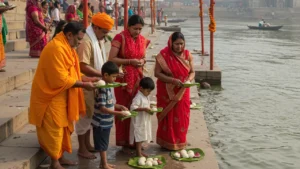
Pind Daan involves preparing rice balls (pindas) mixed with sesame seeds, honey, and ghee. These are offered as symbolic nourishment to the ancestors. At Prayagraj, the pindas are placed at the riverbank of the Triveni Sangam. The Garuda Purana describes how the pinda travels through subtle channels to reach the ancestor’s soul. The deep significance of Pind Daan is elaborated in both Gaya and Prayag traditions, with each location carrying specific spiritual merit.
4. Brahmin Bhojan and Dakshina
Feeding a qualified Brahmin priest — ideally one who is well-versed in the ancestral rituals (pitru karma) — is an essential component. The Brahmin represents the departed ancestor in the physical world. He must be fed a full meal with devotion, and dakshina (a respectful monetary gift) must be offered. The Vishnu Purana states that the satisfaction of the Brahmin directly translates to satisfaction of the ancestors.
5. Cow and Crow Feeding
Offering food to a cow (go-gras) and to crows (kaka bali) is an important subsidiary ritual. Crows are considered messengers between the world of the living and the ancestors in Hindu tradition. If a crow accepts the food offering, it is considered an auspicious sign that the ancestor has received the Shradh.
Important Ritual Tip for Panchami Shradh
When performing Panchami Shradh for an unmarried ancestor (Kunwara Panchami), include their full name and your family gotra in the sankalpa. If the exact name is unknown, you may say ‘all unmarried ancestors of my lineage’ (Sanskrit: Avivahita Pitru). This ensures the ritual reaches the correct soul.
Significance in Hindu Scriptures
The spiritual authority for Panchami Shradh comes from multiple Vedic and Puranic sources. The Garuda Purana (Pretakalpa, Chapter 10) provides detailed instructions on tithi-based Shradh, explaining that each tithi corresponds to a specific planetary energy that facilitates the transmission of offerings to the ancestors. The fifth tithi (Panchami) is associated with Mercury (Budha), which governs intellect, communication, and transition — making it particularly suitable for souls who departed in youth before completing life’s journey.
The Matsya Purana (Chapter 17) specifically mentions Kunwara Panchami as one of the crucial Shradh tithis, stating that failing to perform Shradh for unmarried ancestors causes Pitru Dosha — ancestral affliction that can manifest across generations as delays in marriage, fertility problems, and repeated misfortune in family lineages. Performing the Shradh with proper mantras and pindas is the prescribed remedy.
The Vishnu Dharmottara Purana adds that ancestors who receive Shradh on their designated tithi progress rapidly through the ancestral planes, ultimately attaining liberation (moksha) and no longer requiring rebirth. This is the highest spiritual gift a descendant can offer.
Do’s and Don’ts on Panchami Shradh
Do’s
- Wake early, take a cleansing bath, and maintain physical and mental purity throughout the day
- Use black sesame seeds (kala til) in all offerings — this is mandatory for Shradh validity
- Perform the Shradh during Kutup or Rohina Muhurat for maximum spiritual effect
- Remember all ancestors, not just those who died on Panchami — the primary ancestor of this tithi receives special honour but others may also be acknowledged
- Offer food to crows, cows, dogs (representing Yama’s messengers), and ants before eating yourself
- Maintain a compassionate, grief-free, prayerful state of mind throughout the ritual
Don’ts
- Do not eat non-vegetarian food, onion, or garlic on the day of Shradh
- Avoid arguments, harsh speech, or any form of violence on this sacred day
- Do not perform Shradh after sunset — the ritual window closes with the afternoon
- Avoid starting new ventures, making major purchases, or attending celebratory events on this day
- Do not use iron utensils for the ritual — copper, silver, or clay vessels are traditionally preferred
- Avoid wearing black or torn clothing during the ritual
Perform Panchami Shradh with Prayag Pandits
Performing Panchami Shradh at the sacred Triveni Sangam in Prayagraj — the divine confluence of the Ganga, Yamuna, and the invisible Saraswati — is considered one of the most powerful locations for ancestral rituals in all of India. The Prayag Mahatmya declares this site as supremely auspicious for Shradh, Pind Daan, and Tarpan, with the merit of rituals here being many times greater than at ordinary locations.
Prayag Pandits specialises in complete Panchami Shradh arrangements at Prayagraj, Varanasi, and Gaya — India’s three holiest pilgrimage sites for ancestral rites. Our qualified Vedic pandits guide you through every step of the ritual with proper mantras, correct pinda preparation, and the full Brahmin bhojan and dakshina tradition. We also arrange services for NRI and overseas families who wish to honour their ancestral debt from abroad.
Pitrupaksha 2026
🙏 Book Panchami Shradh at Prayagraj
Starting from
₹5,100
per person
Frequently Asked Questions about Panchami Shradh
For those also observing the adjacent days of Pitru Paksha, see our guides on Shashthi Shradh 2026 (October 1) and Saptami Shradh 2026 (October 2). For the complete overview of all sixteen days and their significance, visit our Pitrupaksha Complete Ritual Guide.
Related Services by Prayag Pandits
- 🙏 Pind Daan in Gaya (Pitrupaksha) — Starting from ₹7,100
- 🙏 Shradh at Prayagraj — Starting from ₹7,100
- 🙏 Tarpan in Prayagraj — Starting from ₹5,100
अक्सर पूछे जाने वाले प्रश्न
What is the special significance of Panchami Shradh compared to other Shradh days?
Panchami Shradh, also known as Kunwara Panchami, has a unique dual significance. It is the designated day to honour ancestors who died on a Panchami tithi AND a special day for performing Shradh for unmarried ancestors — those who departed before marriage or before completing the householder stage of life. No other single Shradh tithi carries this specific provision for unmarried souls.
Can I perform Panchami Shradh if I don't know which tithi my ancestor died on?
Yes. If you are uncertain about your ancestor's death tithi, you have two options: perform Shradh on Sarva Pitru Amavasya (October 10, 2026), which is specifically designed for all ancestors including those whose tithis are unknown; or if you believe your ancestor died unmarried, include them specifically in the Panchami Shradh ritual on September 30, 2026.
Is it mandatory to visit a tirtha (sacred site) for Panchami Shradh, or can it be done at home?
Shradh can be performed at home if travel to a tirtha is not possible. The essential requirements are the same: proper muhurat, black sesame seeds, tarpan, pinda preparation, and Brahmin bhojan. However, performing Shradh at sacred tirthas like Prayagraj, Gaya, or Varanasi is said to multiply the spiritual merit of the ritual many times over.
Who should perform the Panchami Shradh — son, daughter, or any family member?
Traditionally, Shradh is performed by the eldest son of the family. However, the Dharmashastra texts also allow daughters, sons-in-law, nephews, and other direct descendants to perform the ritual when the son is unavailable or has passed away. The key requirement is genuine devotion and proper ritual procedure.
What are the consequences of not performing Shradh on Panchami for an ancestor who died on this tithi?
According to the Garuda Purana, ancestors who do not receive Shradh on their designated tithi remain hungry and unsatisfied in Pitru Loka. This is said to create Pitru Dosha in the family — which can manifest as repeated obstacles in marriage, career, and health across generations. The prescribed remedy is to perform the missed Shradh at the earliest opportunity, ideally on Sarva Pitru Amavasya.
अपना पवित्र अनुष्ठान बुक करें
भारत भर के पवित्र स्थलों पर वेद-प्रशिक्षित पंडितों द्वारा वीडियो प्रमाण सहित प्रामाणिक अनुष्ठान।
2,263+ परिवारों की सेवा
वीडियो प्रमाण शामिल
2019 से
