


अभी तक कोई अनुष्ठान नहीं चुना गया।
पूजा पैकेज देखें →


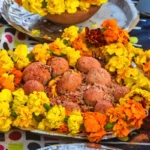
Pind Daan in Prayagraj this Pitrupaksha 2026
₹7,100
₹11,000
35% off
प्रति परिवार · सब शामिल
सत्यापित पंडित
2019 से
सभी सामग्री शामिल
निःशुल्क रद्दीकरण
यह पूजा बुक करें
पहले हमें व्हाट्सएप करें
No hidden charges · Cancel up to 48hrs · GST invoice provided
परिवार हमें क्यों चुनते हैं
यह कैसे काम करता है
1
Book & Confirm Your Date
Select your preferred date and complete the booking. Our team calls you within 2 hours to confirm details.
2
Share Family Details
Provide gotra, departed soul's name, and any requirements. Don't know your gotra? Our pandits will help.
3
Ritual Performed at Sacred Site
A Veda-trained pandit performs the complete ceremony as per shastra at the designated holy teerth.
4
Confirmation & Documentation
Booking confirmation on WhatsApp. Digital documentation available on select poojas within 48 hours.
क्या शामिल है
- Undecaying Merits & Eradication of Sins: The Agni Purana and Skanda Purana teach that any ancestral rite performed at Prayaga yields "undecaying merits." The very name of this Tirtha can destroy sins accumulated over many births. As the Lord of all Tirthas, Prayagraj has the inherent power to draw out and eradicate all negative karma, making it the ultimate place for purification.
- Elevation and Satisfaction of Ancestors (Pitrs): The Padma Purana assures that offering a Pinda into the Ganga at Prayaga leads to the salvation of the performer and ensures that their parents attain eternal heaven. The ancestors are pleased for a myriad of years. The Skanda Purana even states that a Shraddha performed in the Prayaga region can yield the benefit equivalent to a thousand Gaya Shraddhas.
इस अनुष्ठान के बारे में
Among all the sacred sites in India where ancestral rites are performed, Prayagraj holds a position that the scriptures describe in language that leaves little room for ambiguity. The Matsya Purana calls it Teerthraj — the king of all pilgrimage sites. The Prayag Mahatmya, an entire text dedicated to extolling the virtues of this city, declares that the merit earned at Prayagraj surpasses the combined merit of all other tirthas. For Pind Daan specifically, the confluence of three rivers — the Ganga, the Yamuna, and the invisible subterranean Saraswati — creates a site of extraordinary spiritual power for ancestral offerings.
Pitrupaksha 2026 runs from September 26 to October 10. This is the annual sixteen-day lunar fortnight during which the gates between the world of the living and the realm of the ancestors are considered most open. Performing Pind Daan during this period is said to carry many times the efficacy of the same rite done at other times of year — and when that rite is done at Prayagraj, at the Triveni Sangam itself, the scriptural promise is that the benefit reaches across seven generations of the family line, both above and below.
This in-person service brings you to the Triveni Sangam at Prayagraj, where our experienced pandit performs the complete Pind Daan ceremony at the exact point where the three sacred rivers converge. You come to the water, you speak your ancestors' names, and you make the offering with your own hands at the most hallowed confluence in the Hindu world. There is no substitute for that direct, embodied participation — and this package is designed to make that experience as seamless, meaningful, and complete as possible. If you want to understand the full ritual context before booking, our comprehensive Pind Daan guide covers every question in detail.
Why Prayagraj Is the Right Place for Pind Daan
Gaya in Bihar is the most famous location for Pind Daan, and the Vishnu Pada temple there carries its own profound authority. But the question families often ask — particularly after losing a parent or grandparent — is whether Gaya is the only option. The answer is unambiguous: Prayagraj is the Purana-sanctioned alternative that carries equal, and in some texts greater, spiritual weight. The Skanda Purana states directly that a Shradh performed in the Prayagraj region yields benefit equivalent to a thousand Gaya Shraddhas. That is not a minor claim — it is a statement about the accumulated spiritual gravity of this confluence.
The Triveni Sangam is not simply where two visible rivers meet. It is where three sacred rivers converge — a meeting described in Hindu cosmology as the union of the three primary streams of divine energy. The Ganga carries the blessings of Shiva and the Himalayas. The Yamuna brings the grace of Krishna and the Vrindavana tradition. The Saraswati, flowing underground from the northwest, carries the power of divine knowledge and learning. At the precise point where these three meet, the water is considered a tirthodaka of the highest order — a sacred liquid drawn simultaneously from three divine sources.
For ancestral offerings, this triple confluence matters because water from three sacred rivers, offered together, is understood to carry the combined potency to reach ancestors across multiple realms and multiple generations. A Pind offered at the Sangam is said to bring liberation not only to the specific ancestor in whose name it is given but to the entire lineage across seven generations both above and below the one performing the rite. During Pitrupaksha, when the gates between worlds are most open, these effects are amplified further. Performing Pind Daan at Prayagraj's Triveni Sangam during Pitrupaksha 2026 represents the highest expression of this tradition available in a single ceremony.
There is also a practical dimension worth noting for those planning their Pitrupaksha 2026 pilgrimage: Prayagraj is accessible. Major cities like Delhi, Lucknow, Mumbai, and Kolkata all have direct rail connections. The Sangam area is well-organized for pilgrims. Unlike Gaya, which requires more planning for first-time visitors, Prayagraj during Pitrupaksha is a familiar circuit with established infrastructure. For NRI families traveling from abroad, Prayagraj Airport (Bamrauli) accepts direct flights via connecting hubs. For an in-depth comparison, see our guide on who can perform Pind Daan and what the tradition expects from the performer.
What Is Included in This Package
- Complete Pind Daan ceremony performed at Triveni Sangam, Prayagraj
- Experienced, Shastri-qualified pandit who has conducted ancestral rites at the Sangam across multiple Pitrupaksha seasons
- Private boat ride to the Sangam (ghat-side ceremony arranged when river conditions require)
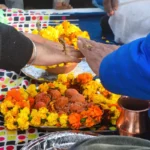
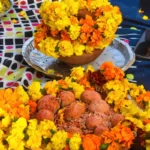
- All ritual samagri — rice flour, sesame seeds (til), Kusha grass, honey, ghee, flowers, sacred leaf plates, Gangajal
- Sankalp with your full family Gotra and individual ancestor names (both paternal and maternal lineages accommodated)
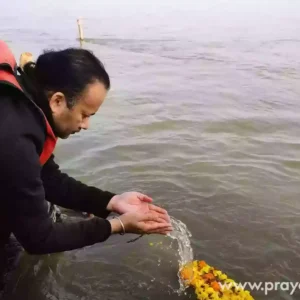
- Tarpan — the water offering made with Sangam jal in the name of each ancestor
- Sangam Poojan — formal worship of the confluence before the main rite
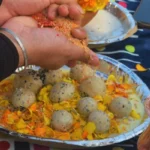
- Pind preparation from freshly made rice and sesame paste according to Shastra
- Recitation of Pitru Stotras, Pitru Sukta, and ancestral invocations throughout the ceremony
- Pre-ceremony consultation to gather your family's ancestral details, Gotra, and tithis
What Is Not Included
- Travel to Prayagraj from your city or country
- Accommodation in Prayagraj during your visit
- Asthi Visarjan, Narayan Bali Pooja, or Tripindi Shradh — these are separate ceremonies available on request
- Ceremonies for more than one family group under a single booking (each family requires its own booking)
- Photography or professional video recording (you are welcome to use your own phone or camera)
The Pind Daan Experience at Triveni Sangam
Prayagraj during Pitrupaksha is a city in a particular mode of collective intention. The ghats along the Sangam are filled with families from across India — from Maharashtra, Gujarat, Bengal, Tamil Nadu, and all the northern states — each performing Shradh and Tarpan for their own ancestors. There is a shared gravity to the atmosphere during this fortnight that is unlike anything at the Sangam during the rest of the year. The air carries the scent of sesame and sacred smoke. The river itself, in these weeks, seems to receive a quality of attention from the thousands of pilgrims on its banks that gives the ceremonies performed here a particular weight.
The boat ride to the Sangam takes approximately fifteen to twenty minutes each way. The boats used are the flat-bottomed wooden boats traditional to this stretch of the Ganga-Yamuna river system, managed by experienced boatmen who have been working the Sangam for generations. At the confluence, you can see where the Ganga's grey-green water meets the Yamuna's darker blue in a visible line on the surface — an actual, observable point where the two rivers become one. It is at this point that the boat anchors and the ceremony begins.
The ceremony opens with the Sankalpa — a formal declaration of intent in which the pandit establishes the time, place, and purpose of the rite in the precise formulation that the tradition requires. This declaration names the performer, their Gotra, their father's name and Gotra, and then the names and Gotras of the ancestors for whom the Pind Daan is being performed. The Sankalpa is the moment when the ceremony becomes real and specific — when the names spoken aloud enter the sacred space created by the Sangam and the ritual context.
After Sankalpa, the pandit performs Sangam Poojan — a worship of the confluence itself, acknowledging the divine presence of the three rivers and requesting their blessing and participation in the ancestral rite. Then the Pind is prepared: fresh rice flour mixed with sesame seeds, honey, and ghee, shaped by hand into a ball that represents the body of the ancestor and serves as a vehicle for the offering. The Pitru Stotras and ancestral invocations are recited as the Pind is offered into the river. Tarpan follows — water drawn from the Sangam is offered in cupped hands, released into the river with each ancestor's name spoken clearly. The ceremony closes with prayers for the wellbeing of the departed and blessings for the living descendants. You can learn more about the mantras used during this stage in our guide to Pitrupaksha Tarpan mantras.
Preparing for Your Pind Daan at Prayagraj
A well-prepared visit makes for a more focused and meaningful ceremony. The practical details are straightforward, and our pandit will guide you through everything in the pre-ceremony consultation — but there are things worth knowing in advance.
Getting to Prayagraj: The city is well connected by rail — Prayagraj Junction (formerly Allahabad Junction) and Naini Station are the main rail hubs, with direct trains from Delhi (approximately 7-8 hours), Varanasi (2 hours), Lucknow (2.5 hours), Mumbai (24 hours), and Kolkata (11 hours). Prayagraj Airport (Bamrauli, IATA: IXD) receives daily flights from Delhi and Mumbai. During Pitrupaksha 2026, September 26 to October 10, the city sees increased pilgrims — it is advisable to book train tickets at least three to four weeks in advance.
Accommodation near the Sangam: The Civil Lines area offers the widest range of hotels at all price points and is approximately 15 minutes from the Sangam ghats. Daraganj, which is closer to the river, has more basic options. During Pitrupaksha, accommodation fills quickly — book as early as possible. Budget pilgrims can inquire about dharamshalas, which are often available near the Sangam at nominal rates during the fortnight.
What to bring and what to wear: Light, natural-fiber clothing is appropriate. Many families observe white or off-white during Pitrupaksha as a mark of the fortnight's solemn spirit. Footwear is removed before boarding the boat and at the ghat. Bring your ancestral information — family Gotra (both paternal and maternal if performing for both lineages), names of the ancestors you are honoring, and the tithis of their passing if known. If you do not know the exact date of passing, the pandit will work with what you have — Sarva Pitru Amavasya (October 10) accommodates all ancestors regardless of their tithi.
Ritual preparation: A brief fast before the ceremony is traditional and considered appropriate for the solemnity of the rite. Many families take only water or fruit in the morning before performing Pind Daan. This is a personal choice, not a mandatory condition. It is considered appropriate to take a bath — in the Ganga if possible, or otherwise at your accommodation — before proceeding to the ceremony. The entire ceremony including boat travel typically takes two to three hours.
Choosing the Right Date Within Pitrupaksha 2026
Pitrupaksha 2026 spans September 26 to October 10. The tradition provides guidance on which day is most appropriate for each family's specific circumstances, and your pandit will advise during the pre-ceremony consultation. That said, there are three dates within the fortnight that carry particular significance.
Purnima, September 26 opens the fortnight and is considered appropriate for ancestors who passed on a full moon tithi, as well as for ancestors whose date of passing is not known or recorded. Matru Navami, October 4 is specifically dedicated to mothers, maternal grandmothers, and all female ancestors — families who have recently lost a mother or grandmother often choose this date for special significance. Sarva Pitru Amavasya, October 10 is the universally accepted day for all ancestors, regardless of the tithi of their passing. It is the most widely observed day of the fortnight and the most attended at the Sangam — if you can perform Pind Daan on only one day, and you have no specific tithi guidance, Sarva Pitru Amavasya is the answer.
For families performing Pind Daan for multiple ancestors across different generations — parents, grandparents, great-grandparents — Sarva Pitru Amavasya allows all of them to be included in a single ceremony under one Sankalp. Our pandit will help you structure the offerings to be complete, specific, and valid according to the tradition. If you are uncertain whether you qualify to perform Pind Daan yourself, our eligibility guide answers the most common questions about who can perform the rite and on whose behalf.
Pind Daan at Prayagraj vs Gaya — What the Tradition Says
This is the question that families ask most often, particularly when they are choosing a pilgrimage destination for Pitrupaksha 2026. Both Gaya and Prayagraj are Purana-sanctioned Pind Daan tirthas. The distinction is one of emphasis and access rather than validity.
Gaya is the Vaishnava tradition's primary ancestral site, associated with Vishnu Pada and the Falgu River. The Gaya Mahatmya in the Vayu Purana and Agni Purana gives Gaya its specific authority for Pind Daan. Prayagraj's authority comes from a different scriptural foundation — the Prayag Mahatmya, the Matsya Purana, the Skanda Purana, and the Padma Purana — which collectively establish the Sangam as Teerthraj, the site that encompasses and exceeds all other tirthas in accumulated spiritual merit. The Skanda Purana's direct statement — that a Shradh at Prayagraj equals a thousand Gaya Shraddhas — is as specific as scriptural authority gets.
In practice, many devout Hindu families choose to perform Pind Daan at both sites over the course of their lifetimes, treating them as complementary rather than competitive. For families based in North India, Prayagraj is often more accessible. For those following a Vaishnava family tradition, Gaya may be preferred for the first ceremony. For NRI families traveling from abroad specifically for Pitrupaksha 2026, Prayagraj's stronger connectivity and infrastructure often makes it the practical choice. We also offer Pind Daan in Gaya for families who wish to honor that tradition specifically.
Frequently Asked Questions
Is Pind Daan at Prayagraj as valid as Pind Daan at Gaya?
Yes — both are fully valid Purana-sanctioned ancestral rites, each with its own scriptural authority. The Gaya tradition is rooted in the Vayu Purana and Agni Purana and centers on the Vishnu Pada temple. The Prayagraj tradition draws from the Prayag Mahatmya, the Matsya Purana, the Padma Purana, and the Skanda Purana, which describes Shradh at Prayagraj as equivalent to a thousand Gaya Shraddhas. Neither tradition invalidates the other — they are distinct expressions of the same ancestral duty. Many families perform Pind Daan at both sites over the course of their lifetimes. If you specifically want the Gaya experience, we offer that separately; if Prayagraj is your destination for Pitrupaksha 2026, this ceremony carries the full scriptural weight of the tradition.
Can NRI families book this ceremony remotely?
This package is an in-person ceremony at the Triveni Sangam — you or a family representative must be physically present at Prayagraj for the Pind Daan. That presence is part of what the tradition requires for this specific rite: the living descendant's hands in the water, the living voice speaking the ancestor's name. If traveling to India is not possible for Pitrupaksha 2026, we offer a separate online Pind Daan service where the pandit performs the ceremony on your behalf at the Sangam while you participate via video call. Please inquire about that option separately. For NRI families who are traveling to India specifically for this purpose, we can advise on timing, logistics, and what to prepare in advance during the pre-ceremony consultation call.
Is Pitrupaksha the only time to perform Pind Daan at Prayagraj?
No. Pind Daan can be performed at Prayagraj throughout the year, and we offer year-round ceremonies at the Triveni Sangam. However, Pitrupaksha 2026 — September 26 to October 10 — is the period when ancestral rites carry the greatest traditional authority. The Pitru Paksha is the annual sixteen-day period when, according to the tradition, the gates between the realm of the living and the realm of the ancestors are most open and receptive to offerings. Performing Pind Daan at the Triveni Sangam during Pitrupaksha is the optimal combination of time and place. If you cannot be present during Pitrupaksha, a year-round ceremony is fully valid — contact us to arrange a date that works for your family.
How many ancestors can be included in one ceremony?
There is no fixed limit. The Sankalpa can include as many generations and individual ancestors as the family wishes to name. In practice, most families include three to four generations — parents, grandparents, great-grandparents — on both paternal and maternal sides. Some families include more specific individuals whose names they know; others name the lineage collectively. The pandit will guide you on how to structure the Sankalpa to be both complete and manageable. Please bring the names and Gotras of the ancestors you wish to include to the pre-ceremony consultation call. If you do not know the names of ancestors beyond a certain generation, the collective invocation covers the entire lineage. This booking covers one family group — if two separate families wish to perform the ceremony together, each requires its own booking.
What if I do not know the death date or tithi of my ancestor?
This is one of the most common situations, particularly for families whose records were not maintained carefully or who are performing Pind Daan for ancestors from earlier generations. The tradition provides for exactly this circumstance. Sarva Pitru Amavasya — the final day of Pitrupaksha, October 10 in 2026 — is the universally accepted date for all ancestors regardless of their tithi, including those whose date of passing is unknown. The Sankalpa on Sarva Pitru Amavasya is structured to encompass all ancestors, known and unknown, named and unnamed. Purnima, the opening day of Pitrupaksha (September 26 in 2026), also serves this purpose for ancestors whose tithi is not known. Please mention during the booking consultation that you do not have the ancestor's tithi — your pandit will advise on the most appropriate date and the correct formulation of the Sankalpa for your situation.
Related Guides
These articles will help you understand the tradition more deeply and prepare for your Pitrupaksha 2026 pilgrimage to Prayagraj.
- Complete Pind Daan Guide — Every Question Answered — the most thorough explanation of the rite, its history, its procedures, and what the tradition requires
- Triveni Sangam and Prayagraj — The Sacred Geography — understanding why this confluence is Teerthraj and what that means for ancestral offerings
- Tarpan Mantras for Pitrupaksha — A Guide — the mantras used during the water offering, with meaning and pronunciation
परिवार क्या कहते हैं 4.4
Quick booking, prompt response, and excellent execution. We were a group of 6 family members and everything was managed well. The pandit was respectful and the ceremony felt genuine. 🙏
Performed Pind Daan here during Pitrapaksha. The entire process was smooth. Pandit ji was very cooperative and explained the mantra meanings. The prasad distribution was also well organized. A truly…
We booked Pind Daan for our late father's shradh ceremony. The pandits were very knowledgeable and performed all rituals with proper Vedic mantras. The whole family felt at peace after…
We had been wanting to perform Pind Daan for years but couldn't travel to India. This online service was a blessing. The entire ritual was done as per shastras. Thank…
बहुत भरोसेमंद और professional टीम है। अगली बार भी इन्हीं से सेवा लेंगे।
प्रयाग पंडित्स ने बहुत अच्छी सेवा दी। Booking से लेकर पूजा तक सब smooth रहा।
After losing my father suddenly we needed guidance on the proper rituals. Prayag Pandits team was very compassionate and helped us through every step. The Pind Daan brought us immense…
पितृपक्ष में पिंडदान करवाया। पूरी व्यवस्था उत्तम थी। पंडित जी समय पर आए और सभी विधि-विधान पूर्ण भक्तिभाव से सम्पन्न करवाए। प्रसाद वितरण भी अच्छा था। 🙏
We booked Pind Daan for our late father's shradh ceremony. The pandits were very knowledgeable and performed all rituals with proper Vedic mantras. The whole family felt at peace after…
प्रयाग पंडित्स की सेवा बहुत बढ़िया है। समय पर सब arrangements हो गए। धन्यवाद।